Jumpin’ Jehosaphat, the place starts rocking

The old church is rechristened, as it were, when their live rock nights take over. In What’s Left, my novel many of the musicians are already connected to the family restaurant, one way or another.

As I explain in a passage that was more than anyone needed in the final version:

Much to their credit, Dimitri and Graham and Barney and Pia have a knack for attracting talent – and for listening to all their ideas. It isn’t all just food-oriented, either.

Oh, I’m so glad Cassia’s stopped talking like this. In the final version, she’s refreshingly snippy.

~*~

Thanks to her aunt Yin, a teenaged Cassia winds up booking up-and-coming acts – ones that can play well in their old church. It’s a matter of people skills and organizational skills, especially, along with taking good advice from her musically alert cousins.

Imagine stepping in for her. What kind of music or other entertainment would you most like on the schedule? Is there a local band or singer or comedian (nobody widely known yet) you’d like to pitch to Cassia if you could? (Feel free to add a link to their website or YouTube action, if you wish.) Go ahead, shamelessly plug them, be the loyal fan club – let the world know! Go wild, oh yay! Me? How about a weekly contradance?
Right next door, hallelujah

Let me confess, as an author, this was an impulse purchase for me. Have you ever driven through an old residential neighborhood and noticed an old church just plunked down in the middle of the block?

The one in my novel What’s Left sits next to the family manse. Here’s an early description of the site, one I decided not to include in the final version:

One thing that hadn’t been discussed when he left was the use of the old white church. We bought it just because we could. Thea Nita has joked it was the missing lot on our Monopoly board, and you could agree that she’s right. Yes, it was a great indoor playground for us kids but, as I’ve learned, that hardly justified the expense. Early uses included folk dancing, especially square dances and New England contras – events that included live music and callers, along with instruction. And there were a few weddings. It wasn’t a particularly big church, though – the pews held maybe a hundred people? Well, we promptly put those into storage.

Oh, I’m so glad she stopped talking like this! In the final version, she’s pretty snippy. You get the idea.

~*~

I’m ready to up that capacity number somewhat, anyway. Wouldn’t 200 be more fitting?

If you’re like me, music’s an essential part of life. I’m in a community choir that rehearses in the social hall of a church that rents out space for our offices, too – we do a big Christmas production at Harvard every year. I could imagine something similar working out of this space.

Where do you go for live music or dancing? Do you prefer a small club setting? An auditorium? A big arena? Or just somebody’s garage or basement? What kind of neighborhood is it in?

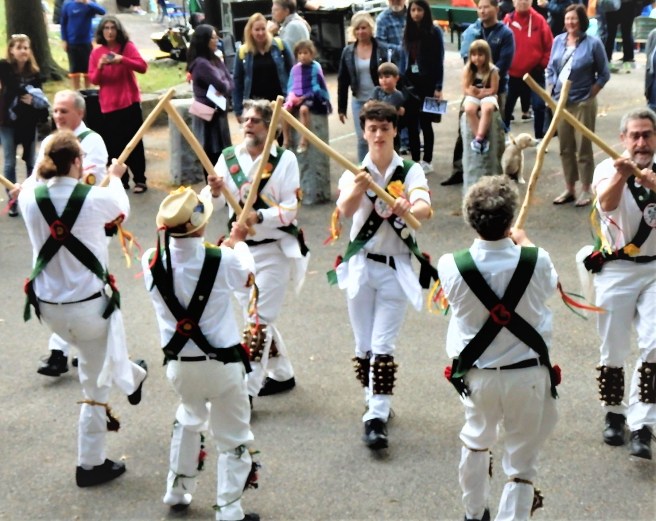
Morris men in a ring at the autumn equinox

The Pinewood Morris Men continue a festive dance style from the late middle ages in rural England. The performers wear costumes specific to their troupe, including bells, and often wield sticks or handkerchiefs in their routines. This group frequently appears in Boston Revels’ events throughout the year. Here they are greeting concertgoers to last fall’s equinox RiverSing in the Herter Park amphitheater along the Charles River in Allston.

They sound like happy fireworks

The street drum band aNova Brazil joined us last fall to help celebrate the cleanup of the Charles River two decades earlier. Here they are warming up for the Boston Revels’ equinox RiverSing last fall at the Herter Park amphitheater along the Charles River in Allston. They later fired up the procession down to the stage and performed several unbelievably complex and infectious numbers. They’re a hard act to follow, but we did it. Boston Revels hosts events throughout the year to enhance community through folk traditions.

Bells of freedom ringing

Thinking of freedom, we can see it as personal expression as well as political opportunity. For some of us, that was a big dimension of the hippie movement.

The 50th anniversary of Woodstock is coming up next month. Normally, that would mark a jubilee, some even acclaiming it as a celebration of the dawning of the Age of Aquarius. Alas, the dark ages we thought had passed have returned from the dead, in intensified deadliness at that.

Jubilee, by the way, is drawn from the Biblical book of Leviticus, and it’s a most radical idea. Every 50 years, all the wealth in the land is to be redistributed. The scriptural passage is inscribed on the Liberty Bell in Philadelphia, so don’t tell me it’s not American.

~*~

One of the passages I cut before the final version of my novel What’s Left is one where she’s asking her aunt about the hippie experience:

I’ve never asked you about your own drug use.

OK? Can I say it was just enough to convince others I wasn’t a narc?

So were you really a hippie? I mean, you had such short hair!

You trying to say a hippie couldn’t have short hair? Don’t you know how radical my style was? You ever think I could conform to anything?

Well, you’ve indicated you weren’t stoned. I’m going down the list.

Have you considered the impact of the Pill? Or free love?

Oh, I’m so glad Cassia stopped talking like this! In the final version, she’s pretty snippy.

~*~

For the record, some of the truest hippies I’ve known weren’t promiscuous or do drugs. And some others never marched in a protest.

Still, as an image of the era, let me ask: What’s your impression of Woodstock? Have you ever been to a big, multiday festival? What’s your favorite music? How do you best express your free spirit?