WHERE’S THE BUSINESS MODEL?

Newspapers have long run on a peculiar business model.

People buy the paper mostly for the news, but what they pay for the product covers only a fraction of the actual cost. Traditionally, advertising generated the other 80 to 90 percent.

That imbalance always resulted in an inherent tension in the executive offices, where any expenditure for news coverage was viewed with suspicion, especially when few of the publishers – the top local executive – came from the news-gathering side.

The rest of the operation included the composing room and related departments that manufactured the actual pages that then went to the presses, plus the “mail room” where supplements were inserted and the bundles were arranged for distribution, the circulation department, and then the ad sales reps, accounting, community services/promotion, and human resources. Especially accounting. In more recent decades, the computer techs assumed their own role.

For a bit of perspective, go to a store and buy an artist’s newsprint sketchpad and then compare its cost and the amount of paper against what the typical paper carries. You’ll see what a bargain the daily paper has been. What you pay for the news essentially covers the cost of getting it from the end of the press to the place you read it.

So this is how things ran until the Internet came along. And then, for a host of reasons, publishers began putting websites up and readers began getting the news without having to view any of the surrounding advertisements that were paying the bills. That, in itself, was a recipe for disaster.

Curiously, long before the arrival of the Internet, I’d noticed that what the readers paid for a paper would be sufficient to staff a newsroom and its supporting services. Leap ahead, and you can see that if users would pay for their local news online, you could create journalism that would not have the advertisers lurking in the corners. Unfortunately, online users have become spoiled and rarely pay for anything. Attempts at firewalls, as we’ve seen, have also failed.

At the moment, the future of American journalism looks grim. And that’s bad news for our political structure and the lives of our communities themselves.

~*~

Hometown News

To find out more about Hometown News or to obtain your own copy, go to my page at Smashwords.com.

 

THE MISSING VOICE

A central problem for newspapers in the past half century is that they became increasingly homogenized and thus lost their distinctive, individual identities. Admittedly, that was always a problem when people saw it as “the paper” rather than the Times or Post or Chronicle or Herald and so on. But in the days when a city would have two or more daily newspapers, each one needed to have some unique identity to set it apart in the marketplace. Sometimes it was along party lines – Republican or Democrat – or social identities, such as blue-collar or proper society, but often it also meant the kind of news that was emphasized: national and international, for instance, versus local. And hometown columnists were always a voice that readers could count on. Think Herb Caen in San Francisco, Mike Royko in Chicago, or Jimmy Breslin in New York – or any of the great sportswriters.

In those days, newspapers were thinner than they became in the last decades of the 20th century – often just two sections – rather than the four to eight that followed in the great mergers and closures that led most cities to have only one daily journal. Much of that problem, we should note, could be blamed on the “unduplicated readership” that ad-space buyers relied on in allocating their budgets. No matter how marvelous the Washington Star was in its final days, or the suburban Journal papers were in the counties around the city, they couldn’t overcome that hurdle – when it came to outright readership, the Washington Post had the monopoly. Since everybody had to read it, there was no point in advertising elsewhere.

With few exceptions – New York, Boston, Chicago, Philadelphia – we’re left with single-paper markets where the product looks and reads like those everywhere else, except that the stories take place there than elsewhere.

As the local newspaper more and more became a one-size-fits-all model, what I no longer heard was the feeling that it “speaks for me” or my section of the wider community. And now, even those special voices within its pages are no longer there – one by one, the columnists were never replaced.

The newspaper I longed to create had little resemblance to that bland crime-and-crashes emphasis that too often prevails these days, in place of more difficult and costly investigative reporting or a bigger view that critically examines education, the fine arts, social justice, the environment, and so on.

It’s hard to get excited by what’s there. And we wonder why circulation kept declining even before the Internet?

This is, I should note, a contrarian viewpoint, since the publishers kept proclaiming the “improved service” each time they merged two papers into one. So here we are, online and blogging.

~*~

Hometown News

To find out more about Hometown News or to obtain your own copy, go to my page at Smashwords.com.
WRITING LONG

Even as a cub reporter, I loved writing long pieces. It’s what I prefer to read, really read, when I have time. By long, I don’t mean pointless minutia or the trivia of, say, a public hearing, but rather the probing look at how and why a thing has happened and maybe even what to expect as a consequence. Add to that the human dimension, especially from the point of view of those most impacted by the action rather than those at the top of the pyramid.

One model of this style of news writing came in the three stories on the front page of the Wall Street Journal each day – what they called their “leaders,” back in the era before Murdoch. If you looked closely, you’d see how each one was composed of several smaller stories, each one telescoping into the next. The reporters could joke that their work was so heavily edited they no longer recognized the finished version, but for those of us reading, the result was rewarding, the way a good meal is.

As a journalist, the irony has been that I spent much of my career crafting headlines and photo captions … short, short, short … and that was even before I relied more and more on news briefing columns to get the day’s world and nation reports into the paper at all.

Not that I lost my love of long writing. My “shelf” of ebook novels is proof of that, including my most recent, which delves into the news business itself.

As a blogger, though, I’m also admitting pleasure in composing shorter postings like the ones that appear here at Jnana’s Red Barn. Apparently, from the stats, they must be connecting.

My other four blogs provide venues for the longer writing, and the results to date are mixed.

To my surprise, my genealogy blog, The Orphan George Chronicles, has drawn far more hits than I’d anticipated. I figured its appeal would be to a few dozen fellow researchers, and having the results online would be much easier to find than if the files were archived in a few libraries somewhere. As for publishing them in paper editions, the likely audience would never cover the expenses.

My Quaker blog, As Light Is Sown, has shifted from the two book-length presentations that appear as the initial postings to a year-long Daybook of short postings, so I must admit that trying to analyze the results there can be inconclusive.

Thistle/Flinch exists to present book-length PDF editions of poetry and fiction, so I guess you can say that’s writing long.

And the remaining blog, Chicken Farmer I Still Love You, is still taking shape, as the numbers show. The first part, Talking Money, presents essential material for addressing the material sides of life … income, spending, wealth, possessions, labor, time, goals, and the like … followed by a close look at New England’s famed foliage. These days, it’s taken on a new focus in reconsidering the hippie outbreak and its renewal. Again, many of its postings are chapters for book-length presentation.

What I am finding in general is that even without the demands of daily employment, time is still the most precious commodity in my life. There just ain’t enough of it for what I hope to accomplish these days – including reading or writing, much less in any length.

So I guess that’s the short of it, for now.

 ~*~

Hometown News
Hometown News

To find out more about Hometown News or to obtain your own copy, go to my page at Smashwords.com.
PHILISTINES AND AMERICAN SOCIETY

Before my graduation from college, back in my social activist period, I wondered how American society could possible afford High Art while so many went hungry and homeless – domestically as well as internationally. Then I began to see everywhere a desire for expressiveness even in every ghetto – for that matter, ranging from ghetto blasters to Playboy. There were murals and blues bands. To say nothing of the infusion of professional sports, to which every poor youth, from the inner city to the mining company towns, seems to aspire. So opera and museums and other “Establishment” operations came to lose their exclusivity in my mind. Indeed, over the years I’ve heard that the real classical music lovers are the ones in the cheaper seats, the ones they can afford. Mankind, after all, has a need to reach to the higher realms of thought and the imagination of the spirit; anything less reduces our existence to nothing more than economics, impoverishing everyone in the society.

Look closely, and you’ll also see that in America, Art has become the state religion, no matter the level of state and federal funding exists. In this country, at least, there’s also been a long recognition of the fine arts as an adjunct to wealth, for whatever reasons. Many sense an abstract “goodness” in the products of art chamber music, art museums, Shakespeare festivals, opera, poetry, the “book” that so many people dream of writing even if the artist himself/herself remains (often with good reason!) somewhat suspect, a shady character. Perhaps that’s why these big institutions stand between us and the rest of ourselves, as artists and audiences. Something abstractly “good” even when they themselves admit they don’t know much about the field. Contrast that to the related state religions in America: collegiate and professional athletics, Hollywood movies, and rock concerts, wherein no one actually advocates any common wealth. (The High Priests are paid handsomely, after all.)

Art as the semi official State Religion of today? Or should that be entertainment and its host of celebrity worship? The stamp of approval. The aspiration.

Art as commodity, too. “How much did it sell for?” What was the box office?

At heart, all art is, primarily, either spiritual/religious or secular/amusement in intent and execution. Take Milton or Pepys. Today, the overwhelming materialism of our society reflects an insatiable hunger.

Even as starving artists we’re enmeshed in materialism, one way or another. It’s so easy to hold the artist up in some idealized light or the product itself as the object of worship, an idolatry, totally forgetting to turn to the Source of All. The worship of living genius, from Beethoven and the Romantic era on. Or the pretty faces of mostly Hollywood celebrity today.

As an editor on newspapers where nearly everyone was giving totally (many unpaid hours of overtime, etc.) in an attempt for excellence, I was always appalled by the charge of “elitism,” which comes to mean “give me mediocrity not the truth” or “mere pleasantry” from the same people who would not accept such standards in their professional football team or new automobile.

The shift in the meaning of “culture” from learning and aspiration to the mundane lowest common denominator of daily life. Culture, as in a petri dish of mold or germs, rather than a rare book library or new opera.

Still, if you want to comprehend the view from the top of the mountain, you need to climb it. And be warned: driving, if a road’s an option, loses a lot in the translation. From a religious point of view, at least, we can’t settle for anything less than the best in the end.

HIGH-TECH CONSTRUCTION

Everything that’s transpired in the 28 years since I first drafted my novel Hometown News has made me feel prophetic.

Now, of course, you have an opportunity to judge for yourself. I just wish it hadn’t taken this many years to become public.

One thing I’d like to point out involves the initial experiment I used in constructing the novel. Quite simply, I wondered if I could build a computer-generated story – no matter how distasteful the premise itself strikes me in my self-identity as a neo-Luddite and fussy literary type. Maybe it was just some of the vestige of the scientist wannabe in me?

So I created a master day-in-the-life chapter, made multiple copies to repeat throughout the story, and included up to 120 variables for search-and-replace functions. And away I went, allowing the S&R efforts to produce their own pace and variations. Not that it quite worked as I’d hoped. I found myself going back over those pages and adding new layers, softening some of the edges, adding shadows and highlights. As they say in the visuals arts, it’s quite “painterly.”

Be that as it may, one thing I’ve observed over the years is how little we typically know of many of our coworkers. There might be a favorite phrase they repeat or a piece of clothing or a distinctive quirk. And that’s it, sometimes year after year. So that part was agreeable to the S&R structuring.

As a technique, though, I’m afraid to report – or maybe more relieved – that the S&R by itself was insufficient. It did provide the core “bones” for the novel, but I did have to paint over much of it to make it more pliant and, well, human.

All the same, I’m feeling vindicated. Maybe it’s a high tech revenge for what high tech is wreaking on the workplace and surrounding community.

To check out my Smashwords ebook story, go to Hometown News.

Hometown News

AN IDEA NOTED EARLY

Not long ago, I came across this note to myself:

“Story idea: paragraph or two, repeated … one or two words changed each time, till the end provides an entirely new view.”

It’s old, probably from the mid-’70s, and yet has become the basis of several series of my poems from the last decade.

In a way, it’s also the basis of my novel Hometown News, although the repeated sections and their variations are much longer than single paragraphs.

Works for me. Wonder what else I’ll turn up.

~*~

To learn more about my novels and poems, go to my page at Smashwords.com.

A TINY DETAIL

We’d get the phone call. “You promised a story.” We knew we’d been very careful not to do that. Instead, it was, “I’ll look into that” or “I’ll pass that along to the appropriate editor for a decision.”

My favorite was the caller who claimed to be good friends with the publisher, who had promised the coverage. Followed by our response, “You know she died twelve years ago?” And their embarrassed silence.

Of course, it’s not just stories.

People read into the most carefully crafted texts and then respond to only the parts they want to hear while tuning out the rest. Or they just plain tune out. It’s called the theory of cognitive dissonance. If they think you’re agreeing with them, they’ll bend the message their way. If they think you’re critical, they’ll shove you out altogether.

Often, all tripping over a tiny detail or two.

~*~

Oh, how I came to hate the telephone when I worked in the newsroom! If you want further proof, just go to my novel Hometown News.

Hometown News


ESTABLISHING MY CREDS

Longtime visitors to the Red Barn are likely aware that I spent four decades as a newspaper editor – experiences that feed into my latest novel, Hometown News.

It’s meant working nights, holidays, and weekends – rarely on a schedule matching the general public’s. And it’s always meant “working under deadline,” where an internal clock is always racing to finish the task on time (or else!). In addition, it’s also given me some insider looks at the surrounding world itself: having a celebrity standing a dozen feet behind your back is just another regular occurrence. (For the record, they often look quite different than they do on television.) Even as a cub reporter, I saw dead bodies, got inside the county morgue, checked out small plane crashes, met ex-movie stars, faced some stiff competition from the pros on the rival paper. Looking back, I sense how often I was in over my head and wonder how I ever survived.

These experiences have also fed into the Red Barn’s category of Newspaper Traditions, where I’ve written about:

  • The best newspaper ever” The glorious final days of the New York Herald Tribune were like no other newspaper. Nothing like fighting hard to the bitter end.
  • Chancing Upon a Profession: Glenn Thompson’s influence hit me, among many others, in one medium-sized city. He had a knack for finding talent.
  • Hot Type: In the days before phototypesetting and then digital publishing, newspaper production was a highly skilled craft. Here’s an admiration for the long gone masters.
  • Living Under Deadline: When your career hangs on meeting deadline after deadline, with no room to spare, you begin to live differently from other people.
  • The Art of Writing a Headline: Trying to steer readers to a given news report with just four words can be a real challenge. Take it from a pro.
  • Editing Obituaries: Announcing someone’s death and funeral arrangements can be more precarious than you’d imagine. This post, one of the most popular at the Red Barn, became a WordPress Freshly Pressed selection.
  • Four Measures: Just what makes “news,” anyone? Here’s one take.
  • Police Calls, 10 P.M.: Well, there is some behind-the-scenes banter, even when calling the cops.
  • One Phone Call Too Many: And then sometimes the facts get in the way of what looked like a great story.
  • Local, Local: How you define “local” news can backfire when it comes to your readers. Especially when it’s boring.
  • Bias: Sometimes those who accuse journalists of being biased should first look at themselves in the mirror.
  • The Shrinking Page: Like many other products, the newspaper page has been shrinking. It’s about half as wide as it was when I entered the trade.
  • The Human Imprint: Not too long ago, the editors and publishers were well-known public figures.
  • Objectivity, for Starters: There really were some strict standards and practices.
  • Windy City Perspectives: The tower of the Chicago Tribune holds some special memories for me.
  • Painful Neutrality: Again, maintaining a discipline of objectivity comes at a personal price.
  • Free of the Entourage: David Broder was the best of the breed. I wish I’d said hi.
  • End of the Line: One of the last editors who put a personal stamp on a paper was David Burgin. Maybe that’s why he was always getting fired.
  • Get Out of the Way: Real reporters are invisible observers. TV’s imitation inserts itself on the story.
  • You Read It Here First: Plagiarism has always been a dirty practice. Here are a few examples.
  • Reality Check: When it comes to seeing “liberal media,” some people fall off the far right of the world. The one that’s still flat.
  • A Logical Conclusion: The more conservative the nation’s editorial pages become, the more circulation declines. Think about that.
  • Death in the Afternoon: The newspapers published in the afternoon once had the blockbuster circulation. Here’s why they vanished.
  • Beware of Unintended Consequences: There are times embarrassing things slip into print. Lewd expressions, especially.
  • Beware of Survey Conclusions: Marketing research can lead to bad choices. It helps to put the findings in perspective before taking action.
  • So Much for Romance: And then there was the reporter’s lament as he returned from covering a large singles’ mixer.

I invite you to visit or revisit the postings, especially if you’re new here. And I promise there are more ahead.

~*~

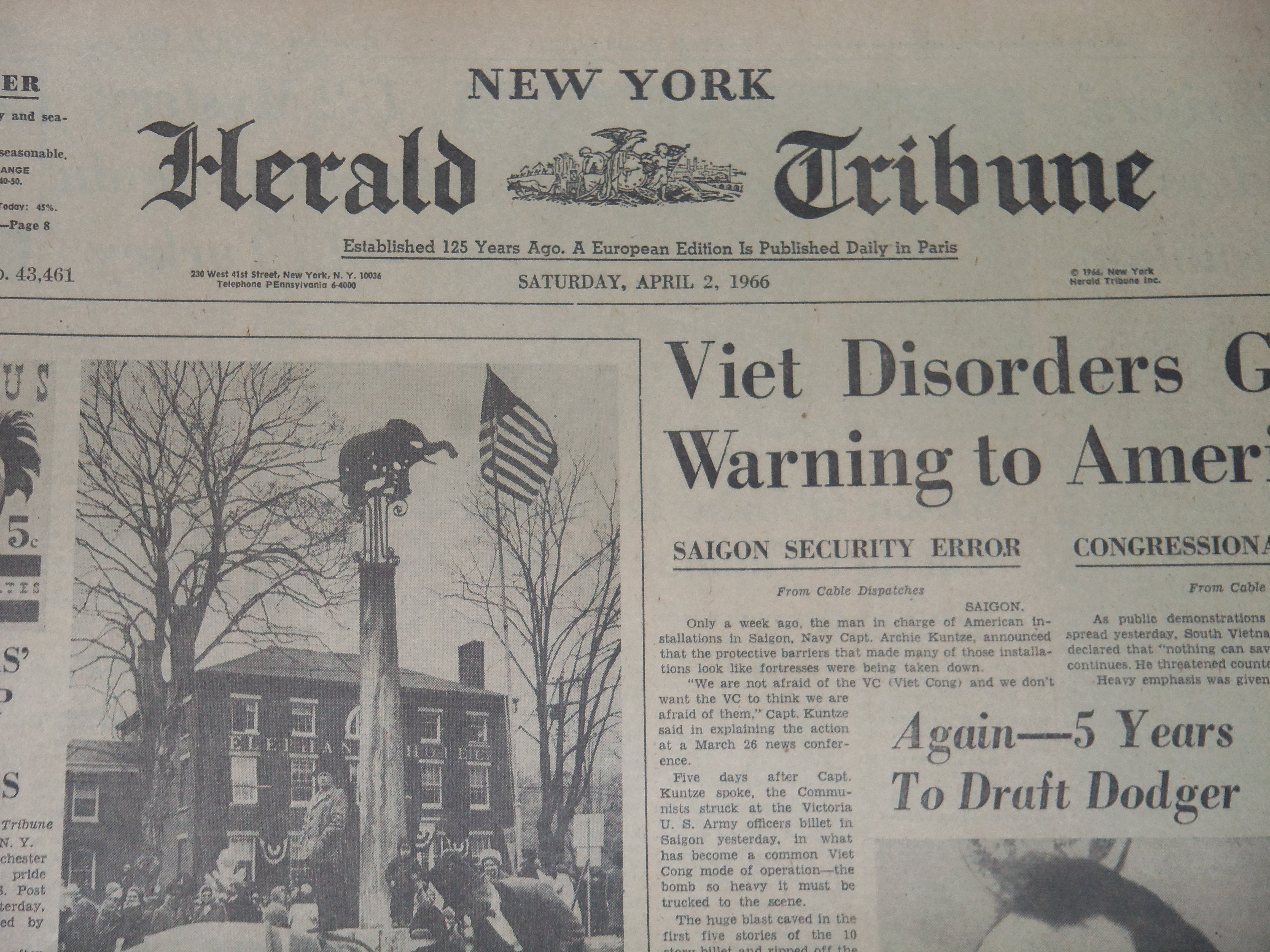
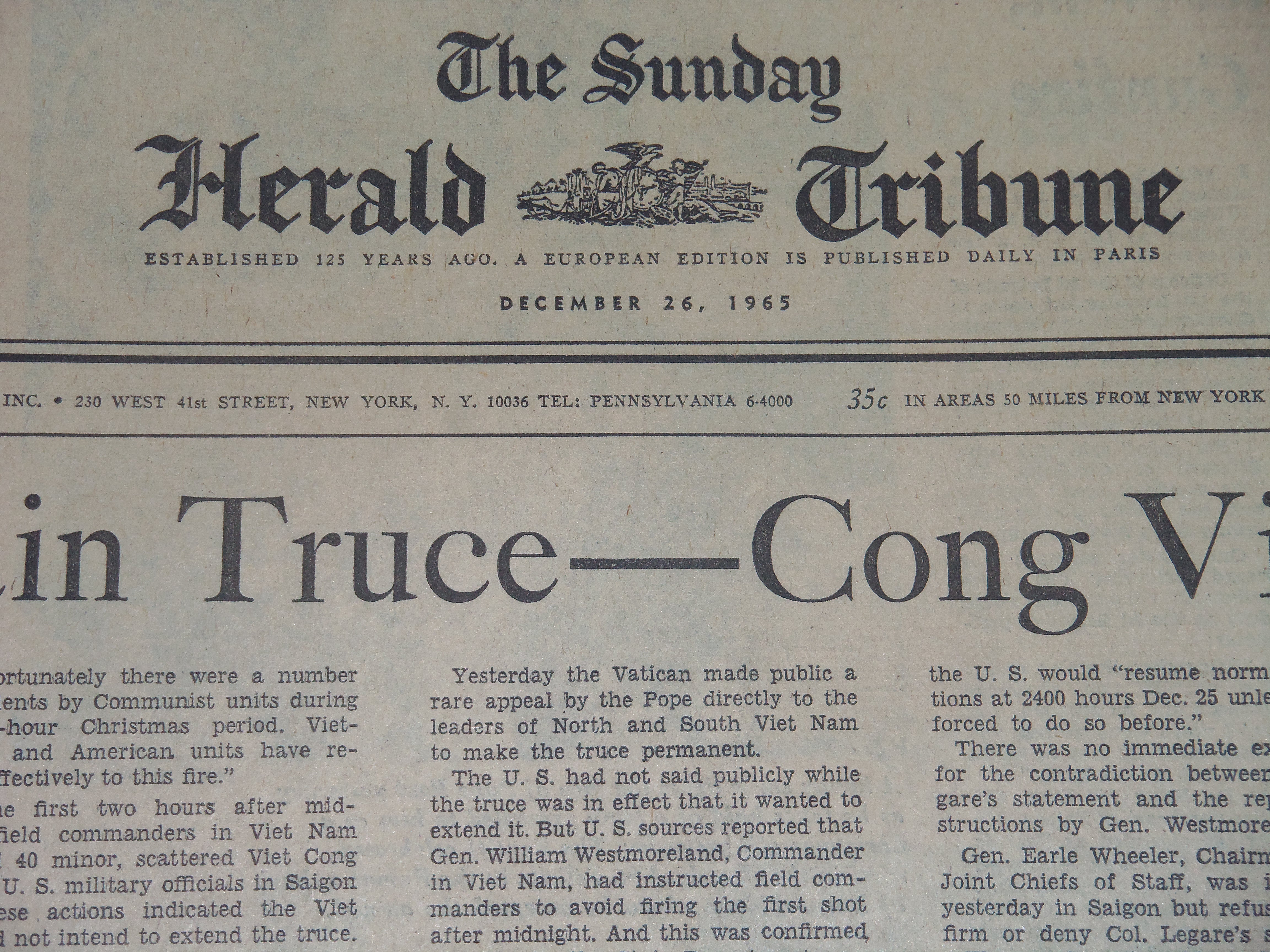
While we’re at it, here are some pages from the New York Herald Tribune’s final years, when it established itself in my mind as the most elegant and exciting newspaper ever. (Remember, I was still a teen and a budding journalist.)

The daily edition.
The daily edition.
And Sunday.
And Sunday.

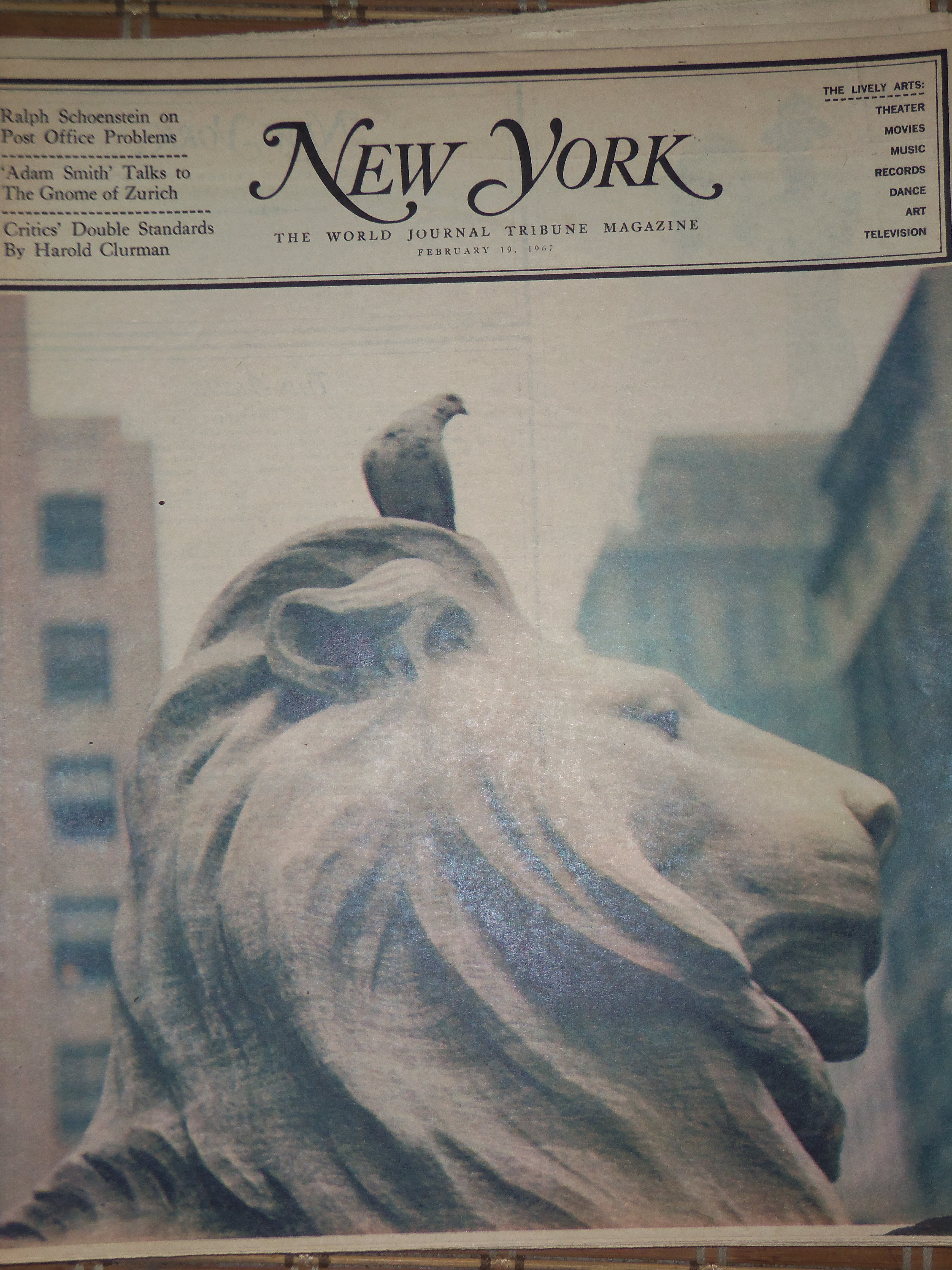
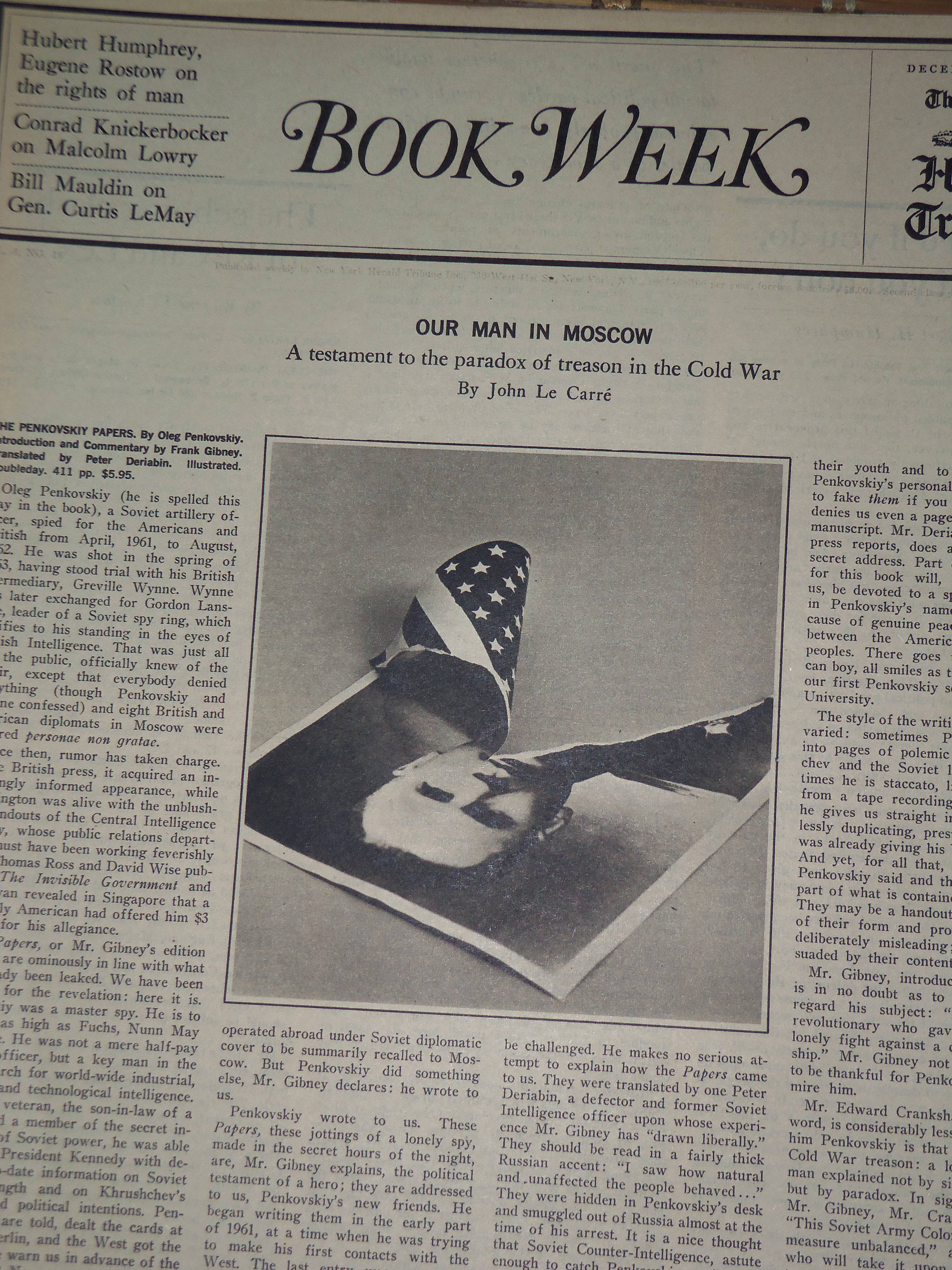
Among the Trib’s legacy was New York Magazine, which originated as the Trib’s Sunday glossy magazine. It was classic. And Book Week reflects a time when books were really important, at least in the eyes of the informed public.

The Sunday mag.
The Sunday mag.
And the books review section.

~*~

Not all of the exciting journalistic action took place in Gotham or Fleet Street or Chicago’s competitive shootouts, though.

Much of the most dedicated and innovative work emerged in small communities in the heartland where a few individuals could make an obvious difference. That’s the story I explore in my latest novel. In some ways, it’s Tom Peters’ Pursuit of Excellence meets Dilbert on steroids. It might even resemble some places you’ve labored.

 ~*~

To find out more about Hometown News or to obtain your own copy, go to my page at Smashwords.com.
AFTER THE TRAGEDY

Here in New England, the battle for control of the Market Basket supermarkets remains the biggest news story – but with a storybook twist. Rather than ending up as another soulless corporate bottom-line victim, there’s been a resurrection.

The bitter DeMoulas family feud finally led to an agreement less than a week ago in which the Good Guy (aka Arthur T) buys out the other half for roughly $1.5 billion. Ownership stays here at home. And, yes, there have been cheers all around in this remarkable alliance of stakeholders – managers, workers, loyal shoppers, and their communities – against the faction that fired the Good Guy and his visionary leadership.

The boycott held through August. The parking lots were vacant. Workers saw their hours cut. Some managers were fired … and now they’re back.

There’s almost a party atmosphere in the stores, but nobody’s slacking. Managers began showing up to work at midnight just an hour after reports of the agreement surfaced. Suppliers offered to deliver goods directly to the stores, rather than the distribution center, to speed the restocking of depleted shelves.

Many details remain to be ironed out, and a lot of damage will take time to repair. But at least there’s also a rainbow.

AN UNFOLDING GREEK TRAGEDY

For past several weeks, the hottest news story across New England has been over what will no doubt be a textbook case of how to kill your own golden goose in corporate America.

The business is a family-owned chain of 71 supermarkets that has somehow managed to carve out the region’s highest profit rate in a notoriously thin-margin field while simultaneously paying its workers more than its rivals — along with profit-sharing and bonuses — while keeping its prices well below those of the other grocers. (You can imagine, for one thing, that the pilferage that undermines many groceries is nonexistent at Market Basket. Its workers are loyal, at least to the executive responsible for the success — a man who seems to know not just each of them but their family members as well.) Add to that a great deal of flexibility for store managers to respond to customer requests and you can understand the wide variety of ethnic foods found on the shelves; consider the fact that our local Asian restaurants choose to buy their tofu supplies at Market Basket rather than the wholesalers, and you get a sense of how that policy pays off all the way around.

In recent years customers have turned in droves away from the competition, and their loyalty is palpable. Lately, I’ve found parking spaces are always available right by the front doors of those underpopulated stores, unlike Market Basket, where the parking lot and aisles are always overflowing.

Given the win/win/win realities of the still growing Market Basket chain, nobody was prepared for the directors’ decision to ax its successful president. Well, half of the board’s decision.

The half that wasn’t prepared for the impassioned backlash from the public or its own workers, who have essentially shut down the operation.

The board’s decision, as far as anyone can see, was based more on lingering bad blood in the Demoulas family that had previously erupted in a notorious 1990 lawsuit that nearly forced the sale of the company, this time apparently heightened by greed. Seems there’s  a $300 million reserve fund, for one thing.

But if the side that ousted Arthur T. Demoulas and his top aides thinks it can manage the company better than he did, it’s produced no evidence to date. Indeed, each day brings another public relations debacle that has gone unchallenged and signs the victorious side of the board is unaware of what’s happening on the streets. Brand loyalty, as the lore goes, is priceless. And it’s hard to win back. If they’re hoping to sell the chain, its value is plummeting by the hour. How often, after all, have you seen managers and workers stand together in solidarity as they are now?

The daily drama is not subsiding.The region’s newspapers, led by the Boston Globe, have been covering the details thoroughly, and I’ll point you in that direction.

For now, there are the petitions to sign and emails to send.

Here’s one example that was sent to the independent board members:

~*~

Dear All,

I have shopped at Market Basket for 30 years. I appreciated the low prices as well as the availability and quality of ethnic foods. When I learned that the employees were also the highest paid of any grocery in New England, that cemented the choice. I’ve barely walked through the door of a Hannaford or Shaw’s in 15 years.

Yesterday, I went to my local Market Basket, but only to sign the petition and cheer on the workers. I then I bought my groceries at Shaw’s and planned a trip to Costco.

You have had a business model that serves customers, employees, and owners. That this model would be thrown over for no discernible reason except personal animosity and greed is beyond me. I do not know or care if ATD is a good or terrible human being. I do believe he is a supremely competent one. He has run a business that gives customer the lowest prices, employees the highest compensation, and  the owners considerable profit, while maintaining zero debt and ensuring the stability of the company. I have paid close attention to every news report I can find to see if there was any substantial reason for ATD”s removal. Nothing I have heard or read has indicated that new management has better ideas, or for that matter any ideas at all. That, in addition it cared so little for the loyalty and dedication of its employees that made the model work is the final straw.

You’ve lost another customer.