The secret to getting ahead, in one list: the ability to say NO.
Every circle, organization, office needs somebody in this role. Few people want to have the responsibility. They’d rather be liked.
“Let me check with Joe,” also works.
You never know what we'll churn up in cleaning a stall
The secret to getting ahead, in one list: the ability to say NO.
Every circle, organization, office needs somebody in this role. Few people want to have the responsibility. They’d rather be liked.
“Let me check with Joe,” also works.
In E’burg, met a poet — Richard Danner — who couldn’t put his wife in a poem until they split, after 12 years of marriage, allowing him to write a book, Single Space. And how jealous they became of the other’s writings.
There’s a dilemma of consider her as an objective subject to be, um, exploited.
Maybe some things deserve to remain private.
Pflum said the words he likes to use are the conditionals: if, then, because, ad infinitum: the words of logic, of possibility, of thought itself …
Yet they often dilute the action. Somehow, they work for him, though.
Kentucky Fried Movie opens with the line, “The popcorn you are eating has been pissed in,” and deteriorates from there.
I have so many overdue books from the library yet don’t want to return them just now.
The Ellensburg library has a whole set of early Cetra opera LPs. Unlike Yakima’s.
20 Apr
Finished the longpoem.
Kitty phoned, depressed, wouldn’t say why.
Why do I put up with it?
Off to the office. [Was I journaling early a.m., after meditation etc.?]
Flow of revisions, largely the Leonard Springs pieces …
Cherries deep red, about to be picked …
Perfection versus sterility
The bounty of the prairie: abide in it
Milton! Getting down to him at last … his head and heart going in opposite directions … damn theology but his heart betraying that in the few moments it can. He was blind to more than vision.
Ideas for revising Native tales: use Bob White or even Rbt. White for quail. Logger, Cutter, even Sawyer for beaver. Cops, FBI, CIA, spooks for monsters or evil spirits. Lawyers for lazy characters or blue jays. Jesus for coyote. Update and urbanize, satirize modern society. Consider quaint spellings for Wyatt, Philip, Sidney, William, Dunbar, etc.
Weave in some glare and grime.
In English poetry, the weight of Christian doctrine closing the range of thought and sensibility to a single, predictable line. Thus, the wonder of Blake’s singular accomplishments.
20:VI
A letter from Copper Canyon Press, wanting to publish my book if “patronly folks” will come through with “essential cash” … great letter, exciting potential (retitle and some revising) …
Also, from Celeste, a tearsheet from a Seattle weekly reinterpreting the Mexican movie Chac, about a “diviner” who carves out his own heart at the end: this piece now viewing the events through Native perspectives … {We had seen the movie at one of Seattle’s art film houses.]
My compulsive reading, a suppressed hunger
Revising poems with a tape recorder … a whole new perspective …
24 Sept Sunday
Heard Bill Stafford read last night in E’burg at Washington State Poets Assn or some such … Grimes and Bodeen were there to sell Yakimas that had just come out the day before. Audience mostly elderly, stout ladies who sighed over lines and applauded single works. I get tired of so many short pieces that fail to break through the prose barrier and do the magic in the backcountry of so much of today’s verse, the realm so few have entered. Grimes said Stafford had done an amazing reading at Cedar Falls, hardly said a word except for what he read, but here he was explaining each one or offering some kind of patter for it. I said he was playing to his audience, and BG agreed fully. Two pitchers of beer for Grimes and me, Bodeen ordering root beer — “this tastes like tomato juice” — getting red beer instead, finally settling on strawberry. First time since he was 17 he’d gone a week without alcohol — “ttat’s seven days, not five,” Grimes explained.
The owner said he had hired Kitty “to give the joint some class”
~*~
From Spiralbound Cascadia with commentary.
Picking up on my old journals:
A month of rain: 2½ inches in December: snow, then melt. Our view of Rattlesnake Hills (rising behind our shack) washed out in fog. Ground soggy, making up for drought.
Vol. 50, 11:II:78
(first trip to Portland, a city that would become our alternative to Seattle, though we never got to know it as well)
longhorn steer on Satus Pass Highway
a longhorn?
Yakama Reservation
Quaker meetinghouse in an old storefront
Service Committee on one side
First-day school upstairs
or a Friends’ apartment? (caretakers
overwhelmed by the Native display at the art museum but not the rest of the collection
Portland-town, calm as Philadelphia
Asian and Native
with an Anglo overlay
afternoon, clouds cleared
revealing Hood, proud and pink over all
– Rainier and St. Helens in the soup
but where, oh where was Adams?
Still so ignorant regarding this land
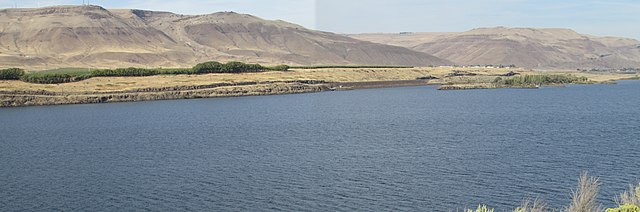
Much of the Columbia River runs through desert before getting to the lush greenery in the Cascades and on westward to the Pacific. Much of the route forms the border between Oregon and Washington state, Here’s a taste of the eastern Columbia River Gorge downstream from the Dalles, Oregon, looking into the “Evergreen State,” photo by Chris Light via Wikimdedia Commons.
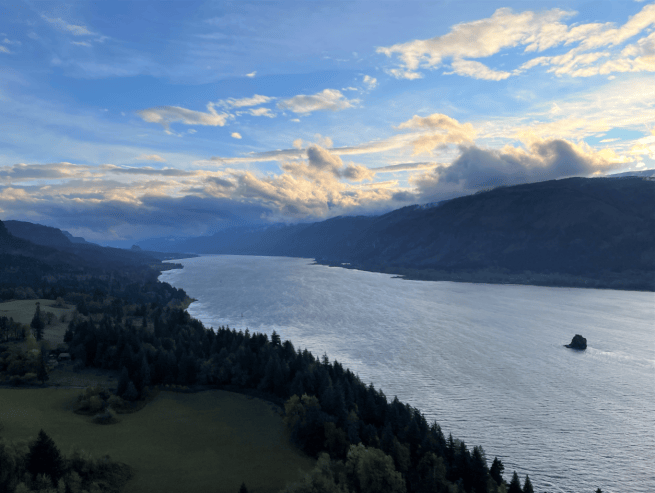
As for the more common impression, consider this photo by Lena Chang/USFWS, also via Wikimedia Commons.
~*~
14:V
Climbing Clemens in fog and rain, encountered my first rattlesnake, dead in the logging road; five rattles. They gain a new one every time the shed their skin, usually three times a year.
Old-timers saying this is greenest, mostly intensely flowered spring they can recall.
17 june
Slept till 9, met Whiz and drove from the Nile to Tieton ranger station, then out, in six-foot snow pack to the Timberwolf Lookout — the forest fire watch building is gone but great panorama of Adams, Goat Rocks, Rainier, the Stuarts — Mount Glacier clear, a ghost of Baker, and crown of St. Helens. Plus Aix, Bismarck, Nelson, Butte, Shellrock, Ironstone, and others.
Kitty, off to Seattle with Michael. Platonic, she insists.
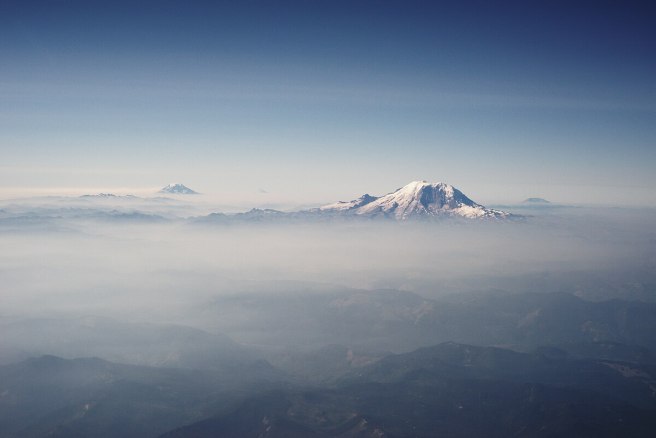
Stratocone volcanic mountains poking through clouds are Mount Rainer, center, Mount Adams, left, with a very tiny Mount Hood appearing halfway between if you zoom in; St. Helens rises to the right.. Photo by Dllu at Wikimedia Commons. A distinctive feature of the Cascade Range is stratocones about 50 miles apart from Lassen Peak in California to Mount Baker near the Canadian border.
~*~
20 Aug, Sunday
Entries lately: weekend to weekend
Sweet smell of conifers in the passes — rain at White Pass
everything clouded in
U.S. 12 still showing washout debris
wrecked guard railing
and other signs of last winter’s thawing and rains
4 Sept, Labor Day
Ginko Petrified Forest (at Vantage, where Interstate 90 crosses the Columbia)
Once, 10 or 15 million years ago, 200 species of trees grew here … the Cascade Range, not yet up, left ocean rains to come far inland (mahogany, maple, magnolia, Douglas fir, spruce, elm, ginko, box elder, beech, butternut among the common examples)
When the lava flows rolled over all, only the waterlogged trees didn’t burn … thus forming this site, one of seven major ones in US, and the one with the most species.
Wanapum tribe, peaceful, never declared war on USA and thus no treaty: and thus, alas, no reservation, no land = seems to sum up too much of Amerikan political and economic system, including judicial-legal mysterium frateritas …
~*~
Sometimes — no, too often — I feel or am wrongfully identified in a situation, perhaps because I do not submerge myself solely in a field — so that within a convention of journalists I may seem to be too ethereal, artsy, not politically-addicted enough, a health-food addict, whatever — yet among poets not hip enough, too square, too wealthy (!) or whatever: even too success oriented.
[Success? Guess that rules out poetry.]
A drive today, up into the Horse Heaven Hills … no irrigation system in sight, a few trees by the gully …
~*~
From Spiralbound Cascadia with commentary.
12:II:78 [before my 30th birthday]
Unbelievable pain, certain Kitty was gonna leave me at last … [early the previous week]
Bodeen phoned, trying to find out over the telephone whether his paste-ups were straight — so I met him at last and am pleased by the poems for the first edition and the way they’re set
Allen McFee on CBC: “And may angels guard your rest” … signing off for the night
Kitty came home on Wednesday as a surprise, took me to Gasperetti’s for dinner with Whiz and Wisteria — his announcing he’s buying a ’77 Porsche ($8,500), trading in the Honda …
Fine Oregon wine: Tualatin, meaning “gentle” or easy, flowing, Vineyards, a white Riesling bottled at Forest Grove …
~*~
30:II
My wife in the process of leaving me: I feel so burdened and so seldom dwell in the realm of spontaneous delight …
In Seattle for the weekend (with Celeste), so was Kitty, in another place. My realization that Celeste doesn’t fulfill me, and there’s some other reason we cannot conjoin — “You’re body shows you’re still confused” …
Spider crab, rock crab, Dungeness crab — Vashon Island, near midnight — the crabs beside starfish (headlight into the water) … boil them, eat at 2 a.m. … Brian / Paul & Judy — Marj stayed home in her robes
A seal that follows Brian fishing …
~*~
26 feb — a long week
Bought LPs in Seattle: Bolet plays Liszt, Eileen Farrell and Max Rudolf, Janacek Sinfonietta (DGG) …
On my drive home, no Kitty in E’burg apartment or her studio nor in Wapato. Learned later we had crossed between E’burg sites, had I stopped at her apartment, would have found her note; instead, not seeing her car when I drove past, I assumed she wasn’t home …
Tuesday, after a hard day at work, an icy bummer phone call from her, her hatred brewing. (Long-distance.) TV mag and farm tab, too, on my end.
Wednesday, Kent told me I had the job but not to tell anyone else yet. Worked OT, elated but still down over Kitty. Went to bed early but couldn’t sleep, watched Georg Solti conduct R. Strauss on PBS …
Thursday, talked to Kitty, told her I’d be up and take her to dinner Friday but then Kent told me we’d be taking our new deskman interviewee to dinner [instead] … went to hear David Wagner read at YVC — older than I expected, white hair … enjoyable reading, though to my ear, flawed: still too prose-like, very little magic. Despite his denials, he remains Midwestern Scots-Presbyterian. He should have gotten lost in Yellowwood Forest, Indiana, rather than by Hoh logging roads (30 minutes, he supposes) … afterwords, with Bodeen and Grimes over three pitchers at Ole’s Tavern (nudes on bathroom walls) … home after midnight …
Half-drunk, drove to E’burg and sleep.
Saturday, breakfast at Adeline’s and then off to art building …
Tender talk, realizing her need to grow yet keeping the marriage alive … off to animal shelter, found a black cat (female, seven months?) … PennZoil — saw a bald eagle sitting in a tree near the Interstate in Selah … parked and watched it … week before I had watched a great blue heron land atop a Doug fir …
Sunday, a lazy morning … made love, showered twice …
The porch, wrapped in clear plastic … the crates of books, her plaster casts for a sculpture, stones collected here and there (turquoise, too), feathers, roped-up shelves, glass canning jars, Grandpa’s sleigh bells, her fabric above the door like a banner, the copper-fish scales she wove.
I dreamed of an art show she’d mount.
~*~
~*~
9 march
Irrepressible sadness, knowledge of losing Kitty — all of her virtues and comforts I love so well, as if I’m suddenly quite old …
Mon-tue nights, I finished part 3 of the poem but can’t get the last section moving … perhaps I should split it …
The red buds on the elm are ready to burst … Belzer with his tractor applying dormant spray …
28 March .. apricots have exploded and petals litter the ground …
Last Thursday no water in the shack … Ivar broke the vein while installing new irrigation line …
Sunday, back from fragrant Seattle … Celeste perturbed by my not being more political — i.e., the Trident demonstrations and her upcoming trial … my necessity for professional neutrality versus moral responsibility … people let evil happen because of their failure to take a stand …
On way back find a note in E’burg, “I’m in Wapato,” and then Kitty in the orchard perturbed by her parents — she had phoned to wish them a happy Easter but let slip she’d gone to Canada, Victoria, with Mark but not by name … and they insisted she not return to school this term … Jeanice ready to fly out the next day. I had to call back, talk her out of it. Then Sam called last night, followed by Vince at 1 a.m. in my deepest of deep sleeps. “Guess who this is.” Moon? Gil? “Your best man.” So he could grill his sister just after he had lost GOP caucus for Wood County prosecutor.
Her dad insisted she not commute and she vacate her apartment. The past two days, a complete stranger to me. Yet if she returned to campus, she could not resist Mark’s invitation for her to move in with him next summer, wherever he establishes his studio nor another’s desire to take her to France this fall …
There are moments I’m ready to throw her out and yet others when I’m taken by how exquisite, soft, sensitive, psychic and nearly perfect she is and how foolish destruction would be …
Before her school vacation, she showed up at the Bushwhacker during our lunch, somehow icy brilliant “cool,” and Whiz observed her cruel side: “What right does she have to come just barging into your life like that?” … with my attempt to curb my emotions after I’d just about staunched the pain … so it would start anew when she’d gone again … she expected me to be angry with her, not kind … and she stayed until Monday, rather than living on the previous Friday morning …
My mother-in-law: You two are more important than college …
Kitty: What rights do I have!
Tomorrow, we go to the Buddhist church for the annual beef sukiyaki dinner.
~*~
6 apr
Letter from Mom noting that Rev. Joel and Sharon had split: she’s remarried, but he has the kids.
Rain in the Valley, snow in the hills …
~*~
Tuesday, 11 April 78
Full doctor’s exam today — Dr. P.H., about my age, younger than I’d thought — an English major at Wooster with Spanish, French, German studies. New practice, no one there but me, an hour and a half ($31 plus $31 lab fee, blood tests) … great relief to know all’s OK. Hearing, blood (cholesterol 190 on an acceptable scale of 150-290). Only blood element out of kilter relates to allergy reaction. No diabetes, eyes still good. Blood pressure 80 over 130. Feel like a stud again. (Only danger is all that coffee.)
~*~
15:IV
Ivar’s frost worries …
Kitty keeps asking what I’m thinking, my answers never satisfy. She wants to be “free” but with me as a friend or lover. Can’t understand why I don’t just up and quit my job, go off to Alaska or New York …
Already cutting asparagus ….
Phyllis phoned, “Wanna go to a concert,” Philadelphia String Quartet (of Seattle) … hold their bows funny — rich, velvety, but no brilliance: not hot in Haydn but great effect in Debussy …
~*~
24 apr
Kitty phoned me at the office Tuesday, she’s vacating her apartment, wanted me to drive up after work but I got mad, partly wondering where everything would go, she destroyed her tree sculpture … back in our place, crowded but cozy … boxes still to uncrate [top of the barn] …
~*~
6 May, Seattle
Kitty flying off to Ohio, Bloomington, and Chicago …
We never see Sea-Tac airport from I-5, which runs under the plateau
~*~
8:V
So mean when I called Sunday night … won’t let me say how much I miss her or love her, tells me to get a girlfriend …
Already the hills turn brown, yellow flowers in Union Gap are gone
The uncommon depth of the desert grass this year means danger: when it dries, flames will be waiting: lightning or careless matches.
Dad phoned to say Aunt Edna had passed away, heart failure. Kitty had visited, leaving a copy of Yakima review. He was going to show Edna the apple poem, but Grandpa did get to hear the piece and was “tickled by the plumbing yard” reference. So now he’s the only one, except maybe Jesse Haines, left of that end of the family. And what will happen to Kenny now?
~*~
21:VI
Ivar and Harold are bidding jointly on a piece of orchard. And Ivar has a bid on another behind Doornick’s, so to speak.
~*~
29:V, Memorial Day
Chinook Pass opened Thursday; came through this morning on my way to Sea-Tac to get Kitty … some packs of snow 20’ high
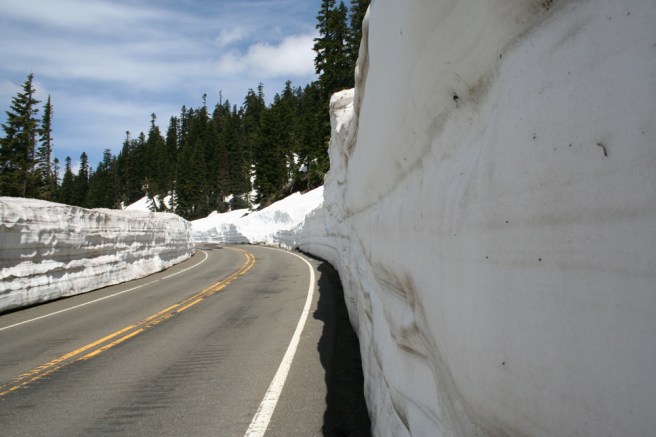
Washington State Route 410 approaching Chinook Pass on a typical June day once the highway has reopened from its winter closure. Photo taken just south of Lake Tipsoo about 1/2 mile from summit.by Mrhyak at Pexels.
~*~
Missed having Kitty at social functions: Mortons’ party Saturday night, Mtg Sunday night … the emotional support …
~*~
13:VI half-moon
After everything came to a head Sunday, a storm of accusations and truths, we drifted into sex. Kitty was closer to explosion than I’d ever seen her, and the air cleared. Still, no resolution — “I don’t love you, but I respect you.” [If only I could say the same.]
Sez she: “We have no mutual friends. You make no attempt to have friends. … We never go dancing, I’ve never seen you drunk … you’ve done all that, I haven’t … if we went to a bar, you’d criticize the band and the people.”
She’s afraid if she goes back to Central, our marriage will break up …
~*~
Kitty called from E’burg, she’s coming home tonight. Had a fight with Michael, he wanted her to have found the questions so she could examine “her problem,” which she was supposed to do over her Ohio vacation. Told her she expected other people to pick her up and carry her load.
Somehow, she’s really happy for once, and in love with life (and us)
Full moon last night/tonight / summer solstice
~*~
Flash forward to now: Revisiting the previous volume was BRUTAL, especially my conflicts with what I have to admit was my unfaithful wife. Part of her problem, as I finally see, was her failure to commit herself to something beyond the present. Her reason for not having children was not, contrary to her proclaimed concern, about what it might do to her body but rather the reality that it would be a commitment for life, hers and the child’s.
As for me? I sense a Tendrils, beginning with the fact I put the women in my life up on pedestals and worship them, regardless of their flaws. Also, the question of what I would have done without her or some replacement; she was never an “editor’s wife.” As for her value of “having fun,” how futile and infantile that proves …
Looking at what I got out of our weird relationship: time to rise early, meditate, and write intensely … something having children would have greatly limited … also, without her, moving would have been difficult …
~*~
19 july
Just that feeling of treadmill: office, home, cook, clean dishes, to bed and up again too soon, to take off once more … what for?
THIS CAN’T BE IT!
~*~
30 July
Kitty seduced me, or whatever, in my sleep this morning. So long since we’ve done anything. Great way to start the week.
Her folks here Mon night or Tuesday through Friday. The Dolphs took off sailing, left Sam and Jeanice their house — a perfect arrangement. Now the in-laws are off at the Emory’s (Claira), possibly the cabin …
~*~
5 Aug, a Saturday
Kitty’s parents here again … nice, to a point. Right night, everything’s that point.
Good time to sit in the orchard.
~*~
8 Aug, Tuesday
Ivar saying he’d have no qualms about evicting us if Zenny were to become farm manager here. He’s making $3,000 a year running the Olympia blueberry patch.
& now I’m wondering if we should be looking to buy a place in town. I sure don’t want the responsibility but space of our own would be nice.
Came home zonked from work but a dip in the circular pool was refreshing and clarifying …
How difficult it is to be “clear” in “the world” — everything is wrong: use people, profit and efficiency above all else. Deplete materials, savor nothing, run but do not center. Unhappiness is the root of materialism, which it in turn sustains.
How quickly summer’s passed, how little I’ve been out.
The in-laws back here Friday p.m., off for Ohio 5 a.m. Sunday …
The Ala, deal off when the asshole started adding “nickel and dime” like 1/2 mineral rights after he had OK’d the deal …
~*~
And here I thought this was paradise? Parts of it weren’t even a good soap opera.
Let me confess
Keyboarding and then posting these is emotionally difficult, even painful, yet also liberating.
~*~
From Spiralbound Cascadia with commentary.
The Harmonites (Rappites) believed Christ, in his Second Coming, will carry a golden geranium. It became their sign, though they also used red geraniums.
~*~
So we learned in a visit to New Harmony.
From a conversation with reporter Charlie Lamb:
Most of the Indians around here believe in Bigfoot. They all say they know him. My neighbor’s kids were fishing by the river in a January fog. They never go there alone. None of the Indians do. A big dark form came charging, rustling in the brush. They shot at it — the one kid’s gun backfired, burned his face. They threw their guns down and ran. Next day, a cow was found with bullet wounds in a pasture by the river.
Indians won’t camp near Satus Pass: the Stick People will stab them in the middle of their sleep. In the middle of town, they’ll steal your beer. Watermelon, too.
This is all I know of this.
In my journal entry, just noticed, my library book was overdue. [Only one?]
~*~
How to Survive
~*~
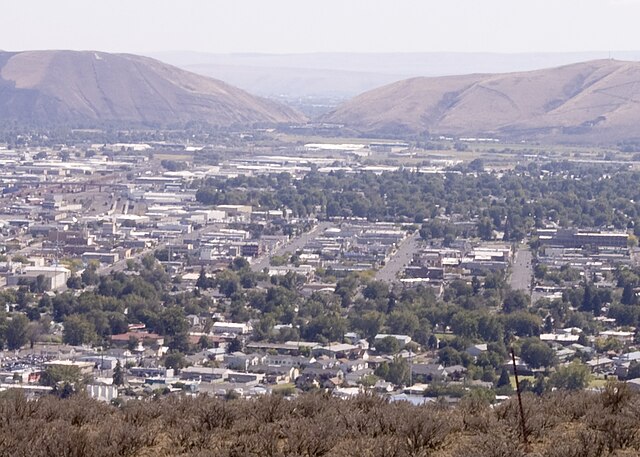
The city sat in the Upper Valley, separated at Union Gap from the Lower Valley. At the time, I was living near Wapato in the Lower Valley and commuting between the two. Photo by A. Balet via Wikimedia Commons.
~*~
First whites in the region arrived mostly as American stock. Most recent immigrants mostly from Netherlands and Scandinavia. Generally, little personal ethnic awareness.
Unlike the Midwestern Germans, or Irish, Italian, German, and Scots elsewhere.
~*~
American values
~*~
From Spiralbound Cascadia with commentary.
As the new year opened, I had been in Yakima as long as any of my other locations since graduating from college. There was no sense that this would be “it” for the rest of my life, but there was a sense that I was on the right track for a big move within a few years, likely to Seattle, the Queen City not just of Washington state but the entire Northwest.
I was still enthralled by the wilderness at hand and my explorations on trails or logging roads. Our Quaker worship group kept the spiritual flame alive that had been nurtured through the ashram, but this time with a peace and social justice awareness that the yoga center strictly avoided. My poems were finding publication in small-press periodicals, the way writers build their reputations. My wife was back on track toward earning her college degree, no matter the larger questions regarding our marriage. Despite its primitive condition, our shack in the orchard was a better fit for us than the quasi-suburban style of our previous duplex, and our landlords, Ivar and Phyllis, and their two sons also served as family.
All in all, I had much to feel excited about.
The key to all this, admittedly, was my income from the newspaper. Still low, compared to other professions, but higher than what I’d earned elsewhere. Credit the Newspaper Guild union for that, even if I was on a management track.
Quite simply 1978 would be a huge year for me as a journalist.
~*~
Soon after New Year’s, Kent posted Day News Editor spot for application, now that Maury had retired.
As I noted, Gil says from within, Kent’s leaning but not committed to me. My element of independence is a complication.
Feel myself in limbo again. By working as a cutting edge, have I cut myself and ended my usefulness here?
Am I just tired, tired of being “asst.” — desiring, perhaps, to just ride rim and rest yet also afraid to stop, afraid of destroying “my career.”
“Go after it aggressively,” Gil’s advice — letter, plan, etc.
What would it have been like working, say, as a plumber for my dad, knowing that someday the business would be mine? Fitting pipes together rather than lines of poems … Would their church have been sufficient?
~*~
In the end, I landed the position but had to keep it under wraps for a while. The biggest gain for me would be having four weeks of vacation a year, rather than two. I could still bank holidays and paid personal days, as I had previously, for getaways. And, yes, there was a bump up in salary.
~*~
Friday, watching Gayman [Frank was our Night News Editor, a step up from me] and Kent size up our new man — an expensive dinner at T’bird [I hadn’t gotten that royal treatment]. Earlier, announcement of staff changes was posted: Belcher reacted, “I think I’ll send flowers to Tippet.” Snickers in the newsroom, no congratulations from anyone except city editor Jim Wallace on my promotion.
3 May: Gayman off on vacation, two rough weeks for me as I filled in for him … 10 extra hours at the office last week …
Indian fishing platforms at Union Gap … salmon dip-netting seen during my commute to and from the office.
Another rough week: Gayman and the Spulers (Phyllis and Dean) all off. Whiz, Macknicki, Kent, Wallace, [Rob] Tucker, and me — downcast, our publisher on Kent’s back over irrational matters … [see in his obituary he had dropped out of school at 15 and later lied to get into the Navy WWII … later earned a BA in business, University of Washington].
Tippet, noting an active Mormon friend’s remark that when a couple marries at the temple, they must consummate the marriage before assembled church elders. Is it true?
The AP dispatch of Donny Osmond’s wedding mentioned that Mormon’s are forbidden from discussing what occurs in the temple but the couple did come out smiling. (Read what you want between the lines.)
Phil Spuler, remarking on a story we did about local official George Eastman: “A lot of people in this town won’t believe he’s had threats on his life. They think this is a friendly town. It’s not.”
And I thought of Fostoria, “home of hospitality,” yet a strange place, as I came to see.
Phil said Eastman’s quotes sounded familiar; many people coming here have said the same. Then Kent said he’d felt the same things, both as a top editor and as a parochial school board member.
“Swami Jnana sez it’s hard to be both a newsman and a poet.”
17 June: I’ve been a full-time professional journalist ten years now — how long ago and faraway that summer internship at the Journal Herald seems now. Met Nikki ten years ago this coming December. Gran has been dead and Kay gone from my life, too. The searching and suffering intensified — God, how did I survive that?
Five years now, out of the ashram. Or the Shankaracharya Pitham, as it’s now known.
Work today frustrating. Farm mag dummies late, then a two-hour meeting telling us we’re coding wrong (the codes keep changing). Me angry over Perth’s “There’s only one person around here dumber than Kent and that’s Hodson.” Let him sweat the copy flow Wednesday night (tomorrow) …
Vacations are hitting the news desk and all these damn computer shutdowns. I spent 7 a.m. till midnight Friday at the office, then noon till 7 Saturday. Still so far behind.
Anything to make the 5-star edition easier on me, so that I can address my other sections.
JMack handles the shop’s interruptions so well, as well as Purdy’s foot-dragging, when it occurs.
5 Aug, a Saturday: Company picnic tomorrow, “strongly recommended”
Completely exhausted, damn office, I’m trying to cover for three vacations without any assistance, and it’s simply too much.
Carol and Phil will have new responsibilities when they get back. I’m cutting Home, Entertainment, and the TV mag free …
Another 10-hour workday — still trying to get weddings etc. in the tube — 20 done today, 20 to go …
12 Aug, Saturday: Workt at office yesterday from 7:15 a.m. till 9 p.m., exhausted, ready for Marriott to be back on Tuesday (will give her the TV and Entertainment sections to dummy, and put more controls on Femme).
~*~
From Spiralbound Cascadia with commentary.
Also from the Yakima library, at the time a volume that became influential in my emerging thinking in poetry and fiction and even spirituality: Regional Perspectives: An Examination of America’s Literary Heritage, edited by John Gordon Burke.
From the chapter, “Crossing the Midwest” by John Knoepfle:
The mind wants to entertain the notion that the further west the frontier the more primitive the life. But that is not so, and that is why the Midwest is so puzzling … And great rafts of hardwood timber were floated down the Ohio River to Cincinnati and Louisville as late as the First World War. … There is room for a native literature in German that remains to be translated … cultures that are supposedly dormant or provincial have a way of flickering into life and proving themselves dramatically related to the contemporary mind. …
Another characteristic of the mid-continental mind is its very hazy sense of itself … But their [cities’] distances from one another help them to maintain life styles that are distinct. … Where is Dodge City? [little awareness of the religious sects and traditions] … (something about a Midwestern ragtime that cannot be explained except in terms of German right-hand piano technique and Black left-hand chord progression arrangements) …
This was all a revelation to me, as would the radical element of the Midwest that Kenneth Rexroth remembered from his youth in Indiana and Chicago.
Had I stayed in the Midwest, where would any of this have shown up in my writing? Or did it, in the exile after Yakima? I would certainly find some of it in my genealogy research that would begin a half-dozen years later and, beyond that, on my mother’s side in Missouri, which technically isn’t Midwest but in my case, definitely German, in part. In discussions of blogging, I would be surprised to see that a tag of Midwest or Midwestern had no impact.
Where does the book Anti-California show up in all of this?
I thought I was free of the Midwest, in a progression my novel Nearly Canaan explores, but cruel fate would prove otherwise.
Remember, my ashram training had taught me to be aware of vibes and the fact that different places had their own vibrations. My, did Yakima and the surrounding lands!
Or, “If it’s got sugar in it, it’s cake; if it doesn’t, it’s bread,” as someone local said of William O. Douglas’ new book at the time. [The blatantly liberal U.S. Supreme Court Justice had returned for his summer home in the Cascades, upriver near Mount Rainier.]
I was still trying to digest previous places I had dwelled in or otherwise experienced.
Remind me that not everyone has lofty ambitions.
~*~
As I noted:
Subway Hitchhikers?
Network of the Heart
Canary folded
= Teletype writer =
Canyon hopper
~*~
My, I was moving up in life! This journaling was getting Serious.
Trying to make sense of my work schedule at this point. “Time for a break = 4 days off, a schedule switch, my last week’s Monday off is today, then my normal Sunday-Monday off days followed by my Labor Day = a well-earned rest. I’m too tired to go to the mountains. Instead, I’m off to the laundromat.” [Good luck if you can follow that. Commiseration if it sounds familiar.]
By mid-October: Using the tape player to rework poems, a strangest joy, back to voice and recognizing what remains incomplete or experimental forms that contain more than I had thought. Also journal notes that need no revision to become poems.
~*~
18:X:77: Our photographer Whiz’s birthday (he was turning 24 to my 29): Snyder’s essays in Old Ways confirms I’ve been on the right track after all, seeking relationships of people to unique landscapes/environments/cultures … [a half century later, what happens when the land itself changes as a consequence of climate upheavals?] …
~*~
19:X, in checkout line at the library, taking a midmorning break from the office, met a pipe-smoking bearded fellow my age or so, Barry Grimes, checking out Allan Tate, Ed Koch, etc. Got his contact info. He and a buddy are editing a new journal along the lines of Paterson. I’m welcome to submit.
Wait, pipe-smoking in the public library???
[A later note in the journal proclaims the tabloid newsprint publication that resulted.]
Comparing [George] Szell’s early and late recordings of Beethoven’s Eroica against Max Rudolf’s; as always, I was amazed by the vitality and clarity / discipline Max obtained, as demonstrated in Cincinnati. The constant daring in each line, each phrasing having a stressed note. (Suppose the stress is largely spontaneous, varying from performance to performance: the players’ improvisation?) Yet the trills together (where Szell gets flutters). The amber warm clarity of tone. Structure revealed. The pivotal balance of conflicting possibilities: a disciplined wildness, savage elegance.
[And this was a period of my life with few live classical performances.]
Georgia O’Keeffe … demanded solitude as a painter … wouldn’t allow Stieglitz to enter the studio when she was painting …
As for Lake George? “Too much green.”
Not that I contested that later, in the vicinity. Green, it was.
~*~
12:XII: Conversation with Barry Grimes and Jim Bodeen: “I wouldn’t think you’d have any trouble getting published anywhere.”
My new longpoem more like Basho’s journeys — commentary linking poems rather than most English poetry.
Recitative and Aria
Potential for something there
Be clear or be clever?
Tribe: Neah Bay is our land because we spilled our blood for it,
a basket woven of snakes.
Symbols shaping the way we react to the land. [Wish I had more on that.]
~*~
25:X midnight
Acceptance of three poems from Roger and Dick (always surprising what editors choose, even when you know them) … with a note, “I like what you are doing. Your style is much harder and clearer. Keep to it.”
~*~
27:X
Among lingering impressions from Regional Perspectives ….
The belief that something remains intact in the backcountry, whether that be Vermont (and not Boston or Cambridge also as New England) or “upcountry” South (versus Atlanta or Nashville) …
How many respected but generally unknown writers are mentioned in passing?
There are great differences within each region …
Emotionally, the suffocation I’ve felt, even in Daffodil …
~*~
6:XII
… what my work lacks so much is the female (universal) element: softening, enveloping, making wet, warm …
Is all love-making feminine?
~*~
From Spiralbound Cascadia with commentary.
Fine art is, after all, an extension of religion. Just look at museums, concert halls, theaters, even arenas as temples.
That said, here goes:
Proprietors: Middle-class or desiring to move up, the kulcher-seekers. Subcategories those seeking familiarity with the old, beside those with “taste,” a little knowledge of “masters.”
Those dragged through: Spouses, dates, children.
Those seeking Experience: Usually modernists with “taste” but possibly those seeking play within art, qualities antithetical to where art must be “serious.”
Fellow practitioners: Usually too poor to collect new work except by trading, but also the most critical and appreciative, depending.
Now, for atheists and agnostics?
After drafting this, I see parallels to dining out for fine cuisine or attending concerts, live theater, even cinema.
Care to add to the list?
Halloween (1977): 22 inches of new snow in Cayuse Pass, 4 in Snoqualmie Pass, two of our routes to Seattle … winter was already closing in.
The kid wrecked the Capri while trying to use the CB he had received for his birthday the night before. Had he been in the Triumph, he’d be dead.
From loose letters, carbon copy, Nov. 28, a now obsolete form of address: “Sirs:” Even “Sir” becomes questionable.
windy night
gusts to 55 mph
highway speed
not feeling well
as Kitty smelled on my breath
~*~
6 Nov, Wednesday, new car arrived today. Feels solid, runs beautifully.
Looking back, I’m surprised that we went with Subaru, at the time a new entry into the U.S. market. I draw a blank at trying to remember the process of signing all the papers or how I even picked up the car, considering that we (make that Kitty) decided we’d keep our VW Bug which had no trade-in value.
That night, I surprised Kitty by driving up to E’Burg.. She loves the new car, its size and color. Took her to dinner.
Back at her apartment, a knock at the door. Two officers checking a strange odor in the hallway, fearing it might be more than rotting garbage. Inquiring about the neighbors. Any elderly? How long the smell? (A week.) Have you seen them recently? (Later she said her neighbor had been crying the day before. She almost offered her a ride to cheer her.) (Wait? In what?) On my drive home, I wondered: Did her neighbor kill the boyfriend she was kicking out? Is Kitty safe? She wouldn’t have answered the door if I weren’t there. Did the officer parked behind my car take down my license plate number? What was he radioing so long? They said a sheriff’s deputy reported the smell, but what was he doing in the building in the first place? Intrigue and foreboding, I presume …
Small-town cops, I’d say now, or perhaps federal ICE agents.
~*~
Mid-November
Snow flurries,
large flakes
briefly at noon
Nancy and Len’s visit all the way to our shack near Wapato, south of Yakima … [surprised to see they did that, though she had parents in the Seattle area … wish I had more!] Sleeping bags on our floor? She was a fine bubbly presence in our Indiana University endeavor.
Kitty’s been asked to place two of her sculptures in a Central [State University] show this spring — it’s by invitation only. Any reassurance she finds will quickly fade …
~*~
From Spiralbound Cascadia with commentary.

