Do you use storyboards and photos?

While these weekly Arts & Letters postings have been focusing on the writing life, at least as I’ve known it, some of the insights do spill over into regular life more generally. (I’ll leave that redundancy for emphasis.)

I am visually oriented, more so than many writers, and I did have four intense years of art training in high school. As a newspaper editor, I was regarded for my design layout skills and photo editing and presentation. I credit my high school teacher for much of that.

As a writer and designer, I’ve collected magazine photos, art books, postcards, and stray photos that happened my way. Use of a personal camera was more sporadic and problematic.

And then came digital photography, for me about the same time I started blogging.

But first, to back up.

Memory can carry you only so far, and even good notetakers miss much at the time. A story or poem can become vivid through a detail that pops a character or a scene. A sensitive writer might find that specific in a scent or a taste or motion or a particular word that’s voiced or sensed, but in many more instances, it’s something visual, the sort of thing you might find in examining a photograph or a painting. I’ve learned how those saved magazine photos as well as later images found online can be valuable that way. You or I can even build memory boards to support certain characters or locales, even a room in their house, to assist in our thinking. Some might use a website like Tumblr to do that, too, though I’ve found much more’s available more openly.

Much of my revision of the novels Daffodil Uprising and Nearly Canaan greatly benefitted from such prompts, as did the drafting of “Miller at the Spring” in The Secret Side of Jaya, and especially some books I won’t tell you about.

Some of these photo archives have become albums I’ve posted at Thistle Finch editions, should you be interested. Others you’ll find there, more recent, are images I’ve been taking in my new setting at the easternmost fringe of the continental USA. They’re more of what I’m considering an adjunct kind of journaling – impressions that might have spurred poems back when I was without a camera. I’m even finding a similar stream in what I’ve posted on my Facebook profile, where the images are more likely to be video. (Yes, today’s author is supposed to be active hustling everywhere.)

I hate to admit this, but the ubiquitous digital camera is greatly reducing my on-paper journaling.

Besides, just what are all of those people out there holding up their cell phones wherever they go planning on doing with all of those digital shots? It’s like they’re trying to confirm their own existence. Note the selfies. Or that what’s in front of them is actually happening.

Not that I’m trying to say I’m somehow nobly above that. (Well, maybe?)

As for photo inspiration? In my household, the collected images are impacting our thinking in the ongoing renovation of our historic old house. At this point, the kitchen, especially.

I am trying to be more selective in what I post here at the Red Barn, even if the subsidiary blogs are picking up some of the overflow. Maybe you’ll enjoy them there, too.

~*~

You’ll find my novels in the digital platform of your choice at Smashwords, the Apple Store, Barnes & Noble’s Nook, Scribd, Sony’s Kobo, and other fine ebook retailers. They’re also available in paper and Kindle at Amazon, or you can ask your local library to obtain them.
More bits from one writer’s journey

I am one of the few poets and novelists who has spent the bulk of his career editing daily newspapers, rather than teaching literature or creative writing. Still, when it came to creating a contributor’s note for a literary journal, I had to think of myself in the third-person.

Here are some of those contributor’s notes I don’t think were published … until now.

  • In a typical year, Jnana drove enough miles to circle the globe, yet rarely ventured far from his relatively small state.
  • Jnana admits there’s something quite frightening in any occasion of encountering a dragon, much less being carried off by one. He’s been scorched more than once.
  • In his lifetime of writing, Jnana has found himself addressing issues of PLACE as much as character or social conflict or even religion and ethnicity. Place, of course, intertwines with history and the natural sciences. In examining where he lives – where we live – and have lived – he also examines movement, change, home, and community.
  • When Jnana graduated from college, the economy was in a tailspin. The hippie movement was flourishing. He was too skinny to be drafted for Vietnam.
  • Jnana once spent a week at an ecological workshop in Port Worden, Washington, where Barry Lopez, Gary Snyder, and Howard Norman were joined by biologists and anthropologists. It’s as close as he’s come to a writing seminar.
  • As copy desk chief, Jnana was a glorified secretary rather than the top grammarian.
  • Jnana began his professional journalism career as an Action Line research assistant.
  • As a homebrewer, Jnana handcrafted more than 2,500 bottles of fine ales and lagers.
  • Jnana’s elder daughter wanted to raise chickens, ducks, and bees at their small-city homestead. He wondered about the neighbors’ dogs and cats, as well as the possums, groundhogs, and skunks. He didn’t want the misery of another henhouse raid.
  • His wife thought Jnana would have fit the mid-1800s better than contemporary America. She wondered how someone engaging an Anabaptist religious line could be so unorthodox in his art.
  • As a daily newspaper editor, Jnana sensed he was among the last to uphold a vital blue-color trade. He wondered how democracy could survive without independent reporting or clear writing.
  • Considering the brevity of New England summers, Jnana had hoped to launch a line of Hawaiian sweaters.
  • Jnana hates onions but loves a good martini. (Gin, not vodka.) With or without olives.
  • As a journalist, Jnana lived in the trenches of community life – in the tensions of industry and finance, retail commerce, social inequalities and prejudices, and reactionary politics. He admires the progressive activists who have maintained their optimism in spite of it all.
  • In management and as an editor, Jnana had his head and heart handed to him on a silver platter more than once.
  • He hopes he never has to load or unload another U-Haul as long as he lives.
  • Jnana is quite grateful his younger daughter gave up rugby for crew as her first college sport.
  • Jnana senses rural values are rooted in his soul. His dad was born on a farm.
  • Jnana’s mother was born in St. Louis. She loved taking him to the zoo.

Journaling over the years

Prodded by a crusty newspaper editor-in-chief to keep a personal journal, I started the practice 55 years ago using spiral-bound notebooks. At the time, I was largely in quest of exploring “my problem,” meaning the deep depression and loneliness that followed the breakup with my first lover and my inability in social circles to find another. Long story to pick up later.

What I found instead was the manic upside in my funky settings during the hippie outbreak. Many of those entries, some of them in my favored 8½-by-14-inch notebooks – an option that disappeared all too soon from the market – found their way into my eventual fiction and poetry, though much of the rest is dross. At their best, they do have a sense of Richard Brautigan. Look him up, if you must.

As for the banal run of most of the entries, people who snooped into my journals and then voiced their disappointment in what they found told me as much. Note to those of you who consider doing something similar, it is an invasion of privacy and will likely bruise your relationship. It is an abuse.

Entries were rarely a daily thing for me, more likely weekly or, of late, even monthly. When I sat down to do so, I was more likely to record what was going on around me than I was to delve into my emotions or underlying perceptions. Those latter elements might appear whenever I had more time at the project. The big lesson was that my life was much richer than I had suspected, and I was too prone to lose the connecting threads without these times of reflection. In some ways, they were like Lewis and Clark’s explorations across the continent, I suppose. Who knows who might need the maps later.

In earlier returns to these, I did find I had duly noted details of unfaithfulness and other impending disasters that I was denying to myself, yet there they are in clear daylight when we return.

Among my goals this year is a thorough revisiting of the 200-plus volumes to date, the latter half mostly  in hardbound 8½-by-11 artist sketchbooks. Most of what I review will be discarded, harsh as that sounds, but I the act will release emotional burdens as well. My novels and poems distill and carry much of that journey, thank you.

The ones beginning in 2000, though, retain so many details of my current situation, I really can use the reminders of things I don’t recall when they’re raised by others. I’ll let you guess who, especially.

~*~

My practice has definitely changed since I began blogging. Much of the recording of events, personal observations, and reflections has deflected from the hardbound journals to these online entries. Well, so has much of what would have gone into long letters to friends and colleagues now has vanished online as well. Emails and texts fall far short of real correspondence, OK?

The journaling on paper continues, though at my age, life feels more routine, less worthy of intense recording. So much of it I’ve already said, even to myself.  Still, as a practice, it’s one more thing I can see as prayer, too.

You’ll likely be seeing more of what I turn up in those yellowing pages.

I prefer, should you wonder …

a shower to a bath, but indulge in hot tubs.

a hot tub to a sauna in the snow, not that I haven’t delighted in the latter.

religion that relies on questions more than answers.

discovery to fabrication. Accuracy more than cleverness.

Chocolate or candy?
White chocolate. Or dark, bittersweet.

Waffles or pancakes?
Either one, awash in melted real butter and local maple syrup. Better yet, a classic cheese omelet. Or baked pears or baked French toast.

Embracing my sunny side

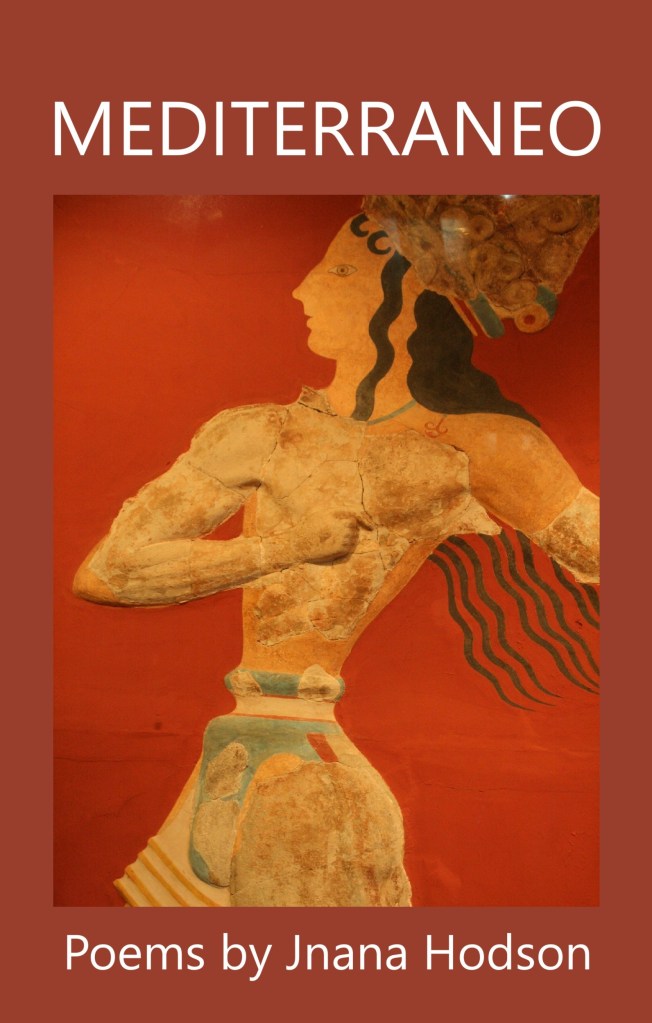
Let’s celebrate the publication of my poetry ebook Mediterraneo this week.

As a series of poems, this book was a turning point for me. My earlier poetry had been mostly of the nature or love genres.

Here I focused on Western culture itself, through places around the Mediterranean Sea. It was someplace I’ve never visited, though it’s had a huge impact on my artistic and spiritual outlook. What I have known comes through artworks, literature, philosophy, operas, insights from my daughter and wife’s travels and those of my goddaughter and friends and even Greek Orthodox dancing and liturgy as well as ancient Hebrew scriptures. Put them all in the mixer, then, and see what we can distill.

It’s quite distinct from my ultimate roots in the British Isles and Germany.

When I created these poems, I had not yet relocated to a remote fishing village on an island in Maine after 20 years in the Seacoast region of New Hampshire. The climate is colder than the Mediterranean’s, for certain, but the light of the sun does reflect off the sea and back into the sky, magnifying the luminance in a way that attracts artists, as it does in many of the locations in this homage to the cradle of notable classic faiths, cultures, and cuisines. I do miss Greek dancing and related dining. The ability to see whales from shore or deer in my small-city yard do offset that.

The Mediterranean is much larger than I had supposed. It would reach from nearly one end of the United States to the other, yet also spans so much more diversity.

While I’ve never been to the Mediterranean, much less Egypt, and never out of the country, for that matter, excepting pockets of Canada, all the same, I’ve flown places in my imagining, and some convey some underlying kinship.

Barcelona is one of those. Seemingly far out of my northern nature, this Latin complex of sensuality, color, and Roman Catholic devotion also harbors a stubborn independence, under its ostensible domination by others. Spanish, but not Spanish. Catholic, and yet in a historic realm of heretical lay movements. A passion for the musical dramas of Wagner, accompanied by industry.

Perhaps my genetic line does run, as a marker suggests, from northern England to the border of Spain. Uncork a red wine, then, and sit in my Smoking Garden on a summer late afternoon. Muse on a line from on friend or other while listening to an opera broadcast.

Consider Pharaoh’s descent, the ways the culture of ancient Egypt anchors one corner of the Mediterranean. Was there another anything like it, in its mindset or visual conception?

Or the pervasive smell of camels with their wave-like gait as they nearly sail from the southern shore of the Mediterranean and on deep into the interior of north Africa. In many ways, it’s their land more than man’s.

Or the continuing influence of Greece and its blinding sunlight, scented with lavender and sage, spills over the the culture we inhabit, sometimes with an air of longing

So much ancient history is filled with brutality and revenge, lusts and conquests. Especially, we would venture, around the Mediterranean and its sea.

The Italian Renaissance, with its lush reds and golden adornments, leaves its mark on the imagination. What would Europe be without it?

As for Minotaur in the Ring, with strokes of Picasso, don’t overlook Barcelona, the fifth most populous metropolitan area in the European Union. Some say the port city was founded by Hercules, which would fit its fierce spirit. It even lives its own language, despite Spanish rule. And then there’s its unique style.

They’re all energies in these poems.

You can obtain the collection in the ebook platform of your choice at Smashwords.com and its affiliated digital bookstore retailers.

When elk move through my mind these days

They are a memory, more as an emblem and ideal than creature. I never tasted elk flesh, though I heard praises. Nor have I stroked the fur. What I’ve known has appeared only on the forest floor as track and scat – no ticks on the neck or patchy summer skin like the moose where I now live. That, and winter encounters viewed from a distance.

The deer who frequent our yard these days are so small by comparison.

Will I ever revisit the Pacific Northwest where I lived? Would I even recognize most of it?

Or was it all gone in the divorce?

What’s left after ‘What’s Left’

Every writer has to face the question of knowing when a particular work is done, as in finished and ready to release.

The problem is that there’s always more that could be added or refined. Writing is, by definition, imperfect. In fact, the vaster the ambitions of a novel, for instance, the more imperfect it will be. Visit the critical examinations of the great novels Huckleberry Finn and Moby-Dick as prime examples.

The decision finally comes down to the line where the work releases the writer. The obsession burns out. You’re exhausted and feel you need to move on. You’ve said all you can say. You’ve discovered just about everything of relevance you can on the subject. For some writers, I suppose, it’s like the end of an affair.

For luckier ones, it’s when the editor or publisher demands the manuscript, ready or not.

~*~

I’ve previously posted on how my novels percolated over time. There was the sabbatical year I gave myself in Baltimore, where I lived off my savings and armed myself with a new personal computer with 5½-floppy disks (for you high-tech geeks with a knowledge of now ancient systems) as I poured myself into keyboarding rambling manuscripts in the search of publication.

When my savings ran out and I returned to the workaday world, I kept picking at those seminal drafts, usually on vacations and holidays. Other efforts at more marketable books also got attention and even a few nibbles, but in the end, none of them panned out. Working full-time, I simply didn’t have the additional open periods required for successful self-promotion.

I’m glad I didn’t wait until retirement, as so many others I’ve known did, to start writing those novels. The details and intensity would have evaporated. Instead, retirement played out in a different way and the novels did finally find publication.

My one fully new book was the one that grew into What’s Left, though it did start with piles of outtakes from the earlier novels as well as other material.

As I’ve also previously posted, it did eventually lead me to thoroughly revise and reissue those earlier novels.

The result is that I have eight books of fiction available today, and I am proud of them, even if they haven’t found wide readership or critical acclaim. Not that I wouldn’t welcome either.

~*~

I am struck by how much has changed for me in the seven years since then, some of it a consequence of the shift to digital writing and publishing. I don’t require as much space for files, for one thing, or for research materials and correspondence. What can be found online with little effort is amazing, as I discovered while writing Quaking Dover. I hate to admit I no longer keep a dictionary or thesaurus at hand.

Downsizing to our remote fishing village at the far end of Maine four years ago meant that I no longer needed a studio in the attic. A corner of a bedroom sufficed for some pretty heaving writing and revision.

It’s a far cry from the dream I once had of remodeling the top of the red barn into a year-‘round studio that included a custom-build semi-circular desk with me sitting in its center – something like the copy desks that were common to many newsrooms.

No need for that now, not even at newspapers.

~*~

The task for me now turns to cleaning out remaining files, both digital and physical, that are no longer needed. I don’t want to leave that mess to my wife and kids later.

One thing I’ll confess is that I doubt I have another novel up my proverbial sleave.

~*~

You can find my novels in the digital platform of your choice at Smashwords, the Apple Store, Barnes & Noble’s Nook, Scribd, Sony’s Kobo, and other fine ebook retailers. They’re also available in paper and Kindle at Amazon, or you can ask your local library to obtain them.

The hardest prompt: a love letter

You’d think these would be the easiest, most natural thing on earth, except that they usually wind up being 99 percent cliché and hot air.

Besides, how many times and ways can you express the dirty stuff, if you dare?

(And be prepared to back it all up in person.)

Really!

In addition, the audience of one can be the world’s most demanding, no matter how fond of you they are.

Even more difficult, add to the assignment something I heard a writing prof say, quoting another one: Never revise a love letter.

Nope, let it gush forth.

~*~

For further humiliation, there was an instance when I was living in the ashram and writing a reply to a beloved’s epistle when several of my fellow yogi residents came up and grabbed my effort, grimaced, and declared, “If I received that, it would be the end of the relationship.”

Those girls were so full of helpful insights, as you’ll find in my novel Yoga Bootcamp.

~*~

Well, I’ve never been good at pickup lines, either.

~*~

About a dozen years ago, I had a spree in the loft of our old barn when I went through the remaining letters to me from girlfriends and lovers over the years.

Earlier ones had been helpful when I was drafting my novels Daffodil Uprising and Nearly Canaan. What jumped out at me in this round was their underlying unhappiness apart from me. It didn’t make for a good give-and-take in a relationship. No wonder things didn’t work out in the long run.

The time for the ritual burning was way overdue. It took longer than I would have guessed.

~*~

More recently I came across some surviving letters written on computer, some of them that were then sent by the postal service and others that went by email.

The ones I wrote now embarrass me. As for theirs? A gentleman won’t say, though they reflect a long search for a fitting relationship that never panned out, like panning for gold. My, all the hours I spent writing those and reading the responses!

Once more, though, a purge is overdue.

We could get into a discussion regarding the intimacy of handwritten letters versus legibly typed ones, though that’s largely moot now that the exchanges have shifted to emails and cell phone texts. That topic deserves its own conversation. For now, let me say that the playful back-and-forth with my now wife via America Online when we were getting to know each other is woven into my Prelude & Fugues poems available at Thistle Finch editions.

~*~

Back to the advice about never revising a love letter. I find it useful as an ideal for other kinds of personal writing, too. Just let it pour out, best as you can. Not that it usually proves so easy.

Yeah, yeah, I fall back heavily on the revise-revise-revise emphasis elsewhere, along with the adage, “Talent goes into the first draft; genius comes in the revisions.”

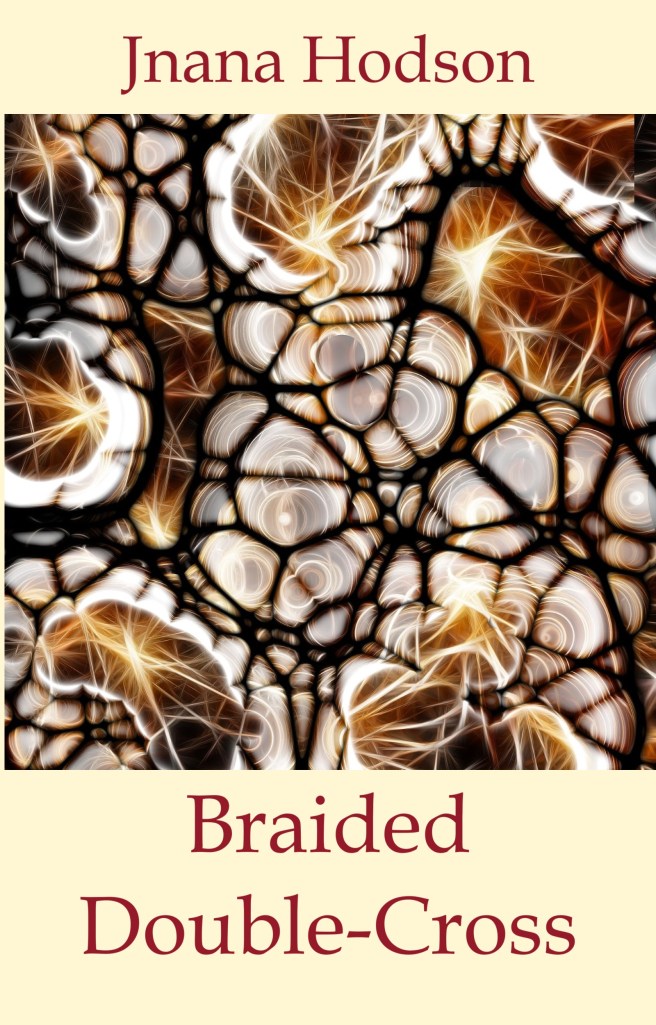
Still, some of those love letters gave rise to the poems in my collections Braided Double-Cross, Blue Rock, and Long-Stem Roses in a Shattered Mirror (upcoming).

Let me add to that the only time – well, just about – that I face the dreaded writer’s block is when having to come up with something spiffy on, say, a get-well card. Like the ones they used to pass around the office. I know of a truly major writer who agrees with me there. Maybe sympathy cards are even worse. You can’t go with “Miss you” there, and nearly everything else is so trite.

~*~

One final concern I’ll raise while we’re circling around the topic involves what would we say to each other now, all these years later. At one time, I tried to find out, thanks to Facebook. It wasn’t encouraging. Some who had been hot on my end barely remembered me.

And while I had tried to be conscious of their objections or potential feelings of hurt in reading the fictional accounts of our lives, I finally had to realize they never read what I had written after our breakups or differing directions.

Ouch! Most of them I missed more than they did of me.

Sound familiar?

~*~

You can find Braided Double-Cross in the digital platform of your choice at Smashwords, the Apple Store, Barnes & Noble’s Nook, Scribd, Sony’s Kobo, and other fine ebook retailers. You can also ask your local library to obtain it.

Recalling an obscure West Coast vinyl record operation

Its albums stood apart from many of the others I borrowed from Dayton’s public library, with its fine record collection and its guardian.

Contemporary Records was the name of the company, founded in Los Angeles in 1951 by Lester Koenig and soon a leading advocate of what became known as West Coast jazz, including Chet Baker, Shelly Manne, Art Pepper, Sonny Rollins, Bud Shank, and Andre Previn. It was even the first jazz label to record in stereo.

It also ventured into classical, including guitarist Pepe Romero, perhaps joined later by his brothers and father, all of whom soon became famous.

The company also offered a Good Time Jazz label focusing on Dixieland, plus the Society for Forgotten Music in a classical vein, and a contemporary composers’ series.

I had thought one of its founders was American songbook master Vernon Duke – aka Vladimir Dukelsky, his Ukrainian name, used for his 12-tone pieces – but I seem to be wrong. I vaguely recall that one of the disks presented his work as played by the Hollywood String Quartet, but find no support for that now, either.

I have no idea what brought all of this to mind, all these years later. What I am seeing now is how easily so much falls into oblivion.