You never know what we'll churn up in cleaning a stall
I like to think that natural beauty can be found anywhere, but I have to admit that too often, what’s happened is that brute ugliness has prevailed in far too many places, typically as a result of greed. There’s no excuse for much of that, either. A little extra expenditure could have added grace to any development, created visual intrigue, lessened the harshness. Urban or rural or what’s in-between, alas.
Whenever possible, I chose career moves that opened me to natural or artistic settings and inspiration – along with opportunities to shine professionally. It’s meant avoiding suburbs, for one thing. Sometimes, though, it’s also meant invoking a sliding scale of value – you know, finding pockets of serenity within otherwise harsh localities. And then there were some other postings that principally industrial, even when it was mostly farmland. So it’s been a mix.
Still, as I’ve said, I came to realize that had I remained in my native corner of Ohio, I wouldn’t have been able to write poetry, the vibe was simply wrong. Or, if I had, it would have been much different from what I’ve done.
On the other hand, the four years I lived two hours east of Mount Rainier, back in the late ’70s, gave me repeated access to one of America’s greatest national treasures, often from lesser-known perspectives. What memories! And that’s before I turn to much of the back country and wilderness that was closer to our home. I even came to love the beauty of the desert where I was living, a landscape that initially struck us as hideous.
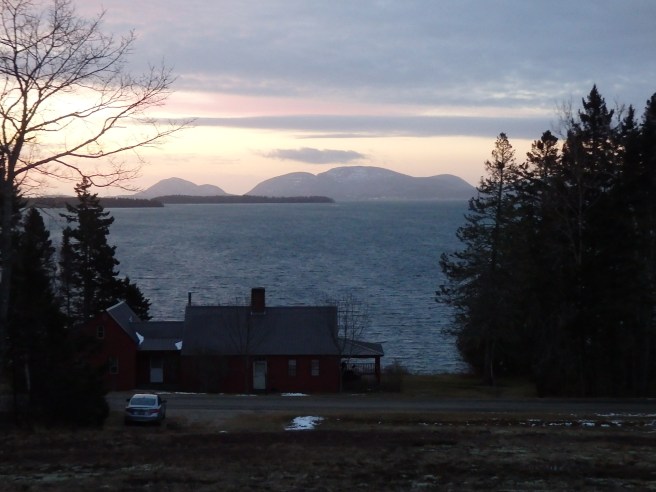
Now I’m finding myself dwelling two hours east of an even more popular natural park, Acadia. Already, I have glimmers of many backwoods and remote rocky shores to explore in-between.
Technically, all of Downeast Maine is also Acadia, the French name of the region. For most folks, though, Acadia means the park.
The biggest land mammal out west was the elk, while here in northern New England, it’s the moose. Just as the celebrated shellfish here is lobster, rather than Dungeness crab.
The fact is, for many people, either place is about as close to paradise as you’d find on earth.
And, yes, I’m feeling lucky – or especially blessed – that way.
It’s hard to believe the Red Barn has just passed its tenth anniversary. Frankly, I thought this blog would be going dormant by now, that we would have exhausted everything I have to say or show, but that’s not what’s on the horizon after all.
Instead, thanks to our downsizing and relocating to a remote fishing village with an active arts scene on an island in Maine (whew!), I promise you the best year yet. And, yes, Dover back down the coastline will still be a big part of the mix, but in a new way.
Each year, the Red Barn has changed its emphasis somewhat, and in doing so explored new fields while leaving others behind. Looking back, I’d say it’s made for a natural evolution. The poetry, for instance, has moved over to my unique digital Thistle Finch imprint. Much of the Quaker experience has gone to my As Light Is Sown blog. And newspapers just aren’t what they were, while their “war stories” fade into a foggy past.
During that decade, though, my novels were finally finding publication, and that provided a lode of new material and thinking to share with you.
Photography also became a much bigger part of the mix, thanks to my digital cameras, so much so that I can now claim shooting as one of my hobbies.
Add to that the bunnies and vanity plates and some wordplay, for a little fun, which will continue, as will the Tendrils.
The original visual artwork from my high school portfolio, alas, has been depleted. Let me confess that as the pieces came up, I often wondered why I had done this or that back then. There are some wild leaps of intuition that amaze me now, not that I’d ever venture such confidence these days. Ah, youth! (Sigh.)
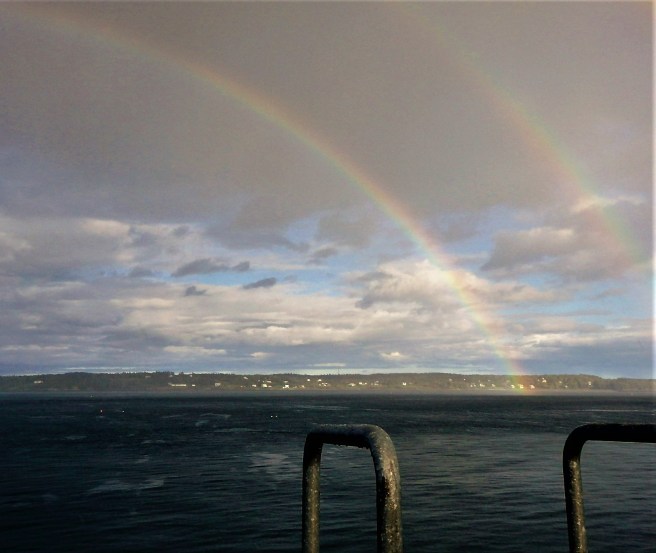
What’s new this year is a close look at Eastport itself and the surrounding Bold Coast and Sunrise County. It’s a remarkable landscape with a host of fascinating characters and wildlife. Having been here a year now allows for some perspective in the discoveries, ones you, too, will be sharing. The encounters have opened a whole new world for me, even as part of upright New England. They’ve also revived many sensations I’d been forced to leave behind in the Pacific Northwest more than 40 years earlier. I hope to be able to convey that awe of natural wonder. I still can’t believe this landlocked Ohio boy looks out the window and sees the ocean daily.
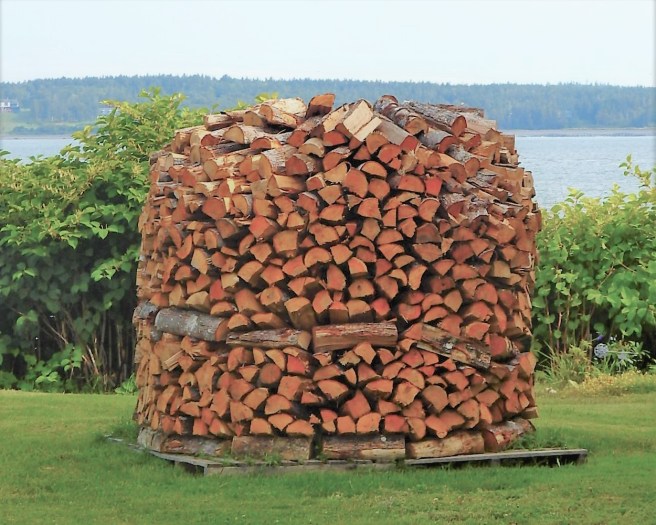
The year also provided me with a writer’s retreat, long stretches of solitude while the rest of the family remained behind, apart from their festive visits.
I was already well into the first draft of my next book when we uprooted but quickly got back down to business here. Alas, after showing the manuscript to a circle of beta readers, it was back to the drawing board for a thorough reworking. I should have been suspicious when the book seemed to write itself. Without revealing too much, I will say the project keeps me connected to Dover but in a fresh way. You’ll definitely be hearing much more while it inches along toward publication.
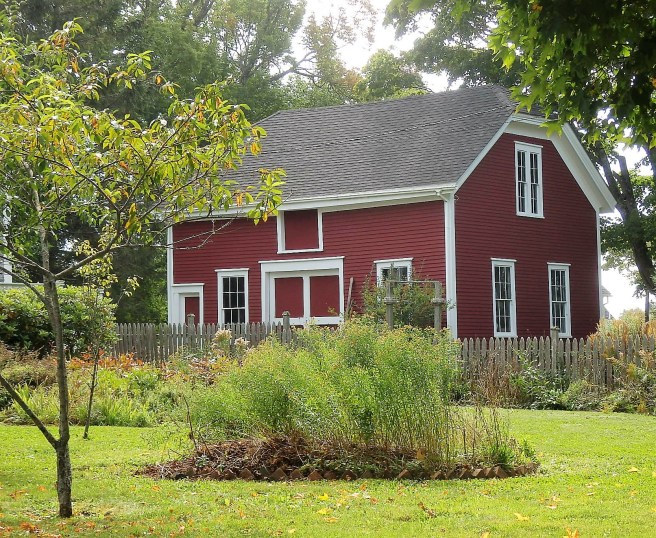
The barn itself has become a memory, a symbol of the longest place I’ve lived in my life, and maybe even my roots in the farming heartland.
At the beginning of the week, we had a tease of the Christmas-card expectations of a white holiday. Whether it holds to the big day itself is always in question, and the forecast seems to shift hourly. Even so, enjoy the scene.


One of my more familiar drives while living in Dover meant crossing over into Maine on my way to or from the Antique House.
Within a seven-mile stretch of the roadway, there were at least 16 family cemeteries – some with only two or three visible stones.
It’s all the more striking when you realize that two separate two-mile stretches have none at all, so the burials actually occur in just three miles. In those parts, you probably couldn’t turn around without encountering a tombstone.
Many of the graveyards are overgrown, with some surrounded by iron railings.
I’m guessing there are more, if we were going more slowly and looking even closer.
Still, we’re left wondering about the families, some who settled the grounds in the 1600s, and how long they remained.
But on the drive, each one is gone in a flash.
With a landmass of 16,577 square miles, the country of Denmark is almost exactly half the size of Maine and has six-times the population of the Pine Tree State. Yet Denmark uses close to 10,000 megawatts of power annually, about double of what Maine uses.
If my math’s right, that means they’re using only a third of what we do, per capita.
How do they do it?
We both have cold winters with long nights. And most of us rely on fuel oil for heat.
And, for the record, nearly half of Maine is uninhabited, year-‘round, meaning the lived-in part of Maine’s about the size of Denmark. They do stay warm and keep the lights on, don’t they?
I’ve been living in Eastport a full year now. Admittedly, during the initial four months, I was commuting the 300 miles back to Dover every weekend or so, mostly to help declutter the house and prepare it for sale. What amazed us, though, was how quickly my loyalties switched – Eastport was where I felt at home, not the house I’d lived in for the previous 21, the longest of anywhere else in my life.
As you know, I delighted in Dover. Some of my previous moves had left me homesick for a year or more – the colleagues I missed, the social and arts circles, the landscape and opportunities. Even in some of the less attractive places, there was something or someone I regretted leaving behind or unfinished.
This time, though, it felt more like dropping a fantastic perfect lover by being swept away by someone more exotic. You know, leaving a knight’s castle to go off to live on a shack on an island with a mermaid, even if she smelled like fish. (Remember, we’re talking about homes here, not actual people.)
Trying to sort out the reasons for the ease of my quick identity shift has been tricky.
I was at a point in my new creative project where extended solitude would be very helpful. And it was. You know, the writer’s retreat or arts colony.
Covid had also already distanced me. I was no longer swimming laps daily and seeing that crowd. Quaker worship and committee work was on Zoom. Choir in Boston was suspended. With museums and concerts canceled, there wasn’t even any point in taking the Amtrak down and back. And the research I was doing had enough resources online that I could finish the project. There are some questions that might be answered if I had a few weeks to spend in the reopened archives, but I’m content to leave off where I have for now.
Eastport has more of an active arts scene that Dover did, though there was plenty once you included a few neighboring towns. It’s just that the one here feels more organic, as you’ll likely be hearing. We have to be resourceful, since there’s nothing like Boston over the horizon, as there had been in Dover.
Getting back out in the wilderness has been especially invigorating, even if the years are taking a toll on my hiking abilities. Ditto for taking yoga classes on the waterfront here in town.
Did I mention meeting a series of fascinating people, all with rich stories and experiences?
Or the artists-in-residence or world-class chamber music performances by local pros?
Quite simply, I’ve declared this was my best summer ever. The prior highs had always had some big downsides – trouble at the office, upheavals in romance, unnecessary complications. Not so this one.
We had hoped to get the renovations under way, but all of the contractors have been booked out for a year – and even if we had one on the job, supplies have been hard to get, as is the case everywhere. The delay does give us a chance to plan more thoroughly for what we want to see done. And it did mean I didn’t have everything torn up for the workers. I’ll leave that for next summer.
Let me admit that looking at the Red Barn posts as they popped up during the past year often left me feeling a bit schizoid.
As this blog has evolved over its nine years so far, its revolving categories run like a merry-go-round, and that’s led me to plan far ahead and schedule accordingly. If I tried to post right as things unfolded, I’d never have time to write anything else. Besides, this way allows me to get in a groove with each of the categories and explore them in more depth as a series rather than one-offs.
Two things I wasn’t expecting at this time last year have intervened with what I had scheduled and uploaded.
The Delta variant of Covid was one, leading to renewed closures and limitations. For me, the jolt came in bits that included seeing pictures of me standing in Canada from a few years earlier. Well, it was a reminder of what we’re fondly looking forward to doing again. In case any of you were wondering.
The bigger jolt came in the posts of Dover and our usual rounds there, especially in the garden. The problem was that I was no longer there, not after we closed on the house sale back in April – the event that sent me off to Eastport and a lot of our possessions into storage. I really didn’t expect the seller to accept our offer, but we bid in good faith and some hard budgeting and a shared dream.
That’s meant I’ve been exploring an exciting new place and learning about it, which I’ll be showing you through the coming year. What I saw on the Red Barn, on the other hand, was what I would have been experiencing through my old routine. And I must admit I’ve really, really missed those heirloom tomatoes. They just don’t grow up here, much less ripen. (Sigh!)
For the most part, my attention has been consumed by the revisions on my upcoming book – one based on a contrarian history of Dover. So I’ve been connected to the old community anyway, along with Zoom meetings with its neighbors and Friends. Be warned: I’m very much looking forward to sharing a lot of the outtakes and thinking with you through the next year. I think it will change your understanding of New England.
During much of the year, I’ve felt slightly AWOL when it comes to social media. I’m really happy to be getting back.

One sight always catches our breath as we drive Route 9 across what sometimes feels like the fringe of civilization as we’ve known it. And, for the uninitiated, the state highway from Bangor to Calais can become pretty monotonous in its long uninhabited stretches. As they say, make sure you have a full tank of fuel before you tackle it.
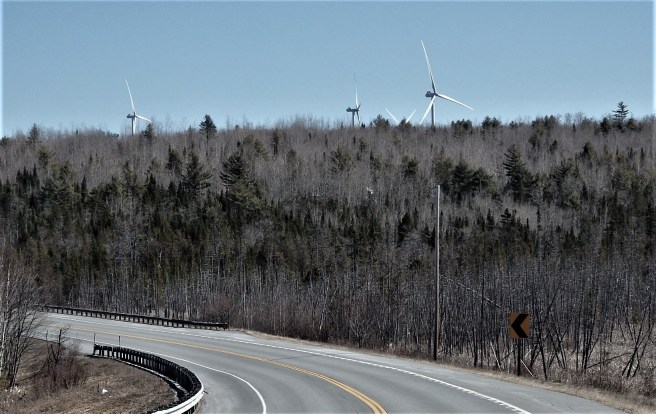
On a clear day, from a dozen miles away you might catch glimpses of a corner of the windfarms on Weaver Ridge and adjoining hills in Hancock County – I’ve counted at least 30 towers before the road dips away – but there are more tucked away in the high terrain. Still, nothing can prepare you for that first flash of the big blades turning gently in the air right in front of your face, or so it seems.
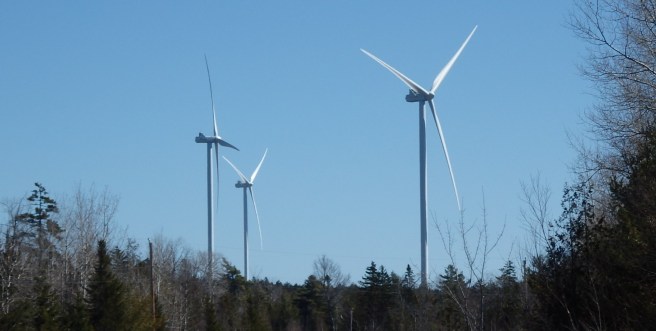
They dance gracefully – sometimes as a solo, then as a pair, or four. You spot them to your left but they suddenly show up on your right – the roadway twists along the slope. As those slip behind you, more giants rise above the hedge of forest. And all too soon, you’ve moved on.
The towers and their blades are bigger than you’d suspect. In fact, at the moment, they’re the tallest wind-powered electrical generators onshore in America, though much larger ones are projected for offshore installation.
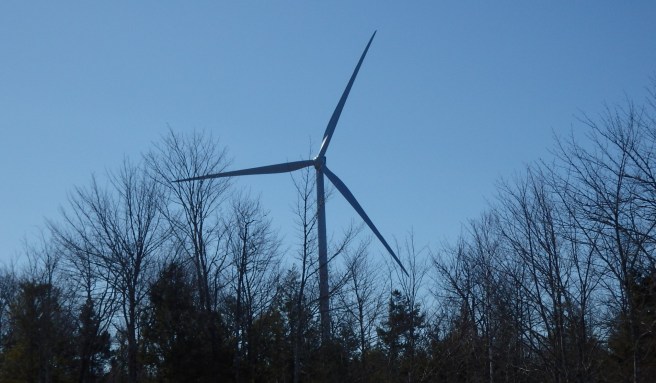
Wind generation accounts for nearly a third of the electrical production in Maine, though the state also imports a fourth of its electricity from Canada, largely Hydro Quebec.
I am baffled by the “not-in-my-backyard” opponents to similar windfarms. They still want energy for their computers and refrigerators and lighting, right?
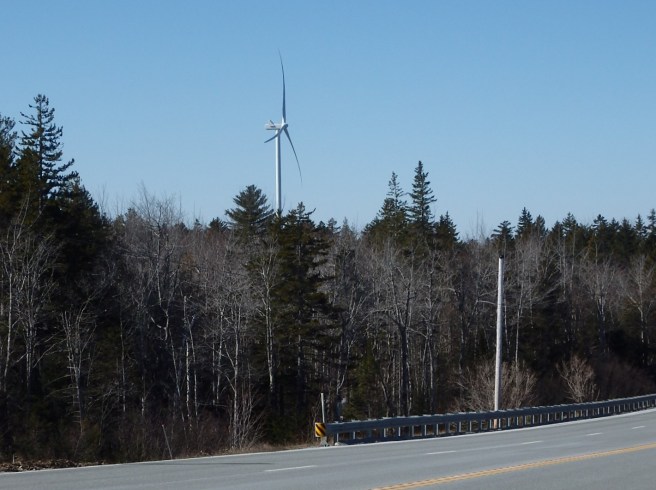
As if these “spoil the view”? I find them mesmerizing, even enhancing as a kind of sculpture and a reminder of the currents in the air itself. They definitely look better than a toxic oil refinery – and there’s no awful smell. For that matter, they strike me as much more attractive than a television transmitter or cell phone tower as a hilltop crown. And they do remind us of the charming Dutch windmills in a much smaller scale.
The latest installation, 22 Vesta towers and turbines, cost $150 million and went into full operation earlier this year.