Just made my unanticipated theater debut

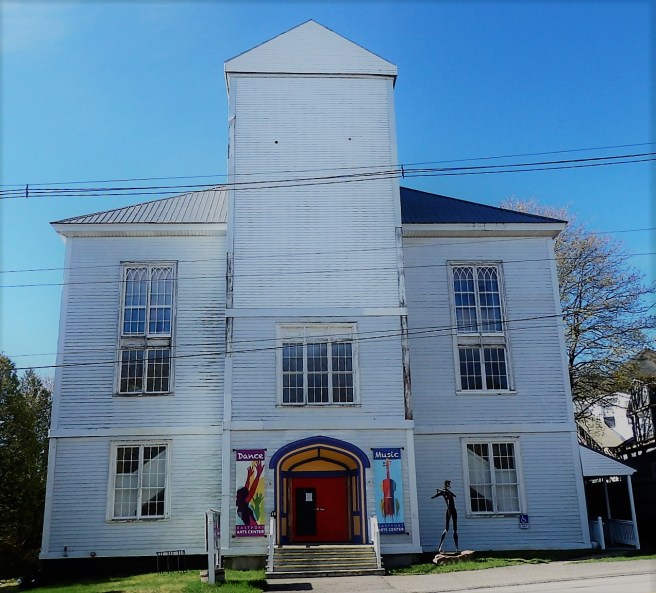
Eastport may be small, but its lively arts scene includes the Stage East company, with some rather lively programming.

At the moment, for example, they’re preparing a world-premiere musical for performances next month.

It’s the kind of place where you quickly get to know half of the town, too, so I wasn’t surprised to get an email from the director Thursday morning, even if its contents were unexpected. Could I participate in a play reading that evening and the next two nights?

An original work, the winner of the company’s inaugural playwriting competition?

I’d never done anything like that before, but in a pitch-in kind of community like ours, you learn to step up when asked, and so I replied fine. Honestly, I felt honored, and it couldn’t be too different from a poetry reading, right?

The initial reading was fun, both times through the one-act play. Better yet, my part was the shortest of the four and the least complicated. And then I learned we’d be doing it in front of a live audience the next night, meaning last night, and again tonight.

The playwright is Wilder Fray Short, a Bowdoin College senior and soccer fan, and the one-act play is In the 45th, about sibling rivalry and a lot more.

The competition, open to young full-time Maine residents and including a week-long residency and $1,000 prize, itself honors the late Jay Skriletz, the company founder, prolific playwright, and believer in social change.

To which I’ll add, it was an amazing experience and if you’re anywhere nearby, show up tonight!

A year of puffin-viewing tours to Machias Seal Island sells out in 45 minutes

The narrow, mile-wide island, claimed by both Canada and the U.S., is treasured by many birdwatchers for having the largest colony of nesting puffins along the Maine coast.

Trips to the island are limited, so much so that when online reservations for daily summer visits opened at 8 a.m. on January 10, all the tickets were booked in 45 minutes – at $180 a seat.

Sounds like a real bucket-list item, even if the boat sails from Cutler in my own Sunrise County.

Be warned, too, that the weather can be iffy, meaning that reservation might be cancelled on short notice.

Should I start considering a trip to Newfoundland if I really want to see any of the distinctive birds?

Deer are everywhere in this city

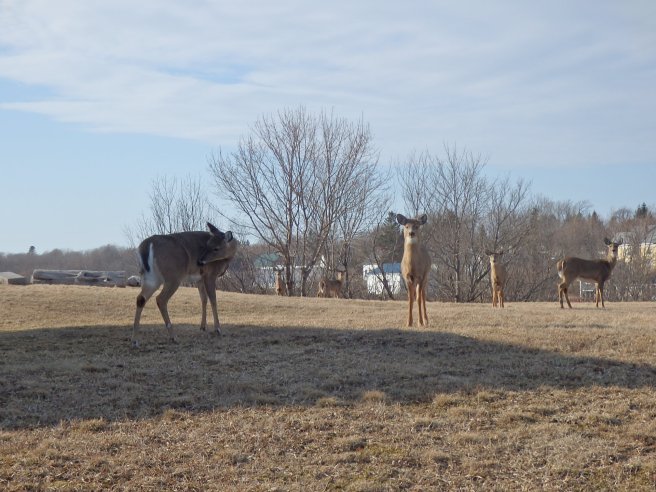
Eastport is a city, after all, and many of the homes are packed in close together. Not that it matters to our local wildlife.

Here’s one in our driveway.
And crossing over to our neighbors.
They frequent a large lawn overlooking Shackford Cove and the sea.
This yard’s only a few blocks from downtown.
And these critters are just a block from the Breakwater.

They’re so much a part of the place they even have their own Facebook page, Deer Eastport, and it is very active.

No matter how cute, though, they’re a gardening challenge. As are the raccoons.


Looking today, it’s hard to envision this as a center of shipbuilding

This cove is where Caleb Stetson Huston became Eastport’s most noted shipbuilder and marine architect. Here he created more than one hundred vessels from 1840 to 1870, surpassing the number of his father, Robert Huston, had built. He was no doubt responsible for repairing many more.

A third-generation shipbuilder, C.S. Huston at one point owned four shipyards on Shackford Cove – his father’s, on the south side of the water, and the William H. Hall and Jacob Shackford yards on its north side, as well as Aymar’s spar shop at the South End bridge, which has long since been filled in.

And how it can look six hours later.

As an innovative entrepreneur, he early on erected a steam capstan to haul boats out of the water, along with a 600-foot marine railway made of thick beams set up as interlocking boxes filled with stones.

Huston lived in a Second Empire style house overlooking the yards, which he purchased from Hall in the late 1850s.

Part of the C.S. Huston house on Third Street incorporates a section of the “Red Store” that John Shackford erected in 1787 at the foot of Shackford Street.

The shift to ships built of steel rather than wood changed everything. Maine had seemingly endless lumber at hand, but not steel. That also allowed for bigger vessels, meaning fewer could suffice for shipping. Finally, with the advent of the automobile, passengers stopped relying on steamships and that, too, ceased at the corner of this cove. But not before the world’s largest sardine cannery extended from its shore – a building 250 feet long.

At high tide it can appear to be quite scenic.

It seems so quiet today.