I never paid much attention to gale warnings before moving to the island.
Seems there’s a “small craft advisory” every other day, not that I sail.
Even in this tranquil life.
You never know what we'll churn up in cleaning a stall
I never paid much attention to gale warnings before moving to the island.
Seems there’s a “small craft advisory” every other day, not that I sail.
Even in this tranquil life.
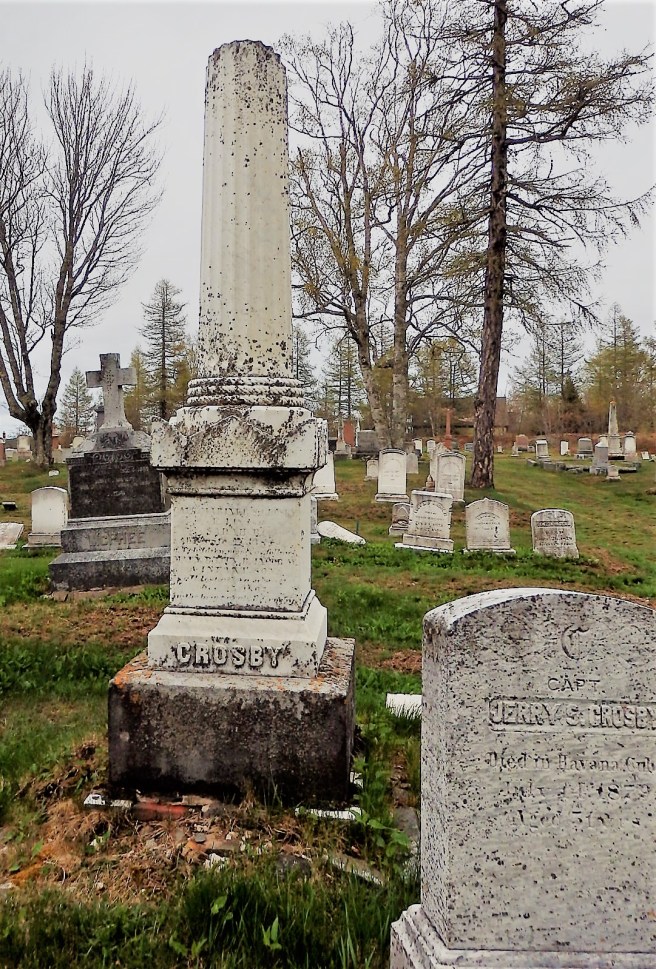
Capt. Mariner S. Crosby. Given his Christian name, it was inevitable that he would take to the sea. That’s what struck me the first time I wandered through Hillside Cemetery.
The second time I went to the graveyard, I was looking for that marker but couldn’t find it. Back home and at my computer, Find-a-Grave led me to the rest of the inscription, which is admittedly rather worn away, as well as some additional facts.
What I found was this:
“Lost at sea with his family and the Brig Sarah B. Crosby,” named for his wife. She and the four children, one of them an unnamed infant, are then listed on the white memorial – Jacob W., Mary B., and Lucy B.
The date of their demise is uncertain, “around Oct. 25, 1867” – in season for a hurricane or some other vicious storm, although a fire in a wooden ship can’t be ruled out.
I trotted back to the cemetery for a closer look. Here it is:
The Chamber of Commerce website reveals more:
“Mariner Crosby was the master of the brig ‘Maria White’ in 1852 and the schooner ‘Mary Jane’ in 1855. From 1861-1863 Mariner was the master of the barque ‘Charles Heddle,’ also built by C.S. Huston,” in Eastport. Around the corner from me, actually. “Mariner’s last command was the brig ‘Sarah B. Crosby,’ named for his wife, which was built in Pembroke. He commanded this vessel from 1863 to 1867 when the vessel was reported overdue. Mariner, his wife Sarah and four children, as well as the crew and passengers, were lost at sea without a trace.”
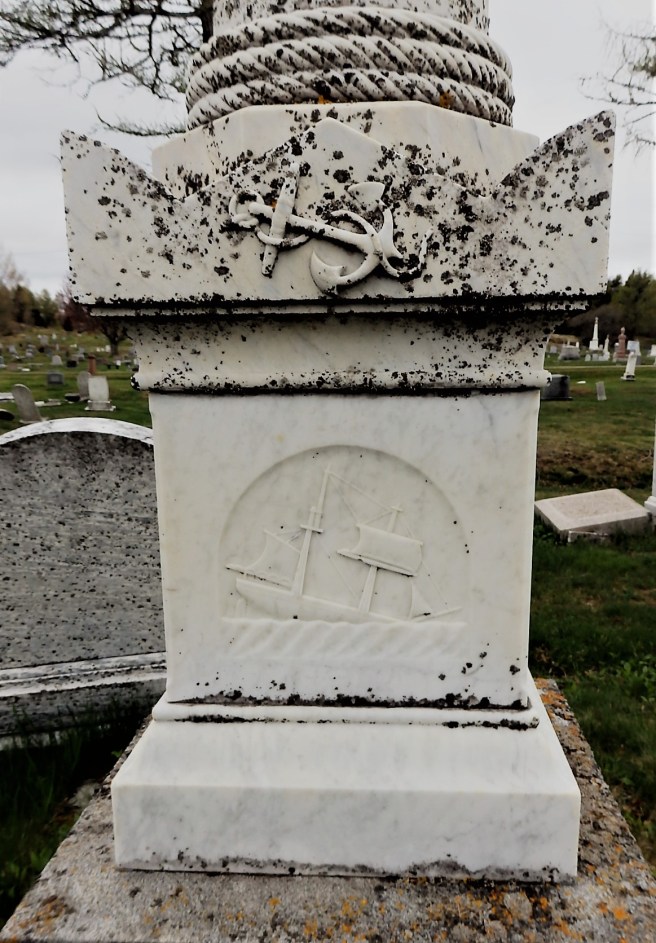
We’re not even told where the ship was bound, much less about its cargo, passengers, or crew. And a brig did require significant manpower to manage the massive square sails.
The two-masted 316-ton “Sarah B. Crosby” was built in Pembroke by George Russell in 1863 and then based out of Portland, bound for ports such as New York and St. John, New Brunswick.
I started to investigate and found a bit more.
She knew the travails of the sea, having wrecked at treacherous Sandy Hook, New Jersey, on March 1, 1865, with the passengers and crew safely removed. And then, after being abandoned, she was reclaimed and repaired, with shipments of coal from Halifax, Nova Scotia, later in the year.
On March 19, 1867, the New York Herald carried this notice: “Brig Sarah B Crosby (of Portland), Crosby, Measina, Jan 27, with fruit to Lawrence, Giles & Co, passed Gibraltar Feb 16; has had heavy westerly gales, with snow and hail, and split sails. Mar 13, latitude 41 30, longitude 65, spoke ship Michigan, from Liverpool for London.” (Measina, a mystery unto himself, was first mate. They would have been just off England at the time this information was relayed.)
I would like to know more in general about wives and children traveling with captains. It turns out to have been common, with a significant number of the children being born at sea or spending a large part of their childhood there. Wives were partners with shares in the business, whether they went abroad or stayed ashore. They even learned navigation, but did not interfere with the cook aboard ship. There were strict lines of authority. Beyond that, what were Sarah’s views and experiences? Was she even related to the 1841 Robert Bates house a few doors up the street from me? She was only 33 or so at the end; there’s no age for Jacob, though Mary would have been around 11 and Lucy, only seven.
While Mariner grew up in Eastport, the son of a Nova Scotia immigrant, Sarah was the daughter of a hotelier in Calais, Maine, best I can tell. Her father came from Massachusetts; her mother, New Hampshire. Mariner Crosby and Sarah E. Bates were married in Eastport February 12, 1855, by the Baptist minister Nathaniel Butler, of note himself. We have no idea how they met.
Mariner came to the sea naturally. At least two of his four brothers were also sea captains. Not just sailors or first masters but skippers.
Capt. Jerry died in Havana in 1879.
And Christopher Crosby led the racing yacht “Coronet” that defeated the “Dauntless” in a famed trans-Atlantic race in 1897. He went to sea at age 17 and was skipper by the time he turned 19. Yes, born to the sea.
And that’s as much of their story as I’m able to find, all prompted by one name in stone.
There I was complaining about not being able to continue swimming laps since Covid curtailed everything, especially followed by my relocation from Dover and its wonderful indoor pool. I certainly wasn’t getting in any regular exercise routine once I moved up here, and one month of yoga down by the waterfront did impress me with just how much this body’s deteriorated from 50 years of neglect. Geeze, how humbling!
I’ve never been one to pursue a solo fitness regime.
But then, when some enlightened souls opened the high school gym for walkers in the early morning, I stepped up, apologies for the pun, but it was something and definitely not at the mall, not that we have anything like that anywhere around. Well, I have posted some photos of Shead High’s gym. Maybe I was getting into shape for some summer hiking?
In the process, I met some interesting folks, all women – guys my age rarely seem to recognize how out of shape they’ve become, apart from maybe weight lifting – and the suggestion kept arising that I should try the twice-a-week fitness sessions at the, uh, senior center. (I really hate that term and definitely prefer to call it the Old Firehouse.)
Most of the time, though, once I started attending, I was the only male in the circle. What a revelation! Yes, I remember ages ago when I would have killed for such odds in my favor, yet these days I’m definitely married. (Got mine!) But still, you wouldn’t believe what I hear. It could be a highly rated TV series, if we could find a focus. Oh, well. As they say, laughter is the best medicine.
The hour-long class is definitely well planned, a blend of stretches, isometrics, cardios, and the like. It can challenge the beginner and adept equally well.
Nonetheless, when the temperature approaches 60 or so, indoors or out, they insist on opening the windows. Claim it’s too hot.
I am, on the other hand, still freezing.

As you likely know, trying to record the changing colors is a challenge. Does your camera ever get the hues and shades to match what you’re seeing? Or is it usually either too cool or too garish? How about those of you who are instead using watercolors, oils, pastels, or acrylic?
One spoiler for a photo, as I’ve found the hard way, is utility lines along most roadways. They’re the prime culprit among a host of other distractions your eyes don’t catch but the lenses do. This year, I was on guard and enjoyed the color in those stretches without stopping to take a shot.
Since most of Maine’s forests is evergreen, I scoped out stretches of deciduous trees free of those intrusions before the color change and kept checking in weekly, at minimum. In my case, the core of the route was an unpaved lane in the Baring district of the Moosehorn National Wildlife Refuge, as well as the country roads getting there.
There’s no way of predicting how things will develop. Drought, blight, storms can take a toll.
But we know what will follow. Boy, do we.
Here’s a look at how it all unfolds here.






And if you want to see what I experienced in New Hampshire, go to my Chicken Farmer blog, where I’ve also posted in-depth reflections on the soul of New England itself. The posts and slideshows appear in the New England Spirit category from August through October 2013.


Yup, home prices went through the roof in most of the country – but not here.
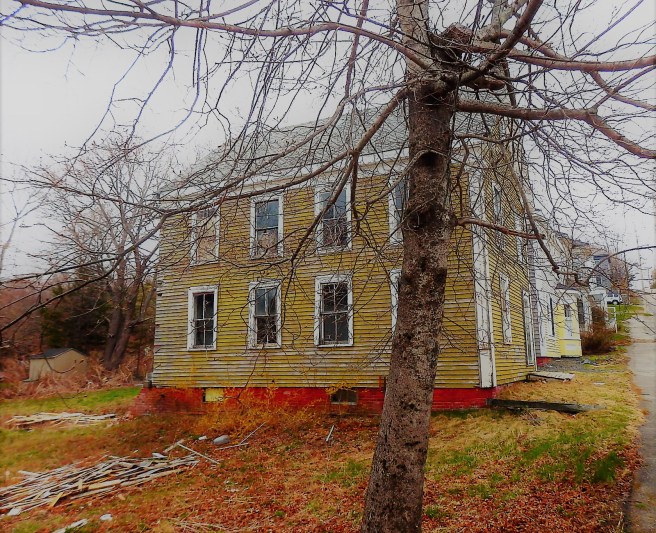
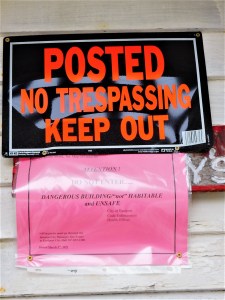
A common sight throughout Downeast Maine is abandoned housing in varying stages of decay. Seeing an old dwelling like that, your initial impulse is that somebody, somewhere, ought to save it. You know, live out in the woods, free from hassles, and all that. It’s gotta have a charming history, right? (Rusting trailers and mobile homes somehow get less sympathy, if any.)
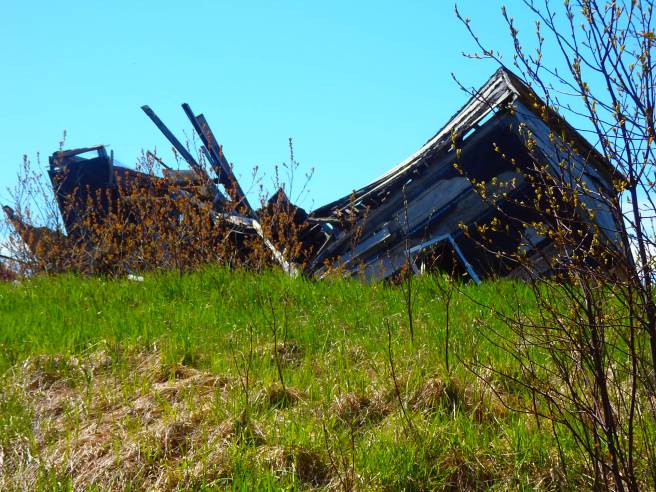
Then reality kicks in. Most of these would cost a ton to renovate – and many are tiny. Insulation, plumbing, and wiring are only the beginning. It’s cheaper to start fresh, if you can. Jobs are scarce, often towns away, if you can find work, so unless you’re retired, that’s another strike. And if you are retired, you might check out far to the nearest doc or clinic. I have to wonder, too, why anyone would want to live that close to the highway and its noisy traffic, other than maybe getting priority plowing after a snowfall. As for the mosquitos and black flies?
Others might tell you it gets boring. No malls or big-box stores, much less neighbors or a real supermarket.
Even as a summer home, then, there are drawbacks. Wouldn’t you rather be on a lake or the ocean?
Eastport’s senior center has invited me to talk about my new book, and that’s what I’ll be doing Friday, October 21, at 1 pm.
I’ll be focusing on Maine’s Nicholas Shapleigh, who was not a Quaker but played a crucial role in sheltering the missionaries who came to Dover. As a powerful lumber merchant, magistrate, and leader of the provincial militia, he was an important figure in what would become the Pine Tree State. His manor on the Piscataqua River sat directly across the water from Hilton Point, where the action began 400 years ago.
The overall content of Quaking Dover has been generating interest in a way I haven’t encountered with my novels or poetry. Having a handsome paper edition from the start is another plus. As much as I love aspects of ebooks, they are much harder to promote than a physical copy in your hand.
Dover may be a five-plus hour drive from Eastport, but there have long been connections.
The center’s at 9 Boynton Street, where I’ll be greeting friends and neighbors.
It’s the first in a series of presentations I’ll be announcing over the next few months. Please stay tuned!
Well, more like Puget Sound.
We have plenty of foggy mornings, often with cold damp air.
Turns just about everything gray, even monotone, a lot like I remember Seattle.
I’ve been part of a study group that’s been trying to envision a sustainable future for our small corner of the globe.
It’s been an exciting exercise, actually, looking for ways we can enhance what we have in conjunction with neighboring communities.
But it’s also terrifying, when we look more broadly.
Nine billion population, up from one billion when I was born. Can the globe really carry that load? I’m doubtful, but maybe.
Let’s start with increasing urbanization. I was blown away by the fact that 75 percent of Britain is considered urbanized today.
Add to that global warming. The regions where population is booming will be scrambling for food and water. Yes, water becomes essential. As well as ways to earn a livable income.
Now consider the automation of many jobs, something that points toward income readjustment, which is being largely ignored in public discussion.
Get political, and Republicans are in utter denial about all this, something I find deeply troubling. Engage, intelligently, will you? The future of humanity is at stake. Or are you really dinosaurs, just looking only for your next meal?
According to the projections, I’m in a good place to survive this – or at least my descendants are. Yeah, the ocean will be closer to our doorstep, even if we are higher than the downtown we adore. Still, the directions on the charts point to a lot of turbulence ahead, especially desperation and violence.
Here, in these workshops, we’ve been looking at the enhanced value of tourism, seeing our place as a pocket of natural wonder. As much as I love that projection, I doubt things will be that easy.
Will Florida actually be off the map by then, along with all of its reactionary politics? Or maybe those partisans will still be denying global warming would ever happen.
Where do you see the world in just 30 years?
Or even in just six, 2030?
 Jnana's Red Barn