A half gallon of fresh scallops

Or about 4½ pounds, purchased from a dragger docked at the Breakwater pier, where the crew of three was busy shucking the morsels from their shells. After dining on these two days straight last Christmas, we agreed we have a new holiday tradition. Unlike ones you would purchase at a market, these have no water added, and that means you can get a lovely sear when sauteing them in a bit of olive oil and butter. Do I need to add they taste heavenly?

Once again, we’ll catch up

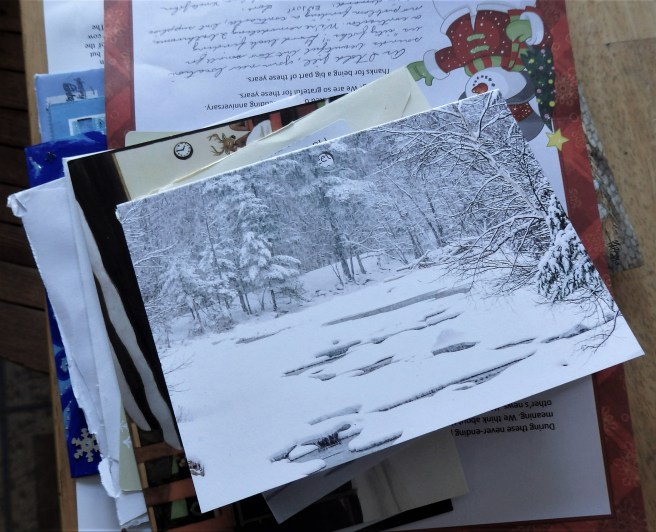
Those (real, postal carrier delivered) cards and letters are a fading tradition, but some of us cling on. Hearing on paper from old friends and some special family members each year is quite different, and warmer, than anything we’d receive online.

Even if it is from the governor or our U.S. senator. In a small state, we’ve usually met them face-to-face.

How different today’s downtown Eastport looks from even the 1950s

Stroll through Eastport’s downtown – rebuilt within a year or two of the disastrous 1886 fire and now in the National Register of Historic Places – and you’d think it was always like this, only with all of the storefronts bustling.

Not so, as I’ve been hearing, and that’s confirmed by a closer look at the undated aerial photograph on the cover of Joe Clabby’s two history books.

So as an idea of how things have changed.

  1. The waterfront is still full of sardine canneries set out on wharfs just behind the storefronts downtown, but many of the operations are now abandoned. There had been 21 at the prime around the turn of the century, but only one is still operating after 1975 and that ceases in the early ‘80s. As one local told me, you could watch the town fall into the water. Only the shell of the American Can factory still stands today.
  2. In fact, you would have a hard time seeing the water. The Waterfront Redevelopment Project, launched in 1978 and completed in 1983, cleaned up much of the scene and installed the popular walkway.
  3. The railway station, successor to the steamboat pier sits, beside the American Can factory. There’s a large apron in front of it, possibly for parking.
  4. A big movie theater occupies the space where the parking lot and the fisherman statue are now. And another big building fills the now-open space of the amphitheater. Today both are big gaps in the row of storefronts but allow more sunlight into the district.
  5. No Breakwater pier. That won’t come until 1961, with extensions later. It’s the focal point today.
  6. And no Fish Pier, which further defines the harbor.
  7. A rail line still runs into town. Service will end in 1978 and the tracks, removed.
  8. The Hotel East sits where the Motel East now is – at a 90-degree angle to the original.
  9. A row of houses is perched at the water’s edge of Shackford Cove. Long gone.
  10. There’s no Coast Guard station.

Here’s how the waterfront looked even earlier, from two photographs taken by Lewis Wickes Hine in August 1911, now in the Library of Congress collection.
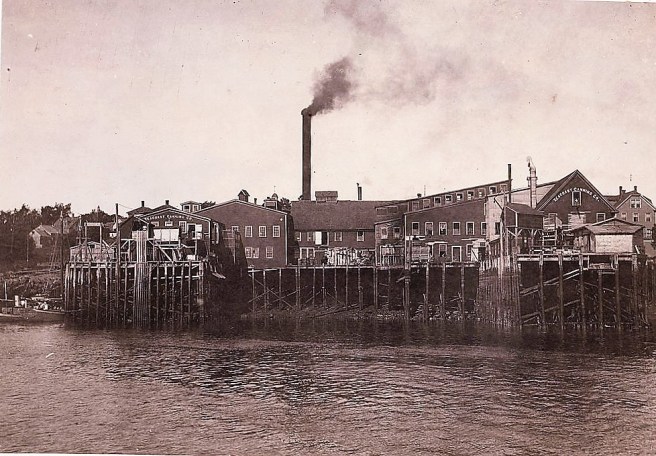
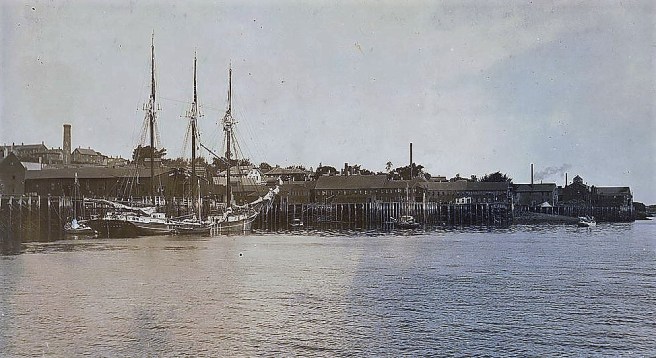
There’s nothing “quaint” about the place in these, is there?

Bunchberry or, if you prefer, creeping dogwood, I still love seeing it

We’ve become fond of this groundcover along many of our trails, with its white blossoms in the spring and red berries well into summer. Here the foliage is fringed with red, set here against moss and a touch of snow in a stretch of what may be a peat bog.

Quoddy Head State Park, Maine

For the record, Cornus canadensis is also known as Canadian dwarf cornel, quatre-temps, even crackerberry,

Wonder how it would work in our home garden.

Yes, I live just a mile or so from New Brunswick

Have to admit “New Brunswick” sounds more exotic than simply “Canada.” Most Americans know where Canada is, after all, but have to think twice when the province is mentioned.

The deep channel between Eastport and Campobello Island, New Brunswick, is called Friars Road, named for a rock formation dubbed the Old Friar. It stands at the foot of the bluff that’s part of the international park honoring Franklin Roosevelt’s former summer estate.

Equally exotic for this Ohio boy is living on one of the Fundy Bay islands, even if we don’t have to take a ferry to get to or from the mainland.

If I’m counting right in the satellite images, mine is one of the one hundred most easternmost houses in the continental U.S. It’s likely I’m even the most easternmost Quaker in the country.

Was this once part of a sardine cannery? Or the steamship terminal? Yes, that’s more of Campobello Island, New Brunswick, on the other shore.

Been here two years now, too, and it’s still amazing me.