Tom, an E.R.
surgeon grew up in Camden
southern California now
capable of handling the helm
the concept of “running
the rail down”
meaning skimming the water
yes, surf

I even got a spree there
where he is
You never know what we'll churn up in cleaning a stall
Tom, an E.R.
surgeon grew up in Camden
southern California now
capable of handling the helm
the concept of “running
the rail down”
meaning skimming the water
yes, surf
I even got a spree there
where he is
Can you imagine big wooden sailing vessels being launched here for voyages to China, Hawaii, or San Francisco? But they were, including majestic clipper ships.
 Now there’s a proposal to dam the small river to capture the tides and use them to generate electricity. A major question is how that would affect the newly restored migratory fish run with tens of thousands of alewives a day heading upstream this time of year.

They’re with us all summer.

Growing up in Ohio, this would have blown my mind. Now I almost take it for granted.
The Pine Tree State has long inspired painters and other visual artists, most of them attracted from elsewhere.
Here’s a sampling:
how would square-riggers look on these waters?
Lost behind a small island

finally, a shadow
and a tinge of warmth
 On what was the Asa Austin farm, the oldest part contains unmarked graves of Quakers, in contrast to the newer headstones.
For more, go to my book Quaking Dover, available in both paperback and ebook editions online or at your favorite bricks-and-mortar bookstore. Or ask your local library.

When the blooming finally hits New England, it can catch our breath.
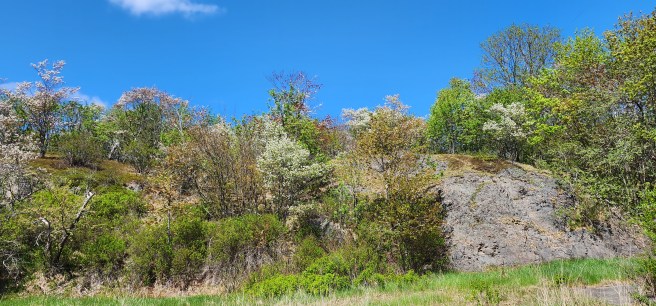
Even when you step back.
Informal racing out on the open waters was already a longstanding tradition when the Maine Lobster Boat Racing Association formed and launched its first races in 1964.
Fishing is a dangerous occupation, one luring a gnarly but dedicated gang into its ranks. It’s said they have salt water in their veins, or as I’ve heard them say of themselves, they’re either crazy or dumb – or both.
It should be no surprise, then, that here in Maine, lobstermen come together on summer weekends to race their boats. They have a pick of at least one every weekend.
Yup, race. Lobster boats don’t exactly look sleek or graceful – they’re built to work in all kinds of weather and take a beating. But they also have powerful engines. I had no idea just how powerful.
Besides, guys being guys, lobstermen have long boasted about their beloved boats – many are named after sweethearts and children, after all. Comparing theirs against their peers’ meant putting their words to the test.
All of that has led to a circuit of races starting in Boothbay and ending in Portland, with ten or so other sites along the way.
With that in mind, here are ten more bits to consider.

At low tide, the remains of the four-masted ship are fully exposed. Built in Shackford Cove, she had returned for maintenance when she caught fire and sank.

Here’s another perspective.

