Continuing the history of our old house:
In September 1983, Elwood Stackwood Richardson and Mary Blanche Richardson of Smithville, Tennessee, took possession for use as a summer home. They already owned and operated the Dennys River Inn, a B&B in neighboring Dennysville, Maine. A decade later, the house was conveyed to Mary Blanche’s daughter and son-in-law, Wayne Henry and Mary Jo Warner of McMinnville, one county south in Tennessee. The move was essentially to handle the details of selling the site.
This stage of occupancy centers on Mary Blanche, who was born in 1916 in Puyallup, Washington, to a family of transplanted Maine lumbermen. After 1976, she married widower Elwood Richardson, born in 1907 in Bristol, Pennsylvania, and relocated with her daughter, Mary Jo, to Philadelphia. That’s where Wayne Henry Warner, born in 1941, enters the picture. He married Mary Jo, born in 1943, and became a high school football, track, and baseball coach in Tennessee.
Thus, they all would have been adults in their times in Eastport.
For them, Eastport was a summer home, one not rented out in winter, in part because of its rundown physical condition, as Mary Jo told me. Her mother had relatives in Maine, either in Whitney or Whitneyville, neither one far from Eastport. She also loved antiquing. Guests during the family’s summer often liked to tour the Franklin D. Roosevelt estate across the water in Canada, causing her to quip that she visited Campobello more than Eleanor had.
Elwood, meanwhile, enjoyed fishing.
Bicycling and taking nearby ferries were other summer activities.
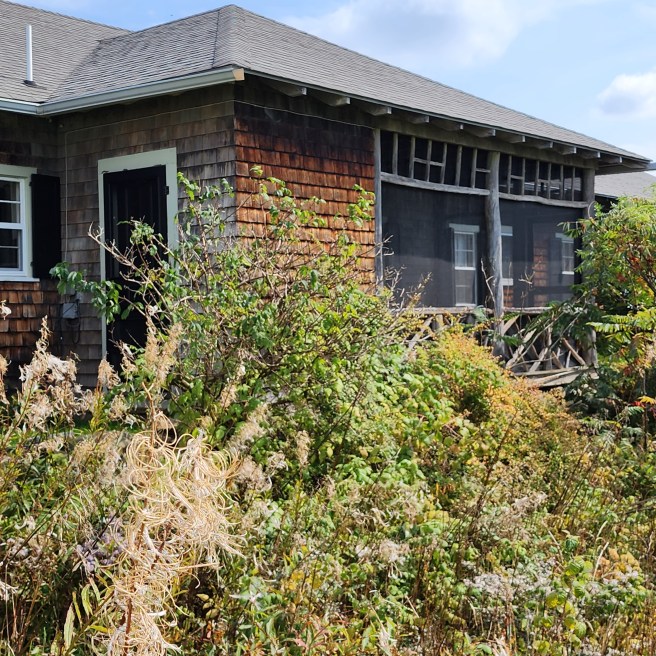
Mary Blanche was responsible for having the shingles put on the exterior and would have appreciated our raising of the roof upstairs. “It was something she wanted to do,” I was told. The move was apparently inspired by New England author and illustrator Tasha Tudor. Mary Blanche did have a cat named Tasha, reflecting the fondness.
Mary Jo also confirmed that the beams in the front parlor existed at the time, along with the “rather basic” kitchen and its Montgomery Ward stovetop. The property across the street also a house trailer blocking a direct view of the ocean. The modular home came later. And she remembered how small the only bathroom was.
She also asked about the sewage situation in the cellar. What?
And then about our contractor, quite surprised that he shows up on time and sticks to his promises. No comment there.
She was equally delighted to learn that the downtown is no longer boarded up and that the arts scene has emerged. Her stepfather, Elwood, took up painting in his summers in Eastport and was part of a circle that had outdoor shows in town.
Eastport did look quite different that recently. It was a time when the population was sinking and many of the remaining but vacant canneries and their piers lining the downtown were falling into the sea, one by one.