Samuel Johnson and his baroque constructions gave a big push to my literary ambitions after high school. Let me just say I’ve loved the clarity of Mozart from my adolescence on, and Bach and Handel have risen in my estimation in the years since. The brash English master fell right into that, though I now see again just how irreverent he was, despite all of his professed orthodoxy.
What it means it that I’m comfortable reading and writing certain kinds of complex sentences that are foreign to modern readers. Perhaps I should apologize? At least it’s not the only way I put sentences in line. Still, there’s a richness that’s missing in Hemingway and his progeny.
And here I am, drilled in the newspaper journalism Papa Ernie claimed was his inspiration. Think again. (Ernie? Makes me think of Pyle, and his big desk at the Indiana Daily Student, where I once worked.)
My wife has noted the dichotomy between my fondness for many Old Ways and the rule-breaking, experimental edge of my writing and thinking. She can point, for instance, to my fascination with the fiery writings of early Quakers in the mid-1660s placed in contrast to wild hippie extremes.
Are they really that different, though? I feel they enrich and deepen each other.
Cassia and her brothers and cousins face a crucial decision. Do they continue to jointly hold the family business as a resource for future generations, requiring them to keep working for a living, or do they divvy up their shares and then live independently wherever and however they desire?
Put yourself in Cassia’s shoes.
How would your life be different if you didn’t have to worry about how you’d make ends meet? What would you dream of doing?
~*~
The family enterprise extends beyond the restaurant itself, as they demonstrate when they buy an old church something like this and convert it into a late-night hotspot.
Many would consider Cassia’s family wealthy, but a close look would find that their money is tied up, mostly in real estate and the restaurant – investments that allow the family to be its own boss in working together and serving the surrounding community.
Imagine yourself with a million dollars. Where would you put it to do the most good?
Some artists begin with an outline of the work they’re doing and stick with it, starting in one corner and continuing to the opposite end. And, for many of them, once it’s filled in, that’s it, the piece is finished. Voila!
Others, like me, set forth in a particular direction with an expectation of what’s ahead but find ourselves often changing course as we go. And once the first draft is finished, we know it’s only a start, far from finished.
There’s a saying in writing that talent goes into that first draft, but genius comes in the revisions — if at all. That first draft can be exciting, even intoxicating, as the piece takes shape — in the case of writing, sometimes out of thin air.
Or, in the visual arts, there’s a description of someone who’s painterly — that is, scraping away earlier layers and painting over and over until something comes into focus. Oh, yes!
The truth is that first draft can be satisfying for its creator. You know where the story wants to go, who the characters are, how the pieces fit together. Your spelling can be irregular; the sentences, unfinished; the events as arbitrary as you wish. You could leave it there and turn elsewhere, should you decide. You don’t have to defend or explain anything.
On the other hand, if you wish to share your work with others, you’ll need to clean it up. Those who think otherwise are at least worthy of suspicion.
Which leads to the next step, one I think demands far more labor than the drafting stage and far more dedication. Revision.
For one thing, it means questioning everything that’s gone into that beloved first draft. Every word, every sentence, every paragraph, every chapter. Ouch! For another, it means asking yourself just what you meant in that brilliant phrase before you. And for me, at least, there’s a stage where I start trying to liberate whatever it is that’s lurking beneath the prose on the page. (Well, these days, the computer screen.) It means tearing apart what you’ve done, discarding large chunks of material, and inserting fresh insights. And it’s much messier than what you’ve done previously. Is there a special maid service for writers?
One item on my mental checklist regarding the revision process has to do with identifying certain words that keeping repeating through a long work like a novel. I then go back through the story, looking for synonyms that will give me another angle on the concept or thought being repeated. In What’s Left, for instance, I had family, restaurant, hippie, and Buddhism high on that list. What could I do to lessen the deadening recurrence of those terms? Slang, I might confess, can work wonders.
From my poetry, I’d long ago learned that this is where the work itself opens into something totally new. What do I really mean here? What is the text trying to say to me? How can I liberate it? Or make it burst into flames?
OK, this sound pretty haughty, but it’s all part of the obsession.
As a parallel, let me suggest cooking, since it’s an element in the background of my new novel. Just look at how the ingredients cook down into something quite different. There’s much more than just throwing a steak on the grill or opening a bag of shredded lettuce. (Especially if you’re going to join me at Carmichael’s in the novel.)
To return to the question of just when is it finished for me, I’d like to say once the work’s been published. But that may be rushing reality.
A thorough revision can leave me exhausted, feeling I have nothing more of value to add. (At least for now.) Or maybe I’m finally released from the subject — it can move into the public arena now.
Thinking of What’s Left, I might mention a parallel in the visual arts where I originally saw the earlier chapters as pop art masters Roy Lichtenstein and then Robert Rauschenberg but narrowing into the black-and-white lithographs of Peter Milton. But then my perspective reversed!
~*~
Do you ever look at events around you like an ongoing movie? (Sometimes even as a cartoon, as I do?)
What would you use as the title for your life?
~*~
Finishing the meal doesn’t mean the job’s done, as Pia would have learned growing up in Lowell, Massachusetts, and working in a diner like this.
Once I had gone back to better unify the stories of Cassia, the basis of What’s Left, and her father, I then saw a possibility of pulling two existing and somewhat problematic novellas into an overall more unified volume. (Yes, I’ll argue that what I have is something other than a conventional series, even when some of the characters appear in multiple novels.) And, I should emphasize, Cassia is far from the scene in the pieces I’m addressing, the ones that now involve Jaya, the center of Nearly Canaan, in a capstone work.
By weaving Jaya into the two novellas, I could pull them together. And since “Nearly Canaan” was set in three distinct parts of the country – Great Plains, the South, and Pacific Northwest – reflecting places where she had lived with Schuwa, a third section was required, one reflecting their interlude in the Ozarks.
Here, my imagination took over, along with some elaboration of earlier research. I might add that the Hodgson Mill cornmeal found on many supermarket and kitchen shelves has a personal connection – its founders were distant kin from North Carolina who spelled their name like mine at one stage in their migration to Missouri. I have to admit that “Miller at the Springs” is especially satisfying for me.
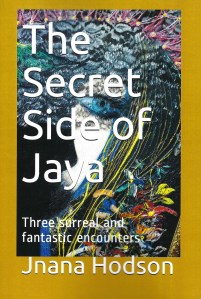
Together, the three form The Secret Side of Jaya, plus a little more.
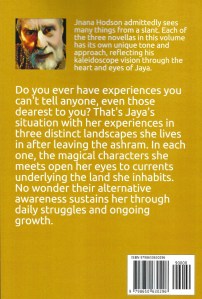
… and the back cover.
I must admit the collection is deeply personal for me and leave it at that. I offer it to you, all the same.
While we’re at it and geography’s on my mind, I should also confess that in “What’s Left” and Daffodil Uprising, when I recast the town of Daffodil by moving it to the Ohio River and throwing in a touch of Dubuque, Iowa, from the Upper Mississippi, I was acknowledging a sense that southern Indiana gravitates toward the big river along its southern border, even though no place along the waterway is only an hour from Indianapolis. Poetic license, then. The Hoosier state was settled largely from the south – in 1850, nearly half of the households had roots in North Carolina, where many Quakers had fled because of the slaveholding culture. And then recasting that Indiana into the Ozarks, I turned heavily toward the use of photos and related documents, somewhat the same way I did in another series about what you don’t know when I tackled my Mediterranean poems.
And I’m somehow surprised that Baltimore, as beloved as it was in my residence later, has never come up in my fiction. And it won’t. The personal drama was mostly banal or I just never got to know the place well enough to go more than skin-deep.
When I was employed full-time at the newspaper, I read interviews with successful authors who boasted they actively wrote two hours a day. Yes, boasted! As if two hours was such incredible labor! My reaction was, “What shirkers! What slackers!” And then, during my sabbatical, I typically spent eight to ten hours a day composing, though admittedly I did have a backlog of raw material to work down. And toward the end, I realized I was going at an unsustainable pace.
Besides, my two years on the road calling on newspaper editors for the media syndicate had convinced me that in a typical workday two hours of actually productive time was the optimum you could count on. In my case, it was the time spent in front of editors pitching our new goods and defending the ones they were already buying. The rest of my daily hours were preparation and cleaning up afterward and a host of other things I label as “infrastructure.”
You follow that? You still have to talk to the boss, do your research, keep in touch with colleagues, that sort of thing. And then there are doctor’s appointments and oil changes for the car. Welcome to the real world. It’s not an assembly line. Or maybe what lawyers would call billable time.
At the paper, I might now consider those two hours as actual keyboarding time. The rest would have included phone calls to interview subjects, plus background reading of the clips and even pondering what questions needed to be asked.
When I was employed, my literary world occurred in my off-the-clock hours. Much of it happened like graffiti, even notes jotted down while driving to the office or after. Flashes I might expand later in something that felt like jazz improv.
Two back-to-back Paris Review interviews in the late ’60s added perspective. The first was Jack Kerouac, with his two-week bursts of hammering away uncorrected on long rolls of teletype paper (like the ends I later used from the newsrooms where I worked – it’s the experience we now have on computers, where we don’t have to pause to insert a new sheet of paper page after page). Voila! He had a novel! Let the editors fix it, if they dare. The other was with Nabokov, the Russian émigré, who polished each sentence in English on a large index card his wife would later copy into a typescript.
I suspect no two writers work quite the same. Unlike one friend, who requires a new chair for each new work he tackles, I’ve been in the same one for 25 years or so now. I can’t imagine keyboarding in an aluminum fold-up lawn seat as he once did. Ahem.
Nor am I a Mozart, able to compose effortlessly on a stagecoach or in the middle of a loud party. I need my own Fortress of Solitude, currently in a corner of our attic though a treehouse might also be tempting.
When it comes to writing, my real work comes in the revisions, with all of the reflections and corrections and distillations and insertions. Initially, I found this oppressive. Something like our warmup exercises in choir, actually, though I really miss them when they don’t happen.
As a journalist, my dream was to have been like Hub Meeker at the Dayton Journal Herald with his State of the Arts column, though my own Corinthian Column at the Indiana Daily Student during my senior year of college at the height of the hippie upheaval did come close, only taking the larger counterculture as its vague subject. By the way, whatever happened to the Washington Post’s Nicolas von Hoffman, from that same frothy upheaval? A column, bang it out and you’re done. On to the next.
Poems and novels rarely happen like that. Still, they require daily “butt time,” in Bukowski’s term. That I finally understand and embrace.
As I’ve revised what I considered “experimental” novels, my emphasis has shifted from the events to the characters. Sometimes even the genders have shifted, adding new nuances. Yes, there are scenes that never happened to me personally, not that I would have resisted. They happened to somebody.
More recently, my now-wife has shown me instances in cooking where I bring in a big batch of something from the garden, say a basket of kale or tomatoes, and watch it cook down to almost nothing. A very, very tasty essence.
So you wonder about what writing’s like? Please pass me the pepper grinder, a lemon, and a stick of butter.
Funny, how that points me toward Cassia and her family in What’s Left.
As a slogan, “must-see TV” gave a network brilliant focus, from the planning of shows to their execution and viewing.
The goal wasn’t just to get ratings numbers for advertising sales but rather hook those active viewers who were passionate about the series and wouldn’t miss the next show for anything. And afterward, they just had to talk about it with somebody or everybody.
As an author, I can be envious. The fact is, we writers need something more than passive readers, not that we don’t value them, too. We want to connect with those hanging on every breath. Even just one. It really does come down to passion.


 Jnana's Red Barn