Acid test short-story master: Catherine J.S. Lee (1949- )

The newest addition to my list is someone I’ve come to know and admire since moving to Eastport.

Lee, a longtime high school teacher and valued community figure who has written short fiction for most of her life, finally released a collection of 12 stories in 2022, and it’s a treasure. Island Secrets is rife with every-day, blue-collar existence on a remote fishing island in Maine – veiled Eastport – but the secrets are those that lurk unspoken in the open. Consider the trials of harvesting scallops in the dead of winter, which runs through the final story. Few consumers have a clue to the dedicated labor involved in the occupation (I’m tempted to call it a profession, including the fact that it is highly licensed and regulated) or of the domestic tensions that accompany the precarious business.

She’s original, a consequence of digging intuitively into the world in front of her, with her prose infused with the precision of her succinct poems as well.

Love life ups and downs

I promised my first lover I’d never write about her, meaning in my books. And I promised another that no matter what, I’d always leave the door open.

So while neither of them is outwardly present, my novels originate in heartbreak. There, I’ve said it. And also in hope.

Yes, I promised her I would never write about her, even though I’m pretty sure she’s never read anything I’ve written in the past 54 years.

It’s not that she didn’t cast a shadow over the story, but rather that her spot on the stage is abstracted into a more universal figure, perhaps even an archetype. Details from later lovers have also been woven in to the point a composite female emerges.

How could I deny the passionate devotion or yearning? Like so much else of the hippie outbreak, it could be embarrassing today.

I did ceremonially burn the letters I had kept until moving to Dover. It was a long fire.

~*~

It’s unlikely that my life would have gone in the direction it did if she hadn’t appeared in my life.

The hippie side, definitely.

And my yoga, while she veered off with the Sufis.

I didn’t realize just how rich they were or how much of my ancestral farmland they were buying up. Her parents were still quite supportive of me, anyway.

I still needed someone to fill her place in my novel Daffodil Uprising.

~*~

Much of what followed turns up in Pit-a-Pat High Jinks, including my first Summer of Love.

I’m curious to hear their side of the story. Most likely, I was pretty pathetic. I certainly was naïve and not the most savvy romantic. Like what did I really have to offer anyone? In my revisions, I was able to include details from twenty-some years later, my second Summer of Love, but Peace and Love had more grittier aspects than the dippy love songs present. Let’s turn to the blues.

For me, at least, the experiences turned out to be very confusing.

At one stage in the later drafts, as I tried to come to grips with the conflicting accounts of one character’s past she had revealed to me (the real-life person, not the abstracted figure in the story), I actually broke down weeping as I sensed she had been a victim of sexual abuse from at least several directions. No wonder her accounts to me hadn’t added up.

We did reconnect online, but I didn’t dare broach the possibility. Was she even aware of them or was she still in denial. There was no way to ask, though. Besides, she barely recalled me, though she had been a big thing for me.

~*~

The love life definitely came into play with Nearly Canaan, though the abstraction underwent greater transposition. Ages and genders changed, for one thing. Tracking real life, the relationship turned into marriage now mirrored in the marriages around the central couple.

I was really dashed when one literary agent said she didn’t like the character based on my now ex-wife, someone I still saw on a pedestal. Back to the drawing board, along with some therapy sessions for a clearer understanding. My remarriage helped me recast much of this, too.

If only I could have kept this within the bounds of a Romance genre, I might have had a bestseller. Right?

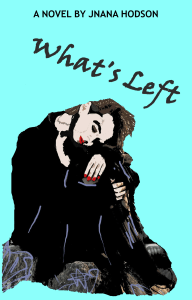
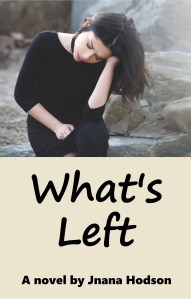
Cover update: Sometimes minor tweaks count

One of the delights of ebook publishing is the ease with which updates can be made. It’s not like having a warehouse of paper volumes to discard in the process.

Recently, while preparing a new book for release at Smashwords.com, I revisited my novel, Hometown News, and wondered if the cover might work more effectively than it did.

I liked the cleanness of the current design and the graphic impact of the elements but questioned whether it might convey a better sense of being about the news business itself. The typeface on the cover conveys the title but nothing else. The story does play out in a moderately-sized industrial city, which also needs to be hinted at in the design.

The photo delivers on the idea of hot news and impending disaster as well as a working-class, blue-collar neighborhood, but I was curious to see if it might have more punch if it reached both sides of the cover. Or “bled” off the page, as we’d say in the trade.

The previous version of the cover did just that, but cropping the photo to accommodate the title and author type was another matter. Remember, ebook covers are essentially thumbnails to be viewed on a cell phone, laptop, or tablet computer screen.

The photo here is cropped less tightly than on the later cover. Does including a portion of the porch roof below add to the message or does it lessen the immediacy? Does the placement of my name detract from that?

There are good reasons this one went back to the drawing board.

The first cover, below, played on the idea of bucolic small-town America and fit into the series of covers of my other novels, but as you can see, there’s no promise of the coming drama within the book itself. So much for brand identity.

While this one was produced by a professional designer at low cost, I must ask myself what an artist would do as an alternative to a photo as the key graphic element. Perhaps a roll of newspaper reaching out across a steel mill and downtown? Downplaying color might allow for the title and author’s name to float over the artwork and still be readable, something that simply wasn’t working with the house fire photo.

Few newspapers have managed with a feel-good approach to community, no matter what many critics would wish. Everybody hates a fire, right? With a morbid fascination?

Returning to the design challenge, here’s where the book stands now:

The key to the redesign was having the name in a single line, like a newspaper nameplate. Thus, a different serif typeface in the new cover. Admittedly, it is harder to read as a thumbnail, but I am going with the tradeoff. I’m venturing that it will reenforce the type on a Web site’s pitch rather than run alone.

The photo, once again, bleeds off the page, delivering maximum visual impact.

More and more, I’m looking at an ebook cover as a poster than as packaging for a commodity.

What do you look for in a book cover?

Just in time for the new political season

My series of polemic political poems – they’re not exactly protest songs, but I wouldn’t complain if they were – has moved from Thistle Finch editions to Smashwords.com, where they’re now available in a range of ebook formats, hopefully for a wider readership.

In the transition, the poems are now presented in a single volume rather than six shorter chapbooks.

These blasts of alarm and rage, 1976-2008, are an emotional mirror of events leading up to today, a not-so-distant past that’s been intensifying toward devastation. Let them stand as a call for personal honesty and engagement, too.

Take heed, if you will.

For me, this also presents the excitement of my first book release since September/October ’22, when Quaking Dover appeared. It comes with an admission that these poems are largely spontaneous, as in combustion, and sometimes sophomoric. I’ll ride with that, considering the fervor of adolescence, including ambitions.

While the poems are rooted in recent history and its headlines, they’re more pertinent than ever.

Having originally appeared as six short chapbooks, this collection is now available on your choice of ebook platforms at Smashwords.com and its affiliated digital retailers. Those outlets include the Apple Store, Barnes & Noble’s Nook, Scribd, and Sony’s Kobo. You may also request the ebook from your local public library.

Please take a look.

Some things ‘Quaking Dover’ has in common with my novels

Not that I really noticed the parallels until now.

  1. Counterculture is central, leading to an awareness of an underground community or at least kindred spirits.
  2. Both have meant learning to write differently than my neutral third-person journalism. Emotion, for instance, over fact, is the rule in the fiction. And the history opened a similar vein as creative nonfiction.
  3. The role of a narrator in both. In the history, that meant developing the gently laughing curmudgeon as he pored over historical data. In four of the hippie novels, it was the snarky daughter reviewing her late daddy’s hippie experiences.
  4. Both veins are self-published, falling under the shadow of being “not commercially viable” by publishing houses. That places an additional burden on the author.
  5. Marketing is a huge challenge. Apart from Subway Visions, none of my stories take place in a big city or address a big audience. How many hippie novels can you name, anyway. As for Quakers?
  6. Spirituality and religion run through all of them. In the novels, it’s often yoga, though Hometown News runs up against a puzzling array of churches. In Quaking Dover, though, it’s often the clash between the upstart Friends and what I first saw as rigid Puritans before both traditions begin to, uh, mellow.
  7. There’s a strong sense of place, even if these locations are far from the mass-media spotlight.
  8. I go for the big picture. I really would like to have a simple book – something, as Steven King advises, having only one big idea – but that’s not how my mind works.
  9. They’ve all undergone deep revision. Much of the fiction actually got new titles and new characters after their original publication.
  10. They were all labors of love.

Acid test nature writer: Barry Holstun Lopez (1945-2020)

My introduction was at a multidisciplinary conference at Fort Warden State Park in Port Townsend, Washington, in the late ‘70s. Lopez had just published his celebrated Of Wolves and Men, and this was a weeklong gathering of writers, naturalists, scientists, and a few others.

Three of his smaller, later books have especially held my attention: Desert Notes, Arctic Dreams, and Giving Birth to Thunder, Sleeping with His Daughter, presenting Native American mythology, especially the Trickster figure, Coyote. These volumes are sometimes classified as fiction, but they really straddle genres.

Maybe that’s why I return to Lopez more than to Rachel Carson or Annie Dillard or even Henry David Thoreau.

He did serve as an inspiration for two of the novellas that appear in my book, The Secret Side of Jaya. Well, maybe even the third one, too.

I had already drafted my longpoem, Recovering Olympus, as well as probing Native American lore since my years in the ashram, where Asian mythology also started infusing my awareness.

Lopez, though, had some serious fieldwork to support his visions.

Acid test poet: Aram Saroyan (1943- )

My first encounter with concrete and minimalist poetry came as an art exhibit in the late ‘60s. Maybe I already knew of otherwise traditional verse presented typographically to represent a visual image on a page – a vase or bird, perchance – but this time, the words themselves took on an independent visual wonder. Think of Robert Indiana’s famous LOVE as a cube of giant building blocks.

The writer I most appreciate in this field is Aram Saroyan, the son of a famed Depression-era novelist. Aram came to fame at age 20 with a one-word poem:

lighght

which became a source for right-wing scandal when it won a $750 award from the National Endowment of the Arts. As conservatives charged, it wasn’t spelled right and it wasn’t a real poem anyway. Things got ugly.

Others, me included, find it a vibrating both in the thought and the image. If that silent “gh” adds something to the sense of the word, either as illumination or as featherweight or even carefree, why shouldn’t two intensify the sensation?

It revives that wonder and puzzlement we’ve all felt, but many writers, I think, more keenly, when we first encounter many quirks of the English language but then later glaze past.

In this vein, Saroyan also has a playful

aaple

as another entry.

His small collection, Pages, has traveled from one side of the continent to another with me. A downside of these works is that they don’t work at an open mic or featured reading. They really do belong to the page.

For my own ventures along these lines, check out Sun Spots and Drumming at my Thistle Finch blog as well as the weekly Kinisi entries here at the Red Barn.

It’s been what you might call a zig-zag path

My professional life didn’t follow the conventional course, where the goal was to land on a major metropolitan daily. If not the New York Times, then the Washington Post, Chicago Tribune, Los Angeles Times, or the down the line from there. What were also called “destination” newspapers, with decent pay and more focused work in contrast to the sweatshops in smaller communities, or what are now called markets.

I had some near misses, but my route instead led me into places that remain largely unexplored, at least as far as literature or public awareness are concerned.

In my case?

  • Binghamton, New York, along the Susquehanna River and the Southern Tier of the Allegheny foothills. What I encountered there appears in Pit-a-Pat High Jinks and, with a heavy New York City connection, Subway Visions.
  • The Poconos of Pennsylvania, when I took off for a few years in a monastic setting based on yoga practice and back-to-the-earth community. This is the foundation of Yoga Bootcamp as well as portions of Subway Visions.
  • Fostoria, a railroad crossing in the flat but very fertile farmland of northwest Ohio. Gives rise to Prairie Depot in Nearly Canaan and to the opening novella in the Secret Side of Jaya. And, personally, the bride in my first marriage.
  • Back to Bloomington, this time not as a student but as a public policy research associate make that social sciences editor at Indiana University. My experiences as an undergraduate frame Daffodil  Uprising and What’s Left, while those as college staff feed into Nearly Canaan and the middle novella of the Secret Side of Jaya, both extrapolated to the Ozarks in Arkansas.
  • Yakima, Washington. It’s the Promised Land in Nearly Canaan and the final novella in the Secret Side of Jaya.
  • Dubuque, Iowa, along the Upper Mississippi. Adds some detail to Daffodil and What’s Left. Personally and professionally, it was a disaster.
  • Warren, Ohio, in the Rust Belt. Hometown News. And how!
  • Baltimore, Maryland, my base as a field representative for the Chicago Tribune’s media syndicate. More detail for Hometown News.
  • Manchester, New Hampshire, and later commuting from Dover an hour to the east. Revisions to the manuscripts and earlier versions.
  • And now, Eastport, Maine, in supposed retirement.

Curiously, my professional locations before Baltimore all infuse my fiction. Strangely, I’ve never written about Dayton, where I grew up, or the places later, at least as fiction. Poetry is another matter altogether.

Acid test poet: Anne Waldman (1945- )

Perhaps best known as a cofounder of the Poetry Project at St. Mark’s Church in Manhattan as well as the Jack Kerouac School of Disembodied Poetics each summer at the Tibetan Buddhist Naropa Institute in Boulder Colorado, Waldman has worked with many of the famed Beat poets a generation older in a life of experimental writing and social activism.

In preparing this post, I was surprised to find she’s only a few years old than me. She’s often seemed to be that much further ahead in the history of contemporary literature.

She first impressed me with a few poems in Disembodied Poetics, an annual review she co-edited. I liked the way the disparate elements danced, something in common with much of what I’ve written. Later, in her collected works, I was taken with the ways she employed repetition, something I had avoided as, well, redundant. My Preludes & Fugues, especially, are beholden to her on that front.

Can a location be a fictional character, too?

In my big writing projects, landscape and geography have formed a major thread.

It’s most prominent in the novel that became Nearly Canaan, which is outwardly more about tensions with an unstable spouse, the trials of career ambitions, and a sequence of three locales that culminate in volcanic explosion on all fronts. Perhaps raising a personified landscape to the fore would have been too melodramatic, but it was an option I’m now seeing I overlooked. You know, the fantasy genre.

Even so, places are a primary ingredient in my fiction and poems.

My four years in the desert of the Pacific Northwest were a revelation. I felt myself on the brink of everything I had hoped for. It seemed embodied in the landscape, including the ways the Indigenous presence resonated in the earth itself.

And then everything exploded and I was, essentially, exiled from Eden.

By the time I could hunker down to collect the debris, I was on the East Coast. I had also lost the extended elation of feeling that my big breakthrough as a poet was about to happen.

I’d say I’ve leaned toward celebrating the good and lovely sides of life – a hopeful optimist, though I loathe that term – but I finally recognized in later revisions the importance of acknowledging the ugly, too, and the overwhelming desecration that’s occurred across this land and the globe despite what I saw in the better sides of the hippie alternative.

~*~

I am a visual person and even considered a livelihood as a painter or graphic designer or architect back when I was in high school. Being named editor-in-chief of the Hilltopper ultimately changed all that. Well, much of my journalism career included selecting and cropping photos and designing newspaper pages. My visual art training wasn’t neglected altogether.

From early childhood on, I loved maps. Hiking and primitive camping in a rogue Boy Scout troop abetted that awareness. Growing up in flat Ohio, I imagined mountains. Even a bump on the horizon, say Mount Saint John in neighboring Greene County, seemed vast, at least on our bicycles. An ocean was inconceivable. The mountains I experienced were the Appalachians, especially a stretch of the Appalachian Trail we Scouts backpacked between my fifth- and sixth-grades. Those magnificent and dreamy heights didn’t have the craggy snowcaps that had captured my imagination, but they did introduce the sensation of being somewhere near heaven and looking down on the world, the way God would. (At least as I would have seen it then.)

Add to that history and historic places. Old log cabins and their unique smells are among the memories imprinted within me. I probably read the entire shelf of Landmark Books’ profiles of famous people in sixth grade, if not third.

In the middle of my sophomore year of college, I transferred from my hometown to the Bloomington campus of Indiana University, where I had hiked and camped in the surrounding hilly forests, but this was a more distinctive locale than I realized in my leap toward a degree.

I mention all this because I’m seeing how much a specific spot on the map has been an element of my poetry and fiction.

An important twist came when I was living in the yoga ashram in the Pocono mountains of Pennsylvania and our teacher, an American woman, returned from her first trip to India. She said the reason Hinduism has so many deities is that many of them reflect the unique vibrations – as she said, vibes – of the different locales.

Thus, it’s not just how a place looks but also how it feels with your eyes closed. Maybe even how it smells.

I hope I’ve conveyed that in my writing.

Subsequent relocations took me back to Ohio and Indiana, on to the mountains and interior desert of Washington state, and then, in exile as it felt at the time, eastward to Iowa, another corner of Ohio, and finally Baltimore and the year of intense keyboarding I’ll describe later. After that, I headed north to New Hampshire and now an island in Maine.

So here we are, wherever.