In your circles, who’s most passionate about the Old Ways?
Would you call them conservative?
You never know what we'll churn up in cleaning a stall
In your circles, who’s most passionate about the Old Ways?
Would you call them conservative?
Thinking of my own time living in the foothills of upstate New York as well as Kenzie’s situation in my novel Pit-a-Pat High Jinks, there’s a big question:
If we loved mountains so much, why didn’t we go climbing? The Adirondacks weren’t that far away, and the Catskills were closer.
For me, anyway, there were so many other fronts to explore, which I did, leading on to the ashram at the edge of forest in the Poconos.
No regrets, then. Besides, what emerged is a better story.
a once-removed cousin and new husband came for the 1812 Overture with puffs from cannons spotted before the booms a time delay with the musical score and then, the Esplanade Fourth fireworks about as close as you can get to the five barges, their computer- programmed pyrotechnics in the Charles just upstream, across from the Clam Shell with everyone listening to the live broadcast
Many days when I enter the Red Barn, I find myself amazed at the amount of work I’ve created. I can get dizzy just touching on the places I’ve lived and loved, or the friendships that have blessed me in those many moves. Or all of the painful losses as well.
Even though I was employed full-time in other pursuits, I set aside time for writing, revising, and submission to literary journals and publishers. These days I keep asking, How did I do it? Or more accurately, just what else did I fail to do?
Still, for perspective, a new poem a week for 50 years comes out to 2,500 pieces. And some poets consider themselves satisfied with a lifetime collection of 400 to 500 poems. Perhaps they’ve lived a more fruitful and balanced life than I have. You’d have to ask the people around them, though, for their perspective.
~*~
On a related note, I’m wondering if those who invaded my journals and expressed disappointment were expecting juicy gossip. In all of the upheaval and daily scheduling, I was usually pressed simply trying to record a trail of where I’d been and what had been happening. Without that, forget the emotions or gossip. Those just might fall into place later, perhaps prompted by the notation that the event had even happened.
My, it’s been a long trail!
~*~
So here we are. My novels are available at the Apple Store, Barnes & Noble’s Nook, Scribd, Smashwords, Sony’s Kobo, and other fine ebook distributors and at Amazon in both Kindle and paperback. Let me suggest starting with Cassia.

I got out before I was axed, but the next three interludes weren’t so fortunate. All ended with my head and heart served up to me on a plate, in terms of my career, yet somehow I always landed back on my feet.
The least time was when I allowed myself a self-imposed sabbatical in Baltimore in the mid ’80s, one of the smarter moves in my life. Putting those savings into a solid investment would have made much better sense than using them for a year of poverty existence writing, but I hoped if I could get published, my shift over to being an author full-time would be assured. I knew too many others who had put off their big dream till retirement but never been able to manifest it.
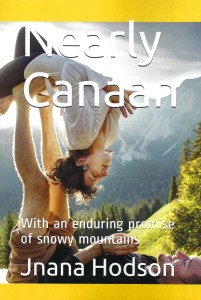
So I hunkered down over my keyboard, kept to a strict schedule, and amassed the bulk of two major fiction projects that now stand as Daffodil Uprising, Pit-a-Pat High Jinks, Yoga Bootcamp, Nearly Canaan and parts of The Secret Side of Jaya. There were also a few other blueprints that remain undeveloped. (As novels, the two boxes of manuscripts were truly too unwieldy, no matter how vibrant their contents.) “Subway Hitchhikers,” now embedded into Subway Visions, was already in place.
That year wasn’t all work, rest assured. I underwent some crucial personal growth and recovery. There were close friendships and time for reading. Mennonites and Brethren added to my Quaker practice. A writers’ group hosted upcoming Tom Clancy one evening, with his first book then being turned into a movie. I was learning to part-sing a cappella. We walked to Orioles games from one couple’s third-floor quarters.
Alas, my money started running out before I could land an agent or see a volume lined up for publication, and so it was time for me to move on. At least I had those precious drafts in hand – or more accurately, on computer diskettes. Even as raw material, they were full of details I’d never be able to recollect a decade or two later, much less in the distance of retirement. And with that, I was off for New Hampshire and a new life.
What became painfully clear was that newspapers weren’t the only part of the publishing world in serious trouble. So was the book trade. A few hot-shot agents replied that the book I’d pitched them deserved to be published but they couldn’t take on anything new, they were utterly baffled by what was happening as the number of houses handling fiction kept shrinking. Most agents didn’t even return the self-addressed stamped envelopes. (The jerks.) Even so, I kept revising, leading to the publication of “Subway Hitchhikers” as a trade paperback in 1990, followed by the hard reality of being “backlisted” and out-of-print when sales failed to materialize.

Still, I was hooked. All along, there was a flood of poetry that found its way into circulation and a few projects that seemed commercially viable, if only I could add the right co-author, one with creds. My years since Baltimore also included book-length new writing, mostly Quaker related, but again, print proved elusive – it is a small market, and the faith as a whole is filled with active writers.
So I was caught in a limbo until the emergence of ebooks, starting with my “Ashram” in 2006 as a PDF from pioneering PulpBits in Vermont and then my Smashwords entries beginning in 2013.
What I now realize how much free time and focus fiction demands. It is, as I’ve learned the hard way, so different from journalism, and not just in the ways I’d be confronting. When I was employed, I could deal with deep revisions of my Baltimore lode during my vacations and holidays, and do the routine polishing of its prose on my free days, but generating entirely new novels was out of the question until retirement, when I turned to creating “What’s Left.”
In short, most of the books of fiction now available under my name are the result of 35 years of labor, more or less. I’m glad I’ve lived long enough to push them on to completion.
You already know about the barn I’ve owned the past 20 years – the one that gives this blog its name. It’s modest, as barns go – more of a carriage house, common in an old New England city like ours, but “carriage house” sounds pretentious and ours isn’t. I usually call them “urban barns.”
I grew up in a Midwestern industrial city, and barns were usually something we passed out in the country. Even so, my novels Nearly Canaan, Yoga Bootcamp, and Pit-a-Pat High Jinks, each feature a barn.
Here are ten I especially remember.
~*~
~*~
A few others I should mention include the massive Shaker barn in Canterbury where I contradanced once, and another in Ohio I once toured. A similar one, but kept to a single story, was at a friend’s summer home in Sandwich in the White Mountains to our north. And then there was a decrepit one at my goddaughter’s family in Enfield, Maine, that was too far gone to repair.
~*~
What are your experiences with barns?
One challenge in a large multi-generational story like What’s Left comes in managing first names. Many families customarily name babies in honor of grandparents, aunts, uncles, cousins, even the parents, but even with nicknames, that’s bound to create additional confusion for readers.
I skirt the issue by introducing names independent of any mention of family connection, perhaps justified with the break from the old country at the outset of their arrival in America and perhaps as a reflection of adapting new customs as well.
Pressed on the point I might respond that Stavros’ three sisters, who remain unnamed in the text, repeated earlier names. And then I wondered about Nicky, a generation later.
Does your family have naming traditions? What’s the pattern? Which names are most popular?
Every year, it seems we have a different weed or two that really takes off in the gardens. Virginia creeper nearly took out some shrubs a few years ago, the same time Jerusalem artichoke went rogue and nearly demolished a rhubarb.
Last year, a newcomer seemed to be popping up everywhere, and we kept tossing it out to the lawn for me to mow or to the driveway. Then, one afternoon, I put some in front of the rabbits … and they loved it.
Then came our quandary. Was it safe for them to eat?
In trying to identify the plant, we came across Better Homes & Garden’s online “only guide to weeds you’ll ever need,” and after scrolling past a few dozen we know all too well, we came across our suspect – pigweed.
And yes, it’s edible, even by some humans.
No wonder the bunnies were, uh, pigging out.
And our weed suddenly became a welcome crop to harvest abundantly.
do you really like me? I mean, nothing beyond some fool’s hazardous perspective up and by god safe in season, I’m whatever happens lovelier than that canopy maybe fully open lifting into play, hopefully without nonsense spreading
When Jaya meets Joshua and his family in my novel Nearly Canaan, she’s introduced to their Pentecostal faith. It’s not like most Christianity.
Here are some points to consider.

