three sessions dancing in a mental field followed by crisis in prayer life and practice of the sexual nature, followed by money and possessions Must run . Will walk later . because I hadn’t thought they’d be so closely related will you scratch the cat for me . every grub feeds on stage fright . with all encouragement, Woodchuck . birds are singing and carpenter ants invade the bathroom my brain goes ever into these leaps, as long as we’re at it at, beginning of the year we received a pay raise under the new contract, finally
In my novel What’s Left, there are hints that Cassia’s father was becoming interested in similarities between his line of Buddhism and the Greek traditions of his wife’s religious roots.
Here are ten things he might have observed.
Both have a funny alphabet.
Both are quite elaborate and ornate compared to other traditions.
Esoteric teachings often based on teacher-student transmission and interpretation.
They’re both viscerally rich. Heavy incense, for starters, and candles, with their wax dripping on fingers, for the Orthodox, while the Tibetans touch prayer wheels or mala beads.
External visualization. Icons, for the Orthodox. Tankas, for Tibetans. Plus robes and processions and gold and deep red color everywhere.
Death obsession.
Chanting and ritual, including the liturgy for the Orthodox and mantra for the Tibetans.
Monastic backbone. It’s a lifetime commitment.
Both are rich in cultural context. Greeks are Greek and Tibetans live at the top of the world.
Family-run businesses present their own unique operating models.
Under the ideal version, the members have an understanding of each other and their mission along with a loyalty that’s unrivaled. The business is part of their identity. Each member of the family understands his or her abilities and place in the enterprise. Often, they learned the operation from childhood on, starting at entry level. For their employees, however, that can come at the price of exclusion and upward mobility.
Sometimes the organization is headed by a patriarch or matriarch with the authority to make and enforce difficult decisions. In this model resentments and perceived sleights can mount over the years before erupting. Or the family head may no longer fit the kind of executive the company needs at a particular stage of its growth; a founder, for instance, may have technical expertise but not the people skills for marketing or adapting to a changing market.
as for the cure to feeling oh so blue center (as in meditation or prayer) untangle knots or go out weeding by the kitchen (see the worshiping community as a kitchen, too) go off to any place where there’s nurture and a certain kind of warmth then prepare a decent meal, slowly concentrate on digging out, one emotion at a time, not just feelings or thoughts on the run before my flight from the opera
Quakers (aka the Religious Society of Friends) stand at one end of the Christian spectrum, while Zen Buddhists also stand at one end of the Buddhist spectrum.
As I’ve been discovering, Greek Orthodox (and the other Eastern Orthodox churches) stand at the other end of the Christian spectrum, much as Tibetans do in the Buddhist world.
Has me recalling a comment by Gary Snyder when he noted, arms outstretched, how one branch starts at one end and, as a practitioner advances – raising his arms in an arch overhead – they eventually pass each other to end up at the opposite end.
That said, let’s look at the Quaker/Zen starting point and what they have in common.
An ethereal ascetic. Strip away distractions, down to a stark black-white dichotomy. Maybe with distinctive Quaker dove gray.
They’re both minimalist.
Use of questions to guide aspirants. Queries, for Friends. Koans, in one branch of Zen. No easy answers, in either.
Worship as “just sitting.” OK, few Quakers focus on their breathing and most are sloppier in the posture. Even so …
Emphasis on the here-and-now, rather than the afterlife.
Concentration on daily practice and awareness.
A practical outlook. As they teach in Zen, “Before enlightenment, chop firewood, carry water. After enlightenment, chop firewood, carry water.”
Direct personal experience focusing on the inner self. As in experimental, by trial and error.
Sin is not discussed. Well, among Quakers, rarely, as in “missing the mark” rather than a human defect.
Both originated as reform movements and are open-ended.
In my novel What’s Left, her generation of the family will face some crucial decisions that resemble those their parents were charting when her father-to-be showed up in the household.
In a passage I cut from an earlier draft, she wonders:
What would you do?
While Dimitri and Barney have niches in the business, Nita has her chosen career. Tito, meanwhile, will likely have his hands in both the Zap enterprises and an independent law firm.
That leaves Manoula, who hopes to head off in a literary direction, not necessarily as a writer.
~*~
As I’m revisiting this, I’m getting a bit steamed. I realize how little guidance I had regarding my future. We didn’t talk much about it at home, and even college was somehow mostly off the table. The so-called guidance counselor at my large high school was mostly a disciplinary officer and military-draft registrar. College? No help from him!
I got more from the editor of the first newspaper that hired me as an intern. He had a knack for nurturing talent. I just wish he hadn’t retired when he did.
Dimitri seems to possess much of that skill, perhaps even more than Nita. They’d likely ask:
What would you really like to be doing with your life? What do you need from us to help? So what do you really want to do with your life? And what do you need to get there?
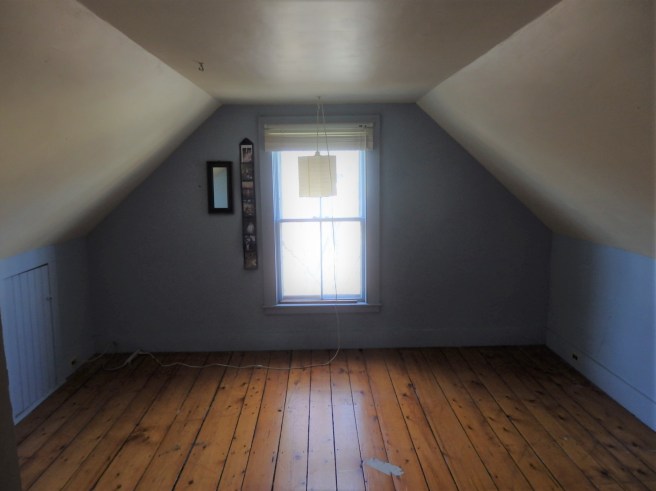
It’s hard to believe how much I had shoehorned into my attic studio. It’s the space where I’d spent so much personal time writing and revising over the past 21 years, but looking at it when it’s stripped down to this is really difficult.Ditto when I think how much we had in the other half of the attic, a combination of guest room and crafts-projects storage once it stopped being a bedroom for one or the other of our daughters.



 Jnana's Red Barn