And you wonder how I work?

When I was employed full-time at the newspaper, I read interviews with successful authors who boasted they actively wrote two hours a day. Yes, boasted! As if two hours was such incredible labor! My reaction was, “What shirkers! What slackers!” And then, during my sabbatical, I typically spent eight to ten hours a day composing, though admittedly I did have a backlog of raw material to work down. And toward the end, I realized I was going at an unsustainable pace.

Besides, my two years on the road calling on newspaper editors for the media syndicate had convinced me that in a typical workday two hours of actually productive time was the optimum you could count on. In my case, it was the time spent in front of editors pitching our new goods and defending the ones they were already buying. The rest of my daily hours were preparation and cleaning up afterward and a host of other things I label as “infrastructure.”

You follow that? You still have to talk to the boss, do your research, keep in touch with colleagues, that sort of thing. And then there are doctor’s appointments and oil changes for the car. Welcome to the real world. It’s not an assembly line. Or maybe what lawyers would call billable time.

At the paper, I might now consider those two hours as actual keyboarding time. The rest would have included phone calls to interview subjects, plus background reading of the clips and even pondering what questions needed to be asked.

When I was employed, my literary world occurred in my off-the-clock hours. Much of it happened like graffiti, even notes jotted down while driving to the office or after. Flashes I might expand later in something that felt like jazz improv.

Two back-to-back Paris Review interviews in the late ’60s added perspective. The first was Jack Kerouac, with his two-week bursts of hammering away uncorrected on long rolls of teletype paper (like the ends I later used from the newsrooms where I worked – it’s the experience we now have on computers, where we don’t have to pause to insert a new sheet of paper page after page). Voila! He had a novel! Let the editors fix it, if they dare. The other was with Nabokov, the Russian émigré, who polished each sentence in English on a large index card his wife would later copy into a typescript.

I suspect no two writers work quite the same. Unlike one friend, who requires a new chair for each new work he tackles, I’ve been in the same one for 25 years or so now. I can’t imagine keyboarding in an aluminum fold-up lawn seat as he once did. Ahem.

Nor am I a Mozart, able to compose effortlessly on a stagecoach or in the middle of a loud party. I need my own Fortress of Solitude, currently in a corner of our attic though a treehouse might also be tempting.

When it comes to writing, my real work comes in the revisions, with all of the reflections and corrections and distillations and insertions. Initially, I found this oppressive. Something like our warmup exercises in choir, actually, though I really miss them when they don’t happen.

As a journalist, my dream was to have been like Hub Meeker at the Dayton Journal Herald with his State of the Arts column, though my own Corinthian Column at the Indiana Daily Student during my senior year of college at the height of the hippie upheaval did come close, only taking the larger counterculture as its vague subject. By the way, whatever happened to the Washington Post’s Nicolas von Hoffman, from that same frothy upheaval? A column, bang it out and you’re done. On to the next.

Poems and novels rarely happen like that. Still, they require daily “butt time,” in Bukowski’s term. That I finally understand and embrace.

As I’ve revised what I considered “experimental” novels, my emphasis has shifted from the events to the characters. Sometimes even the genders have shifted, adding new nuances. Yes, there are scenes that never happened to me personally, not that I would have resisted. They happened to somebody.

More recently, my now-wife has shown me instances in cooking where I bring in a big batch of something from the garden, say a basket of kale or tomatoes, and watch it cook down to almost nothing. A very, very tasty essence.

So you wonder about what writing’s like? Please pass me the pepper grinder, a lemon, and a stick of butter.

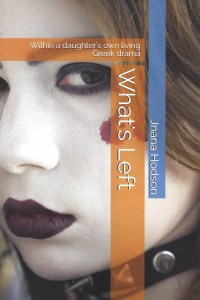
Funny, how that points me toward Cassia and her family in What’s Left.

Ways to define a family

It’s a major theme in my novel What’s Left, not that these are the answers there.

  1. Husband, wife, and kids under one roof. Often traditionally recast as a breadwinner and dependents.
  2. A mother and all who turn to her.
  3. Two romantic partners in their own place, with or without other relations nearby.
  4. Those connected by genetics and blood line. Say siblings or cousins.
  5. A shared last name. Or address.
  6. Those who join together as in-laws through brothers and sisters and so on.
  7. Grandparents and grandchildren.
  8. Inheritance.
  9. Memories, good or bad.
  10. Home of last resort.

~*~

In the novel, there’s also a shared business and an ethnic identity.

How else do you see a family in real practice? Or even as an ideal?

Thinking about superfans

As a slogan, “must-see TV” gave a network brilliant focus, from the planning of shows to their execution and viewing.

The goal wasn’t just to get ratings numbers for advertising sales but rather hook those active viewers who were passionate about the series and wouldn’t miss the next show for anything. And afterward, they just had to talk about it with somebody or everybody.

As an author, I can be envious. The fact is, we writers need something more than passive readers, not that we don’t value them, too. We want to connect with those hanging on every breath. Even just one. It really does come down to passion.

What really excites you these days? 

Like brother monks on the road to nirvana

Cassia’s conversations with Rinpoche lead her to crucial new understandings of her father.

In earlier drafts of my novel What’s Left, I considered these possibilities, but rejected them as, well, too wordy, esoteric, or preachy:

Your Baba was on the cusp of some original thinking about Christ as Light, Rinpoche tells me. He was connecting that with an ancient line of Greek philosophy about a term known as Logos. It was all very, very exciting. He was seeing Christ as much more than the historic person of Jesus, much as we see Buddha as something much more than a historic person — you know, Gautama — too.

Well, that happens to be a hobbyhorse I ride. Let’s give her father a break!

Rimpoche continues. Your Baba had scorn for those who claim a personal spirituality without any disciplined tradition. He wanted to encourage people to delve into a practice — not that they’re all equal, but they have their own unique wisdom to impart — and that led to his organizing some fascinating ecumenical dialogues, ones that included your Orthodox priest, plus a rabbi, a Sufi or yogi, an evangelical, and so on.

Maybe we’d better leave all that for a later discussion? Cassia has more pressing questions, many of them regarding his photographs and family.

Throughout his monastic studies and labors, he’s pressed to concentrate totally on what’s happening in the moment. Even while sleeping. Looking through a lens would, according to Manoula, place a filter between full experience of that timeless breath and himself. It would place a mask across his face when he most needs to be fully naked, as it were. Who knows what he wears in the monastery, for that matter. We can guess from the photos he took later, on his return visits — and his portraits of his teacher and fellow practitioners. For now, he needs to see not just with his eyes — and his Third Eye — but also with his nose, tongue, lips, ears, and especially his fingers and extended skin. And from there, to embrace the eternal realities rather than the ephemeral illusions flickering and dashing around him. Through this stretch, he heeds fellow monks who create beautiful colored-sand mandalas and then scatter them to the wind rather than preserve their work. This emphasis on the present while pursuing eternal truth may seem to be a paradox, but he submits to the instruction and its flowing current.

So that, too, was filtered out of the final revisions. As was this:

Baba and Rinpoche had grown close when they were both residents in the monastery. Rinpoche was then just another of the aspirants, albeit a Tibetan refuge with a lineage. Their teacher blessed their venturing into the Heartland to establish the institute here, and Rinpoche, with his mastery of Himalayan languages, took up an offer to teach academic courses at the university while leading a spiritual community from the house.

~*~

Like Rinpoche, Cassia’s father was in many ways a teacher. In their case, they were dealing with ancient Buddhist lore. Good teachers, as you know, are rare.

Tell us about your favorite teacher.

~*~

Orthodox Christian iconography can be out of this world. Just look at this church ceiling!

Talents I would love to have

  1. Empathy.
  2. Name-face recall. You know, an instant recall of names and faces and tidbits about the person.
  3. Better recollection of conversations. Who said what, when, and how, rather than the stew I usually retain.
  4. Small-talk charm.
  5. Woodworking and carpentry.
  6. Plumbing and electrical.
  7. Recall of herbs and spices.
  8. Auto mechanics.
  9. Baseball coordination and strength.
  10. An ability to recall a joke and tell it well.

~*~

Gee, I didn’t even mention making real money!

So what would you admit to?


Other panoramas opened

Thinking of my own time living in the foothills of upstate New York as well as Kenzie’s situation in my novel Pit-a-Pat High Jinks, there’s a big question:

If we loved mountains so much, why didn’t we go climbing? The Adirondacks weren’t that far away, and the Catskills were closer.

For me, anyway, there were so many other fronts to explore, which I did, leading on to the ashram at the edge of forest in the Poconos.

No regrets, then. Besides, what emerged is a better story.


How radiant the blood

a once-removed cousin and new husband came for the 1812 Overture with puffs from cannons spotted before the booms a time delay with the musical score and then, the Esplanade Fourth fireworks about as close as you can get to the five barges, their computer- programmed pyrotechnics in the Charles just upstream, across from the Clam Shell with everyone listening to the live broadcast