A revival of Indigenous languages, which were long suppressed by federal policy, is gaining momentum where I live in Way Downeast Maine.
For one thing, the Passamaquoddy are now teaching it in their schools.
For another, their words are pronounced in ways that transcriptions into Latin-based letters don’t quite capture. There are simply sounds that my ears miss entirely and my tongue and lips will never manage to enunciate properly. How humbling!
“Passamaquoddy,” for instance, is pronounced more like “peskotomuhkati,” meaning “people who spear pollock,” reflecting their ocean hunting skills.
Linguistically, the Passamaquoddy language works differently than do European languages with their subject-verb-object constructions, and reflects an alternative way of comprehending the land, waters, and skies where we dwell.
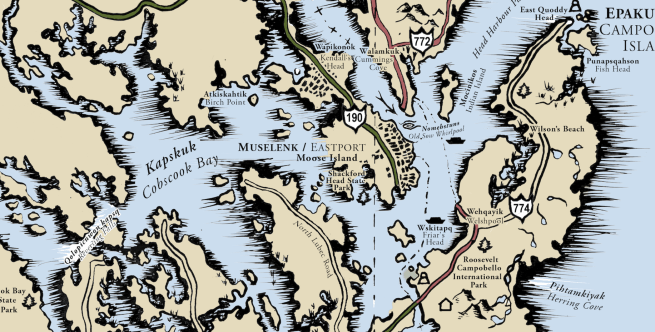
Detail of the new map, with some places denoted by dual names.
The latest edition of the Tides Institute’s Artsipelago map of communities and sites around the tidal waters of our corner of Maine and neighboring New Brunswick, Canada, now includes Passamaquoddy names in addition to the more familiar English, Anglicized, and French ones.
To my eyes, this adds another dimension to our awareness of the landscape and its legacy.
When last summer ended, I proclaimed it my best one ever – in part because there were no complications from an employer or romantic upheavals. Instead, it was filled with new adventures, explorations along the Bold Coast and out on the waters, introductions to fascinating characters and geezers (both positive terms, in my estimation) who live here at least a goodly part of the year, plus a sequence of fascinating artists in residence combined with local painters and photographers and their galleries as well as a world-class chamber music series by mostly resident performers. Whew! And, oh yes, I had plenty of time to devote to a new book and setting up posts for this blog. I even got a new laptop, which meant importing and tweaking everything.
This time around has simply amplified everything.
The temperatures are generally cool on the island – often ten degrees less than what’s happening on the mainland even just seven miles to the west – so I rarely suffered from sweltering. On the downside, heritage tomatoes are rarely found here. Remember, in Dover I lived on tomato-and-mayo sandwiches from the beginning of August into October, some years, though in no small part due to global warming. Even so, the ocean temps here are too cold and the currents too treacherous, for any swimming, though inland lakes and streams provide a welcome alternative.
Well, that’s only half of it. Summer is when Eastport comes into its full glory. The streets are swarming, like a big party. To think, I’m experiencing the ideal of summering on a Maine island, combined with a lively artistic dimension! Never, in my wildest dreams, would I have expected that.
But all good things must come to an end.
Three-quarters of the Eastport’s population is what Mainers call Summer People. Now they’re mostly going-going-gone and we’re on the verge of getting back to our more essential state, something akin to a ghost town.
Not that we go down that easily.
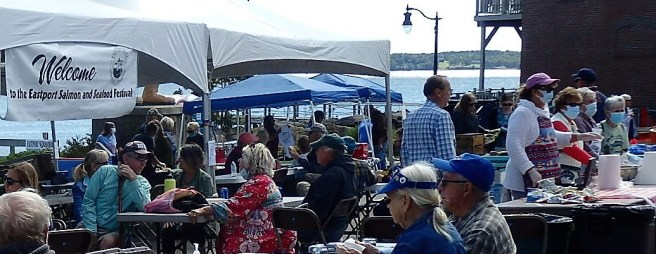
This weekend featured the annual Salmon Festival, a delightfully low-key event highlighting local musicians, galleries, and crab rolls served by the senior center and Episcopal Church on Saturday and salmon dinners on Sunday, as well as tours of the salmon farms at Broad Cove.
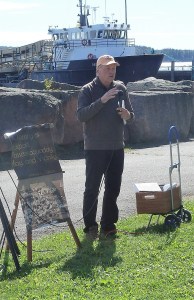
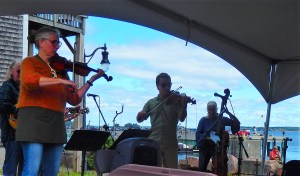
The Salmon Festival is a low-key event, centered on the waterfront..Historian Joe Clabby tells a circle at the amphitheater about the region’s rich past. One local wag calls this our “NPR festival,” in contrast to what’s coming next weekend.Celebrating local seafood, there are crab rolls on Saturday and a big salmon dinner on Sunday.And, of course, live music.
The event honors what was once the Sardine Capital of the World in its current incarnation as a center of aquaculture in the form of salmon.
But it’s also a prelude to next weekend’s blowout, the Pirate Festival.
On Saturday, a mini-flotilla, armed with water balloons and squirt guns, sailed down to invade neighboring Lubec. Next week, they’re expected to return the favor, all in good spirits.
with neglected stretches afoot this past so jammed with rocks juts up between ferns and trees tensing into some ongoing anxiety of unseen opportunities in the day and a traipse around the Quaker burial ground in Ellicott City perceives the stone meetinghouse now a private residence : suspect it was called Elk Ridge Meeting but no proof yet : even boulders where elk roamed or buffalo now a stone enclosure under fieldstone forest before a floating worship the midweek turn here tomorrow night’s a blessing while my suburban exile draws to some close : humbly all we still share
When I arrived in the Granite State 35 years ago, I expected to be spending a lot of my time in the mountains to the north, but that never really materialized. I’ll blame my quest for love, usually found down in Boston, in the opposite direction, back before I met the woman I adore.
Contradancing soon claimed a lot of my social attention, with regular events across the state, across the border in Maine, and especially in Concord and Cambridge, Massachusetts. Add to that all of my time hunkered down in my literary endeavors or Quaker activities, even before I started singing in an incredible choir weekly in Watertown, just outside Boston, or swimming laps daily once I’d retired from the newsroom.
Whatever the character ultimately is, I found sufficient nurture and inspiration to do some good work. Gee, that’s starting to sound like Garrison Keillor.
Each of the six states, by the way, has its own character despite the overall New England identity. In general, those New Englanders are friendlier than their reputation for aloofness contends. It’s just that they’re more reserved – respectful of your privacy – but open up with a sparkle, for the most part, given a hint.
So here’s what I learned while residing in Manchester and then Dover.
New Hampshire isn’t as archconservative as I had expected. Not that it doesn’t have a lot of blockheads, but the place was definitely shifting, especially along the border with Massachusetts.
A large portion of New Hampshire residents have roots in Quebec, and others in Ireland, providing a significant Roman Catholic presence. Both reflect the textile-mills workforce in the 1800s. But other ethnic minorities have thrived, too.
At heart, the population is largely blue-collar in outlook, generally practical, but these days, half of them come from other states, especially Massachusetts.
Some of us used to joke that the stereotypical New Hampshire male had a Harley and his wife or girlfriend had big hair. That wasn’t far off the mark. Add a snowmobile, more than downhill skis or hockey skates.
Agriculture isn’t a major economic factor. There aren’t many large commercial farms these days. And what farming exists is typically diversified.
There are relatively few large employers. The commute to Greater Boston and back each day is huge – that’s where the paying jobs are.
That also means few deep pockets for the arts and charitable action.
It’s the most perfect test market for presidential candidates we have. Forget trying to find the ideal demographics, this delivers.
Avid Red Sox and Patriots fans abound, with Celtics and Bruins supporters close behind. Keeping up with the teams’ developments is socially important. College sports, on the other hand, hardly matter.
It might not have a sales or income tax, but you still have to pay for public services somehow. And so your property tax or apartment rental rate will be a whopper.
Have to confess the Red Barn posts have been moving along on schedule, but just not as many or as varied as usual.
Seems I’m not alone that way, here on WordPress or other social media, for that matter.
On this end, I’m knee-deep in trying to get a big project in gear – the part that follows the publication of a new book, which is just around the corner. These next steps are time-consuming and emotionally a roller-coaster. I’m always feeling I’m way behind there, as well as uncertain of the way.
As a complication, about a month ago I suffered a physical fall in the middle of the night and was reminded once more how fragile the body gets in older folks, aka the elderly, and how risky that can be when living alone. I’m still feeling some of the aches after the bruises and what else and won’t be resuming the twice-a-week fitness classes till after Labor Day.
Quite simply, that’s slowed me way down.
And then there was my week at the annual sessions of New England Yearly Meeting of Friends (Quaker) off in Castleton, Vermont, now that we’re gathering face-to-face again. Getting across northern New England, however, is a remarkably drawn-out trip, no matter how stunning some of the scenery can be. I did see parts of Maine, New Hampshire, and Vermont for the first time.
Weighing on me especially has been the surreal political and social nightmare unfolding here in America. It’s not just Trump, either, but closer to home the threatened return of Paul LePage to the governorship of Maine. Trying to write about that has been paralyzing, and the news developments keep mounting at a dizzying pace.
So here we are and summer’s almost over. It hasn’t exactly felt lazy.
so where are the agents at the end of this uphill trial if you meet the test only to pack away crates of hallowed vials and jugs to haul northward for further aging the first time? that truly is such a big butt for such a tiny face
Maybe I just didn‘t notice, but I don’t recall noting so many quirky sides in the other places I’ve lived. Maybe they’ll pop out when I review my old journals.
Still, there are things in Eastport I hadn’t anticipated. For instance …
As far as birds go, it’s basically gulls and crows. Just listen. Even with bald eagles right overhead.
In summer, it’s ten degrees cooler than the mainland seven miles away. In fact, I wore my shorts only three times last year – and two of them were when I was running around inland. Well, as far as that goes, I should mention how much I now perceive the fact I’m living on an island.
Watching the fog roll in from the Bay of Fundy, either up from the channel by Lubec or down between Campobello and the islands just north of it. As well as watching spectacular sunsets from the other side of town, in contrast to the amazing dawns I face from my house.
No nightlife. Apart from events at the arts center, the place pretty much settles in after dusk. And then rises early.
No commercial net fishing. The haul is largely lobster, scallops, clams, and urchins – a delicacy in Japan. But we were also once the sardine capital of the world, which left a bigger impact than I ever imagined.
The importance of smuggling in the port’s past, as well as shipbuilding.
The impact of Dover on its early settlement. Many of the early settlers came from the Piscataqua watershed, and even those who claimed Portsmouth or Newburyport, Massachusetts, could trace their lines back to Dover.
Horn Run Brewing and Bocephus. Two new businesses, each one run by an enterprising and delightful couple.
Diver Ed. A long-time tourist attraction in Bar Harbor, with all of its Acadia National Park crowd, he pulled up anchor and brought his Starfish Enterprise to our Breakwater instead. As a natural ham, he knows how to entertain an audience, even otherwise reticent teens, while teaching them the wonders in our waters.
The number and variety of wild apples. That helps explain the appearance of so many deer on the island. I’d call them wild, but (another surprise) have seen neighbors feeding them by hand.
the home trip was shorter than any desire worth pursuit followed by a week strip-mined between Wheeling and Zanesville where the alphabet winds down and begins again in Ashland or Barnesville, maybe in another language still here I’m settling down as a monk in my scriptorium or as a bootlegger distilling silos of citations and trophies or as a bachelor milking his own antiquity to that point where you no longer know if you’re any good or not, you’re just pushing what you have to your best abilities . not everyone comes back