This is a clue to what really occupies my mind some days

Ten random notes in no particular order:

  1. I’m still learning to spell Katahdin.
  2. Was it a mama moose I hit that cold night on my commute back from the office, rather than a deer? Now that I’m getting to know deer, I think the collision involved something bigger.
  3. Red states? They’re where nobody really wants to live. Or at least the paying jobs.
  4. How dark the house is at night in an electrical power outage! There’s no ambient light from the street lamps or apparatus power-on buttons.
  5. Glyphs = little typographic devices.
  6. I dreamed I was playing violin again. In an orchestra, no less.
  7. How deeply backpacking as a youth shaped my values (forget efficient as a factor). It’s that travel light thing.
  8. After living in New Hampshire, I’m still not used to a sales tax.
  9. English country dance lyric, “If love were an ocean / and water was gin / I’d walk a long plank / and throw myself in.” It’s not from “Robin, Mad Robin,” is it?
  10. A voicemail message for today: “Let me a message or text me. I’ll get back.”
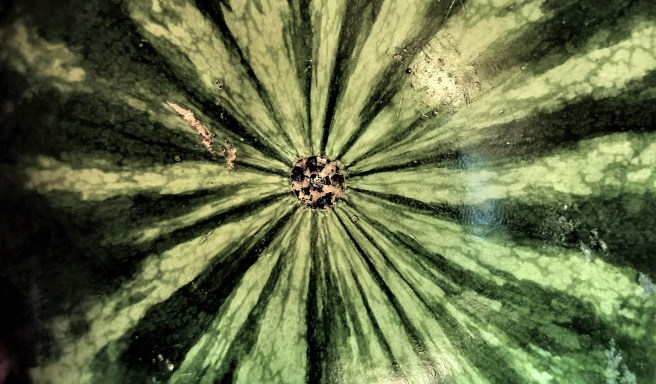
 

Does anything celebrate summer more than a watermelon?

And here I was about to investigate all kinds of melons, starting with cantaloupe.

That said, just consider:

  1. A watermelon is one of the few foods to be classified as both a fruit and a vegetable. Wish I could count it twice on my daily dietary requirements but guess that would be cheating.
  2. It’s a relative of both pumpkins and cucumbers.
  3. It’s far and away the most popular melon in America.
  4. There are more than 1,200 varieties, but the seedless hybrids are the only ones you’ll likely find nowadays at the market, at least in the USA.
  5. Those seedless versions aren’t genetically modified. Technically, they’re simply sterile with white seeds that are perfectly safe to eat.
  6. Watermelons originate in Africa and have been cultivated in Egypt for 5,000 years. That’s why they really do need a long stretch of summer.
  7. Based on weight, watermelon is the most consumed fruit in America.
  8. It’s 92 percent water yet rich in vitamins and contains only six percent sugar. By the way, there’s no bad fat or cholesterol.
  9. Its flesh isn’t always red – orange, green, yellow, or white are other options.
  10. In Japan they’re grown in glass boxes to maintain the unnatural cubed shape.


Where to from here, as a writer or a person?

Creatively, I’m feeling a lull or perhaps more accurately adrift.

After my Cape Cod presentation via Zoom earlier this month, I have no other Quaking Dover events on the horizon. Nor do I feel compelled to undertake another big writing venture.

Authors these days are often saddled with the promotional end of any publication, and I’m coming up on a year of launching the marketing push on my latest book. Admittedly, I am proud of my public appearances on its behalf – each one unique, reflecting what another writer declared a “rich feast of a book” – but it’s also exhausting, especially, as I hate to confess, at my age.

Do I cut the ties and say it’s time for the book to sink or swim on its own, or do I find new ways to try to generate a buzz? It is the one book that seems to speak to a wider audience, especially, say, than poetry or my hippie novels.

The blogging hits have slowed down, perhaps as many viewers have shifted to other platforms. Social media and mass media both appear to be hemorrhaging there, so I can’t say I’m alone.

I’m certainly out of touch with youth and often can’t understand their conversations. That really hurts. I believe there’s so much knowledge that needs to be handed down but don’t know where to begin. Besides, I’ve often found them a source of great energy in my own outlook.

In short, I don’t have a big project calling for my attention and devotion. That part feels really weird.

I do have a big backlog of periodicals and books to finally tackle as well as a shelf of personal journals that deserve visiting, so that points to an overdue reading orgy.

There’s plenty of outdoors around here to indulge in, too.

I may even have to look at my remaining possessions and reorganize and cull them.

As I’m saying, I’m feeling a bit strange.

I’m sold on Maine’s crab

Ours are smaller than the glorious Dungeness of the Pacific Northwest or Chesapeake Bay’s popular Blue delicacy, named for the color of their tips.

But that’s not to say Maine doesn’t have crabmeat that’s as sweet. Ours comes from two species.

Here’s some perspective.

  1. Jonah crabs are the slightly larger and more celebrated of the two. They’re reddish with large, black-tipped claws, and found primarily in deep waters offshore.
  2. The meat comes from the claws. When Jonahs show up in a lobster trap, a fisherman typically removes one claw and throws the rest of the crab back. The crab, we’re told, can survive on one claw while the other grows back.
  3. Jonahs are regulated by an interstate commission that places a 4.75-inch minimum size on keepers and prohibits the retention of egg-bearing females.
  4. Atlantic rock crab, or “peekytoes,” live in bays and tidal rivers closer to shore. These measure just five inches across and are the most commercially caught crab in the state.
  5. Peekytoes cannot be shipped live, presumably because they’re too delicate. Instead, they’re cooked and hand-picked before shipment.
  6. Both commercial and recreational crabbers require a license from the state and must observe strict limits on their take. At least, those specifically going after them. See the lobstermen, above, for a clue to exemptions.
  7. Locals in the know say that picking the meat from a crab is a nearly lost art. They admit they can’t avoid getting hard bits of shell in the tender flesh, no matter how carefully they try. Instead, as they advise, go to Betty’s in Pembroke or Earle’s down in Machias for your supply.
  8. Favorite dishes around here are crab rolls, crab salad, and crabcakes. Our house also celebrates a heavenly crab imperial. Others make them into a dip or spread. And, in some circles, Jonah crab claws make an appetizer served like a shrimp cocktail.
  9. They can be harvested year-‘round, though fall, when crabs are most packed with meat, is the peak season.
  10. Smaller, invasive, nasty green crabs have been proliferating as Maine waters warm, decimating other marine species and their breeding grounds. Some enterprising chefs, though, see tasty opportunity in some dishes to counter that.

Me? I haven’t yet had to complain of having too much. Now, please pass the Old Bay.

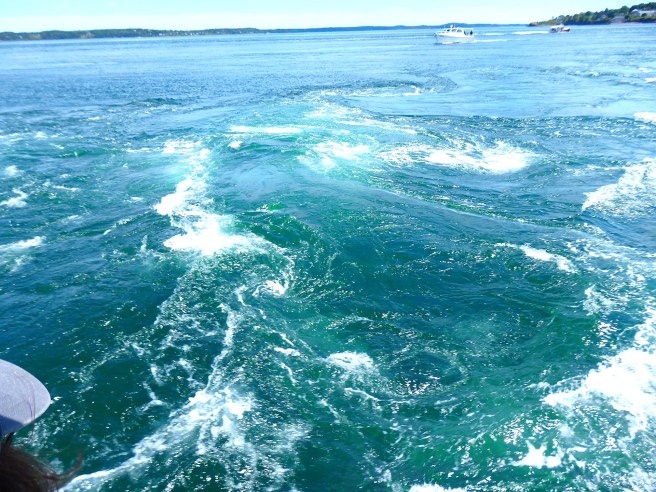
Now, for our big whirlpool

One of Eastport’s travel attractions is the “Old Sow,” the world’s second biggest whirlpool or the biggest one in the Western Hemisphere.

~*~

Before you make reservations to come see it, let me point out a few things.

  1. Its intensity varies greatly, depending on the gravitational tides cycle. It’s best about three hours before high tide, especially around the new and full moons when 40 billion cubic feet of water flood through the half-mile-wide passage to Passamaquoddy Bay.
  2. Its swirling diameter can reach 250 feet or drop 12 feet into its vortex, but it’s also likely to appear as a series of boiling countercurrent piglets and eddies.
  3. Most of the time, it’s not particularly visible from land. It is, however, a regular feature on Butch Harris’ whale watch runs. And even then, it will likely be a disappointment if you’re expecting to see a big hole in the water.
  4. It remains, nonetheless, a hazard to small boaters and has claimed lives, most notably in 1835 when a mother watched from shore as a two-masted schooner was sucked down with her two sons. The young men were never seen again.
  5. Another account, from the late 1800s, tells of two men with a barge loaded with logs, that went under and the bodies never found.
  6. It’s closer to Deer Island, New Brunswick, than Eastport, Maine, in part a consequence of public works construction of a causeway to the north during the Great Depression that pushed the current eastward.
  7. The name likely derives from the mispronunciation of “sough” as “sow” rather than “suff,” reflecting a “sucking noise” or “drain.” Or even “grunting.”
  8. The phenomenon arises from a unique funneling of powerful currents over a sharp trench on the seafloor, with water rising abruptly from 400 feet to 119 feet. It then intersects other trenches to thicken the action.
  9. The upswell brings nutrients and small sea creatures from the depths to the surface.
  10. The channel’s ferocious currents can run six to seven knots, a special hazard for divers as well as small boats.


This is the big day for pyrotechnic displays

Unabashedly, I am a snob when it comes to putting big fireworks together in an aesthetic whole, rather than something that resembles an action movie big car smashup.

A smart design team can use the entire sky as a canvas of evolving colors, combined with the timing of a sharp comedian.

That said, here’s some perspective.

  1. A show like Boston’s on the Charles River Esplanade fires off 5,000 pounds of explosives in its half-hour glory. That performance requires a computerized launch system for five barges floating on the water.
  2. Macy’s, the nation’s biggest, goes for an average 1,600 shells a minute – more than three times as many as a typical town display uses for the entire night. That show has more than 40,000 shells fired from six barges in the Hudson River.
  3. China produces 85 percent of the world’s fireworks.
  4. Many of the styles are named for flowers such as peony, chrysanthemum, or dahlia. Others, after trees, as in willow and palm tree.
  5. Prices vary wildly, especially when you’re looking for some serious color intensity and blending rather than honky-tonk garish.
  6. Shells are sold by tube diameter, commonly six-, eight-, and ten-inches, with each additional inch typically adding another 100 feet of elevation to the shot. Are some of those bursts really a thousand feet overhead?
  7. An aerial shell contains six parts. Or more, depending on what bells and whistles are added on.
  8. Larger shells cost average around $336 apiece and may require an 840-foot display radius.
  9. Even a small-town show will run between $7,500 to $15,000 to produce, just for the fireworks. Add to that set-up and clean-up labor, sanitation, musicians, and public safety expenses. The average municipal show costs $25,000. In contrast, a wedding show is tabbed for $1,500 to $3,000. But don’t hold me to those figures. Other estimates I’ve seen simply soar.
  10. Injuries send about 10,000 Americans to the emergency room every year, two-thirds of them males, and many of the injuries are to children. That’s in addition to 7.9 fatalities. As another safety consideration, more fires are reported on July 4 than any other day of the year – some 19,000.

I hate having to admit an unexpected ugly side of the hippie outbreak

The ’60s and early ’70s unleashed a revolution, one I tend to see from the progressive side of the experience.

But after writing about it in many of my novels, I’m having to acknowledge a dark underbelly.

There was a strand of ghouls who opposed any kind of common action, including politics. They were deeply angry but wanted to hide in a hole rather than celebrate oneness with each other and the greater universe and then work to advance that awareness.

That points, unfortunately, to the Trumpist ultra-right wing or Libertarians with no broader community sense other than what they can get out of it directly – or otherwise get out of supporting, period.

What I’m having to see as anarchy.

Yup, I’ve overlooked those who just wanted to escape any, well, Peace & Love revolution outside of their own turtle shell.

Maybe that’s the side the younger generations have perceived all too clearly in their negative view of hippie, despite the many other aspects they openly pursue.