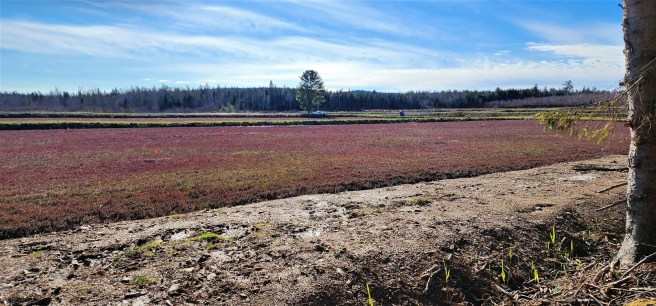
Cranberries!

Not everybody loves them, but they are a Thanksgiving tradition, jellied or stewed or otherwise.

Here’s some background.

  1. They’re one of the few fruits native to America.
  2. They don’t grow in water but the berries do float, which is how many of them are harvested, starting with a machine called an eggbeater.
  3. They also bounce.
  4. Only five percent are sold fresh. And eating one raw will be unpleasantly tart.
  5. Americans consume 400 million pounds of cranberries a year – roughly a pound and a half per person – a fifth of that during Thanksgiving week. How do you measure up?
  6. A gallon of juice requires 4,400 berries. Did we mention it’s a great antioxidant and high in Vitamin C?
  7. The “Sex in the City” TV series in the 1990s boosted the popularity of the Cosmopolitan cocktail, which features cranberry juice and vodka. Well, there’s a classic version with gin instead. Cosmos are typically served in martini glasses, after all.
  8. I’m quite fond of Craisins, the dried berry version that goes nicely in green salads and yoghurt, at the top of my list.
  9. Seven out of every ten cranberries sold in the world today come from Ocean Spray, a farmer-owned cooperative with more than 700 grower-families.
  10. Wisconsin is the leading producer in the U.S., followed by Massachusetts. A few are even grown here in Downeast Maine.


WWJD in practice?

Quakers advise living in simplicity, but it can be complicated.

For example, how do we feel about heated car seats?

Especially if the car already came equipped with them?

And, for extra points, was purchased used?

As another example, how about eating fresh scallops in season? Sure, they’re expensive but also so heavenly. Cooked at home, a dinner can be priced out around the cost of a meal at McDonald’s these days and will likely be healthier. The morsels are also so simple to cook, if you’re paying attention.

If you’ve worked through the Money Talks exercises on my Chicken Farmer blog, you know I’m a believer in simple luxuries, things my frugal wife labels as Quality of Life improvements. These can be as simple as a great cup of coffee savored in the morning, rather than a full pot gulped habitually. Or a fine sweater purchased at a yard sale that still gets compliments a dozen years later.

Looking closely also points to many conflicts we see as First World problems, things that upset spoiled Americans and Europeans and the rich in other realms but are utterly beyond the reach of most of the world’s people. You know, even having a car.

Those could prompt a Tendrils here at the Red Barn, but I’m passing for now. I mean, some folks are upset having to eat leftovers while the majority of the global populace is going hungry.

My most recent round with this arose over the funeral arrangements for someone who was not exactly in our family but still being handled by one of us rather than one of hers. As I was saying about complications?

Without getting into the details, I can say that hers, shaped by family and friends’ expectations, easily cost many times more than a Quaker burial would have – and the memorial service itself would have been free and far more personable.

When I go, I definitely want any earthly wealth to go to my family and worthy endeavors than being poured into the ground. OK?

Now, back to those car seats. How do we feel about air-conditioning in the car?

Heads up!

Oh, my, so much has happened since the Common Ground Fair at the autumn equinox.

The week that followed, when I was out in the schooner, introduced so much, and two days after I returned, the big renovation project on our house finally began.

Many of those developments will be presented in weekly posts after the New Year. I do need time to digest the implications. Remember, I spent too much of my professional life as a journalist in the immediacy of daily chaos. I do value a longer view.

For now, there are other bits to catch up on as well.

Life is feeling very rich, indeed, if I don’t let it become overwhelming.

Was getting a Covid booster and flu shot at the same time a good idea?

At least we did it on a Friday, allowing for our being laid low over a weekend. It did involve a trip up to the Walmart in Calais, which was running way behind once we got there, but at least it’s one more thing we’ve crossed off our to-do list. These things add up as some kind of forward progress.

As for the condition of pharmacies in the USA? One more item ripe for a rant, from what I’m seeing. Fire away in the comments if you’re ready. At least we have a fine family version here in Eastport, except for getting that Covid booster or my insurance dealing with the flu vax. I’m not complaining. But they do refill prescriptions days faster than the Walgreens or Rite Aid another family member deals with down at the other end of the state.

I did plan for a “sick day” or two, perhaps reading if I was up for it. Don’t rule out the importance of such rebound days.

As it turned out, I did feel a whammy and slept through much of the next two days. Oh, home sweet home, even with a very sore arm. It was ultimately mild.

The break in my usual routine also gave me time to finally examine two movie distributors’ offerings and reflect on how they might apply to our local film society in its revival after Covid, now that I’m on the committee. Am guessing I’ll share those thoughts here at the Barn, too, for any of you so inclined.

We do have a lot of arcane material here at the Barn and in our lives, too, don’t we?

Onward, then!

Doodling around with the origins of ‘Yankee’

The label does have a range of applications, from residents of the six-state New England region or Connecticut in particular to a Manhattan professional baseball team to anyone north of Dixie (often prefaced with “damn”) to anyone from the USA who lands in a foreign country.

Along with the shortened “Yank.” Or its many uses as an adjective.

The word’s origins, though, are contested.

  1. The earliest recorded use is credited to British General James Wolfe in 1758 when he complained about the Americans under his command. The British continued to use it in a derogatory fashion. The pompous fools.
  2. A largely dismissed theory had it arising in a French word for English-speaker that the Wyandot rendered into Y’an-gee.
  3. Another had it being adopted when New Englanders defeated a Native tribe who had identified themselves as Yankoos – meaning invincible. Problem there is the tribe must have been invisible all along.
  4. More likely is a derogatory Dutch-language origin in the early 1600s through New Amsterdam, beginning with the name Jan, for John, pronounced Yan. One theory has Jan being applied to any Dutch-speaking English colonist, a kind of winking acknowledgement that they could converse. How about having it originate among those Dutch-speaking Englishmen? I haven’t seen that suggestion before.
  5. Or it may have been imported from the Old World as Jan Kaas, “John Cheese,” a generic nickname the Flemish had for Dutch in the north.
  6. Or Jan might have been combined with another popular Dutch name, Kees, into Yankee, as English-speakers turned it against the New Netherlanders.
  7. And then those New Netherlanders soon slapped the word on English colonists in nearby Connecticut.
  8. By 1681 there may have even been a Dutch pirate, Captain Yanky or Yanke. The Dutch settlers, now subsumed into the English colony of New York, may have seen the Brits as pirates. Sounds awfully late in the timeline for me. I think it was definitely widespread slang before that.
  9. By the time of the Revolutionary War, the song “Yankee Doodle” was well established. Whatever its original intentions of mocking the Americans as simpletons, New Englanders took it as a badge of honor, macaroni and all.
  10. Somehow, after the Revolution, it became a synonym for Protestants descended from New England Puritans and their values. Take “Yankee ingenuity” as a prime example.

None of these quite convince me, but I feel Scottish, Swedish, and even Persian roots are even less likely.

Living on $10,000 a day. Or even an hour.

The thought crept upon me the other morning as I was pondering simplicity and frugality.

Yeah, look at the flip side.

I remembered reading a recent New York Times piece on a Long Island boutique that catered to billionaires and noted the owner’s insight that they spent differently. I shrugged it off then but come back to it now.

Suppose your after-tax income came to $3½ million a year? That would be nearly $10,000 a day. (I did miscalculate and put that at $100k a day, a more interesting figure. Still!)

For perspective, the median pay for S&P 500 chiefs was $14.5 million last year, in contrast to an average $56,000 earnings for American workers.

The No. 10 guy on the list, Tim Cook at Apple, came in at $99 million in salary, benefits, and bonuses. More than $240,000 a day. That is, $10,000 an hour.

Ahead of him were the CEOs of companies like Alphabet, Peloton, Live Nation, Sarepta Therapeutics, and CS Disco, plus four I recognized. Please, can somebody tell me what the head of Pinterest is doing to make him pocket $123 million for the year? A tad under $337,000 a day?

As one scion of affluence told me a half century ago, there isn’t much real difference between a $20,000 car (today’s prices) and a $200,000 vehicle, as far as everyday performance goes. Let me add, today’s median family car is far superior to the luxury vehicles back then. Air conditioning? Seat warmers? Cruise control?

As I played with the $100,000-a-day figure, nearly twice the yearly earnings of real workers, I realized how little of that was needed for everyday expenses, even at inflated expectations – how many houses does one need, anyway, or how many hotel suites while traveling? What came into focus was the vanity opportunities: collections of antique cars, paintings, sexual playthings, political hobnobbing. Just name it and claim it.

And that’s where it gets scary, even when you scale back to $10,000 a day.

Conservatives like to quote Lord Acton’s “Power tends to corrupt and absolute power corrupts absolutely,” while they pursue the maximization of their personal wealth, which intensifies their power and, thus, corruptedness. Per the logic.

Renting a luxury yacht – $100,000 a week plus expenses, last time I looked – is peanuts in comparison. As is a private jet. They might even be business expenses, paid by the company.

Well, F. Scott Fitzgerald did quip, “Let me tell you about the very rich. They are different from you and me.”

But I am wondering what he’d make of today’s mutations.

What would you do, given that much at hand?


Losing a reclusive neighbor we never really met

Moving to a new community three years ago meant meeting new neighbors, and Eastport, as we’ve found, can be a friendly place, even for us who are “from away.”

But one of our abutting neighbors was very-hard-of-hearing, as my wife discovered in attempting to talk to her, and ignored my attempts of waving in greeting. In many ways, she resembled my late asocial mother-in-law, not only physically but also in a heavy cigarette habit. Don’t know if she rolled her own, though. Still, she seemed to relish her independence and had a support system that included a few handymen I could approach with problems to address. Which they did.

We did worry about her occasional drives to the grocery or doctor or wherever. She could barely see over the steering wheel while puffing away, for one thing. And her backing out of the driveway did appear questionable. Still, she eventually returned home, apparently unscathed. I did see her one day in the IGA parking lot receiving a lot of help packing her trunk with her purchases.

I did wonder about her living in a big house all by herself, though that’s not uncommon in a town that’s largely elderly.

So flash forward to a day before what was left of Hurricane Lee was to hit town and I looked out the kitchen-sink window to see a police officer nosing about, checking her car, knocking on her door (and receiving no answer). No surprise there, her lawn-mowing and snow-removing crews got much the same.

Still, he was persistent, making repeated calls from his cruiser after trying all doors and walking around the house.

The next thing I knew, an hour or two later, was a white glove through her apple trees and the black SUV before the blanketed gurney came into focus.

Even before the obituary, an online search gleaned details that she had been born in Eastport to the manager of the local Newberry’s store and, when it closed, moved by stages to Upstate New York, and then, after college, to San Francisco before the Summer of Love and a career in banking.

And then, in retirement, she returned to her roots – from the City on the Bay, as we say, to the City in the Bay.

Her maternal side ran back to a family of Loyalists who fled to St. Andrews, a neighboring community in New Brunswick, before relocating to Eastport early on, while her paternal line was Pennsylvania Dutch by way of Virginia.

The family’s eventual obituary adds details.

~*~

In the aftermath, masked family and friends have been working steadily over two weeks to collect bags of trash and purge the house, including a colony or two of rats. (The rodents, it turns out, are well established in our end of town today – one more challenge to address.)

This also raises the question of just how much I leave to others after my own passing, and how much I need to clear out before then.

In the meantime, other questions loom, including the meaning of life for each of us.

We do wonder who will be living there next – hopefully not one more Airbnb but a real family with kids.

Onward! As I like to say.

Not that I wouldn’t love hearing the rest of her life story.

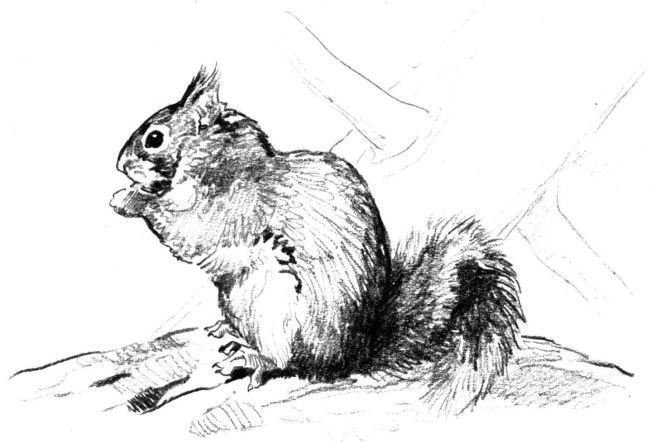
Sometimes I’m accused of acting squirrely

Back in New Hampshire, I was often engaged in a losing battle with squirrels. We had them for a while in the wall of the house and in the bay window, found they’d chewed into the attic through the flashing around the chimney, and were never able to eradicate them from the Red Barn, where they pretty much devoured a 20-foot strip of crown molding. They were always digging up bulbs or taking chunks out fruits and vegetables in our gardens.

At least we eventually got a birdfeeder that would send them falling off, an advance that left us endlessly amused, especially when we noticed the obsessed critter as a new kid on the block.

One good friend, an avid gardener, aptly dubbed them tree-climbing rats with big tails.

Here are a few related facts.

  1. They eat their own body weight every week, typically 1½ pounds.
  2. They can find food buried under a foot of snow or, for males, smell a female in heat a mile away.
  3. Their front teeth never stop growing, even when they eat right through wood.
  4. They can climb about anything. Yes, metal poles are no problem. Plus they can rotate their front feet 180 degrees.
  5. To elude predators, they run in sharp zigzags. They also have a way of moving to the side of a tree trunk opposite the side of a human, keeping themselves out of sight.
  6. They can leap ten times their body length. But not quite that much straight up, which I think is only five lengths.
  7. They can fall 30 meters without injury and run sprints at 20 miles an hour.
  8. They can travel as much as 100 miles in a day. So much for all those Havahart trap runs I took across the state line, just to add a river between us and the liberated rodent.
  9. By chewing electrical wiring in the walls and attic, they’re a major cause of house fires, perhaps 30,000 a year globally. They’re also responsible for an estimated 20 percent of electrical power outages, including knocking out entire transformers and leaving towns in the dark.
  10. Chipmunks are a kind of small squirrel with a prominent stripe rather than a big fluffy tail. They may be cute, but they may be the most destructive of all of their kin.

At least we don’t notice them around our current home on an island in Maine. Instead, we have deer.