The Appalachian Trail is the grandaddy of a hiking marathon

Other parts of the world have long had their pilgrimages, but in the United States, when it comes to doing that on foot rather than by car, I’d say the Appalachian Trail tops the list.

The public pathway was conceived in 1921, built by private citizens, and competed in 1937. It officially became the Appalachian National Scenic Trail in 1968.

Here are some other perspectives.

  1. Length: Almost 2,200 miles involving 14 states from Georgia to Maine. Parts of the path get rerouted over time, a consequence of urban development pressures, loss of access across private lands, or other factors. It’s touted as the longest hiker-only trail in the world. Pack animals and wheeled things are shunted to other options.
  2. Heavenly heights: The trail ascends many of the tallest peaks in the Appalachian Mountain system, including the Great Smokeys of North Carolina and Tennessee, the Green Mountains of Vermont, the Presidentials of New Hampshire, and Maine’s Longfellows, many of them rising above the tree line. Most of the trail is forests or other wildlands, although some sections, especially in the valleys, pass farmlands, follow roadways, cross bridges, or run into small towns.
  3. Backpackers: Sections traversing roadways often have trailheads that give day hikers or overnighters access for short treks, the AT is celebrated for its backpackers, carrying all of their food, clothing, and gear and camping each night somewhere in the wilds. Some, like my Boy Scout troop when I was 12, venture out for a week or two, but the truly serious folks are the ones who trek from one end to the other in a single season. They’re known as thru-hikers, and those who return to hike the AT from the other direction the next year are considered a “yo-yo.” An estimated 3,000 people set out each year to hike the entire length, with a fourth of them actually succeeding. In 2017, 715 northbound and 133 southbound thru-hikers were recorded.
  4. Weather factors: Winter weather in effect shuts down many sections of the AT, at least for thru-hikers. Since the weather warms earlier in Georgia than in Maine is the reason most of the thru-hikers start at the south end and head north, hoping the snow and ice have melted from northern New England sections by the time they arrive that far. Some veterans argue that the trail is easier in that direction, too.
  5. Self-discovery: As one gets a distance away from a road or peopled location, the terrain becomes more pristine. There’s less litter and debris and less noise, too. The hiker encounters not only nature, on gorgeous days and raw ones, but also personal challenges and inner resources.
  6. Dedicated organization: The AT is maintained by 31 trail clubs of volunteers and other partnerships and managed jointly by the National Park Service, U.S. Forest Service, and nonprofit Appalachian Trail Conservancy.
  7. Angels along the way: Thru-hikers tell of remarkable locals who routinely come to the aid of the travelers. Need a bath or shower? A lift into town for groceries? A phone call, back in the day before cell phones? (Maybe today that’s a recharge?) They’re there.
  8. Memories: Many of the experiences are unforgettable. The scenery, especially. But there can also be downsides: Rattlesnakes, copperheads, bears, as well as ticks, mosquitoes, and black flies. Or some brutal weather, even in the height of summer.
  9. Mostly protected now: Passage of the National Trails System Act of 1968 allowed the Park System to purchase most of the lands still in private hands, assuring the AT of a permanent route.
  10. It’s not necessarily free: Portions of the trail require payment for backcountry permits or park entry as well as for shelters and campsites. Otherwise, access it free. Your gear, foodstuffs, and getting there are, of course, expenses to consider.  

 The AT is no longer the only long trail system in America, but it’s still the oldest. To achieve its length combined with Continental Divide Trail (2,700 to 3,150 miles, depending) and Pacific Crest Trail (2,653 miles) is considered the Triple Crown of Hiking in the United States.

At this point, not quite as scheduled

When it comes to the past few months on the house renovation, there hasn’t been much to show.

Our contractor has been trying to align the removal of the front half of the upstairs to some favorable (meaning dry) weather, and that has been tricky. Plus, he has to line up a crew to participate in the most labor-intensive steps.

The electrical work has been continuing details, ultimately leading to rewiring about everything, including the discovery that the house was not grounded – period. Well, that’s been fixed, and a temporary strip for the main line coming into the house has been installed in preparation for the removal of the front roofline itself.

Then there was some work for other clients, including a new metal roof for the neighbor who recommended him to us. We can’t begrudge him that. A few other jobs were essentially trades in time with the carpenter who has been assisting him here in the bigger stuff. You know, I help you on your projects and then you help me on mine. That makes sense, too.

Oh, yes, and he really did get a well-earned week of family vacation in South Carolina.

Now the scaffolding is in place around the front of the house, gutters have been removed, and other obstacles are cleared away. But the demolition phase had to be delayed a couple of weeks when he discovered that all the dumpsters around here have been reserved nearly a year for the vendors and related events at Eastport’s big Fourth of July and homecoming week festival. We are expecting the dumpster on the fifth or sixth or even the following Monday.

Well, that hiccup did create an opening to remove the rickety ramp and accompanying deck at our back door and to start an enlarged new deck and stairs there. Again, not much to show at the moment unless you want the beginning of a step-by-step instruction manual.

The plumber, meanwhile, has been off in Indiana supervising the piping installation in a new lithium factory. He’s back in town and promises to be on our project next week, to our big relief.

Still, it’s hard to believe we’re 30 weeks into this venture.

Somehow that rainbow seen through the scaffolding at the front of the house feels appropriate.


The DLQ adds up

The Q in my DLQ acronym doesn’t stand for Quaker, though it’s not that far off, either. Instead, it’s from Dedicated Laborious Quest, a concept I constructed from Gary Snyder’s Real Work, or life mission. It usually differs from daily employment or a career. Maybe the middle term should have been “labor-intense” or “labor-filled,” we can discuss the subtleties later.

As poet Donald Hall pointed out in his memoir Life Work, our labor falls into three categories: jobs, which we do to earn money; chores, necessary tasks that pay nothing; and work, which can be energizing. In his own case, he realized that when your work coincides with a job, life’s good. For most of us, work is a money-losing activity. More of his thinking along those lines could be found in the Talking Money category at my Chicken Farmer I Still Love You blog.

In one draft of what would become my novel Nearly Canaan, DLQ was the core of Jaya or her earlier figure’s life, a blend of yoga spirituality (only at that point it was Sufi), an arts engagement, and the altruism of her career. It also came to reflect Kenzie’s journey in the hippie stories, though not so overtly.

It may even be an expression of an individual’s magnetic center in the esoteric philosophy of P.D. Ouspensky. If I interpret this correctly, you have to have something you do with a sustained passion, such as an art or a sport, something that requires daily practice and discipline. Without that foundation, you cannot advance spiritually. Checking up on that, I’m seeing a whole literature on magnetic center in mechanical physics, making me wonder if it’s applicable to Ouspensky’s metaphor, if at all.

This goal isn’t for everyone. As the Bhagavad Gita says, only one in a thousand – or maybe one in a million – pursues it, and out of that, only one in a thousand – or a million – arrives at the summit.

Whatever it is, the yogis at the ashram, Kenzie and his Buddhist buddies, and Jaya all craved it.

~*~

The practice of writing is a big part of my own DLQ, but for a long time I felt vaguely guilty about the amount of time I devoted to it, as if it was a selfish endeavor when I should have been doing something more productive or even more worthwhile. Only after the prayer workshop at New England Yearly Meeting of Friends that one summer, when I was told that writing was a spiritual gift I needed to nurture, did I feel the permission to type away as needed.

My job at the time had me on a four-day workweek, which gave me a three-day weekend after a double-shift on Saturday. Following a suggestion from the workshop, I dedicated one day a week, usually Tuesday, to my writing and revision efforts.

It didn’t seem like that much, frankly, but looking back, I now see that added up to ten weeks a year, plus another two or so of my vacations. For perspective, consider how many people manage to draft a full novel in the month of November as part of the NaNoWriMo challenge.

For me, that time was allocated among fiction, poetry, and nonfiction projects – one of them resulted what became the Talking Money series at the Chicken Farmer blog after a book publisher backed away when a potential coauthor with financial counseling creds failed to mesh into the proposal. Submissions and queries also occupied some of that time.

~*~

It was also time taken away from other parts of my life: from my spouse or significant other, family, travel, hiking or camping, physical exercise, service on city council or a school board, friendships. Even reading got slighted.

From another perspective, I could have devoted it to an overtime shift every week, at time-and-a-half pay, which would have more than covered the mortgage.

~*~

What becomes apparent to me in these reflections is that the DLQ was essential for my sanity. My moves across the country and, for a while, up the management ladder, kept uprooting me, leaving much uncompleted in each place or, at a gut level, undigested. Writing was not only a means of recording highlights and depths before I lost them but also of releasing and letting go of self-imposed obligations to my past, freeing me to more openly face the present.

Letters from a retired hippie

I’m sorry about what you’re inheriting. I’m sorry about the parts we’ve messed up.

It’s not all our fault. We were too trusting, for one thing. And so green, as in naive.

Looking around, we see too many old losers and the sense of hippie as essentially a girl thing.

A sense of betrayal, futility.

It was a youth movement. That’s what you need to know about it.

As for the other options?

What makes someone a ‘character’?

Often, it’s a flip comment and everybody nods as if knowing exactly what’s meant. Except, if you look closer, the actual definition gets fuzzy.

Calling someone a “character” falls in that vein.

The term itself reminds me of an older Quaker I knew. At the time, her mobility had been confined to a wheelchair for a decade or more. Members of the Quaker Meeting out in Ohio, where we both maintained our affiliation, always said, “Oh, that Anna! She’s a character!” But they would never tell me why.

Finally, when I had charge of her memorial service in New Jersey, I popped the question. And it was a rich experience.

Among the examples was from the days when she was still driving but relying on that wheelchair. She rolled up beside the passenger door, crawled into the seat, folded up the wheelchair and tossed it into the back, and then somersaulted into the driver’s seat. I can’t imagine, much less what was involved when she arrived.

What I did realize, on my drive back to New Hampshire, is that each of us has our first 40 years to get our act together and the next 40 to be a character.

So, back to matter at hand – sharpening our definition of a character.

Aided by responses from another circle of friends, here are ten things to consider.

A “character” is in at least several of these:

  1. True to self: Authentically themselves regardless of the opinions of others; comfortable in their own skin; possessing strong backbone.
  2. One of a kind: Standing a step apart from social norms; a nonconformist, unconventional. By definition, exceptional or original.
  3. Attuned to a lofty goal: Religion, art, social action, or so on.
  4. Faithful to moral values: It’s more than having character – integrity, honesty, loyalty, compassion, for instance – but of actually embodying them. This can manifest as courage, perseverance, and confidence to move through difficult situations.
  5. Eccentric: I’m guessing this goes beyond everyday preferences and habits of a mundane nature, like how we have tea or coffee. But it can mean something more than just one-of-a-kind. Maybe colorful? Quirky? A streak of ornery, in many cases, but not too much – like fresh ground pepper on a meal. Or even stubbornness.
  6. Seen in a positive light: Likeable, funny, interesting, amusing, a bit of a charmer, willing to do or say what we shy away from but would secretly consider. “I see it as a good thing … a positive thing.”
  7. Or in a negative sense: Nuts, weirdo, strange; annoying; rubs people the wrong way. “I hear it as snide, not meant to be flattering.” A slang thesaurus comes up with Soup Nazi and Ron Paul as synonyms. The matter of intonation does not show up in the definitions, but hearing a voice would certainly thicken the plot. (Did I put those two synonyms in the wrong spot? Some folks might see those individuals in a positive light.)
  8. Open to praise or ridicule: “They often have no idea they’re not conforming.”
  9. Willing to make self-sacrifices: Back to that lofty goal. Or at least not squander time and money on less worthy items.
  10. Sometimes even a big personality: In this case, being the center of attention, almost like they’re always performing. Well, an actor does play a character, but that’s just make-believe. This goes beyond that.

How ‘Pit-a-Pat High Jinks’ came into play

Indiana wasn’t the only thing bogging down my original subway manuscript. The dude’s life off in the countryside after college was another big complication.

Well, that and my grounding as a journalist, meaning focusing on facts as I observed them, in contrast to writing as a novelist, meaning putting feelings and some imagination first.

Head for the hills, then, as I did by default to upstate New York. I didn’t get there quite as I describe Kenzie’s journey, but the route wasn’t that far off, either. In the story, I’ve kept the location rather vague. It could as easily be pockets of western Connecticut or the Berkshires in Massachusetts or even southern Vermont. Let them blend together.

I was pretty lost in my first year-and-a-half after college, the period leading up to my embrace of yoga. It was a wild ride for me, at the margin of general society; my highs punctuated deep depression. Most of my friends – including housemates and girlfriends – were from The City or its wider orb, and that included short trips with them when my work schedule permitted. (I rarely had two days off in a row, much less three.) And, my, was I green.

For much of that period, my own journalism slash writing career and dreams were going nowhere and paid next to nothing. More troubling, my love life was non-existent, even considering how I had a housemate who came back every night with a different bedmate, all of them delectable in my sight. What was my problem? What was wrong with me? What was I missing?

And then I found yoga and everything changed. Even the romance.

What could possibly be wrong with that story?

Well, it had fed into Subway Hitchhikers, but most of what I had drafted there was eventually excised to focus on the urban dimension of the story.

~*~

During this period, my social life revolved around two locations.

The first was a once luxurious apartment building turned slum at the edge of downtown. I later moved it to Daffodil along the Ohio River far to the west for the college-years novel. Well, many but not all of the renters were college students.

The second encampment was what many people would consider a hippie commune out in the hills, a very rundown farm high in the hillsides along the state line. As I explain in what’s now Pit-a-Pat High Jinks, we shared the expenses but not our incomes. I now think there were some freeloaders anyway.

Both dwellings, from what I see in satellite photos, have been torn down.

And I still believe my two-ring circus there (three, if you include the newspaper where I was employed) was a richer source of characters than, say, Bonanza or the Friends sitcom.

~*~

I’ll have to revisit my journals for clues about how the lode from this period evolved during revisions. When I heard about Smashwords a dozen years after the subway novel had been published, I must have already had two versions of the experience in hand, both drawn from the earlier outtakes augmented by journal entries and correspondence.

They differed sharply in tone and focus.

Hippie Drum was closer to a memoir that focused on the general hippie scene around me. Hippie Love paralleled the chronology but focused on its erotic encounters, with the added twist that our protagonist had far more success in the love department. One was gritty; the other, free-wheelin’ trippy.

In these parallel accounts of the same story line, the first focused on Kenzie’s overall adjustments to being out on his own, adapting to the workplace and his new housemates and a wider underground, freaky community. He was desperate for love but rarely connected. Frankly, much of the hippie life was drab and impoverished. The other, an R- or X-rated version, was more fanciful, examining what could have been if he had possessed a bit more finesse. Both books ended at the same point.

Making sense of what happened in my outwardly dull life in goofy counter-culture times included what happened out in the sticks were nobody seemed to be looking, that is, where I had landed or even taken refuge. It was just up the road from Woodstock, only on the far side of the Big Apple.

~*~

I originally envisioned the two books kind of like the three-show play The Norman Conquests, where a line of conversation starts in one room and of finishes a night or two later on the other side of door he had passed through. Not that I was that meticulous in my crafting. I was just trying to run with the material at hand.

Alas, the “love” book was wisely deemed “adult” content, invisible unless you checked your filter.

~*~

As for related input? Leonard Cohen’s Beautiful Losers, Jack Kerouac’s spree narratives, Anais Nin’s sexual frontiers, Robert Crumb’s stoned cartoons, and Arlo Guthrie’s “Alice’s Restaurant” can be seen as touchstones for what finally came back together as a single volume, Pit-a-Pat High Jinks, in its current incarnation. There may even be some Hunter Thompson in the mix.

~*~

Hippie Drum was the first book I published at Smashwords.

Hippie Love came out the next month.

Both, in the autumn of 2013.

‘Big cities’ in my life

I’ve long been fascinated by major metropolises, or at least the concept of a downtown as a pulsing power center buzzing with fashionable activity. My hometown, while a thriving city at the time, never struck me as “big.” As for glitz? Forget it.

In the list I’ve assembled, each of the cities has at least one professional baseball team, and today also an NFL team, not that sports were a big factor for me. Great symphony orchestras and art museums, however, definitely were. And later, I came to see subway systems as another measure; the majority of the cities here have them.

All but one of these locations is somewhere I’ve been more than once, and we’re not even counting connecting flights at the airport. While I’ve resided inside only one of these hubs, I’ve lived within the gravitational orb of another seven.

That said, here goes, presented more or less in the order in which I experienced them.

  1. Cincinnati: I grew up about an hour away, and once I got my driver’s license, I got to know the place much better than just Crosley Field, riverboat rides, the zoo, or the observation deck atop the Carew Tower, destinations of family outings or school field trips. I’ll save the details for later.
  2. Chicago: The Loop, with its narrow canyons between skyscrapers, and the walkway along the Chicago River still embody the visceral excitement I identify as big city. An initial visit as a teen followed by visits to friends and lovers later culminated when I worked for the media syndicate of the Chicago Tribune and was whisked up high in its tower overlooking Lake Michigan.
  3. New York: I didn’t get to the Big Apple until the summer between my junior and senior year of college. I was living in a boarding house and working an internship about four hours Upstate, but after graduation I returned and had housemates and friends from The City. Visiting the place with them was delightful. Later, living in the ashram about two hours away or in Baltimore to the south, I got in for even more exposure.
  4. Seattle: During my four years in the desert of Washington state, an escape to “the wet side” of the Cascade mountains was a regular part of our existence. I’m not sure how much I’d recognize the place now, but we did have friends who’d put us up. Even then, people were worried the city would lose its charm, the way San Francisco had.
  5. San Francisco: In my one visit, there was still some charm left. Especially the affordable ethnic restaurants out in the neighborhood where we were staying, with our sleeping bags on the floor. The hippies had long gone to greener pastures, but City Lights bookstore was still packed.
  6. Cleveland: Living about two hours away, I got to know the city on Lake Erie mostly as University Circle, with its extraordinary art museum (free admission), famed concert hall, genealogical library, and Quaker Meeting. The downtown still hadn’t rebounded. I’ll also include the famed orchestra’s summer home south of town as part of the experience.
  7. Pittsburgh: Two hours in the other direction, we spent more time in Squirrel Hill and the university neighborhood than downtown. The steel mills were long gone, but major corporate headquarters still flavored the core, much more than they did Cleveland.
  8. Baltimore: Oh, how I loved the place. My first apartment was the top floor of a rowhouse within walking distance of symphony hall. The gentrified neighborhood was something like Boston’s Beacon Hill but pre-Civil War era rather than Colonial. Even when I relocated to a suburb, I spent a lot of time in Roland Park and a few other neighborhoods. The Inner Harbor was always a delight.
  9. Washington: Living about an hour to the north in my Baltimore sojourn meant I could head down easily, usually to visit friends in the Maryland suburbs. What surprises me on reflection is how little I made of the opportunity to do more. Yes, I did use the National Archive and Library of Congress a few times for genealogical research, and visited the imposing National Gallery and the Phillips more collegial collection, but I never got to the Smithsonian or White House tour or any of the monuments, really. Besides, there was nothing much of a downtown – charming Georgetown seemed to fill that function.
  10. Boston: It took me a while to warm up to Boston, but once I was living an hour to the north, my attitude changed. For more than 30 years, then, I turned to its museums, theaters, concert venues, bookstores, record stores, restaurants, and more, even contradancing two or so times a week, and that was before having a girlfriend or two in the suburbs or joining a suburb community choir just beyond Cambridge. In the end, though, I was still an outsider.

I realize how much the experience of most of these places is based on walking. Pedestrian-friendly was a key element separating them from others.

Honorable mentions: Worcester, Saint Louis, Toronto, Philadelphia, Montreal, Detroit, Providence.


Falling into a time warp

 When Adam came downstairs with this, I felt it was validation for a bit of history I had just come across online.

This was the backside of a baseboard.

He does look like something of a space alien here, adding to the time machine impression. But a full dinner for $1.50 and up? That does seem surreal today.

The sign was one of several he had uncovered while removing baseboard upstairs. The writing had faced the wall. Yankees are notorious for frugality of the sort that wastes nothing, if possible.

I had just started researching the history of our house, starting with the property deed transactions at the courthouse in Machias. One of our predecessors had owned and operated a well-known restaurant. Her obituary also described her as an exacting carpenter, so here was a piece of evidence.

I’ll save her full story and those of the others for later in this series, but let’s just say, the house was beginning to look a lot older than we’d suspected when we bid on it.

For example, hand-split oak lathing like this had gone out of use by 1830, or so we were told. This piece was extracted when carving out space for the toilet and bathtub.

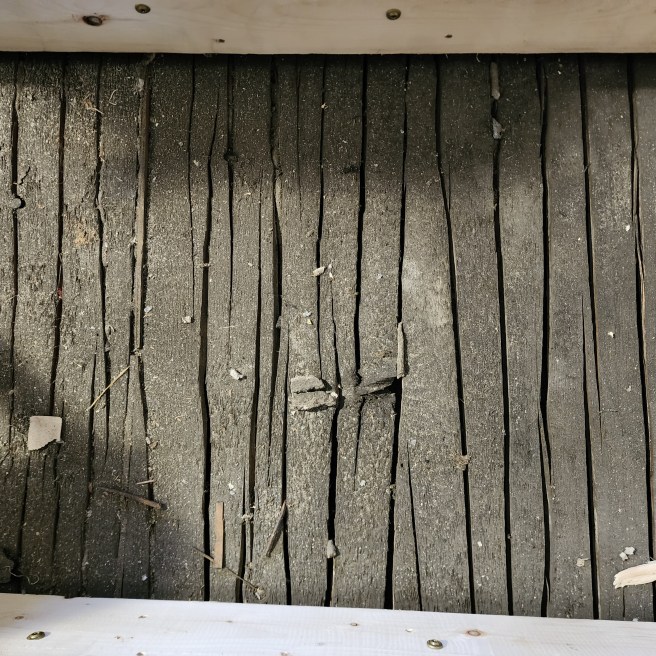
Hand-split oak lathing went out of usage by 1830, I’ve been told. Ours was also charred by a house fire, possibly one from a nearby chimney.

The burn marks on the underside of the flooring also suggested another serious house fire.

Another detail is the molding on the side of our stairs. The same pattern is found on other houses in town from the 1830s and 1840s.

I’m assuming this was from an update to the house.

And, from a technical point of view, ours wasn’t a post-and-beam house but rather timber framed, meaning wooden pegs held the big pieces together – and the weight of the structure didn’t come down the inside walls.

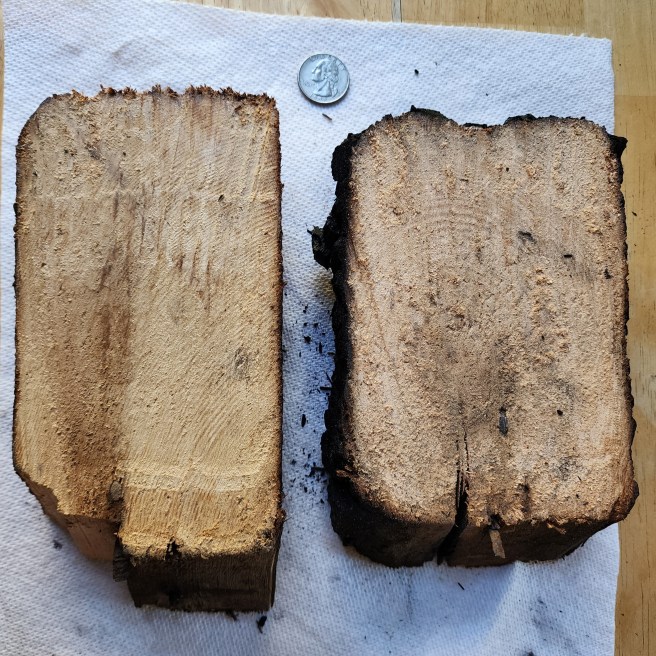
The old wood was denser, too, than what you’d buy today.

Cross-section of our old rafters.

I do love daffodils, by the way

Having Subway Hitchhikers come out first did throw a ringer into the sequence of what would emerge as a kind of series. For one thing, it was out of print when the ebooks came along.

For another, I needed to tone down some of the hippie excesses.

As I’ve said, it started out as a nice, thin book. I completed the first draft shortly after leaving the ashram. But somehow, before I could land a publisher, it started growing. And growing. It gained a sizable back story as well as a parallel out-in-the-sticks hippie existence.

Getting to what would be published as Daffodil Sunrise leaves me in somewhat of a fog. Chronologically, it’s the earliest part of the story, detailing the transformation of a straight young photographer from Iowa into a hippie on a state university in Daffodil, Indiana. OK, no secret, it’s an abstraction of Bloomington and Indiana University, embodied the emergence of the character who started out as Duma Luma but now goes by Kenzie.

From what I’ve seen, very little fiction has been published about today’s American Midwest, at least in contrast to Manhattan or Los Angeles or even the South. Who’s speaking up for that part of the country, relating a viewpoint its natives might feel is theirs? It is vastly misunderstood.

Within that, Indiana stands as a crossroads, one with a strong Southern influence as well. I’ll argue it’s even a kind of symbol of middle America. It’s the only Midwestern state, by the way, not to carry a Native name but rather the generic Indian-a. It also is largely farmland with big cities at its corners: Chicago, Detroit, and Cincinnati.

Kurt Vonnegut strongly resonated with me as a missing voice, a straightforward one with biting humor. As I turned to drafting and revising, he definitely felt like a clarion in the wilderness. Especially his novel, God Bless You, Mr. Rosewater. Do I have do explain what growing up as a Goldwater Republican was like?

To get closer to the hippie vibe, add Tom Wolfe, definitely not a hippie but someone I first read when he was a columnist for the New York Herald Tribune, my favorite newspaper of all time. His supercharged prose fit the sensation of the surreal and vibrant new world the Revolution of Peace & Love was unleashing. Or so we thought.

Other influences I might throw in are Abby Hoffman’s Steal This Book, though I didn’t buy any of it, or Jerry Rubin’s political entreaties, or Herman Hesse’s shining ideals. As for love, though? I’m drawing a blank. At some point Richard Farina’s Been Down So Long It Looks Like Up to Me caught my fancy, along with Thomas Pyncheon’s V, which finally made sense under an altered state of mind.

Perhaps Genji and Monkey, too?

Bloomington was seen as a wild and somewhat threatening place throughout the rest of the state, yet seemed to be so backward compared to, say Yellow Springs and Antioch, which in turn would seem so far behind the radical curve once I got to the East Coast.

I didn’t want to see any of what I was writing as a rite-of-passage tale, not even for an entire generation of my contemporaries in a Vietnam era. And yet?

I wasn’t seeing the experience, mine or that of those around me, anywhere in the public eye. What was appearing in the spotlight was San Francisco, the Manson cult, the Kent State shootings, and the later circle that abducted heiress Patty Hearst, which originated in Bloomington after I left.

Activist Saul Alinsky, among others, was right in his criticism of hippie political and social action, by the way.

Back to my story. What we think of as the hippie movement really revolved around university campuses. Think about that. It was no longer destitute runaways in San Francisco but legions in enclaves around the country.

Here I was, writing furiously in 1986-87, wondering where it had all gone. Or, I should say, is going.

The big issues still remain, bigger than ever, from climate catastrophe on down.

How could we have gotten this so wrong?

Well, Flower Power did have a lasting impact, though it’s largely taken for granted. The best I could hope for, then, is a reminder or better yet, to rekindle the flame in a younger generation.

Ever really look at those playing cards?

Yup, there are 52 in a deck, plus one to six Jokers, at least if you’re looking at what’s considered a standard commercial deck. There are, however, other traditional, and often older, suites to consider. Today we’ll put those off for another time and stick to the French-suited cards that are almost universally found in English-speaking countries. Got that?

To continue:

  1. The deck has four suits (clubs, diamonds, spades, and hearts) that come in 13 ranks, starting with the ten numeral or pip cards – if you’re wondering why there’s no “1,” it’s actually the Ace, despite its usual power. And then there are the three ranks of royalty, the court or face cards we know as Jack, Queen, King.
  2. Each numeral card displays the appropriate number of pips (the suit images) as well as the numeral itself.
  3. Early cards were single-headed, or single-ended, but that changed around 1860, when the double-headed versions appeared. These could be read without having to turn them to an up-position. Corner indices were added around 1880.
  4. The Jack of spades and the Jack of hearts appear in profile and are thus known as “one-eyed” Jacks. Likewise, the King of diamonds is depicted with one eye. The rest of the royals are shown full-face or oblique.
  5. Suicide kings appear in hearts, where he usually has a sword behind his head, as if stabbing himself, and in diamonds, where he has an ax pointed blade-down toward him. Adding to the nickname is the blood-red color on the card.
  6. The Queen of spades, holding a scepter, is also known as the black lady or bedpost Queen. She’s the only Queen facing left.
  7. The Ace of spades is sometimes called the death card. Those printed or sold in England from the reign of James I until 1960 carried an indication of the printer and that an excise tax on the deck had been paid.
  8. The 52 cards are said to represent the 52 weeks of the year, with 13 cards for each season or the 13 lunar cycles of the year.
  9. Possibly originating in China or India or Persia, the cards arrived in Europe from Egypt in the 1370s, perhaps in the hands of Crusaders. The first cards were hand-printed, limiting them to the wealthy classes. That changed with the arrival of the printing press at the end of the 15th century.
  10. Originally, the suit symbols were taken from everyday objects, which may have had any symbolic meaning: flowers, animals, birds, shields, crowns, pennies, rings, even pomegranates. I rather like the possibilities there, “King of bears” or “Queen of bananas.”