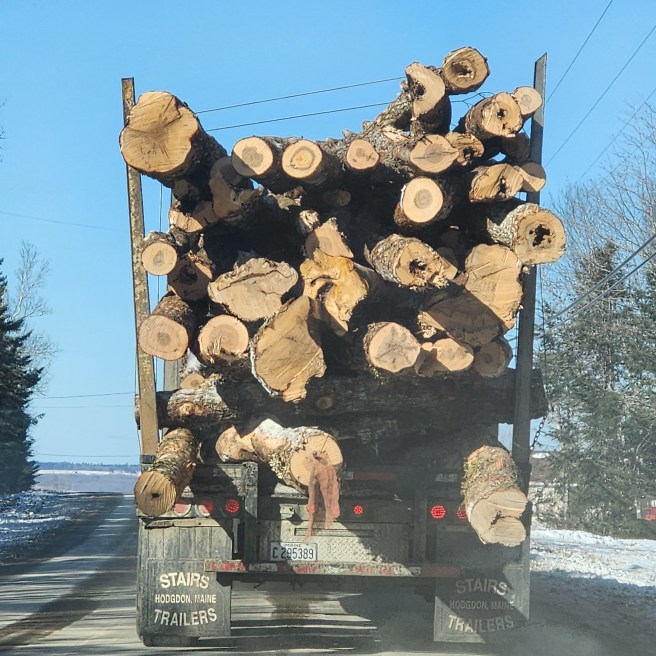
Winter is when lumber is cut in the forests. The ground is frozen solid and there are no bugs in the air. Load up the trucks, then, and head off to the nearest sawmill.
You never know what we'll churn up in cleaning a stall
Winter is when lumber is cut in the forests. The ground is frozen solid and there are no bugs in the air. Load up the trucks, then, and head off to the nearest sawmill.
Among the things we truly miss living on our remote corner of Maine is a first-class bakery, the kind that can turn out genuine baguettes and croissants.
Previous posts here at the Barn have touched on these distinctively French delights, but today the attention turns to matters of what makes something as basic as bread so marvelous.
Consider.
I have several pairs of identical thick wool socks – all gifted, by the way – that I’ve worn the majority of the time since moving Way Downeast, summer or winter. You can say I’m quite fond of them and their cushiony effect. But then, the other day, one pair finally wore out – under the heel in one and a toe in the other.
Emotionally? Oh well, it’s about time. Or, I definitely got my mileage out of them. Or, in response, I could elaborate on my belief in having multiple pairs of identical socks so that if one gives out, you’ll ultimately have a new match when one in another set gives way.
Instead, I was left facing a situation where that didn’t exactly fit my model. Or, what is that people say about if the shoe fits?
After a couple dozen or so years that have been focused largely in the revision of fiction and then the roots of Dover Quaker Friends Meeting, itself a challenge to conventional New England history, I’ve found myself revisiting my trove of poetry.
It’s part of a big cleanup project that’s accompanying our downsizing move from New Hampshire to the far end of Maine, and I’m at a point of trying to discard everything I no longer need and put in order anything else I feel is of value.
As a result, several central full-length collections that had been presented piecemeal as chapbooks at my Thistle Finch editions blog are now released as ebooks at Smashwords.com and its affiliated digital bookstores. You’ll be hearing more about those as the year progresses.
In their place in the Thistle Finch lineup are new chapbooks of sets of my more recent poems, meaning ones from this century, though their origins go back further.
The task has come as a revelation, watching the evolution in my style and underlying voice. Each stage, reflecting geographical moves in my life and the upheavals of my closest relationships, edged me away from narrative-driven content to increasingly image and confetti centered clusters. Don’t ask me to explain them, they just are, whatever.
For me, poetry is a kind of mysticism – one foot in the inexplicable wondrous, the other in everyday life. Prose, of course, is more secular.
My newly released chapbook Aquarian Leap leads off the new run at Thistle Finch. Frankly, looking back over these, I’m not sure what to make of them other than the wild energy they inhabit. I certainly wouldn’t – or couldn’t – draft them today.
These poems, in some manner, still reflect the working of my multi-layered, mercurial thought process. (Never mind my heart, all the more elusive and often contradictory!) I love those lucid moments – sharp, brief – when everything, including thought and emotion, is centered, full, and stilled. Rarely, however, does my intellect flow in such a focused narrative. That requires more effort.
More typically, it flashes on something and then leaps to another, seemingly miles away. Some say this is characteristic of my natal sun sign. That is to say, the typical Aquarian will hear one subject and shuffle through fifty-two logical connections in a flash, and then blurt out something that will leave everyone else in the room wondering, “Just where did that come from?” (Except, perhaps, for another Aquarian, to whom it will seem perfectly logical.)
Often, my writing was constructed and amplified and then distilled from notes, many of them scratched out on a daily commute or on a hike in the woods, or sometimes even a twist while journaling. Curiously, when I assembled these into collage-poems, I was conscious of an underlying logic. That is, many snippets did not fit the emerging sense and must be laid aside. But a few others did, leading to what I hope is an internal thesis/antithesis/synthesis that’s ultimately beyond any surface or attempted cleverness. I prefer for my work to discover and uncover rather than invent.
The result in this set and a few ahead feels more like confetti. So there!
Something similar happens in disciplined meditation, such as traditional Quaker worship, where routine thoughts are patiently laid aside while one’s awareness clears and sinks to a more intuitive and integrated state. Perhaps some of that also infects these pieces.
I should confess to a few works by two poets, G.P. Scratz and Aram Saroyan, I’ve long admired, poems that defy explication or understanding yet spring from the intuitive burst that takes us beyond apparent meaning – and closer to a jewel-like condition.
Or even the freedom of dancing, which I find in a similar vein in the work of Philip Whalen, especially.
Consider the linguist’s Wolves and Consonants. (My reading of “Vowels” in a book title my elder daughter was reading.)
The growling of wolves adds a whole new way of following the Voice here.
As for any effort to define poetry itself? I guess I prefer the wilder side. Go figure.
You can find Aquarian Leap at Thistle Finch editions.
Most Americans, dare I venture, have vast gaps in their knowledge of the history we inhabit. And inherit, as well.
Even though I had visited the site several decades before I wrote my book Quaking Dover, the impact of the attempted Popham settlement came back with a whammy in the developments that followed.
More recently, a post-concert conversation with Fred Gosbee of the folk-music duo Castlebay thickened the plot.
Here we go with ten points.

For me, this stage of winding down, or at least refocusing, includes recognizing realities of aging and finances while living in a remote area of the country. Here are some things I’d say are in my past, no matter how actively I pursued them:
My second brace of fiction, ultimately three books in all, addressed the dozen years in the aftermath of the hippie outbreak, though I’ve tried to fudge the era precisely. I do think much of it is continuing.
Naturally, for me, they were semi-autobiographical, even though the protagonist is now a woman named Jaya who winds up with a much younger lover who becomes her husband.
The pivotal piece is Yoga Bootcamp, with her now as a central character, along with the guru they sometimes called Elvis or Big Pumpkin. My residency in the ashram was a transformative period in my life, even in the face of details I’ve since learned. We were a rogue outfit in the period when yoga took root in America. This down-to-earth story will probably scandalize your local yoga studio instructor, but the experience did reshape many of our lives, hopefully for the better. I’ve certainly carried many of its lessons far through some other faith traditions.
The central piece is now compressed into Nearly Canaan, originally an ambitious triptych that comprised the hefty novels Promise, Peel: As in Apple, and With St. Helens in the Mix. At the outset, a sense of place was central as Jaya relocated from a small town on the prairie in the American Midwest to the hardscrabble Ozarks to the apple orchard country in the desert of the Pacific Northwest, but the central theme now condenses as the question of how much influence one person can extend over others, hopefully for the better. I can ask now whether it would have been more compelling if she’d been conniving and manipulative.
The third book, The Secret Side of Jaya, is a set of three novellas, each one set in the places she lived after leaving the ashram. Each one, quite different, is premised on hearing and seeing figures in a locale that others don’t. Maybe you encounter them, too, where you are.
You can find these books in the digital platform of your choice at Smashwords, the Apple Store, Barnes & Noble’s Nook, Scribd, Sony’s Kobo, and other fine ebook retailers. They’re also available in paper and Kindle at Amazon, or you can ask your local library to obtain them.
Love, if you haven’t noticed, can be very hard to define. Really define.
Here are some examples. Add “Be Mine” at your own risk.
As a postscript, let me add this: “If I love you, what business is it of yours?” – Johann Wolfgang von Goethe
So how do you define love?
Or so I keep muttering to myself when I realize I’ve lived here on an island in Maine longer than eight other locations in my zig-zag life’s journey. Somehow, looking back, those others feel more action-packed, dramatic, even influential while this one seems to have flowed by more gently and quickly and, yes, more pleasantly overall.
This, of course, is Eastport, my remote fishing village with a lively arts scene at the easternmost fringe of the continental United States.
The mere idea of writing from an island in Maine strikes me as pretentious, yet here I am, far further east than the others, and I am here year-round, whatever.
My habitations of shorter duration were all in my 20s and 30s, largely career moves one way or another and mostly taken as professional stepping stones to something higher, though the next move was rarely the one I anticipated. This, in contrast, is in my 70s, with any dreams of next steps largely evaporated. Rather, I’m savoring an awareness of culmination, even if the big successes I desired ultimately remain vaporous. Especially the bestseller rankings or critical approval or genius grant recognition remain vaporous.
Add to that the fact of time going faster the older you get, something I’ve previously remarked on here at the Barn.
Returning to the thought of residency, the three longer locations in my route were my native Dayton (20 years) before I set forth to other fields, and then, finally, slowing down again in New Hampshire, with 13 years in Manchester and 21 in Dover.
I’ve been attentive to what I have in all the turmoil.
As I’ve previously mentioned, for much of my adult life, I’ve thought of myself as a retired hippie. Or I’ve simply been called one by others. One of millions and, unlike many, one who’s not embarrassed to admit it, that was a time to remember, no matter how short we’ve fallen from its promise and potential, even though I’m not so sure how much I’d want to go skinny-dipping with others these days or even sleep on the ground or a mattress on the floor.
That said, I’ll also admit that much of my first year after graduation from college in the height of the hippie movement was deep misery and loneliness punctuated by playful discoveries. The writing of Richard Brautigan definitely fits in here.
What’s often overlooked in the era is that the central element was the hippie chick. Plus, personally, I was without one, since mine had moved on and left me stranded. (Oh, misery, oh, woe, I am sounding pathetic, but let’s move ahead.) My novel, Hippie Farm, celebrated her in her many guises, even if you can’t even use the term “chick” anymore without being corrected. At the time, though, it was a badge of honor and invitation – one leading, in this case, to that rundown farmhouse in the mountains outside a college town I definitely restructured in terms of fiction.
A second novel, Hippie Love, retold the same plot line from a different perspective, one more of a what-if optimism. I would love to have heard that story retold from their impressions. Ouch? Were they as lost as I was? One I’ve been in contact with all these years has shared her insights, helpfully, and another, reconnecting much later, barely remembered who I was. And here I had thought she might be The One. Oh, my.
In the light of the publication of What’s Left, those two books were then greatly revised and newly released as a single volume, Pit-a-Pat High Jinks. Compressing the two was a major effort, but ultimately satisfying, at least for me. So much happened personally within that short span.
The inspirations cover quite a cross-section of people, with one becoming a United Way executive, another a U.S. Attorney, yet another one an OBGYN physician. Not that you would have guessed it at the time. As for most of the rest, I have no clue. Some were real losers, likely lost to drugs now. Others, tragically damaged. Being hippie wasn’t always a quest for enlightenment, justice, and equality. And when it was, it was countered by powerfully invested self-interests. Sometimes I’m surprised any of us survived, even before we look at the Vietnam veterans on the other side and their continuing traumas. Not all addicts, by the way, were hippies.
Flash ahead, then, and I don’t see youths today finding community anywhere, much less a shared cause. This is supposed to be an improvement?
Contrary to many people who lived through the era, I saw much that happened needs to be remembered and often cherished, even comically. It’s a place where people can begin rebuilding. I’m holding on, then, in my Quaker Meeting as one root to be grafted.
Look closely at the women, especially, and see how much of the legacy continues in spite of everything. (The kids today have it right, their perception of hippie as a girl thing.) Or, as they say. We’ve come a long way, Baby.
Yet that hippie label, I should add, has undergone its own transformation, rarely positive. Alas. Especially for us males.
Most of them, I hope, come across better in the book.
Still, it’s an account of history as we encountered it.
You can find Pit-a-Pat High Jinks in the digital platform of your choice at Smashwords, the Apple Store, Barnes & Noble’s Nook, Scribd, Sony’s Kobo, and other fine ebook retailers. It’s also available in paper and Kindle at Amazon, or you can ask your local library to obtain it.

