Employment is a big thread running through my fiction

In my parallel universe, my real-life life, newspapers were caught up in technological “advances” that kept setting us back. Those changes had started well before my sabbatical break, but they were speeding up. Back when I was starting, perforated teletype tape meant we really couldn’t edit stories we received from the Associated Press or United Press International or similar services. And then scanning of typewritten pages made improving even staff reports physically difficult. After that came the early stages of computer screens and keyboards, where editing took about three times longer than it had with a pencil – moving that cursor around took more effort, certainly, and computer crashes were commonplace. These were all matters that impacted the emerging story of Hometown News, though I believe anyone working in a large business office would have parallel experiences to relate.

We forget how much reliability our laptops and PCs have gained. Does anyone else remember losing a draft to a static electricity spark that then erased whatever was on your screen? Or, for that matter, when it was a bigger power outage?

I could detail the shifts from letterpress and hot type to pasteup and eventually pagination or from typewriters and linotype machines to early computers to, well, the digital devices we have today or from letterpress to offset printing and now digital editions skipping paper altogether.

Or similar leaps in photography, as we see in following Kenzie.

~*~

Paid work occupies a large part of most adult lives. Even when it doesn’t, how we handle our money, wealth, time, and so on is a highly emotional issue, no matter what the dismal science of economics insists. (For that line of useful inquiry, go to the Talking Money series on my Chicken Farmer I Still Love You blog.)

I just couldn’t create characters without their having jobs. Well, most of them – the hippie farm had some of dubious means.

Besides, so much of a typical male’s identity and life purpose is tied up in his job, especially when he can take pride in it. The job even defines his social circle.

I didn’t want to add another book about a hopeful writer to the literature. What a cliché. Or a musician or actor or even a painter. How about a plumber or fireman or circus clown?

But I still needed a witness figure for the history abstracted to fiction that was before me. I defaulted to using a photographer, in part because I had wished I had taken up a camera, if only I could have afforded the time and a darkroom, blah-blah-blah, and in part because I had been a serious visual artist in high school. You can see those elements developing in Daffodil Uprising and later coming together in What’s Left, but they also play out in Pit-a-Pat High Jinks and Subway Visions. I’m a highly visual guy in my awareness and thinking, OK? The fact he was employed at a newspaper is one part I couldn’t evade.

I still value novelists who manage to set their story outside of the writing world, and that includes universities. Charles Bukowski gets points for me for his novel Post Office. Well, I guess that’s also where genres kick in, too. They’re about detectives and spacemen and billionaires and cowboys and so on.

Photojournalist? At the time of the first draft of Subway Hitchhikers, I didn’t have any models to draw from, but that quickly changed. I wound up working with some of the best in the business.

Over time, photography, the kind that required light meters and F-stops and film and darkrooms, became ancient history. That part I would have to intensely rework and explain as my books underwent revision, thanks to Cassia in What’s Left.

In contrast, Hometown News was primarily about work. I had no problem in this case where everything took place at a newspaper plant, though the economics of the surrounding community also emerged as a central thread.

Jaya became a more difficult case. Her career in the early drafts was drawn from my newspaper offices and hours, now vaguely abstracted to management in general. It would get more specific in the revised titles, where she specializes in nonprofits management. It’s a real job description in a major component of the economy. For that flash of inspiration, I could look to one neighbor in Dover and the impact she had statewide in peace and social justice matters.
Ever feel like an imposter?

My first brush with the concept came in a hearing a classical musician talk about his arrival in a major symphony orchestra and looking around at all the talent and amazing sound they were creating. “I felt like an imposter,” he said.

Oh, my, I could identify.

Little did I know of the Imposter Syndrome, a term coined by psychologists in the 1970s.

Rather than go into the details and nuances – there are many, look them up if you wish – I’ll mention ten places it hits me.

  1. Music circles. Yup, despite my extensive knowledge of repertoire and so on, I can find myself cowered at times in choir when a technical issue pops up. We’re singing in what key, now that we’ve hit this chord? What do you mean? Or of course I’m supposed to know which Chopin etude that is, not that I play piano.
  2. Books. No matter being a fairly well-read author, there’s no way I can keep up with the output. “Have you read” has a 99.9 percent chance of a negative answer, even in one of my specialty areas. Reading the New York Review makes me feel like a complete ignoramus. How about you?
  3. Poets. At least few other poets or poetry lovers know of the writers I’m most fond of, even the ones considered major figures. Now, what are their best lines?
  4. News events. Forty years in a newsroom and I still can’t follow it all. Local? Regional? National? International? As for the players’ names? Which leads to ….
  5. Politics. A congressman, for one, faces more proposed new legislation than anyone could ever examine. And I’m supposed to be one up? How about city council issues? Like when I’m having a beer once a week with some fine neighbors?
  6. Cambridge. Despite singing in a chorus with a number of Harvard and MIT grads, they are an inside circle. Being told my portrait hangs in one of the dorms on the Yard – I don’t remember which one – only made things worse.
  7. Quakers. There are circles I know but so many more I don’t. As for keeping up with the current reading? Back to books!
  8. People’s names and faces. I’m really at a loss there most of the time. Sorry.
  9. Money dealings. I’m still baffled by our cell phone contract and the monthly bills. As for dealing with car salesmen or realtors? WTF? A guy’s supposed to be savvy with this, right? Well, that leads to truly painful area:
  10. Male role: Yup, capable of repairing anything, solving any problem, knowing just who to contact when needed.

Tell me I’m not alone. Please?

Considering historical accuracy, too  

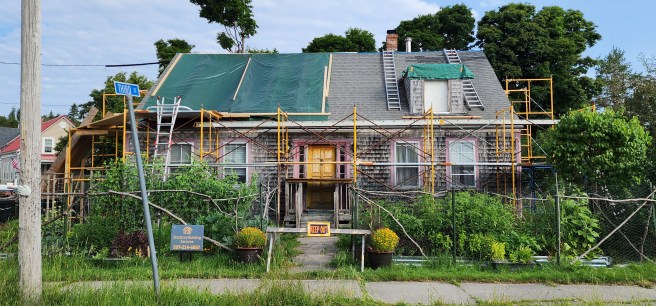
The two small dormers in the front bedroom were more of a pain to remove than you’d expect. That part was labor intensive, and they weren’t even braced to handle the weight load of the rafters above them. No, those had merely been sawed off. We have no idea how the heavy slate roofing that came later didn’t crush everything beneath it. (I’ll save that history for later.)

The dormers apparently weren’t added until after 1850, anyway. (Again, an explanation that can wait for later.)

The cedar-shake siding came even later, maybe the early 1990s. For a while before that, it was green asphalt siding. Yes, like what you might see on a roof.

The house color by 1830 was yellow, though we haven’t yet found any evidence of that.

All of that gives us more leeway for redesign, no?

With the front of the house, we’re keeping the outermost panels of the original roofline in recognition of the Cape Cod style. In the renovation, though, we still needed to upgrade the support beneath them, even before replacing the roof covering.

The dormers, by the way, were not identically distanced from the ends of the house. There was a half-foot or so difference. Did they not have tape measures? Make that yardsticks?

The single, big dormer will be a dramatic change, inside and out.

Here it comes!

When a fictional scene can use a shot of reality

While I’m thinking about visuals, let me mention a few ways they’ve helped me in creating my novels.

Not to slight dialogue, even when you nail it, or, for that matter, narrative, but a visual detail can be a great way to spark attention in a character development or a scene. It can make a passage visceral. It can rescue a connecting passage that’s gone flat or leaving you floundering for just the right idea.

I don’t know about you, but my memory overlooks a lot of telling specifics in the history I’m investigating. It’s not just memory, either, but so much that should be obvious but we simply block from awareness. That’s where I’ve found photographs to be a great prompt. Sometimes they even provide data, as my Orphan George blog demonstrates in posts examining family photos, when they’ve been available. Other genealogists can weigh in on ways snapshots and portraits have provided crucial data.

Through many of my moves, I didn’t even have a camera. I have no shots of many of the people who were central in my life, not even some of the lovers or places I’ve inhabited. The shots can counter my tendency to idealize. A bit of grit can restore some reality.

In the process of writing and revising my novels, I began collecting photos from magazines or other sources as prompts. This character in my book (often they’re a compression of several real people) might look like the one in this photo or wear something in that. Or here’s a small-town square that would work. They even allowed me to reconstruct a darkroom for Kenzie.

The Internet, of course, has made this backgrounding much easier.

Away she goes, Act 2

Removing the old asphalt roofing and underlying sheathing and replacing them with standing-seam metal roofing promised to be an encore act of last fall’s drive on the back half of the house. A dustpan, or shed, dormer, connecting what had been two small dormers would be the biggest design difference.

This time the work would be in full view on a central pedestrian-friendly thoroughfare. By now, the renovation is a widespread topic of conversation, year-round residents and summer people alike. Yes, one more aspect of small-town living.

Once again, new rafters would replace the old ones, many of them charred in the 1886 downtown fire as well as a later chimney fire or two. And the new 2-by-12s would be more numerous than the old 3-by-4, 4-by-5, and 5-by-6 beams they were replacing. They would also be up to building code rather than sporadically placed. Better yet, they would be solidly joined to a ridge pole and the four central structural support columns our contractor had inserted last fall. Earlier episodes of this series discuss the intricate work of getting those significant details into place.

Once underway, this phase turned into something more than a quick encore. Removing the two dormers had its own complications, and then a series of rainy day forecasts prompted Adam to concentrate on the south end first rather than the full roof in one sweep.

Further complications came in finding the sheathing was doubled, unlike the back, and a desire to salvage as much of the timber as possible. Some folks in this project are hoping to make a dining room table or some such to recognize the home’s heritage.

Our thinking about this project has definitely changed. Adam is really rebuilding the top half of our house, not merely remodeling it. We’re most impressed. Technically, it’s still post-and-beam aka timber framed.

Would I have gone along with all this if I had known about all this at the outset?

We really didn’t have much choice. As we’ve been discovering, there was so much trouble just waiting to happen. Fortuitously, we’re addressing it all proactively rather than in a panic after an overhead disaster.

We’re no longer tempting fate, are we?

Let’s be clear, you do judge a book by its cover

With my training as an artist, I have some strong feelings about book covers. Most of the ones I see leave me cold. I think they’re too cluttered, and most of them lack a strong graphic element – I prefer a good photograph though am coming around on the painted image argument – and I like a clean, easy to read impression. Some of the typefaces used for the title or the author are nearly impossible to make out.

I did have a friend who was a professional illustrator for a Fortune 500 corporation. CAD (computer assisted design) was overtaking the field, and he felt it was destroying his artist’s hand, the one with the Rhode Island School of Design sharpened skills. His aspiration was to design old-fashioned book jackets, and while his style there wasn’t my cup of tea, I could see its appeal. Fortunately, he conceived a children’s book that took off, in part because it was based on a Pete Seeger song, which did get buyers’ attention. And led to many more all on his own.

I still don’t understand all the nuance, though. Is it true that a certain strand of fantasy is supposed to have a specific element woven into the cover to alert a potential reader that this is the subgenre she’s looking for? You know, maybe a touch of moonlight or a small bat in flight or a golden glimmer in someone’s eye?

I am learning, though. A cover makes a promise with a reader, so I’ve heard at Smashwords.

My thoughts on cover design and some of my favorites appear in earlier posts here at the Red Barn.

Self-publishing requires much more than merely producing a compelling text.

Naming a book is hard enough. For the record, I found naming What’s Left to be my most difficult, as I’ll explain in a future post.

In the world of books, and not just ebooks, a strong cover is crucial.

If you can afford to hire an illustrator or graphic artist to design yours great. I’m envious.

My first novel, in paper, wound up with an “art designer” misfire. Rather than respecting the black-and-white photo of passengers in a subway car, a flat yellow lotus shape was cut into the image with the title and author credits inside that field. It didn’t fly. In addition, my name wasn’t left as simply Jnana, as I desired. It was the full yoga version, an additional five syllables or 14 letters. Well, it kinda has a 1950s feel, even with some graffiti on its walls, but the action was all high hippie ‘60s and early ‘70s. I’m now wondering if getting a tagger to do the cover would have been a more successful alternative. I’m sensing it would have been a more in-your-face result. Buy me now!

For my first round at Smashwords, I hired a book designer who was, I seem to recall, living in the Czech Republic. Emailing made everything easier, including paying him via PayPal, which was new to me. Since he had a deal with a stock agency for low-cost photos, I rifled through its online pages filled with shots that might fit my need.

It’s harder than you’d think.

A good cover isn’t a poster. It’s more like a billboard on a much smaller scale. And your potential readers are zipping by.

The right photo turns out to be a rarity. It has to somehow reflect the story and still attract a buyer.

Even when you find a good fit, there can be problems. For instance, the photo I settled on for Hippie Drum was a black-and-white portrait of a shirtless young male playing a set of Conga drums. It even looked a lot like me at the time of the story. Little did I know how many viewers it repulsed.

There is debate over showing a person’s face on the cover. It can limit a reader’s perception of your central character, for one thing, and one reader’s ideal can be an instant rejection from another.

If you’re going the human face route, you may find the perfect photo with one slight flaw. She’s a redhead while your character’s brunette. It may be easier to tweak the book to fit the cover.

The experience of tweaking a character to fit the cover image.

There’s also a debate over a painted or drawn artwork versus a photograph.

When I got around to designing my own covers, I came upon a drawn image of a single daffodil bloom. How perfect and I still love it. And within the title I inserted a peace emblem for an “O” in DAFFODIL SUNRISE.

A few years later, when I changed the title, that cover went out of circulation. That peace emblem just didn’t work with the new version’s Kindle print-on-demand cover, either.

I have to admit a special fondness to the ones on Subway Visions, Yoga Bootcamp, and the Secret Side of Jaya – none of them photos.

Memories of places in the town I grew up in

I’ve mentioned a few others, such as the art museum, in other posts here. Now, to add a few more, in no particular order. Again, I’m looking at Greater Dayton rather than strictly inside the city limits.

  1. NCR: The National Cash Register Company’s world headquarters looked more like an open college campus with linden trees and pristine lawns than an industrial jumble behind barbed wire and hurricane fencing. It even had a fine auditorium and pipe organ, used for its gatherings of salesmen but also the concerts of the Civic Music Association – I heard a number of famed musicians there. And I was awarded my Eagle Scout badge and later my high school diploma on its stage. And, oh yes, I can’t overlook Old River, the employee park with the lagoon and boating, a fine miniature golf course, and a huge outdoor swimming pool – when one of my buddies whose father worked at NCR and thus had a pass to the park asked if I wanted to go, there was only one possible answer. Please!
  2. The corner display windows at Rikes department store: The pioneering retailer was the place to shop in town, and anytime we took the bus, say to the library or a movie, we’d wind up checking the latest display – especially at Christmas. During my senior year, some of my art work was used in the background of the featured fashion.
  3. The YMCA: I learned to swim at the indoor pool and sometimes applied my allowance to a grilled cheese sandwich later, over on the men’s side. And then, little kid that I was, I enjoyed the freedom of taking the bus home on my own.
  4. Frigidaire employee park: Thanks to my best friend’s father’s employee pass, we spent many summer nights enjoying free Starlight movies. My dad worked for another General Motors division in town, one that had no such benefits.
  5. Troop trails: My Boy Scout troop had a long hike one Sunday a month, in addition to a primitive camping weekend. Our routes often followed a river or crossed farmlands or even trekked along railroad tracks. I remember especially a few that traced the abandoned Miami-Erie Canal with its mule bank and its eerie remains of limestone locks left in vines and trees.
  6. Suicide Hill: A decent snowfall (quite modest by what I’ve experienced since) meant sledding at Hills and Dales Park. How insignificant the slope looks now, but there were some serious injuries. I had a near call.
  7. Memorial Hall: It really wasn’t designed for concerts, but it’s where the Philharmonic performed, and since my dad had access to tickets, I heard many top soloists. Hard to believe now, actually.
  8. Our big ugly high school: built in the 1960s and long since torn down. In my memory, I recall it more than the older but equally ugly elementary school.
  9. Yellow Springs: Once I got my driver’s license, the bohemian town in Greene County, home of Antioch College, became a welcome retreat. Its funky stores, before funky was a word in my consciousness, were mind-expanding. Nowhere else could we find Earl Grey or gunpowder tea or sticks of incense or perfumed soaps. Then there was the professional summer theater series at the amphitheater, itself a revelation. By that time, I was in love, at last. And that leads to mention of a covered bridge by moonlight: Yes, making out afterward in the moonlight at a covered bridge that’s no longer existent down an unpaved road.
  10. The Art Theater: Where I first saw foreign films, black-and-white alternatives to Hollywood’s commercial concoctions. And then there was the Lemon Tree coffee house next door with its folk music and blues.

My, all that was a world ago in my life.


The picture really can change in a day

It was one of those stretches where nothing seemed to be happening. For me, that translates into stuck, or more accurately, an emotional funk.

And then, in a single day, the dumpster arrived, opening way for the big front of the upstairs demo to begin.

The plumber showed up, after a few months on a big project in the Midwest. He made necessary moves preparing the upstairs bathroom and laundry room for walling, lighting, and flooring to be finished before the toilet, bathtub, shower, sinks, and washer and dryer go in.

He also removed our one outdoor faucet, with its leaking pipe in the wall and no indoor shutoff valve, with three new spigots and lines, all of them closer to our gardens. This was a huge quality of life improvement we do enjoy right now.

Three cords of firewood were delivered, about a month after being ordered. It was our first time dealing with them, and while I wasn’t worried that they wouldn’t show up before the first snow fell, this was reassuring and I’m satisfied with the quality of their product. Now I’m spending an hour or so most days stacking it. (Let’s not overdo it, not at my age.)

We heard from the mason, who was slotting us in with other projects around town. He and a helper were on the scene a few days later to repair the top of the chimney. Added to his work were repairs to the facing on the foundation – something noted in the building inspection when we bid on the property – and several future tasks, including moving the wood stove and metal chimney to another part of the front parlor. This was our first time dealing with him, and I can say he takes pride in good work.

Our contractor installed the flooring on the deck, restoring use of the back door to us. The railing is next.

Each of these lifted another obstacle from the horizon. Each one felt quite invigorating. The deck even has us in amazement.

Now, for standing on my head

I’m not sure when or where I began drafting my yoga novel or where, but I know the bones were in place before I began my self-declared sabbatical in 1986-87. Perhaps it was during my month of unemployment before landing in Baltimore. For one thing, I had revisited the ashram in the year before my big writing spree and perhaps even driven past it the previous year. I was hoping to get some answers for questions regarding my manuscript must say the encounter was unsettling. I wasn’t even allowed inside the center, and the woman who had taken over as guru declared herself too busy to say hi. A deputy was dispatched for that, with tea, while I sat beside Swami’s grave.

Well, that was a perk of being “on the road” as a newspaper features salesman, otherwise known as “field representative.” I even got my name in brochures and full-color ads in the industry magazine Editor & Publisher.

My ashram residency a dozen or so years earlier had been life-changing, but the connection broke completely when I relocated to the Pacific Northwest in 1976. Swami had demanded a large chunk of my meagre salary, and besides, I was newly married with a wife in college. The upshot, quite simply, was that I felt ostracized. I was certainly shunned it that social call. In the bigger picture, the yoga movement itself had gone into eclipse and my own spiritual journey had resettled in the Quaker vein.

Still, the yoga life in America was a largely untold story, even if it had put “karma” and “om” into the American vocabulary and mindset.

When I began drafting the book, I had no idea where everyone had scattered and had no way of contacting them. I mean, if I was ostracized, what was the point of contacting the headquarters? Did I even know that Swami had died? Perhaps, though some communication I had with someone who had been a regular guest and went from being a rock-band manager to a Messianic Christian comedian. I managed to make that connection through a wire-service news story I came across before my leap to Baltimore. So now I’m thinking the yoga novel originated even earlier than I’d thought. (I really do need to sit down with my journals for a very deep dive.)

I do see that some of the outtakes from Subway Hitchhikers were woven into what became my second published book, Adventures on a Yoga Farm, which came out as pioneering PDF ebook from PulpBits.com in 2005.

~*~

What do you do with a rogue outfit like ours? I definitely wanted to avoid the sticky sweet guru worship I’d seen in other books, and I definitely wanted to avoid a scandal-mongering expose, though I would later find that nearly all of the religious imports from Asia would face financial or sexual embarrassment. Michael Downing’s 2002 Shoes Outside the Door: Desire, Devotion, and Excess at San Francisco Zen Center would cover that reality in one of the more prominent and, up till then, respectable organizations.

When I sat down to write my novel, I decided to stick to one day in the community’s life. I created a composite of eight young yogis and their woman swami guru. Each resident student represented a different stage of development. It also involved compressing the two years of my experience into a single day. I’m guessing the one-day focus reflected the Greek theater ideal.

And I do stand by my original structure of eight disciples within a single day.

The book was republished via Smashwords in 2013, this time with more popular platform choices than PDF. My, have times changed.

What I really wanted, I think, was my own version of Be Here Now.

I don’t think I could have adequately presented the inner turmoil of a charismatic leader without a college degree now having a tiger by the tail much less uncovered all that got covered up in the frenzy.

Would anyone really care?