Fir tipping is a big job around here

The signs “fir tippers wanted” this time of year can be puzzling, so here’s the scoop for those of you who don’t live in Maine.

  1. Christmas wreath makers need stands of evergreens to shape into their festive rings. In Maine, the traditional material is the tips of balsam fir branches. Don’t confuse the inch-long needles for spruce or hemlock.
  2. “Tippers” are the folks who have the skills to collect tips that usually range between 12 to 20 inches.
  3. Quality needles are found only in the mid-section of the tree. Tops and bottoms are deemed unsuitable.
  4. The season is short. The greens cannot be collected before the “tips” are set when a tree goes dormant for winter, usually around November 1, and that’s if the stand has had three nights of 20-degree or lower nights. (Beware of global warning.) Any earlier and the tips lose their needles prematurely. But the wreath-makers do need to get the product to market before Christmas Day, too. It gets busy.
  5. Millions of wreaths are crafted in the state each Christmas season. The trees are abundant and the fir branches are easily worked. Balsam is pleasant to smell, too.
  6. The work is a welcome boost in income for many rural families and comes after the crops are in.
  7. Tips can be harvested by a firm grasp between forefinger and thumb followed by a quick downward motion. Loppers or pruners do the trick for more out-of-the-way tips.
  8. Skilled tippers leave enough on a tree for it to recover in about three years.
  9. The tips are commonly gathered on a “stick” made of a small conifer stripped of most of its branches. When the stick has 40 to 75 pounds of tips, it’s carried off. Bundling the tips into smaller bunches is another method of transport.
  10. Tippers do need to get permission before harvesting from a site. Sometimes that means paying a fee for a permit.

– Source: University of Maine Cooperative Extension Service

In our longest nights

How long the day now? Our shortest is a mere 8¾ hours of visible sun if the clouds permit, barely a third of the 24-hour cycle.

Where I live, we’ve now reached the earliest sunsets. They’ll be inching later by the solstice.

Enjoy the long nights, then. Perhaps by a fire but especially in sleep. Or even out, bundled up, viewing Northern Lights and meteor showers.

One checkpoint where we lucked out

A miraculous thing for us was that the roofing shingles, which had prompted our big renovation project, had held on for the four years between the insurance company’s alarm after our purchase and the actual replacement. Not so for many other shingles around us, even those that had been replaced during those years.

My initial impression, looking at the real estate market when we started considering this move, had been that we could fit into something cheap and make do. But things were shifting.

Most homes we saw for sale had problems, either for my coconspirators or me. Many of the remodelings were utterly puzzling. Others really needed to be redone.

I wasn’t the one who zeroed in on Eastport, but now I cannot imagine anywhere else I’d want to be at this stage in my life. Maybe it’s like Swami when she came to the Poconos and felt the vibes.

The ideal of moving to an island in Maine is almost a cliché. Even a Downeast shore, or a bit to our west, like the Wyeth clan. But we did need to downsize.

At one point, my dream had been to live on a mountain lake. The ocean never even entered into the picture.

Yet here we are, surrounded by interesting people, too.

Where is today’s local communication and shared identity?

Unlike many localities, Eastport has a fine newspaper, one that appears twice each month. It covers much of Washington County in Maine and Charlotte County in neighboring New Brunswick, Canada.

You get a good sense of the place from its pages. I can’t say that for many of the newspapers I’ve seen across the country, even when they were big moneymakers.

Living in out-of-the-spotlight localities, I’ve been sensitive to the nuances of each landscape and the people who inhabit there, not that I’ve often found them reflected in mass media outlets.

It’s not just newspapers or, for the most part, TV, though Northern Exposure did create the sense of one, especially with Chris Stevens as the disc jockey on KBHR radio.

I do sense that the lessening of local identity reflects the loss of local economic power centers, largely through corporate buyouts. The pharmacist no longer owns the drug store, nor does the local bank have its own president. The newspaper is part of a chain, as are most hospitals these days. The list goes on.

As I’ve explained, for many years, despite the arcane business structure in which advertising rather than sales of copies provided the bulk of the income, hometown newspapers were cash cows for their owners – who, in turn, paid their reporters and editors minimal wages.

The resulting management practices – reflecting those of surrounding corporate retailers and manufacturers – have put news coverage at risk, endangering both the communities and democracy itself. How will they, like the reporters and editors, survive?

Oh, yes, the big box stores – especially Walmart – rarely bought advertising space in the local paper, even while they squeezed the smaller retailers out of business. I remember one year when an economic downturn put five of our ten largest advertisers out of business.

~*~

Social media posts by amateurs may fill some of the gap, but there’s no substitute for fact-checking and other accuracy. Reporting and writing take time and devotion, not a given when you have a real job and family vying for attention.

And if you’re out there solo, who’s going to back you up when the topic at hand gets nasty? As it does, when corruption seeps in.

Anybody else feeling crushed?

So many threads have led to here

This pause in our renovations seems like an ideal time to reflect on the ways this project builds on much earlier dreams and becomes, perhaps by default, their culmination.

My junior high art teacher instilled in me a love of 20th century contemporary architecture as well as Japanese and Scandinavian art and culture. That dovetailed into Shaker traditions that had once existed just down the street from us and a county or two south as well. Plainness, exemplified by Quaker, Mennonite, and Brethren history is in my blood and bones, as I’ve learned digging into genealogy.

Add to that an appreciation for William Morris’ arts and crafts movement, which infused the bungalow I eventually owned in the Rust Belt, and my exposure to historic New England styles, including Queen Ann.

And then a sense of neighborhood, too.

Had you asked me at the outset where I wanted to live, I would have responded central city, perhaps in a high rise, or out in the wilderness, perhaps beside a mountain lake or stream. What was clear that suburban was nowhere in my preference.

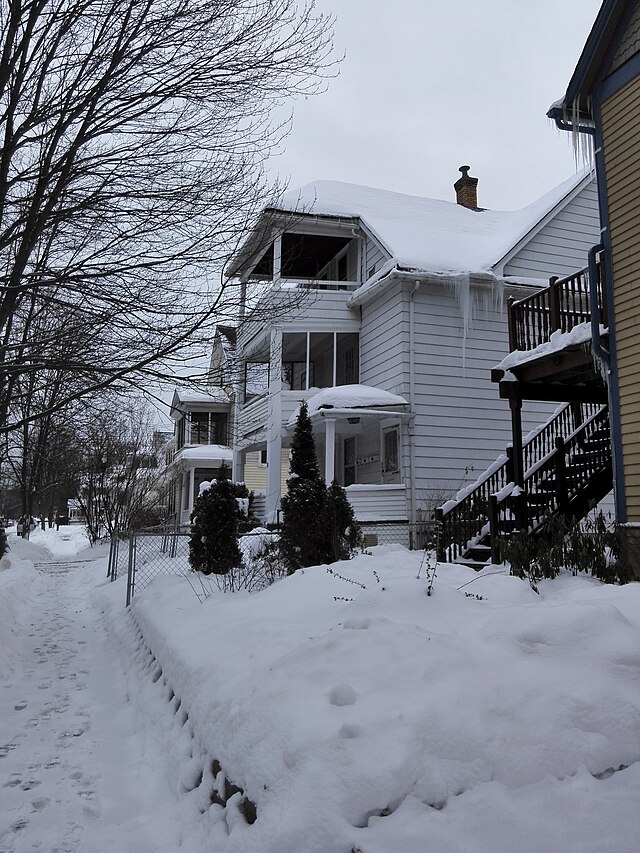
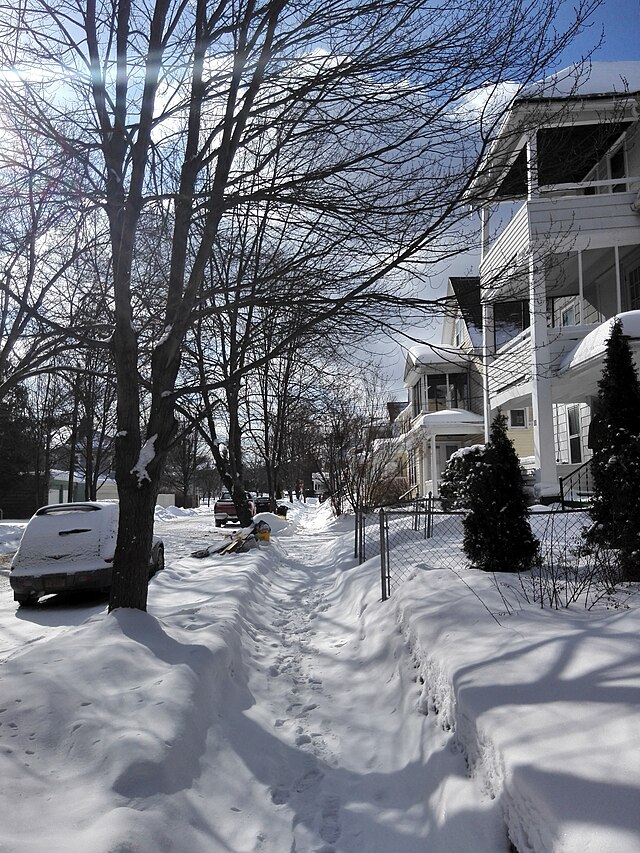
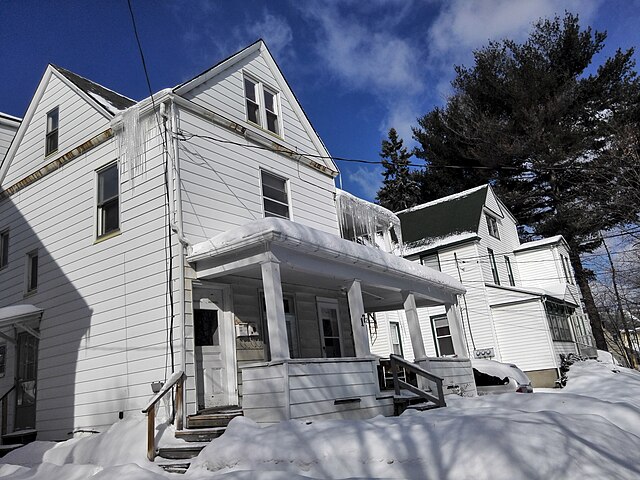
So here I am in a historic sea captain’s home a block from the Atlantic yet at the edge of a funky downtown and arts scene and – utterly amazing, to me – within minutes of forest, lakes, and streams.

When I sit in our second-floor rooms, the heart of our renovation project, I have moments of feeling the best of both worlds. In following the new roofline for our ceilings, we’ve avoided creating boxes as the rooms. One criticism of so much architecture objects to “boxes with holes cut in them.” Rather than boxiness, sometimes I’m reminded of the contours within a ship’s hull or a sail overhead.

This time of year, I’m reminded, too, of the flurry of work just before the previous two Christmas celebrations. It got chaotic, up to six tradesmen at one time. We were tripping over ourselves as the rest of the family started showing up.

Throughout it all, we had the ongoing Viking Lumber deliveries, mostly with Tim driving. And our wonder at having the right contractor after all of the delays.

So here we are with the continuing surprise of the historical significance of the house, not just that it was 80 years older than it had been claimed, but that it had been so central to what has evolved here.

As our mason once asked, “How much is enough?”

For now, let’s leave it at that.

Yes, follow the money

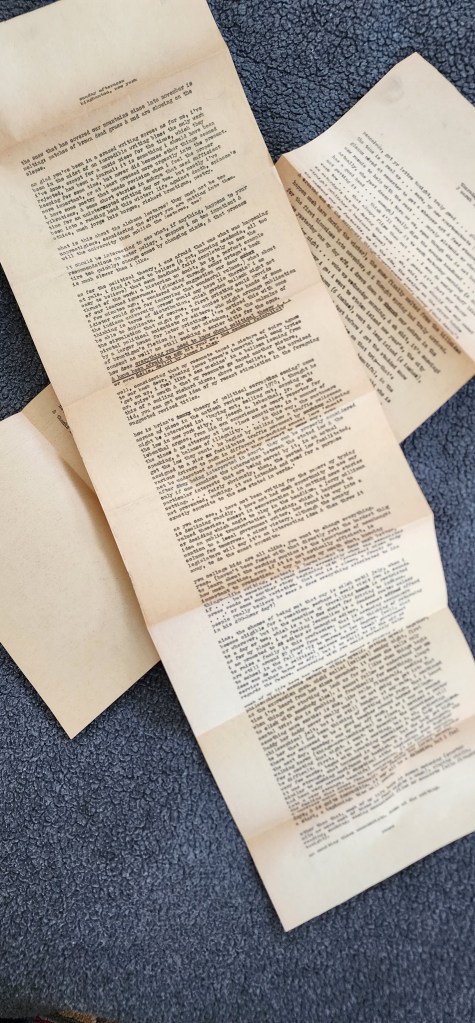
Here, should you be curious, is the conclusion of my working paper about the future of publishing as seen about 50 years ago.

~*~

As I wrote at the time:

Another aspect is that many publishers have turned toward the textbook market, which is basically a monopolistic. As a result, textbooks are generally high-priced, & in hard-cover, which increases the cost.

It is cheaper for many libraries to buy the soft cover edition (if it is sewn & not glued) & to have their own binding put on than to purchase the over-priced, & profitable, hard-backed version. hard published guarantee a market of say 2,000 over two or three for the university (or

This takes us back to the early days of publishing (ie, pre-Industrial Revolution) when readers would buy their book in paperback & have their own, often elaborate, bindings secured at their own expense & taste.

Books in the mid-1700s in England were often published by individual bookstores & sold exclusively at there. Of course, this was a period in which the realm of lettered men numbered only a few thousand in the country. Have we returned to this kind of situation, in our own unique way?

Book clubs: eliminate the middle men: find an audience.

Distribution again. Is there sufficient range of former students & others so aligned that we could years for the students of these students? We could distribute informally, at a lower cost: we could have an official cost, with a built-in mark-up, bookstores. (IU charges Workshop an additional 50 cents for special ordering a book: we could do it cheaper.)

~*~

Storage & secretarial: additional infrastructure costs.

[There was nothing more here.]

~*~

To sell to students, we must keep the cost below 5 cents a page (or 2½  cents where pages are around 5 ½ by 8 inches .2 .5 cents) to beat many Xeroxes; in some places, the machines cost 10 cents.

But our recent experience in MAXing our newsletter at a cost that  rivals off-set presses makes me wonder if we beat pirating.

On the other hand, potential pirates must first be able to get their hands on the original material before it can be copied. Hence, some publishers may be planning to sell only library editions, in a fancy hardback, from which students & scholars will make their own copies at a lower cost. Maybe it takes us on to cheaper ways for publishing our own material, with the additional hope that a second photo-copying may be of such low quality that the user depending upon photocopy sustems will require two to four impressions a page, with careful glueing afterwards, to reconstruct the original in his own reproduction. This implies a non-photocopied original.

~*~

No labor union in this visual can guarantee a creator a decent return on his labor.

[And this was way before AI].

~*~

In drawing these diverse thoughts and problems together, it seems that the problems of distribution & the declining base of broad areas of literate concern go hand-in-hand. The rise of increasingly specialized audiences has failed to acknowledge the changing economics of publication & distribution, or the increasing difficulty of policing artistic property rights.

Linked with this has been an author’s work (Xerox, magnetic tape), which with it the paradox of filling specialized markets while undermining the very royalties that make it possible for most artists to work at all in these specialized endeavors. To reap the just rewards for his own labors, the artist is now required to seek means to reproduce & circulate his own work at lower cost than is possible for the pirates — a situation that I would assume, by definition, is impossible. However, there may be a can guarantee any artist a decent living, nor a thoughts together, it seems increasing ease of pirating carries few strategies left to the artist by which he can circumvent the pirates. These are a few areas of our concern.

~*~

What are the that artist/editors can form legal co-ops to ensure the protection of their own property rights?

What are the possibilities & realities that artists/editors can form legal coops to ensure the protection of their own legal property rights?

~*~

One solution to the royalties problem could be derived from the action taken by musicians to deal with the spread of recorded music, especially on the airwaves. (We must remember that through most of the thirties, the radio networks, at least, were required, by either competition or internal decree, to rely upon only live music; changes in the economics of radio, however, brought about an onslaught of use of music.) The musicians formed two unions — ASCAP, or the Association of Songwriters, Composers, Artists, and Performers, and a rival BMI, Broadcast Music Incorporated; collect a flat fee from every station in the plays any of their works. Since policing the airwaves or relying upon station logs to determine music has been played would be prohibitive & encourage stations to falsify their records, a station plays a flat percentage of its gross or a negotiated fee, I’m not exactly sure which — but it pays that amount covered by the organization or plays nothing but its records. The collected fee is then divvied among the members.

The musicians had earlier formed the Fund or Performers Trust Fund or some such organization to counter the original inroads of records the creation of live music throughout the country. The funds collected on recording sessions (beyond the performer’s royalty) go into a fund that is distributed across the country to support concerts in the parks & so on.

A similar fee could be imposed upon all photocopying machines in the country, based on the assumption that every machine will be used at least once to copy material that is covered by copyright. The amount of the fee could be based upon the amount of usage recorded by the machine (Xerox, for example, keeps tabs on this), or on the amount of special supplies like ink or paper purchased.)

The collected fee could then be distributed among special groupings to support, physical science, and fine arts/literary journals. Poetry & fiction, by way of explanation, already receive some support from the Coordinating Council of Little Magazines, backed by National Endowment for the Humanities funds.

Although there would be the obvious difficulties in determining who would get what, at least somebody would be getting some return on their labor & a source for encouraging the unknown writers, the unknown researchers, could be established.

The courts, in several recent decisions, have said in effect that the decision is up to the legislatures and not the courts. Pending Congressional legislation would allow libraries to make one obviously not alleviate the difficulties of selective piracy.

This is where my ramblings end now.

~*~

Or so I said a half-century ago.

~*~

My, if I only received minimum wage plus interest for all the hours I’ve put into literary writings since then, I’d be rich.

You can find my works in the digital platform of your choice at Smashwords, the Apple Store, Barnes & Noble’s Nook, Scribd, Sony’s Kobo, and other fine ebook retailers. You can also ask your public library to obtain them.

Gertrude Stein could quick to the cut 

She does show up in my sets of art gallery poems, accompanied by Norman Rockwell, for good reason, if only a fictional role.

Here are ten things she really said.

  1. “We are always the same age inside.”
  2. “Why should a sequence of words be anything but a pleasure?”
  3. “It takes a lot of time to be a genius. You have to sit around so much, doing nothing, really doing nothing.”
  4. “The thing that differentiates man from animals is money.”
  5. “A writer should write with his eyes and a painter paint with his ears.”
  6. “Literature – creative literature – unconcerned with sex, is inconceivable.”
  7. “I always say that you cannot tell what a picture really is or what an object really is until you dust it every day and you cannot tell what a book is until you type it or proof-read it. It then does something to you that only reading it never can do.”
  8. “It is always a mistake to be plain-spoken.”
  9. “Money is always there but the pockets change.”
  10. “America is my country, and Paris is my home town.”

For the art gallery poems, go to my blog Thistle Finch editions.


Books? Yes, we have plenty

Mine is a family of booklovers, which means we need bookshelves everywhere in our renovated home. Make that two homes, considering the younger daughter and son-in-law, too, in their new purchase in suburban Boston. To that let me add one friend, a famed author, who had so many volumes stored in his Maine barn that one corner collapsed, according to the New York Times Sunday magazine. I’m not prepared for that possibility here in our historic house.

Still, this gets painful as we prepare for triage. What volumes must each of us keep, which ones become optional, and where will all of the remainder go?

On my end, after much culling, I’m finding my eyeballs no longer support the small type in many paperbacks, many of them with binding that is crumbling.

Gee, I’d never thought it would come to this. Take a deep sigh before they are trashed.

The other partners in this move will have to explain for themselves.