Before you start your car, thank this auto pioneer 

When we think of many of the technological advances that impact our daily lives, we usually don’t know the names of their inventors, even when we know the businessmen who got wealthy as a result. Elon Musk did not invent the Tesla, for instance, nor did Bill Gates invent the internet or Henry Ford, the auto. The list is actually a long one.

Consider John William Lambert, mentioned in a previous Tendrils.

I remember visiting an early coworker and, upon seeing an old car with an impressive Lambert name in brass across the radiator sitting at an open garage door, I asked, “Ann? Is that car any relation to you?” She replied that her grandfather used to make them but otherwise conveyed no knowledge that he had been so prominent a figure.

Here are ten facts from his life.
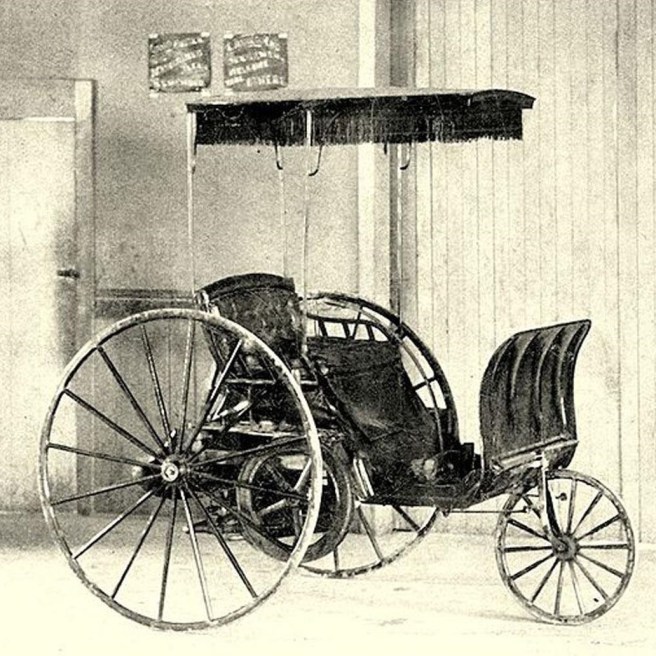
This was the breakthrough vehicle.
  1. He invented the first practical American internal combustion gasoline automobile in 1890 in Ohio City in Van Wert County, Ohio, where he tested it on the village streets early the next year. It was the Buckeye gasoline buggy, a surrey-topped three-wheel runabout with one seat. It had a three-cylinder, four-stroke engine.
  2. In 1891, that horseless carriage became the first automobile offered for sale in the United States. Priced at $550, it attracted no buyers.
  3. Undaunted by the buggy’s reception, he turned his attention in 1892 to making stationary gasoline engines for farm and industrial factory use.
  4. Lambert’s base of operations was the Buckeye Manufacturing Company, which he had founded in 1884 as a farm implement manufacturer and moved in 1892 to Anderson, Indiana.
  5. His experiments with drive-train technology led to the Lambert friction gearing disk drive transmission. The gradual, or gearless, transmission became a signature feature on all of his future cars.
  6. His next attempt at an auto line came in 1895 with a model called the Buckeye. It was a four-wheel modification of the buggy but failed to find buyers.
  7. His first marketing success was the Union, released in 1902. About 300 of the tiller-steered cars were sold.
  8. In 1906 he introduced his first Lambert, establishing himself as one of the more successful automakers of the time. Production peaked from 1907 to 1910 with 2,000 cars a year.
  9. Buckeye Manufacturing, which built the cars, had moved by 1905 to Anderson, Indiana. The Lambert Automobile Company was one of its subsidiaries. Touting its Lambert Friction-Drive Automobiles and Trucks, the Buckeye factory mass-produced Lambert’s cars, gasoline engines, and auto components as well as fire engines, railroad inspection vehicles, and steel-hoof tractors before closing in 1917. At its height, the company had more than a thousand employees.
  10. Lambert held more than 600 patents and died in 1952, age 92, in Anderson.

At its prime, the Lambert came with 15 layers of hand-painted color.


A few things I’ve celebrated over the years

(Prompted by artist Jane Kaufmann.)

  • Acceptances for publication large and mostly small.
  • When newcomers return to Quaker meeting.
  • When meeting for worship settles into warm silence.
  • Fires in wood-burning stoves.
  • Truly fine pizzas.
  • Wines and cheeses.
  • Appearances by bald eagles and osprey, some of them over my yard.
  • My wife’s Christmas traditions – especially the observation of Advent and the 12 days after.
  • Retirement and the opportunities it’s opened.
  • Viewing whales from shore here.
  • Whale watch cruises, no matter what we wind up observing.
  • A week’s windjammer cruise. Twice now.
  • Great classical music performances, including opera.
  • Part-singing in choirs, chamber choirs, and Mennonite circles.
  • The renovation of our 1787 homestead.
  • Small-town life in Eastport and Dover.
  • Sunrises and sunsets.
  • Riding big-city subways.
  • Full solar eclipses and Northern Lights.
  • The Greek Orthodox festival and community.
  • Mount Rainier.
  • The election of Barack Obama.

So why did I write poetry?

A poetry editor a decade or two ago asked why I write poems, and in response I came up with this:

I’ve been writing poetry and fiction for so long the questions of “how” and even “when” and “where” arise long before any consideration of “why.” That is, the practice quickly turns directly to “just sit down, start keyboarding, and see where it goes.” Even so, my “why” quickly turns to a succession of motivations within an evolving exploration that continued to present itself as poetry. So here are some of my primary Whys along the way:

  • Because it sustains expansive dimensions of language and thinking that have been precluded from my employment as a newspaper (and, briefly, social sciences) editor, where expression is intended to convey a single layer of factual presentation.
  • Because it allows me to pursue wordplay, surrealism, ambiguity, innuendo, absurdities, but especially my own emotions and experiences that are forbidden in objective third-person writing. (Intentionally or otherwise, my literary endeavors have worked as a reaction against and counterweight to the strictures of professional journalism, the way a pianist might balance classical and jazz or country-western performance.)
  • Because it has kept my skills as a headline writer sharp and pliant.
  • Because it collects and distills the seemingly random wanderings of my Aquarian mind and my often-obscured impressions and feelings.
  • Because it reflects the intuition and clarity that arise in my practice of meditation.
  • Because revision, a crucial element of writing poetry, pushes me beyond linear narrative to a more mysterious matrix as I looking between the cracks and broken syntax to admit other voices to appear.
  • Because it allows me mythologies for exploring and celebrating places I’ve lived and people I’ve known along the way. (If I’d taken more photos during all those years, would the drive have been lessened?)
  • Because it immerses me in a long stream of poets, troubadours, singers, storytellers, mystics, prophets, and shamans before me.
  • Because it’s a kind of prayer.
  • Because it keeps me looking at the world around me with an awareness of gratitude and wonder.

Well, that’s what I wrote at the time, and the editor fired back with a round of questions I didn’t have time to answer. Way back then. I have no idea how I would answer now. I do hope it would be less ethereal.

When it comes to daily bread, the French set a standard

Among the things we truly miss living on our remote corner of Maine is a first-class bakery, the kind that can turn out genuine baguettes and croissants.

Previous posts here at the Barn have touched on these distinctively French delights, but today the attention turns to matters of what makes something as basic as bread so marvelous.

Consider.

  1. While the roots of the baguette go back at least to the 18th century, the distinctive Parisian staple didn’t even go by that name until August 1920, when the department of the Seine regulated the product, declaring that the loaf had to have a minimum weight of 2¾ ounces and a maximum length of 16 inches and not cost more than .35 francs, making it affordable for nearly everyone.
  2. Today’s baguette has a diameter of roughly two to 2½ inches, a length of about 26 inches, but that can range up to 39 inches long, and a weight of 8¾ ounces. I’m sure the price has been adjusted over the years, even before the euro.
  3. The word itself means wand, baton, or stick. Well, from baguette to baton does make a bit of sense.
  4. French bakers were already using highly refined Hungarian high-milled flour, a compact Austrian yeast, and Viennese steam oven baking. Later ovens heated to more than 390 °F use steam injection to allow the crust to expand before setting. Vive la difference.
  5. Long loaves were already part of French culture. Some of them reached to six-feet long, resembling crow bars, in the eyes of some. Pity the poor maids trying to convey them to their master’s homes.
  6. The airy, chewy, crunchy-crust elongated bread loaves are made of basically flour, water, common salt, and yeast, perhaps with a few tweaks. We’re back to the importance of really good flour and yeast. As for the water and salt?
  7. By French law, a baguette is defined principally by its dough, not its shape. No wonder so many imitators on this side of the ocean disappoint.
  8. Sometime around 1920 (the accounts vary), bakers were legally prevented from working before 4 a.m., making it impossible to make traditional round loaves in time for customers’ breakfasts, as the Wikipedia account goes. (The bakers were also banned from working after 10 p.m.) Switching from the round loaf to the previously less-common, slender shape of the baguette solved the problem, especially since the bakers could no longer work later than 10 at night.
  9. When it comes to consumption, Algeria leads the world, with 49 million baguette loaves a day, compared to France at a mere 30 million.
  10. As far as history goes, we can revisit the classic quip of let the public eat cake when they’re out of French bread, even of the pre-baguette variety. Was Queen Antoinette out of her head? In my humble opinion, cake definitely finishes in second place.

Consider this a footnote or two

I have several pairs of identical thick wool socks – all gifted, by the way – that I’ve worn the majority of the time since moving Way Downeast, summer or winter. You can say I’m quite fond of them and their cushiony effect. But then, the other day, one pair finally wore out – under the heel in one and a toe in the other.

Emotionally? Oh well, it’s about time. Or, I definitely got my mileage out of them. Or, in response, I could elaborate on my belief in having multiple pairs of identical socks so that if one gives out, you’ll ultimately have a new match when one in another set gives way.

Instead, I was left facing a situation where that didn’t exactly fit my model. Or, what is that people say about if the shoe fits?

What is poetry, anyway?

After a couple dozen or so years that have been focused largely in the revision of fiction and then the roots of Dover Quaker Friends Meeting, itself a challenge to conventional New England history, I’ve found myself revisiting my trove of poetry.

It’s part of a big cleanup project that’s accompanying our downsizing move from New Hampshire to the far end of Maine, and I’m at a point of trying to discard everything I no longer need and put in order anything else I feel is of value.

As a result, several central full-length collections that had been presented piecemeal as chapbooks at my Thistle Finch editions blog are now released as ebooks at Smashwords.com and its affiliated digital bookstores. You’ll be hearing more about those as the year progresses.

In their place in the Thistle Finch lineup are new chapbooks of sets of my more recent poems, meaning ones from this century, though their origins go back further.

The task has come as a revelation, watching the evolution in my style and underlying voice. Each stage, reflecting geographical moves in my life and the upheavals of my closest relationships, edged me away from narrative-driven content to increasingly image and confetti centered clusters. Don’t ask me to explain them, they just are, whatever.

For me, poetry is a kind of mysticism – one foot in the inexplicable wondrous, the other in everyday life. Prose, of course, is more secular.

My newly released chapbook Aquarian Leap leads off the new run at Thistle Finch. Frankly, looking back over these, I’m not sure what to make of them other than the wild energy they inhabit. I certainly wouldn’t – or couldn’t – draft them today.

These poems, in some manner, still reflect the working of my multi-layered, mercurial thought process. (Never mind my heart, all the more elusive and often contradictory!) I love those lucid moments – sharp, brief – when everything, including thought and emotion, is centered, full, and stilled. Rarely, however, does my intellect flow in such a focused narrative. That requires more effort.

More typically, it flashes on something and then leaps to another, seemingly miles away. Some say this is characteristic of my natal sun sign. That is to say, the typical Aquarian will hear one subject and shuffle through fifty-two logical connections in a flash, and then blurt out something that will leave everyone else in the room wondering, “Just where did that come from?” (Except, perhaps, for another Aquarian, to whom it will seem perfectly logical.)

Often, my writing was constructed and amplified and then distilled from notes, many of them scratched out on a daily commute or on a hike in the woods, or sometimes even a twist while journaling. Curiously, when I assembled these into collage-poems, I was conscious of an underlying logic. That is, many snippets did not fit the emerging sense and must be laid aside. But a few others did, leading to what I hope is an internal thesis/antithesis/synthesis that’s ultimately beyond any surface or attempted cleverness. I prefer for my work to discover and uncover rather than invent.

The result in this set and a few ahead feels more like confetti. So there!

Something similar happens in disciplined meditation, such as traditional Quaker worship, where routine thoughts are patiently laid aside while one’s awareness clears and sinks to a more intuitive and integrated state. Perhaps some of that also infects these pieces.

I should confess to a few works by two poets, G.P. Scratz and Aram Saroyan, I’ve long admired, poems that defy explication or understanding yet spring from the intuitive burst that takes us beyond apparent meaning – and closer to a jewel-like condition.

Or even the freedom of dancing, which I find in a similar vein in the work of Philip Whalen, especially.

Consider the linguist’s Wolves and Consonants. (My reading of “Vowels” in a book title my elder daughter was reading.)

The growling of wolves adds a whole new way of following the Voice here.

As for any effort to define poetry itself? I guess I prefer the wilder side. Go figure.

You can find Aquarian Leap at Thistle Finch editions.

Behind the first English ocean-going vessel built in the New World

Most Americans, dare I venture, have vast gaps in their knowledge of the history we inhabit. And inherit, as well.

Even though I had visited the site several decades before I wrote my book Quaking Dover, the impact of the attempted Popham settlement came back with a whammy in the developments that followed.

More recently, a post-concert conversation with Fred Gosbee of the folk-music duo Castlebay thickened the plot.

Here we go with ten points.

  1. As far as North America goes, the French had already failed with their St. Croix Island settlement, 1604-1605. I’ve posted on that previously, since it was only a few miles from where I now live. Quite simply, New England winters can be brutal. The English established a toehold in Virginia, at Jamestown, 1607, and were attempting a twin in today’s Maine, at Popham. Again, weather would be a factor.
  2. Sir Ferdinando Gorges, the godfather of New England, as I describe in my book, was the major mover behind the project. As I’ve argued, he’s largely overlooked in his impact on what would become New England. The Native honored today as Squanto actually lived for a few years in Gorges’ manor in England, where he learned English. (Alas, he had been kidnapped. Another story, no matter that Gorges was appalled.) The Puritans would arrive in New England only because they ran a successful end play around Gorges, and then had King Charles I, fatefully, fall prey. Not that I’m particularly pitying the king.
  3. Back to Popham, 1607, where the settlers at the mouth of the Kennebec River somehow managed to build a seafaring vessel during their dark winter. Try to picture them felling and shaping trees in the depth of winter, and then framing them into a ship. Where did they get the sails, nails, and other essential items? They were barely surviving as it was.
  4. The ship, which they named Virginia or Virginia of Sagadahoc, was a pinnace, a small tender. Even so, once a supply ship arrived in 1608, they were able to use it to abandon the new colony and sail back to England. The small ship not only made it but later returned to the New World.
  5. The second and third “local” pinnaces (Deliverance and Patience) were built soon afterwards in Bermuda following the loss of Sea Venture, another story altogether. Let’s just say that conditions in Jamestown were dire.
  6. One of the Popham colonists, a young boy named David Thomson, was intrigued enough to return in 1623 to the mouth of the Piscataqua River and briefly lead the settlement in what’s now New Hampshire. That plays into my Dover book, even though he vanished before he could claim any title. His colleague Edward Hilton, however, stayed on and earned due rewards.
  7. Gosbee also told me that one of the Popham leaders had also received a major inheritance during his New World sojourn. Hearing the news of his windfall, he joyfully headed a return to Merry Old England on the new ship.
  8. The site of their colony later served the bunkers at Fort Popham and Fort Baldwin on the opposite side of the river, defenses against intruding vessels. The beach, meanwhile, is a very popular state park with some of the best swimming along the Maine coast.
  9. The Jamestown colony, meanwhile, could be the basis of a big, juicy, scandalous streamed series. Folks who are opposed to “woke” would be truly rattled by the turns in Virginia’s origins.
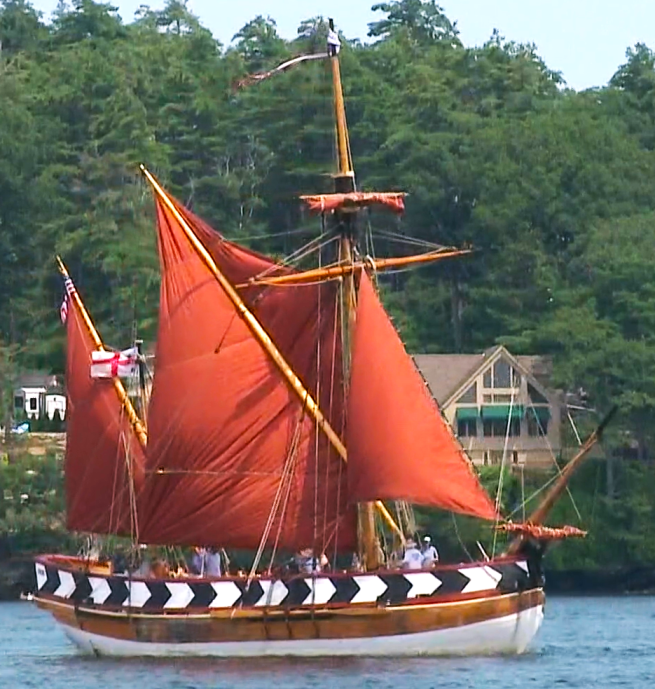
  10. A replica of the Virginia now has naval scholars wondering about some of the rigging. She is a most unusual vessel, from today’s perspective.
A replica of the Virginia of Sagadahoc plies the waters of the Kennebec in Bath, Maine, upriver from the site of the ill-fated Popham Colony. Can you imagine crossing the Atlantic in such a small craft?

Parts of my life I likely won’t be doing again

For me, this stage of winding down, or at least refocusing, includes recognizing realities of aging and finances while living in a remote area of the country. Here are some things I’d say are in my past, no matter how actively I pursued them:

  1. Hiking to the top of a mountain.
  2. Climbing a ladder more than a few steps.
  3. Hearing a full symphony orchestra in person.
  4. Ditto for attending an opera.
  5. Peyote, psilocybin, or acid. Not this far after taking up meditation.
  6. Some of the easier hatha yoga positions. Forget even attempting the harder ones.
  7. Writing and revising another novel.
  8. Sending out resumes.
  9. Camping in a tent or out in the open under the stars.
  10. Prolific orgasms.

On to the Pacific Northwest via the prairie and Ozarks

My second brace of fiction, ultimately three books in all, addressed the dozen years in the aftermath of the hippie outbreak, though I’ve tried to fudge the era precisely. I do think much of it is continuing.

Naturally, for me, they were semi-autobiographical, even though the protagonist is now a woman named Jaya who winds up with a much younger lover who becomes her husband.

The pivotal piece is Yoga Bootcamp, with her now as a central character, along with the guru they sometimes called Elvis or Big Pumpkin. My residency in the ashram was a transformative period in my life, even in the face of details I’ve since learned. We were a rogue outfit in the period when yoga took root in America. This down-to-earth story will probably scandalize your local yoga studio instructor, but the experience did reshape many of our lives, hopefully for the better. I’ve certainly carried many of its lessons far through some other faith traditions.

The central piece is now compressed into Nearly Canaan, originally an ambitious triptych that comprised the hefty novels Promise, Peel: As in Apple, and With St. Helens in the Mix. At the outset, a sense of place was central as Jaya relocated from a small town on the prairie in the American Midwest to the hardscrabble Ozarks to the apple orchard country in the desert of the Pacific Northwest, but the central theme now condenses as the question of how much influence one person can extend over others, hopefully for the better. I can ask now whether it would have been more compelling if she’d been conniving and manipulative.

The third book, The Secret Side of Jaya, is a set of three novellas, each one set in the places she lived after leaving the ashram. Each one, quite different, is premised on hearing and seeing figures in a locale that others don’t. Maybe you encounter them, too, where you are.

You can find these books in the digital platform of your choice at Smashwords, the Apple Store, Barnes & Noble’s Nook, Scribd, Sony’s Kobo, and other fine ebook retailers. They’re also available in paper and Kindle at Amazon, or you can ask your local library to obtain them.