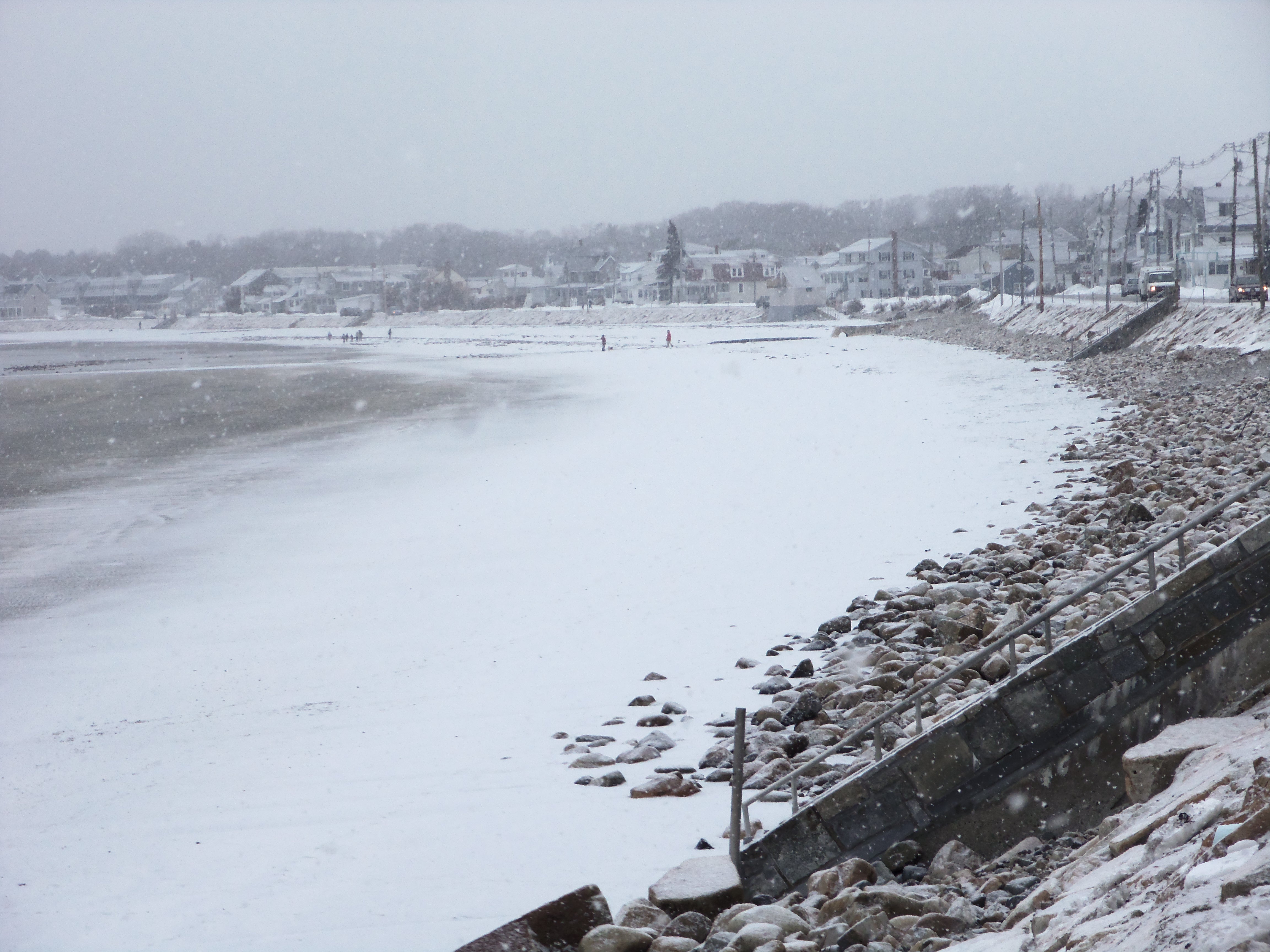
The New England coastline can be impressive anytime of the year. While most visitors see it only from midsummer into early autumn, it is unmasked much the rest of the year.



You never know what we'll churn up in cleaning a stall

The New England coastline can be impressive anytime of the year. While most visitors see it only from midsummer into early autumn, it is unmasked much the rest of the year.


While I’ve never gotten wrapped up in my wife’s fascination with gingerbread houses, my contrarian nature has embraced the idea of making an annual gingerbread LIGHT house, and here’s one result .
For the recipe and the templates, especially if you want to go for fancier results, check out this story, recipe, and assembly directions. (It’s not the only gingerbread lighthouse at Coastal Living, by the way, in case you’re really adventurous.)
The model was based on the Whaleback Light just downriver from us, so I feel it’s an extra special touch. And the gummy lobsters and gummy sharks, along with the candy rocks for the lighthouse wall, were purchased from Yummies just beyond the Kittery Outlet stores. That can be a destination for Maine visitors all in its own.


As I said at the time …
For me, writing means watching my own shifting mind while opening myself up to all the living energies around me. It means simplifying, following unexpected leadings and openings, sometimes to dead ends, other times to unanticipated ranges. Some time ago I discovered that to write poetry I had to be sitting in meditation every day. And later, I found once a week would suffice.
If ego is an ever present trap, the practice can introduce repeated humbling. As do the rejection slips.
Detachment: who wrote that! And when? (The surprise of rediscovering your own work five or ten years later. Who wrote that, it is so incredibly fine! Or: Who wrote that piece of tripe? I’m glad it never saw publication. Sometimes only pages apart.)
And then the piece goes its own way: a living organism: readers, editors see it differently from you. What you would cut they love. What you love they see as sore thumb.
What we’re most fond of is likely to be what bothers others the most; what we’re about to toss out in the next revision may be what is most effective with our readers. (Point raised, I believe, by Joyce Carol Oates; true to my experience.)
As critics of others’ work: harshest, at times, on those whose work is most like our own! Too much mirror? Push ourselves as far as we can, coming to a point where we no longer know if a piece is any good or not only that we’ve done everything in its pursuit that we possibly can at this period in our life.
Prophetic practice: light in the wilderness.
The dilemma of arts/responsibility/spirituality brought into focus by looking at something like the Florentine court of the Medici: High Art interwound with brutal political/economic force. (Throw the man out the fourth floor window; nowadays, we have helicopters. How exquisite.)
The dilemma of the news photographer: Should I save the victim and lose the opportunity of taking a great photograph? Or should I be “professional” and observe the world as an outsider? This holds for all artists: at one point are we being selfish in our pursuits? At what point is our solitude essential for the well being of all?
Into solitude / the Silence / the Holy Now, as Thomas Kelley phrased it.
At its core, I write to discover / remember / connect / distill.
In my writing I collect – that is, bring myself back together. More and more, I think on paper. I write to find what is under the words and phrases before me. Go deeper, and then wider. I write to listen. Eventually, I write to sing.
I’m inclined to agree with Bukowski in blaming Disney (with all that “happy, happy, happy”) for America’s problems. Or even the world’s. Not that I’d agree with his solution for escaping them, meaning cigarettes and the bottle or a barroom brawl and violent sex.
You see, I’m uneasy when it comes to “happiness” as a goal or a life’s purpose. There’s too much suffering and oppression around us, after all, and no spiritual unity with the universe can exist by denying that. Still, that’s not to argue we need to be pulled under with its negative impact.
As for “fun”? I see that as a self-defeating destination. Its flipside, we should note, is boredom.
Joy, however, is another matter. It’s central to the message of Jesus, as the 16th chapter of John makes clear.
To that we could add bliss or contentment, not in the sense of denying the upheavals and evil of the world but rather in the dimension of accepting a personal inner peace that allows one to labor in furthering the Kingdom of Heaven on earth.
For me, this means learning to be more loving, and that’s a never ending challenge. It’s quite different from being giddy or depressed or self-centered or even blaming, gee, I was at the beginning of this post.
Oops! Back to Square One, once again.
Although we don’t bring the Yule tree indoors until Christmas Eve, baking and decorating the gingerbread cookies that will adorn its branches can be done days ahead.


Once each week I get more than enough of rush hour, Boston style, which doesn’t rush at all when you consider the traffic’s at a standstill. Don’t know how people do it morning and evening, day after day, week after week.
It’s what I’m calling “crush hour,” even though it’s more than an hour.
Even if it’s where the jobs are, especially the ones that pay.
One of the criticisms that Evangelical Friends level at quietist Meetings like ours is that we are short on teaching. “Silent worship, for those who are well-instructed in divine truth, has real benefits,” they write, before cautioning: “upon those who have neither read the Bible nor hear it expounded the effect may be very different.” The passage I quote continues: “As a result, the Friends Church became victim to a group of erroneous teachers, among whom Elias Hicks was most prominent.” The section also points to some very deep misunderstandings among Friends, including Job Scott’s decision to remain silent in sessions called on his behalf during his traveling ministry; he sensed too many people had come with “itchy ears” primed for novelty rather than an open heart.
Ideally, vocal ministry arises as a prophetic voice, as William Taber describes in his Pendle Hill pamphlet, The Prophetic Stream. From this perspective, pastoral sermons can be criticized as arising too much as a matter of teaching and too little as an outpouring of the Holy Spirit.
Walter Wangerin Jr.’s novel, Miz Lil and the Chronicles of Grace, also addresses this, though from a different perspective. There, the young Lutheran pastor realizes that in greeting parishioners after the service, he cannot tell whether one woman is telling him he offered good teaching or good preaching on any given morning. One Sunday, however, it becomes quite clear she has been making a distinction: “’Pastor?’ All at once, Miz Lillian Leander. She took my hand and we exchanged a handshake, and I let go, but she did not. … Her voice was both soft and civil. It was the sweetness that pierced me. I think its tones reached me alone, so that it produced a casement of silence around us … there was Miz Lil, gazing up at me. There was her shrewd eye, soft and sorry.
“’You preached today,’ she said, and I thought of our past conversation. ‘God was in this place,’ she said, keeping my hand in hers. I almost smiled for pride at the compliment. But Miz Lil said, ‘He was not smiling.’ Neither was she. Nor would she let me go. … The old woman spoke in velvet and severity, and I began to be afraid.” Then she gently rebukes her pastor for unintentional consequences, after he has prided himself for being frugal by cutting off the water to an outdoor faucet.
“’God was in your preaching,’ she whispered. “Did you hear him, Pastor? It was powerful. Powerful. You preach a mightier stroke than you know. Oh, God was bending his black brow down on our little church today, and yesterday, and many a day before. Watching. ‘Cause brother Jesus – he was in that child Marie, begging a drink of water from my pastor.”
I love the way that passage illustrates how the prophetic voice flowing through an individual can be larger than its vessel. “Did you hear him, Pastor?” I love, too, the way it illustrates an elder laboring with a minister: “Miz Lillian Leander fell silent then. But she did not smile. And she would not let me go. For a lifetime, for a Sunday and a season the woman remained immovable. She held my hand in a steadfast grip, and she did not let it go.”
Quaker circles seem to be big on potluck dinners, which are humorously called a “meeting for eating” rather than the traditional Meeting for Worship or Meeting for Business. I know we’re not alone in enjoying this kind of gathering – in some locales, they’re called a “covered dish supper,” and I suppose other terms are used elsewhere in the world. And I still have fond memories of the Mennonite versions.
Still, trying to decide what to prepare and take can be baffling, as I found back when I was single. Many people lean toward soups, which I find difficult to handle in any setting that means mingling rather than sitting down at a table. Ditto for salads. There’s also the temptation to present purely showoff dishes, which in reality are usually overlooked in the array on the buffet.
My solution was potato chips, and these were often the first thing to disappear, especially if children were around.
Since then, we (meaning wife and daughters) have found several simple-to-make sure-fire hits, though:
So that’s for starters. Apart from the tater tots or the torte, though, there’s nothing for vegans. So what would you suggest for the list? It is a potluck, after all, and the table’s open.
I’d long thought of my life as an open book. No guile, no mean streak.
More recently I’ve been finding how hard others have found trying to understand me. How often, too, my efforts have hurt or offended. How often my responses have been petty, crabby, even downright nasty.
What can I say?