SAGELY, SAGGITARIUS

Why wait for the dust to settle? Here are 10 bullets from my end.

~*~

  1. Crows – dozens upon dozens – all over town, roosting together somewhere. Rook, as they say.
  2. Late afternoon driving: so much glare, not just the low sun, either, but blazing up in reflections. Wet pavement or a waterway I’m crossing.
  3. Midnight here now really fits around 10:30, unlike 12 in the summer, calculating midway from sunset to sunrise.
  4. Cranberries, so quintessentially New England, remind me of driving to Cape Cod and passing all the bogs where they’re grown.
  5. When it comes to Friends, we need new blood.
  6. Eastern Orthodox Advent starts on the 28th and continues to the Feast of the Epiphany, Jan. 6 or 7, not our more widespread Christmas Day! Since we’re taking this up voluntarily, rather than under church discipline, we make some adaptations. Thanksgiving, for one, and ending Advent on Dec. 25, for another. Does it make us look like wimps?
  7. Poetry as a heroic journey. Holy, my voice. Or gritty.
  8. Where am I NOW? Where’s my HEART?
  9. Good to be reminded of ACTIVE WAITING, especially through periods when you feel suspended, on hold until others make a decision or act or all the pieces to fall into place. Drawing from James Nayler, Brian Drayton sees a sequence in spiritual response. The waiting prompts a response, which requires prompt obedience. Next is suffering, perhaps as embarrassment or upheaval. And then public witness – telling others, even if only in a small circle. Throughout, small steps count, however tentative.
  10. How much of being a public figure is a matter of being a performer, too – someone who needs a circle of fans?

~*~
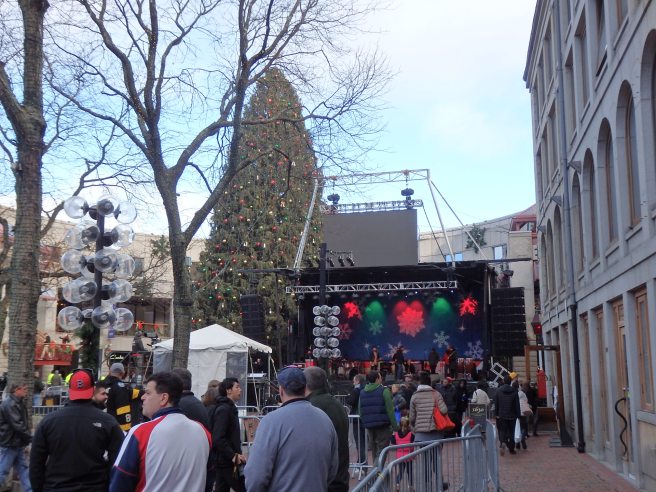
It's always an honor for our choir to perform a set for the lighting of the huge Christmas tree at Faneuil Hall in Boston. The 80-foot tree is an annual gift from Halifax, Nova Scotia, expressing gratitude for relief given its citizens after the 1917 harabor explosion that killed an estimated 2,000 people. The tree is adorned with 30,000 lights.
It’s always an honor for our choir to perform a set for the lighting of the huge Christmas tree at Faneuil Hall in Boston. The 80-foot tree is an annual gift from Halifax, Nova Scotia, expressing gratitude for relief given its citizens after the 1917 harabor explosion that killed an estimated 2,000 people. The tree is adorned with 30,000 lights. Here’s the stage before we make our entrance.

IN ADDITION TO SHOVELING SNOW

yes, they lived in a small city where he would

Pull maple seedlings, in spring
Mow the lawn, in summer
Rake the leaves, in autumn
Watch out for falling ice, in winter

they should be celebrating
all this wonder,
opportunity, unacknowledged ritual,

never-wrapped presence
now, light another candle
looking ahead, then, and looking back

Poem copyright 2015 by Jnana Hodson
To read the full set of squirrelly poems,
click here.

WANT DO YOU WANT FOR QUARTERS?

All the fat girls in town
had congregated in this Laundromat
to giggle at a skinny hippie.

When they sat, mouths agape,
stomachs bulged more than their breasts.
Everywhere, there’s a pecking order.

The manager in her blue scarf and coat
fluttered in to chase neighborhood children out.
“They mess the place up. I don’t want them.”

Kids, kids, kids, she muttered
raking in quarters – all this bitterness
robed in garments of honey and bees.

As for me, another day,
another dollar, down the drain.

To continue, click here.
Copyright 2015

A MISCELLANEOUS TENDRIL OF LITERARY ADVICE

Why wait for the dust to settle? Here are 10 bullets from my end.

~*~

  1. De-racinated, “no root system,” a criticism Tony Hoagland makes regarding so much contemporary American poetry. Also, he notes our fiction is far less diversified than our poetry, in its many tribes.
  2. Don’t know who described Franz Wright as not a formal poet yet “the structure of his poems develop organically, driven by music, rhythm, and symmetry.” Not a bad model!
  3. For that matter, who wrote, “Their humor often depends on a single word: in fact the whole laugh can rest on a single word choice,” before quoting Mark Twain: “The difference between any word and the ‘right’ word is the difference between a lightning bug and the lightning.”
  4. TONE as the angle of sensibility toward the subject. Looking, too, for the fractional element – the bit that counters the previous.
  5. As far as the persona of the writer, think of that time before World War II and the larger-than-life characters who were largely self-created: the conductor Leopold Stokowski or movie star Cary Grant as examples who wound up as caricatures of themselves, or at least strangers. It was, after all, a Sol Hurok era. As for our own obsession with “celebrities” rather than “doers”?
  6. Czeslow Milosz: “The purpose of poetry is to remind us how difficult it is to remain just one person.”
  7. Denise Levertov corresponding with William Carlos Williams: “I have been honest in what I’ve written – but with what hypocrisy I have selected what I wrote!”
  8. To which Williams replied: “You know yourself better than anyone else can ever know you. … Perhaps you will never be able to say what you want to say … deep feeling that would reveal you in what may not want to be revealed … In that case, the loss will be great.”
  9. John Berryman: “You should always be trying to write a poem you are unable to write, a poem you lack the technique, the language, the courage to achieve. Otherwise, you’re merely imitating yourself, going nowhere, because that’s always easiest.”
  10. “And these bottles of wine, which we filled, were new; and, behold, they be rent: and these our garments and our shoes are become old by reason of the very long journey” (Joshua 9:13, KJV).

~*~

OLYMPUS DIGITAL CAMERA
The Boston Public Library, left, faces Copley Square in Boston’s Back Bay. How many other landmarks, by the way, can you name that give honor to an American painter? At the right is the 1873 Venetian Gothic Revival style Old South Church. They are seen here from the steps of famed Trinity Church, whose shadow reaches across the green.


WITH THE LOCO IN LOCOMOTION

My awareness of the importance of forested trails of my own sanity and balance has evolved slowly. I see two parts at work here.

First is the aspect of locomotion. I could begin with the fact I’ve never been an athlete. As a youth, I delighted in speed — as in running or riding a bicycle — or in swimming, with its parallel of flying suspended in space. But I’ve never enjoyed the repetition of exercise for its own sake, gym class was a bore, and team sports have largely eluded me. Since I existed largely within mental activities, such as science or the arts, the idea of doing something that involved a mindfulness to my own body in motion did not register with me, at least until I took up yoga after college. I could add to this a recognition that I’ve also been filled with nervous energy and general restlessness. Sitting still — and focused — is something I’ve had to learn in the course of practicing meditation and attending Quaker meeting for worship.

Second is an encounter with natural history. Somehow, at an early age, I was introduced to geology, birding, tree identification and the like. I’ve also been interested in maps and map-making. Human history, too, which often turns up as discards in places returning to the wild.

What I’ve come to appreciate, though, is largely an esthetic response in walking through places of repose. If forest trails are the symbolic ideal here, I must admit they are not the only examples. Walking miles along the Atlantic on the outer Cape Cod shoreline, for example, serves well (although walking on sand always presents an effort) or trekking above treeline or through wild meadow can be heavenly. Even a stroll through a wooded cemetery or a city park can be recommended. But I speak of forest because of its timeless nature, in both senses of the phrase; this is what this land would remain at climax, forever. Everything is in balance or harmony. There are, of course, seasonal changes, but these are within a rhythm or cycle of returning, much like the movements of a symphony played over and over. Somehow, this begins to merge with the rhythm of walking, which itself begins to pace my own thoughts and emotions. Nothing too rushed, too overwhelming: everything, one step at a time. Uphill or down, all within reach. Walking along a city street or even a country highway can induce some of the step-by-step rhythm, but the balance is off: traffic rushes past, always as a threat, especially at intersections; there’s too much commotion or stimulation; my soul’s not at rest. Look around and notice all the trash and discard, all the waste as a social illness. The wilderness, in contrast, is continually healing. “Come to the woods for here is rest,” John Muir counseled. “There is no repose like that of the deep green woods.”

For more insights from the American Far West and Kokopelli, click here.

ALWAYS SOMETHING

1

a decrepit mess / pit

put them away

a cat, a dog, an auto executioner
gone, finally, by dawn

desperate houses plunked down in rock face
where will everyone live?

2

Warren Farm’s disastrous pick-your-own corn experiment
DeMerritt Hill Farm now owned by New York City refugees
who need to make the mortgage

while I’ve planted

blueberries, raspberries, asparagus, pussy willow,
rosa rugosa
the laurel and rhododendron that didn’t survive
all mine, all the same, within some inexplicable current

3

gentleness versus meanness
anger (I’m angry all the time)

RITUAL
versus
SURPRISE

Wild Willy’s still closed on Sundays

To continue, click here.
Copyright 2015


MORE THAN A COMMITTEE, ACTUALLY

Perhaps it will also help to keep in mind that the modern Ministry and Counsel committee reinvents the traditional select meeting of Ministers, Elders, and Overseers: those with recognized gifts in prophetic, free-gospel vocal ministry; in being bishops or anchorites, holding the meeting community in prayer; and in being pastoral caregivers, aware of temporal and spiritual needs and responding to them. At Agamenticus our biggest weakness is on the overseer front. In many pastoral congregations, I would argue, many problems arise because the pastor or minister is expected to embody all three functions, and the “priesthood of all believers” is subsequently lost. That’s a far cry from “releasing” the pastor to fulfill one gift, with the congregation performing the other roles as they, too, are gifted. In an unprogrammed meeting, this means being aware of the ways each person fits into the body of Christ.

I sense that it will be important for you to reach out beyond Orono Meeting, to find within Vasselboro Quarter and the Yearly Meeting the “secret Wilburites” who seem to exist in every meeting, but who often feel isolated; in my travels among Friends, they often come up to me after the hour of worship and express gratitude for hearing a Christ-centered, Bible-based message. One Friend observed that as she grew spiritually, she began to discover that everyone she considered a “Weighty Quake,” a Friend with depth and grounding, was also a devoted Christian. And the traditional Bible Half-Hour each morning at Yearly Meeting has contained some of the best spiritual study I’ve encountered anywhere, arising more “in” the text than “about” it.

~*~

For more Seasons of the Spirit, click here.

TURKEY TALK, TOO

The mind dances here and there, rarely in a linear progression. So what’s in my thoughts these days? How about counting on these fingers?

~*~

  1. While driving through town, I glance over at a small cemetery and notice wild turkeys padding about. A whole flock, actually, reminding me of hunting season hereabouts and the national holiday just ahead. Somehow, the critters know the calendar, and the wiser ones find sanctuary in town. Good luck to the rest of their brood.
  2. With the return of cold weather, we once again use our front entryway and the mudroom beside the kitchen as auxiliary refrigerators. Don’t trip over the pots and pans when you visit.
  3. When it comes to problems, focus on what’s closest, rather than always on the horizon. (The view from Mount Aquarius.)
  4. It’s all New Work, in the works.
  5. After all the lost or difficult years, the dashed dreams and desires, broken promises, upheavals – mingled, curiously, with gratitude. I’M HERE!
  6. What never happened – and then?
  7. Asked how long they’d lived there, in an American Walden, the artist replied: “Too long!”
  8. Could the text be made simpler, rather than wildly reaching?
  9. It’s better to know, even if it’s bad news, than to be left hanging in limbo
  10. We keep trying to find a good system for storing our leeks through the winter. We’re very open to suggestions.

~*~

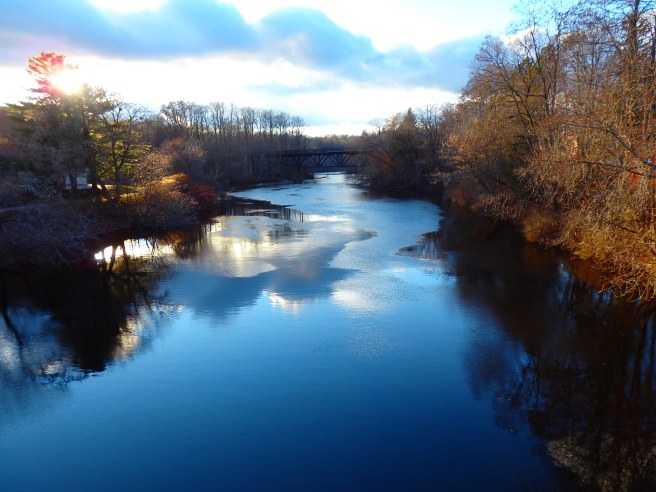
A mid-afternoon view of the Cocheco River running through Dover carries a forewarning of winter.

BUT THAT’S NOT EVERYTHING

in the median strip of Route 17 just north of Pennsylvania
Paula and I found a road map of Fayette County, Tennessee
“you wanna talk about getting lost?”

all these vehicles entering a busy traffic circle
are just a matter of shuffling cars . as the matron confided,
“Harry and I used to go down to Buffalo” to do this or do that

careening along curving roads, I saw the moon
swallowed and released over mountains . “she’s
a nice girl who does well in school, but that’s not everything”

or we could have just stopped at a
BAR DINING ROOM
flashing in orange and green neon

To continue, click here.
Copyright 2015