The role rides on conflicted feelings

As I continue to reflect on the writing life as I’ve known it, I’ve been collecting loose ends and wrapping them up. As I writer, I feel I’ve gained much with age, countered by so much that’s been lost.

I do wonder about how the parallel works for people whose best moments have been in their youth – professional athletes or dancers, for instance – but most novels do seem to be rooted by events and experiences of people under 30 or so. We can argue the same for movies, and then salute the efforts to look beyond that.

Sitting down to compose a novel requires some bravado, an assumption or presumption, even outright arrogance, that you have something important to say and an ability to do it in an interesting way.

You know, balls, swagger, mojo. Go to a writers’ group and just listen. But it’s not all sheer ego-driven. For many, at least, there’s an ongoing tension between believing in our own talents and shielding ourselves from the nagging self-doubts. Even Stephen King has them. Remember, the practice of the craft is a solitary act, not a team sport. It gets lonely, especially in the absence of feedback or fans in the stands, whether they’re cheering or jeering. Sometimes, to your surprise, harsh criticism is easier to handle than any praise.

Unless you’ve been there, you have no idea how important a voiced reaction can be in nurturing you. Those brief reviews and star ratings are important, not just for guiding others to certain books but for guiding you as an author in your practice. An astute reader picks up important elements that have slipped right over their creator’s consciousness. Please, please, please take a few moments to weigh in when you finish a volume. We all need confirmation that we’re not wasting our time – or yours. Best of all is the epiphany when we’re left feeling that someone finally “gets it,” actually understands what we’re about. Don’t be shy.

I recall giving a friend a booklet I’d written about the Quaker metaphor of Light. (By the way, in the first two centuries of the Society of Friends, the term was always Inward Light or some variant, never the Inner Light expressed today. It’s a crucial distinction.) When he finished, he thanked me, said the text had cleared up his understanding, and then added, “You write very well.” Even after four decades in the words-on-paper business, I was taken aback, considering that he is, by any measure, an important American literary figure and a master of the language. It was like “welcome to the club,” the exclusive one with the dark paneling and Manhattan address. It was like a cup of fresh water in a desert. Within myself, I felt freed from the “hack writer” label so often applied to journalists from Dr. Samuel Johnson on.

Later, in an aside, he told me I was more of a poet than a novelist. Knowing his fondness for poetry, I took some comfort in the perspective, as well as some umbrage about the fiction part. On reflection, I now have to agree on his assessment, at least as my novels stood then. He certainly helped my character Cassia press her case for the reworking of all my existing novels, as I did in the aftermath of What’s Left, where she’s the star. The revisions in that book really took off once she started dictating to me.

There’s also that frightening moment in the gap between when a book’s been accepted for publication and when it actually comes out. We’re afraid someone’s going to somehow uncover our darkest secrets or that we’ll be shamed by some indiscretion or that we’re about to make an unforgiveable transgression or that we’ll be sued for everything we have and more. Again, go to a writers’ group and listen or even ask. If you’re an author, you think you’re somehow bonkers when you feel this, not knowing how much company you actually have.

As I’ve previously confessed, I’m of the camp that hews to Bukowski’s regime of daily “butt time” at the keyboard, day in and day out, regardless of how inspired you might be feeling. Many days it’s a dry struggle, but on others something different and amazing blossoms. From my perspective, it’s when writing becomes a kind of prayer and you find yourself in a “zone” where things come together as if by magic and characters start dictating to you, if only your fingers can keep up with what your soul is hearing. It’s a dialogue with the Other, as in Muse, and you’re the mere scribe at her service.

It’s not always at the keyboard, either. Sometimes it happens while you’re in the shower or on the throne next to it or swimming laps in the pool or commuting on the highway to work.

You can’t control this. Realistically, it happens when you’re not in control.

It happened to me at the finale of Subway Hitchhikers, which years later became the launch pad for What’s Left, where I had to make sense of what I’d been given, however intuitively.

Perhaps the best, well, I just had a phone call and lost the thread of thought. Maybe it wasn’t that important.

~*~

To back up, then. I hope you’re among my small but loyal following.

Not just here at the Barn but in the novels and poetry, too.

I would like to think all this work has not been in vain.

How’s that for raw and candid?

Not that I would know how to cope with fame or fortune.

Still, every writer and other kind of artist yearns for the support of fans and a loyal following.

If you like a work, tell everyone you know.

Otherwise, tell the source. In this case, me.

You have no idea of how important even a brief review, too, can be.

I experienced that with my book Quaking Dover, especially when readers delighted in the quirkiness that led one publisher to reject it.

Let me emphasize my deep desire as an independent writer for recognition (affirmation!) – after years of largely reclusive labor. But I’m also asking which circle did I most want to recognize me – Quaker, international literary, Seacoast New Hampshire? At some level, perhaps, it was also wanting to visit Dayton and be known even there – or to hear again from many people I’ve known and lost contact with in my relocations. The Quaker world seems awfully small and restrained, especially with its three sharp divisions. The literary world, meanwhile, has so many high priests and exclusive emphases – could I move among them? Yet, if the Society of Friends is to survive and grow, I sense I must have somehow moved beyond its confines and reached out to a wider audience. In a larger sense, then, my recognition would have been as one who brilliantly bridged those disparate worlds.

Labor on, then. Or simply quit and do something more sustaining.

Still, let me fall back on this: “Jnana, I’m really amazed. I didn’t think thee had it in thee to write a novel, at least from what I had seen in thy letters and Tract Association writings. But this is amazing, I couldn’t put it down. I read the first seventy pages last night after work, and if the rest of it’s just as good … why, it reminds me of Vonnegut. Thee writes in swatches, just like him. Jnana, we’re quite different in so many ways, but thee knows what? I’ve just realized from reading this that thee looks at women the same way I do. I had the feeling that thee was speaking what I had felt.”

Well, perhaps I’m still trying to find the RIGHT people.

And I’m wondering if I’ve been too kind to the true villains along the way. Maybe their “truth” still needs to be exposed as Satan’s?

Oh, will this ever let up?
Carpooling

Bob Stratton tells of driving home from work in Lordstown when a thunderstorm rolled up:

“One of the fellas in the car said, ‘Hey, the car behind us is sure coming comin’ up fast with its brights on.’

“It was no car. It was rolling lightnin’ that hit us.”

They drove on to a diner. “I smell something singed,” the waitress said.

“If that’s all it is, we’re lucky,” they laughed, and then told her what had happened.

Several weeks later, stopping there during another storm, the waitress was now telling them their story.

“You must not recognize us,” they laughed. “We’re the fellas it happened to.”

Would I even recognize Seattle now?

In my novel Nearly Canaan, Joshua and Jaya settled into a place unlike anything they would have imagined. It was (and still is) desert, for one thing, where nearly everything has to be irrigated, for another. Quite simply, it’s a lot like Yakima, in the middle of Washington state.

But they did repeatedly visit the Queen City of the Pacific Northwest, over where the endless gray and its rains were. The enlightened residents had a propensity for dark German movies in some unique art film houses, and I doubt that I’d recognize the place if I ever go back. Remember, I left well before “Sleepless in Seattle” or Dr. Frasier Crane’s arrival from Boston, not that I’d been there, either.

That said, here are ten high points to consider.

  1. Unlike most American urban areas, there’s more poverty outside the city limits rather than within them. That probably reflects racial dynamics elsewhere or even gentrification conflicts in older cities.
  2. Seattle has some outstanding opera and symphony experiences. The Wagner’s Ring Cycle in summertime week-long festivals is legendary, even in English. The art museum, meanwhile, is third-rate despite the presence of visually intriguing local artists, at least when I was there.
  3. Yes, it can be gray for six months or more in stretches. Residents simply dodge the ongoing light rain. It can drive some people over the edge, though.
  4. When the clouds break, breathtaking views of the Olympic Range appear to the west and Mount Rainier to the east, the latter of which is technically within Seattle’s metropolitan statistical area covered by the U.S. census. Elk and bears are not enumerated.
  5. The city is the home of Starbucks coffee and the glorious Pike Street vendors’ market.
  6. That said, eat Dungeness crab early and often. It’s a delicacy found from San Francisco north to Alaska, and is at its best before shipping elsewhere.
  7. The U.S. military is a huge economic influence, even before Boeing executives fled for Chicago and the company’s reputation went into decline. Microsoft, meanwhile, keeps booming.
  8. If you visit, ride the ferries that many commuters ride daily. Puget Sound is a very active waterfront. You don’t even have to take your car if you simply want to ride out and back.
  9. I won’t even touch on the history of Grunge etc., but I will recommend wool Pendleton shirts. They’re the choice of the region’s loggers, who know wet “cotton kills.”
  10. I also recall the prevalence of mossy roofs and huge garden slugs.

Add to the list of missing in action

I’ve already mentioned telephone books.

And rotary telephones.

And now phonebooths and pay phones in general.

It’s largely gone over to donations, too, which typically prefer online credit card entries rather than paper checks. Try finding the address to send that check when you’re searching their website, perhaps on your smart phone.

For that matter, handling cash in general is overshadowed by those plastic cards.

Parking kiosks that demand credit cards do upset me, though.

I know I’m overlooking a lot more. Care to add to the list?


Some discoveries along the way

Some writers manage to follow a detailed outline, but that’s never worked for me. Sometimes I’ve had a vague timeline or trajectory or anticipated structure, but then the piece started going its own way.

Technically, that makes me a “pantser” – someone writing by the seat of his or her pants.

I do write to discover as well as remember, or as another artist once said, “What’s the use of sticking to an outline if you already know how it will end?”

Point taken.

An artwork in progress can become a living organism. It will be seen differently by readers and editors differently than from you do. What you would cut, they might love. What you love, they see as sore thumb.

I’d love to hear from songwriters and filmmakers and playwrights and painters along those lines.

There’s also the potential of becoming so rarified we lose all connection to others.

~*~

I suppose that rigidity can extend to the way we work. Do we keep a tight schedule – so many hours a day, putting in what Bukowski called “butt time,” or do we slack off and then explode in a two-week frenzy the way Kerouac would?

Again, we all differ.

Me? I used to prefer the wee hours around midnight. And then somewhere it switched over to early morning.

I had imagined having three books published each year – one of poetry, one of Quaker practice, and one of fiction or memoir/genealogy. (They were already written.)

The rest of the time would be correspondence and basic living, including a social life, with concerts/plays/etc. filling the evenings.

My wife rather scoffed at that, seeing so much I was overlooking. Alas.

As I once noted: Trying to catch up but constantly behind – the modern mind. The motor mind. As for your visions in the night?

~*~

Another shift has come in my appreciation of slang. It can truly enliven a passage.

The words don’t always continue with the same meaning, either, which is an additional live wire.

But listening to kids today or even athletes and pop musicians I’m finding I have no idea what they’re saying, not even the sentence construction.

~*~

When I first began reading contemporary poetry (for pleasure, independent of classroom assignment), I sensed that often the poem existed as a single line or two, with the rest of the work as window dressing. Now I read the Psalms much the same way, for the poem within the poem, or at least the nugget I’m to wrestle with on this occasion. Psalm 81, for instance, has both “voice in thunder” and “honey from rock.” How wondrous!

Also: Revise, revise, revise, and be alert for the flash out of nowhere.

I translated the motto inside a friend’s harpsichord as “Who sings once, speaks twice.” The original quotation, from Augustine, was “He who sings prays twice.” Maybe out of need?

Good poetry, I’ll insist, also sings. Or perhaps drums, I’ll take either. Even when it doesn’t fit traditional scanning.

Let me repeat the challenge that bad religion can be overcome only by good religion. Ignoring that only allows it to fester.

For me, the act of writing – especially poetry – becomes a form of prayer. Not that you will necessarily see that.

Does that work for any other writer? I’m all ears.

~*~

Remember, you can find my novels in the digital platform of your choice at Smashwords, the Apple Store, Barnes & Noble’s Nook, Scribd, Sony’s Kobo, and other fine ebook retailers. They’re also available in paper and Kindle at Amazon, or you can ask your local library to obtain them.

Message from another era

Art Newlin rose in Meeting and told of driving two- or twelve-hitch rigs as a young man. Once he hitched two strawberry roans to a tongue, and while they’d worked a rig before, they’d always followed and never really felt the bit or anything. Nonetheless, they performed well, even backing on command. Only later did he realize the risk he’d taken. “They could’ve become runaways. They could’ve killed me.”

He credited faith for protecting him.

Sharpen your knives for social occasions

If you’re among those of us who have some reticence or even dread about attending social gatherings where you have to engage in small talk – with strangers, no less – I’m offering this. Admittedly, mostly for my own reference, as needed. Please, please, add to the list when it comes to comments.

Get ready to tell an offending bore:

  1. “It’s hilarious watching you try to fit your entire vocabulary into one sentence.”
  2. “I’d agree with you, but then we’d both be wrong.”
  3. “Thanks for sharing your misery. Now just go away.”
  4. “You’re as sharp as a marble.”
  5. “You’re so ugly you make blind kids cry.”
  6. “Your expertise in my life is both unexpected and unnecessary.”
  7. “I don’t have the time or the crayons to explain this to you.”
  8. “If you were twice as smart as you are, you’d be half as smart as you think you are.”
  9. “May you stink forever. Just the way you are.”
  10. “Keep rolling your eyes, and you might find a brain back there.”

If your slicing and dicing of their mental lack of ability doesn’t do the trick, you can turn to their vanity or birth origins.

  1. “You’re not pretty enough to be this stupid.”
  2. “You are depriving some village somewhere of an idiot.”
  3. “Your birth certificate is an apology letter from the condom factory.”
  4. “Your parents are disappointed in you.”
  5. “It was called a jumpoline before your mom jumped on it.”
  6. “You’ll never need birth control with a personality like that.”
  7. “Oh, did the middle of my sentence interrupt the beginning of yours?”
  8. “You’re the reason God created the middle finger.”
  9. “People who tolerate you on a daily basis are real heroes.”
  10. “You should really come with a warning label.”

I really do regret not having these when the character of Cassia was emerging in my novel What’s Left, they’re right up her alley. To continue in what’s becoming my first-ever Triple Tendrils:

  1. “I don’t know what your problem is, but I’m guessing it’s hard to pronounce.”
  2. “You look like something that came out of a slow cooker.”
  3. “I’ll never forget the first time we met. But I’ll keep trying.”
  4. “Please just tell me you don’t plan to home-school your kids.”
  5. “You look like a ‘before’ picture.”
  6. “You’re about as useful as an ashtray on a motorcycle.”
  7. “I’ve seen people like you before, but I had to pay admission.”
  8. “If you’re going to be two-faced, at least make one of them pretty.”
  9. “You are proof that evolution can go in reverse.” Or, “I believed in evolution until I met you.”
  10. “I hope your wife brings a date to your funeral.”

I suspect this just touches the surface of what’s exchanged on the scrimmage line of professional football games.

Besides, please remember, when somebody says, “Where have I seen you before?,” just reply, “I’m a porn star.” Or at least, “Was.”

Should you want to compare the before and after

You may have guessed we’ve taken tons of photos of the renovations in our historic home. You’ve been viewing some as progress reports in this weekly series, but those show steps along the way.

Sometimes it’s helpful to skip over those, going straight from how things looked at the beginning and then leaping to what the work delivered in the upstairs phase of renovations.

Should you be interested in that comparison, I’ve assembled a gallery of before-and-after contrasts in a free photo album, one I’m making available to you, should you be interested.

As I’ll explain next week, we’re hardly as far along as we had hoped. So I’m calling the album “Before & Midway After.”

In assembling the photographs, I was emotionally overrun in seeing how dramatic some of the advances have been. It’s helpful in facing the remaining work ahead.

~*~

That said, check out the free tour at Thistle Finch editions.

You’ll also find the history of the house and its previous residents in another booklet, should you be curious.

Gleanings from the pressroom

After four decades as a daily newspaper editor, I was recognizing I was among the last in a long tradition. I do worry about the future of community and democracy in the aftermath.

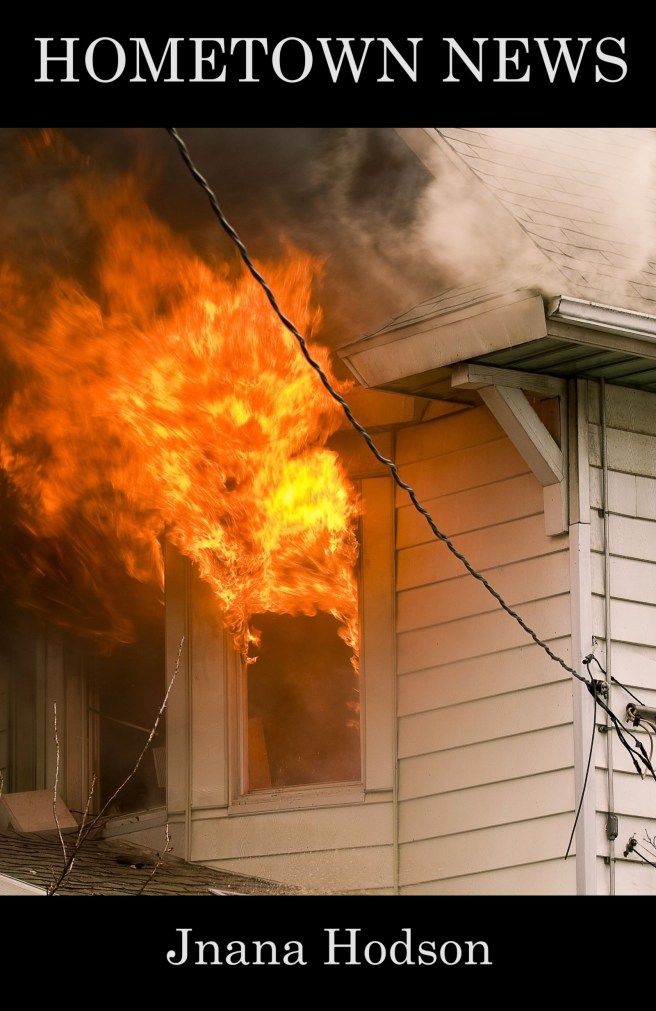
As I pitched my novel at the time, “Hi, my name is Jnana Hodson and I’m not surprised American newspapers are in crisis. In my four decades as a professional journalist, I’ve seen news coverage under attack – not just from the outside, but more crucially from owners who first bled billions from its renewed growth and vitality and now give the product away without a viable business model in sight. My novel, Hometown News, pays homage to the battle and what could have been, along with journalists’ role in the survival of communities across the continent and democracy itself. Along the way, Brautigan and Molly Ivins meet Dilbert and Kafka on the prairie, even when their names, sex, and races are changed. May I introduce you to the full story?”

An alternative version went, “Hi, my name is Jnana Hodson and my career as a journalist has placed me in enough decaying industrial cities to shape my novel of high-level global investor intrigue. If you think Dilbert tells of modern business operations, think again. May I show you my take?”

A bigger question was why anyone would be interested in this or see themselves impacted by these corporate machinations.

At their best, daily newspapers have shaped both a central identity for localities across America, and their conscience.

For many years, despite the arcane business structure in which advertising rather than sales of copies provided the bulk of the income, hometown newspapers were cash cows for their owners – who, in turn, paid their reporters and editors minimal wages.

The resulting management practices – reflecting those of surrounding corporate retailers and manufacturers – have put news coverage at risk, endangering both the communities and democracy itself. How will they, like the reporters and editors, survive?

As a journalist, my touchstones have been Accurate, Informative, Useful, and Entertaining. I wonder how those apply to poetry, as well.

The novel is cast on an experimental frame, one that anticipated AI and then backed away from it. The daily events, however, get weirder and weirder as the demands and tensions ratch up. You might even think of it a dystopian.

That said, you can find Hometown News in the digital platform of your choice at Smashwords, the Apple Store, Barnes & Noble’s Nook, Scribd, Sony’s Kobo, and other fine ebook retailers. It’s also available in paper and Kindle at Amazon, or you can ask your local library to obtain it.