What makes for a memorable getaway?

Getaway? I was about to say vacation. Who am I trying to kid? I’m retired!

Actually, when I was dutifully employed, “vacation” usually meant hunkering down at home to concentrate on my literary enterprises and revision, or maybe even a reading orgy, or taking off to a family or Quaker gathering. T’ain’t quite the same as going fancy free. Still, I managed to get away on some memorable trips.

In this list, I’m ruling out daytrips. Gotta be an overnight, at the least.

Here are ten I remember fondly, sometimes even from repeated visits.

~*~

  1. Appalachian Trail. Backpacking when I was barely 12 was an ordeal. One that’s everlasting deeply imprinted in my soul, especially the mountaintop of blooming rhododendron at the end of our week. What I recall most is the discovery that if you go far enough away from the trailhead, the litter disappears … and then you’re in a whole new, pristine, world.
  2. Fort Warden. The location itself didn’t overwhelm me, even though it overlooked the point where Puget Sound and the Strait of Juan de Fuca come together. I think that was because of all the remaining fortifications. But such incredible waters! The former World War II naval post had become a Washington state park for the arts and hosted a weeklong workshop with some of my favorite poets. Nearby Port Townsend gave us some fun bars for our evenings. The former base is featured in the movie “An Officer and a Gentleman.”
  3. North Cascades National Park. My three times of camping there and a single mountain climb with views of Mount Shuksan included finding gold dust in my dishes as I washed them in a mountain stream that swelled with melting ice during the day. I had no idea how many tall peaks rise in British Columbia till I crested the summit that day and looked north.
  4. San Francisco. It was the southernmost point of a two-week vacation that included North Pacific Yearly Meeting sessions in Olympia, Washington, and camping in the North Cascades. My then-wife and I spent two nights in our sleeping bags in the San Francisco Friends meetinghouse (I think we paid two dollars a day). My introduction to fine Japanese and Thai cuisine came just around the corner. Why haven’t I returned?
  5. Chicago. Repeatedly, each one leaving vivid memories. The art museum alone is worth the trip, but I’ve also spent time high in the Chicago Tribune tower with Pulitzer-winning journalists. The last few visits were helped by having a lover residing in Hyde Park.
  6. Greensboro, North Carolina. It was a genealogy-research trip that then swung northeast to Philadelphia and Brooklyn. I need to go back and see more, now that I know what to expect.
  7. Lake Sebago region. The year before I remarried, I spent a week in October in a rustic cabin on the shore of Crescent Lake in Maine. Cold nights required a wood fire, that sort of thing. Learned to canoe there, too. Guess it was my Walden Pond experience.
  8. Cape Cod. Since the kids’ grandfather lived in Wellfleet, we had a great excuse to visit. It was an easy walk to the ocean and a short drive to Provincetown.
  9. Providence. We found a great deal on a luxury downtown hotel, one where we looked down on the dome of the Rhode Island state capitol. The mattresses alone were enough to make us not want to go anywhere else, but we did enjoy innovative cuisine and easy public transportation. Our strolls along the river and Colonial neighborhoods were enchanting. And then there was our tour of the Slater Mill and the industrial revolution.
  10. Eastport, Maine. To put this in context, we had earlier visited Camden in dead winter and were delighted. But that’s a tony, crowded tourist hive each summer and way out of our league. Ditto for another B&B up the shore in Belfast, when we attended the Common Ground Fair. Our trip to Eastport on a Memorial Day weekend, however, was more inviting. The unpretentious, working-class easternmost city in the U.S. simply felt like the real thing. And yes, the ocean views and fresh seafood were spectacular.

~*~

Where would you suggest? Any great memories?

How personal should a character get with the reader?

In the final revision of my novel What’s Left, I’d take a passage like this and have her speak directly to him, rather than about him. It makes a world of difference. Think it would work here?

~*~

I could say it was always gentle and kind, rather than laced with frustrations and sharp clashes. I wish, well, who is any of us, in the end? Maybe I need to ask our Orthodox priest more about the Book of Life or the Book of Judgment and all that?

~*~

Do you hear her asking her father if he was always gentle and kind? Or if she should ask the priest about the rest? Do you, too, feel that line needs to be inserted?

We can easily create a shopping list of what we desire in those dearest to us — or, if we’re more ambitious, what we can offer to others. So let’s fire.

What quality would you most want in the person who’s closest to you?

~*~

Cassia’s roots included inspiration like this. Greek Orthodox icon at Mount Athos created by Father Vasileios Pavlatos in Kefalonia, Greece using the technique of Pyrography. (Via Wikimedia Commons.)

~*~


Ten cool facts about glaciers

In my novel Nearly Canaan, Joshua and Jaya settle into a place unlike anything they would have imagined. One of its features is the glaciers on Mount Rainier and Mount Adams.

Glaciers are made up of permanent snow cover that’s become compacted into what are sometimes called rivers of ice as they are pushed down a mountainside or valley.

Here are some details.

~*~

  1. About 10 percent of the earth’s surface is covered by glacial ice, but that’s shrinking fast.
  2. Glaciers store about 75 percent of the earth’s fresh water.
  3. If all of the land ice melted, sea levels would rise 230 feet.
  4. During the last ice age, glaciers covered up to a third of the world’s land mass.
  5. Glacier National Park in the Rocky Mountains of Montana has 35 named glaciers. At current global warming rates, none will be left by the year 2030.
  6. Scientists categorize glaciers into eight types, from ice caps and continental ice sheets to hanging glaciers and cirques in depressions on a mountain.
  7. Their surface often appears rough and wrinkled, containing deep cracks or fissures known as cravasses. These can be a deadly hazard for mountain climbers, especially when hidden by fresh snow or a whiteout.
  8. Ice caves melting into a glacier mouth are filled with ethereal blue light during the day.
  9. Antarctic ice shelves calve icebergs that are up to 50 miles long.
  10. To be classified as a glacier, an ice field needs to maintain at least .1 square kilometer of size throughout the year. That’s nearly 25 acres or 19 football fields.

~*~

Have you ever seen one? Up close?

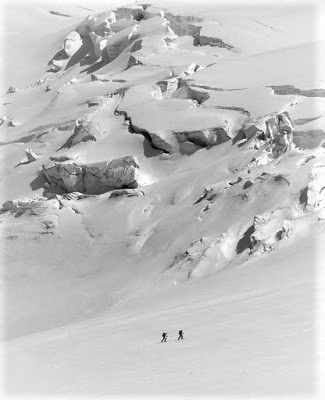
Two climbers pass under a glacier. (Photo by Kurt E. Smith)

Remembering Nosmo

I’ve never been a dog person, but we did have cats when I was growing up and again in my first marriage. These days, it’s been household rabbits, a whole different story.

But my all-time favorite cat was an all-black, marvelously sleek male tommy who was half-Siamese. He’s the inspiration for Gobi in my latest fiction. Our dog-loving neighbors even gave him the compliment of saying he was more like a dog than a cat, and their own German shepherd was one dog I came to enjoy.

The naming came about in one of my flights of imagination. I was sitting in a classroom looking at a NO SMOKING sign and wondered about shifting the space. That led to NOSMO KING, which was soon bestowed on our kitty.

I thought I was being pretty clever, but a few years later my in-laws sent us a newspaper clipping where a human named Nosmo King was mentioned. I don’t remember if he had a different last name or whether King was it. Drat!

Yes, sometimes reality is stranger than fiction. And sometimes it just leads to some strange fiction.

One way to get inside the publishing scene

As I revised my novel What’s Left, I compressed the details regarding her mother’s book-publishing venture. Here’s how it stood in an early draft:

As her dream of establishing a small-press also takes shape, the family council decides not to include it outright among our Five-Spokes enterprises but rather to extend a ten-year microloan to allow her to retain full control of its success or failure. Her game plan anticipates a modest start, essentially continuing the annual calendar and the greeting cards featuring local photographs by Baba, as well as the release of the first volume of Nita’s collected columns. These are things Baba can shepherd along while Manoula finishes her degree. From there, a cookbook would be a no-brainer in the lineup, something Barney can begin putting together immediately. We know he’ll be fussy and irritable, miss deadlines, do the whole prima donna bit. Besides, he’s not a writer, so there will be extensive editing and revision. After that, Baba can worry about the photos. He says shooting food’s a specialty all to itself. You can bet, though, the results will be worth it. And all that’s before Manoula gets to anything like poetry or fiction. 

~*~

This is so far from the snippy colloquial vibe the novel has since taken. Think of it more as a memo to the author in conceiving a plausible pathway to independent business success for Cassia’s mother. Or possibly just an old dream of my own, way back when, along with memories of a few difficult collaborators.

One struggle in shaping What’s Left was the matter of determining just how much of her family’s business side to include. Passages like this one ran the danger of turning the story into a case study for marketing or investment classes, rather than focusing on Cassia’s yearning for emotional healing.

Was I right in deleting the passage as too much “insider” insight for the novel? Or does it add to your understanding of Cassia, her mother, and her family? Do you ever dream of doing something the way her mother does?

~*~

In the family, Cassia may have had food like Spanakorizo, a common Greek dish prepared with spinach and rice and flavored with herbs such as dill and/or fennel. Photo by Katerina Strak via Wikimedia Commons.

~*~


As for that dream house itself?

We’re at a point of downsizing. On a limited budget, at that.

Here’s what’s on my list of considerations.

~*~

  1. A pleasing work area: In my case, that’s the writing studio. For my wife (the foodie), the kitchen and pantry plus utility space. And in both, abundant wiring.
  2. A good view: In our dream, we’re looking at the ocean, but a lake or mountain might do.
  3. Wood heat: At least as backup. We’ve been very happy with our efficient Jotul wood stove. Besides, it’s good backup during power outages.
  4. Adequate insulation and heating/cooling: We’re set on New England, after all. Cold drafts are expensive and annoying. And summer is really only six weeks.
  5. Easy maintenance: I’m not a hobby do-it-yourselfer, and I have other ways to spend my time than amateur house repair. Our budget needs to keep calls to construction-industry tradesmen minimal.
  6. Smart use of space for our needs: Think affordable IKEA. Bigger is not necessarily better.
  7. Sufficient and efficient storage: Closets are a recent addition to New England houses. Take it from there. In our case, this would also include expansive bookshelves and a large garden shed.
  8. A three-season porch: Elbow-room, if you want, especially for entertaining guests in all but deep winter or tackling special projects.
  9. Minimal snow plowing: Even a short driveway can be difficult to clear if there’s nowhere to pile the snow. A long driveway can be expensive to keep clear and, for that matter, decently paved. As for parking?
  10. Hot tub? Well, this is a dream list and there is that three-season porch.

~*~

What would be on your list?

Considering bang for the buck in restaurants

We don’t dine out all that often, but when we do, we want to get our money’s worth. It’s not that we’re afraid of the bill, but rather that we eat well at home and expect something that can at least match that standard.

On one hand, we’ve come to admire inexpensive menu items done precisely right. French fries or cole slaw can be especially telling, as can an amazing vanilla, as in ice cream or gelato. Freshness also is crucial, and attentive service is always a plus. That sort of thing.

Steak or lobster aren’t hard to cook, so we don’t expect to be impressed there. Scallops, on the other hand, can be tricky. And then we get to selections that require technique. That’s where we really pay attention.

What does irk us is pretentious, pricy dishes that seriously miss the mark. The stories we can tell!

Our biggest test is what we call the Oh Wow factor. You know, one bite and you’re amazed. It’s not always at the fanciest restaurants, either, so it’s not a matter of cost. Some of our favorite examples have come in storefront operations in the sleaziest parts of a town – the kind where you want to keep an eye on your car at lunchtime. Some have even been takeout only or a food truck.

I have to admit we’re more critical as the menu price escalates, but if they deliver with mastery and attention to detail, we pay gladly – and then some. Best of all, in our positive experiences, the great cooks in my family come away inspired, and I look forward to all that will follow.

What delights you the most when dining out?

One more throwaway line

I still like the line, even though I cut it from my novel What’s Left:

Manoula, in the end, would become Penelope awaiting Baba’s return.

~*~

Do you think a teenager would have uttered a sentence like that? Do you catch its classical reference? Or would you need to have it explained?

~*~

Cassia’s roots included inspiration like this. Stairs in Patras, Greece, with view of Varasova mountain across the Gulf of Corinth. Photo by Jerome via Wikimedia Commons.

~*~


What would your dream home have?

My, have things changed from the time I first proposed this as a Tendrils topic and the time I actually sat down to draft the text. I thought I’d be living in Dover for the rest of my life, but now we’re actually looking to relocate to somewhere, well, for us more dreamy. I’ll leave it at that for the time being, and besides, that prospect just may turn out to be a very pleasant pipe dream.

What I am sensing that much of the dream has to do with location, beyond the house itself. This week I’ll focus on the locale. Next week, the walls, floor, and roof.

~*~

  1. Walkability: Pedestrian-friendly, with suitable restaurants, stores, parks, medical facilities within an easy stroll. What we like to call civility.
  2. A Quaker Meeting: Kindred spirits and spiritual friendship.
  3. Natural wonder: At the moment, that includes a view of the ocean. Nearby trails a plus.
  4. Cultural amenities: Classical music, live theater, classic film series, that sort of thing. A good choir to join, poetry readings, especially. Plus a decent library.
  5. Medical facilities: At my age, having qualified doctors and a hospital or well-equipped clinic at hand has become an important consideration.
  6. Good neighbors: We’ve been quite lucky in Dover that way.
  7. Community spirit: A sense of common good makes a huge difference. I’ll include local and state taxes here, with an eye to what’s provided for the buck. (In Dover, for example, my indoor swimming pool activity would fit into the equation.)
  8. Public utilities: Hard to think that in our times, the reliability of the electrical system or broadband access has to be questioned. Water and sewage become considerations, too.
  9. Visual balance: This includes houses, gardens, and retail areas that are well maintained and have personal expression. That rules out most suburbs.
  10. Safe and secure: Low crime rate, as well as fast fire and ambulance response, are definite considerations.

~*~

What would be on your list?


Roads not taken on the way to earning a living

In my novel What’s Left, Cassia ponders her father’s career. In an earlier draft, she noted:

At the least, he might take a position on a magazine or major metropolitan daily, based on the portfolio he’s amassed.

Even so, about the time he moves in with her family:

He replies honestly. He’s living hand-to-mouth as it is, thanks to his full-time professional calling.

~*~

I’ve known more than a few people with great talent and great potential. Somewhere, though, they failed to leap the gap. I could point to big changes in society that increased the distance, but even so, I mourn that we’ve lost much.

Step back and look at your situation now. In the movie version, where would you find glamour? And what would come across as funky? Give it a title, if you will, as part of your pitch. Let’s live fully, where we are!

~*~

Don’t forget: You better be good to toads!