I’m owning up to fantasy and the paranormal

Never thought I’d be writing a ghost story, but that’s what happened in a chapter toward the end of What’s Left. Actually, it kinda dictated itself.

In retrospect, it looks pretty natural, considering that Cassia’s trying to recover her deceased father. What happens along the way, though, is that she uncovers a lot about her other ancestors, too, and from there she begins realizing the crucial impact many people, past and present, have in shaping her future.

The ghost story wasn’t all my idea. I was inspired by one in the novel whose structure I was adapting. The two chapters, for what it’s worth, are quite different.

The poet Gary Snyder, quoting an ancient Chinese folk song, has noted that the traditional way of making an ax handle was to take another one and use it as the model in making a copy. Likewise, I wanted something other than the usual 20- to 24-chapter novel and, as it turned out, the structural model for the new story remained intact. It didn’t quite hold for Daffodil Uprising, but it was still useful. The model also had me looking at each chapter as a panel or tile that might be moved around independently, a concept that didn’t entirely remain in what emerged.

As for the ghost story?

Remember, I’m coming from a “just the facts, ma’am,” career in daily journalism. Verifiable facts. Cold, hard facts. As for emotions? In fiction, I might stretch that to reporting what individuals say they’re feeling, but beyond that? Well, as I’m learning, fiction allows me to record how something feels, rather than how it empirically is. A lot of that awareness, by the way, came about for me in my revisions with Cassia.

Still, when it comes to ghosts, remember – little of my writing is conventional. So my ghost story winds up being humorous, rather than scary. Got a problem with that?

I might add that living in New England, I’ve become aware of how many people admit having ghosts in their houses. Even highly educated, otherwise rational folks. As far as I know, mine’s an exception, unless the specters inhabit that room we still haven’t discovered after 19 years here – the one housing all of the things that have gone awol, one by one.

~*~

I’ve previously posted on my aversion to genre, and that includes fantasy, especially of a paranormal sort.

But Cassia had me reconsidering that. I mean, I loved the Hobbit epic back in college. And what do I make of my appreciation for mythology or even Wagner’s Ring Cycle? Where is the line drawn?

So as I ventured on to revise the novels dealing with Cassia’s father (remember, she was nowhere on the horizon of my radar at the time they were written and published), I felt a new liberty. Why not employ elements of fantasy and paranormal, especially, in addressing the ’60s? They really do seem to fit the story.

I’ve long had a fondness for surrealism, which was a central strand of my subway novel. But my new thinking about fantasy now infused the revisions there, too. The second half of Subway Visions is livelier that way. The book is no longer an image in search of a narrative.

My novella With a Passing Freight Train of 119 Cars and Twin Cabooses also was framed on a surrealistic leap. The characters, though drawn from different points in history, were never ghosts, but seeing them from a fantasy perspective certainly made the revision easier as I realized it could fit into the third book of Tender Connections, my series about Jaya.

A related novella, Kokopelli’s Hornpipe, likewise benefitted. Its basis was mythology. What, a flute-playing giant cricket couldn’t also be fantasy?

To pull the two novellas together as a single book, I really needed a third novella, and Miller at the Springs emerged to sit between them. It easily slipped over the limits of hard-and-fast for me and was a delight to write, even when I had no idea where it was headed.

The three now fit neatly, I think, into The Secret Side of Jaya. Let me know what you think.

Gee, I wonder if I’ll ever have a place to include dragons? Or …

~*~

Don’t forget: You better be good to toads!

We’re coming up on what would have been the big 50th anniversary Revels Christmas production

Every December, the Boston Revels produces a new winter solstice celebration that now plays to 18 sold-out performances in Harvard’s historic Sanders Theatre. Or did, before the Covid-19 restrictions.

From their first round in 1970, the shows have grown into a unique hybrid of storytelling, theater, dance, concert, audience singalong and other participation. Each year focuses on a different corner of the world or a historical event.

Guest artists bring their traditions to the company, and the costuming and sets are always spectacular. Nobody could forget the big canoe that came flying out over the audience in a Canadian show a couple of decades back.

Well, this year’s production won’t be live in the flesh, but rather a streamed online retrospective. I don’t really know how to count it. Still, if you go to the revels.org website, you can attend a virtual show wherever you dwell. Admittedly, it won’t quite be the same.

Here are ten we’ve especially enjoyed.

~*~

  1. Leonardo da Vinci. This was founder John Langstaff’s final appearance with the troupe, and it focused on three different cities in Renaissance Italy.    
  2. The road to Campostela. The culture of Spain’s Galatian region was featured in this homage to the pilgrimage known as The Way. Storyteller Jay O’Callahan was captivating, the flamenco was quite moving, and you wouldn’t forget those Spanish bagpipes.
  3. Wales. There’s more to the British enclave than Dylan Thomas, though it did provide the timeframe for this production.
  4. England’s Crystal Palace. How truly Victorian.
  5. Venice in the 1500s. The music wasn’t all Italian and Latin, by the way. The Croatian, Sephardic, and Turkish pieces were all hits. And the story was a delightful comedy.
  6. Acadia and Cajun. We followed the life and expulsion of this French-speaking people from Canada to New Orleans. The big tree at the back of the stage kept shifting color as needed, and the stream of immigrants into exile seemed to be endless, even though it was only the chorus of children and adults repeating their exodus toward the audience.
  7. Nordic. Six languages, including English, big slices of the Kalevala myth, and a lot of polkas. The Scandinavian fiddles are distinctive.
  8. Armenia and Georgia. I loved the economy of this one. The first act centered on a pilgrim in Armenia, where the Christian church took root at the foot of Mount Arrat, the landing place of Noah and his ark. From there, the second act followed him one locale over, to the Republic of Georgia. Though so close together, the traditions were also strikingly different. The Revels headquarters is in Watertown, a major center of Armenian population and culture, so finding a great cantor was no problem.
  9. Scotland. Langstaff had a passion for Britain, and its folk culture is deeply engrained in the Revels DNA. We didn’t get to the acclaimed Irish show, but this one included reels we still dance in New England as well as songs familiar and rare.
  10. American roots.  Last year’s show started at a rural radio station somewhere in the South and covered a lot of ground by the end.

~*~

What live Christmas season events have become part of your tradition?


Sustaining the teaching — and the teacher

Until the next-to-the-last chapter of my novel What’s Left, the resident Tibetan Buddhist master, Rinpoche, stays largely in the background.

He’s a stabilizing influence of Cassia’s family, all the same.

As she realizes, in earlier drafts of the novel:

I am impressed by Baba and Tito’s roles — the entire family’s role, in reality — in establishing the Buddhist institute. Our charitable foundation was established as a vehicle to support Baba’s research time as well as the institute and the new Pan Orthodox church — along with college scholarships for family children as well as those of many who’d worked for us. The foundation, then, was another enterprise from Dimitri’s socialist cognizance as it blended with our growing spirituality.

The family’s financial security was especially important in supporting her own parents through some transformative years:

For my parents, it provided enough income for them to pursue their dreams, even before we kids came along. Manoula’s share of the dividends and, I’m inclined to think, a consulting stipend from the company itself also allow Baba to focus on establishing the Tibetan institute here. For the first year, the Tibetan research operates out of their apartment, along with our publishing setup. And then, with Rinpoche in place, the institute settles into a small house more or less in the middle of Mount Olympus, where the guru can live in proximity to selected students the way Baba had.

But over the years, their individual practice wavered. With Barney, for instance, as Rinpoche explained:

More and more, we argued. Your Baba could still converse with him about these matters, but Barney kept quoting another teacher, far more permissive than me. What he allowed, we wouldn’t. But a few years ago, that guru died of complications of his wild lifestyle. It was scandalous.

As for her aunt Pia?

Rinpoche tells me she attended the weekly sessions with Theos Barney and the rest of the family, but her heart remained with the church.

And then Cassia has more pressing matters:

Pain? You say it’s an illusion, not real.

Oh, I’ve had some long discussions with your priest about that! From a Buddhist point of view, pain’s not real the way material things aren’t real. That doesn’t mean they don’t get in the way. You just have to learn to see through them. You can’t refuse to directly examine an obstacle, though, and expect to be liberated from it. You just have to remember what’s beyond it.

The mountain?

There’s no avoiding it.

~*~

In Cassia’s family her father finds much more than a circle of faith. He gives and receives support in everything he values.

How do you support others? Is there one place you feel is especially important? What causes or organizations do you help?

~*~

Tibetan Buddhist double-dorje emblem. To me, it looks almost Greek Orthodox.

~*~

What is it about Memphis?

In my novel Yoga Bootcamp, Jaya’s guru is a native of Memphis, there on the Mississippi River.

And much of the action in my novels Nearly Canaan and The Secret Side of Jaya takes place in Arkansas, right across the river.

It’s more influential than I’d thought.

Here are ten tidbits.

~*~

  1. It’s populous. With a metro population of more than 1.3 million, Greater Memphis is the most populous locality in Tennessee. However, the city itself has 650,000 residents, making it second behind Nashville.  
  2. FedEx headquarters. The airport is the world’s second-biggest cargo operation.
  3. The river. The busy shipping port moves 11 million tons of cargo a year, much of it arriving by train or truck.
  4. King Cotton. Half of the nation’s cotton is traded at the Cotton Exchange on the riverfront.
  5. Music. Sun Records (founded in 1950) became the birthplace of rock ‘n’ roll in the 1950s. It was the first label to record Elvis Presley, Roy Orbison, Jerry Lee Lewis, and Johnny Cash. It was sold in 1969 and eventually moved to Nashville. Meanwhile, Stax Records (1959-1976) was a fountain of the Memphis Sound, mixing blues, rhythm and blues, and soul.
  6. Graceland. Presley’s mansion is visited by 600,000 tourists each year. In America, only the White House attracts more.
  7. Civil rights. The motel where Martin Luther King Jr. was gunned down in 1968 now houses the National Civil Rights Museum, a Smithsonian Institution affiliate.
  8. Edible flesh: The city is the largest livestock and meatpacking center in the South.
  9. Fire up: The World Championship Barbecue Cooking Contest each May offers $110,000 in prizes.
  10. Namesake: It’s named for the city on the Nile in Egypt.

~*~

Ever been there? What struck your fancy?


How Cassia herself evolved in the revisions

No matter how much my novel What’s Left is framed by the ending of my first published novel, most of its characters and action are entirely new.

Well, if you can call going a few more generations “new,” they’re fresh characters in my fiction, filled with color all their own.

Cassia herself and her brothers and cousins and aunts Pia and Yin are certainly original to this story. And yes, a lot has happened in the 50 years since her father joined in with the family.

As one now-deleted line admitted:

Your very presence alters the vibe. There’s the whole nonconformist groove.

This was a description of what her parents’ generation was doing to the restaurant immediately after the fatal car crash, but it could fit much more widely.

In each revision of the novel, Cassia took another step forward. She’s always started her quest at age 11, but most of it was told as a young adult recalling her string of discoveries. Now, however, much of it emerges when she’s 13 and moving up through her teens. For contrast, the final section comes a decade later, after she’s ranged the wider world.

Crucially, in the final revision, she’s speaking directly to her father throughout, rather speaking about him. And, as noted, much of the action has moved forward into her early teen years.

Somewhere along the way, her quest took a flip. It became more about her discovering just who she is and her role in the action. And that’s when she started dictating passages to me, the author.

When I selected her name, Acacia, I didn’t realize how prominent it is in the Bible. In the King James translation, it’s rendered as shittim — what an ugly word! — but Moses was very fond of the extremely hardy wood, and it’s mentioned more than 30 times, often as a required material for holy construction. Americans are most likely to encounter it as the fragrant black locust tree, thorns and all. (OK, officially that’s considered false acacia, but still … close enough for me.) Its flowers are quite fragrant.

~*~

Well, an author can’t include all the details.

What do you think Cassia’s favorite food would be? (Don’t you dare say the Streetcar!)

~*~

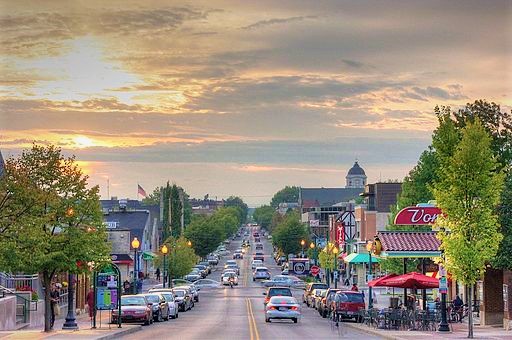
Kirkwood Avenue in Bloomington, Indiana, a town that inspired much of the novel. Cassia’s family compound and restaurant would have been off to the left.

~*~

Work! A four-letter word

One of the ideas at work — oops! — in my novel What’s Left, is work itself.

Most of us tend to think of it as menial labor, I suppose, but it doesn’t have to be. In the story, for example, Cassia’s aunt Pia has a way of making every task fun and meaningful. And Cassia and her brothers and cousins all put in hours at the family restaurant from an early age on.

~*~

Her aunt Nita also had some insights on work. Here’s one I cut from the final version of the book — we simply had more on our plate than we could manage:

Day by day Nita worked her column like a line cook … a station chef. And she dared tell me journalism’s not like an assembly-line job?

~*~

The poet Donald Hall once broke labor out into three kids: work, jobs, and chores. Maybe you’ll see how they differ.

Tell me about something you do for the pure joy of doing it, even though other people might think of as, uh, tedious work.

For some of you, this could be gardening or cabinetry or decorating cakes or arranging flowers or, well, you get the drift. For others it might be an art or sport or public service.

Is it something you also get paid to do? Or could you?

~*~


Things I’d do if I were president

It’s in the air. Can’t help but wonder.

  1. Raise taxes on the super-rich to bring them more into line with the rest of the populace. Like if you own 50 percent of the wealth, you pay at least 50 percent of the federal budget. Use the income for health care, education, and similar benefits for all citizens. (Yes, it’s income redistribution … but so is an economy where cheap imports keep lowering wages.)
  2. Support environmental action and sustainable economics. We’d be back in the Paris climate control accords, for certain.
  3. Raise the cap on Social Security contributions by the rich. Of course, we can afford Social Security if we’re willing. Just raise the cap on the superrich.
  4. Demand auditing controls on military expenditures. Bernie’s right on this one.
  5. Impose a national sales tax for health care relief for domestic manufacturers. This would level the playing field when it comes to imports versus homegrown.
  6. The next step? Medicare for all.
  7. Raise the minimum wage. Nobody can live on the current level. It’s an insult to the value of labor.
  8. Recognize a shorter work week as the basis for benefits and workplace protections.
  9. Break up the banking and financial conglomerates. Too big to fail is an invitation to another colossal collapse.
  10. Name Barack Obama to the Supreme Court.

~*~

OK, since we’re dreaming, I’d also have a problem-solving Congress. One without Mitch McConnell.

What would you do?

Maybe this is backwards, but the cover can change the story

This self-publishing field means an author is typically deeply involved in all parts of the project rather than just the writing itself.

In my Smashwords releases, I initially hired a book designer to do the covers, but my current releases have all been created by me. (Someday, I really would like to have an artist design the front, but for now, I’m sticking to photos or existing stock artwork. We’re on a strict budget.)

Still, finding an appropriate image can be a challenge.

Has anyone else had this experience? You come across a picture that clicks and select it – and then you go back into your manuscript to make the visual fit better with the text?

For me, that happened with the portrait I settled on for Promise – the model gave me a clearer vision of my character Jaya. (That novel’s now part of Nearly Canaan.)

More recently, with Yoga Bootcamp, the handstand dog reminded me to keep the story lighthearted and humorous in my final revision. Did my decision to nickname the swami Big Pumpkin and Elvis come after the pooch was on board? I don’t recall now, but it certainly wouldn’t surprise me.

Do tell me about your favorite book cover. Does it influence how you see the story? If you’re a writer, has the art on your book led to revisions?

~*~

By the way, I do hate it when the character on the cover is shown, say, as a blonde but is described in the story as a brunette. That sort of thing.

And don’t forget: You better be good to toads!
Feel like quitting?

Got the day after Labor Day blues? Think of a job or school or volunteer post. Whatever. If you need an excuse, you can always tell them something like this.

  1. I’m tired.
  2. Won Megabucks.
  3. Am about to be beamed up, out of here.
  4. Got a better offer.
  5. Have had enough B.S.
  6. Don’t like the public I’m dealing with or my coworkers or the setting or my surroundings.
  7. Don’t agree with policy.
  8. Can’t live with the dress code.
  9. Just don’t care.
  10. It’s too expensive compared to the pay.

~*~

And here I am, retired.

What would you add as an excuse?


Missing from his photographic evidence

As Cassia discovers in my novel What’s Left, her father’s photographic record includes some serious gaps.

One involves a side of the hippie era, especially his experiences going underground in New York City.

As Cassia comments in an earlier draft of the story:

From his photos, I have little to go on regarding the hitchhiking, much less the subways. Not that there aren’t images — they just don’t reveal anything. Maybe it was largely in his mind. Maybe mostly a pipe dream. Entertaining, all the same. And one or the other landed him here.

~*~

Looking back on the era, I wonder how I’d react seeing photos of the people I was with or the experiences we shared. The nude group swimming at the remote lake in the summer? Not nearly as sensuous as I remember? Former lovers? Half of the places I lived have been torn down, as I see from satellite maps. You get the idea.

The time seemed so full of promise.

Tell me about the biggest disappointment you’ve ever had.

~*~

~*~