Vol. 18 began at the onset of my ashram residency. 23:XI:71.
On the inside cover, I inscribe, I, Elektrik Blue, Uranian, incarnation of Sacred Self, continue this journey.
Not a lot of poetry here but it does include early attempts at my astrological charts and some personally deep ashram mud.
First of all, I was deprived of many of my usual supports: reading of books and magazines, recorded music (though I did have my violin and attempted Bach two-part inventions on piano), movies or other outings, favorite foods. My newly blooming romantic outlook was totally nipped (celibacy and then the brahmacharya rags that served as a jock strap), although I was very much attracted to L.G., 17, daughter of Hunter’s friend Dick, and we had more charming interactions than I had recalled – until the incident in the attic. (I first record her as “Lynn,” which led to complications in reconnecting the thread.)
I was heavily criticized for what I said (too bookish or lecturing), inattentiveness to others, negativity. I was also put on my first Silence.
My struggle included attempts to reconcile my idealistic expectations with the sloppy realities I was inescapably facing. Except for Levi, the rigorous, systematic scholarly framework I sought was absent (even in a Zen absurdist degree). Cedar had her brilliance and insights, but nothing sustained. Levi pointed out that he and I were there for the discipline (practice), unlike the others who saw more of a back-to-the-earth party household. (Sports editor Russ Warman had thought my reason for relocating was to taste “rural life” – how curious considering how many of my residences have been that: Eggs Ackley, such a contrast in group living to the ashram, and then the places I settled in returning to Bloomington, and then on to the orchard in Washington State, the pig farm in Iowa, and perhaps Dover, with our city farm.
What began as an attempt to understand “my problem” (the depression) now had me once again sensing I didn’t fit in. My goal of becoming naturally high, wise, and holy enough to win back Nicki remained a motivating factor, along with self-liberation and enlightenment – transcendence.
I’ve joked about taking up yoga because I couldn’t afford psychiatric therapy, but I now see that both have wound up forcing me to examine the darker sides of my inner workings.
The resentments and anger, especially, built up as I ran up against the lackadaisical airs, and sometime irresponsible or inconsiderate actions of the others.
Especially heavy was my having to shut down all of the newly released sexual freedom and ecstasy. More on that anon.
My notes overflowed with locker-room coaching kinds of exhortations to push, strive, not let up, in the practice. In essence, to fly over my problems, rather than turn them into compost. My verse was largely bombastic, polemic, didactic generalizations and diatribes contrasting our superior ways to the rest of society.
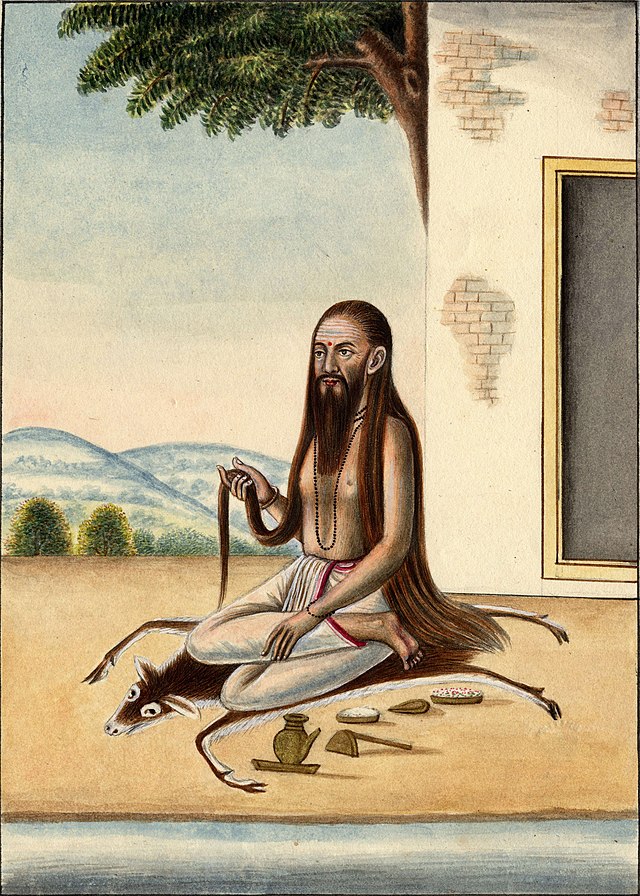
Well, this is kinda how I saw myself at the time. This image of Bharadwaja, seated on an antelope skin and surrounded by implements needed during his meditations, is from Wikimedia Commons.
All of this was intensified when Swami took off with Levi and Theo on extended travel to the Midwest (including Dayton). I was left as the sole resident male with three hippie chicks, at least that’s how we were seen on our trips out in public to the supermarket or diner. I noted that having a woman was my desire a year earlier but now? I perceived how inadequate these three were for my needs, even in celibacy.
Would it have helped to point out that I had to own up to my own demons? A year earlier, I never have considered that mumbo-jumbo.
Swami did point out that unlike us guys, the girls played games of their own invention, something that drove me further nuts.
This became extremely pronounced in trying to write an article for Mother Earth journal. Everybody had a different take, taking us further and further from what the editors wanted. In the end, the proposed story went off the rails.
Ria was the most complex case, I’m thinking. She had been involved in some of the more satanic streams – she “used to go with the guy who wrote Rosemary’s Baby, the infant with solid gold eyes, a tail, and long claws. [The author who wrote the bestselling 1967 novel was born in 1929 and divorced in 1968. The plot thickens.] We observed that what she really wanted was a home on a small pond with a rowboat.
After leading hatha and meditation one night, she turned to me, “Where were you? Your vibes were absent during the second half of our sitting.”
Theo (our seven-headed horse) usually appeared as the happy-go-lucky physical laborer counterbalance to Levi and me, though my early notes show him instead as intensely egotistical and “two-faced.” Ouch! He did teach me ways to ease off and loosen up, on the sly.
Our first, chaotic, week-long intensive session came over Christmas break, much earlier in my residency that I recalled.. Some of our actions I now must admit were offensive, even harmful, not that I could object at the time. Still, it was a huge opening in reshaping the direction of the ashram’s mission. One guest did mention hearing scandalous stories about our ordaining swamis under “questionable circumstances.”
Curiously, some of our guests – usually female – took me aside to say I was the only one in the community who understood and embodied our beliefs. That was tempting.
As for my response to the Zen koan, “What was your original face before your mother’s birth,” I noted: Close your eyes! (The koan really goes, “Show me your Original Face, the one you had before your parents were born.”)
Other bits:
“Last night in meditation, I saw Jesus – the dark, straight-nose, pointed jaw Jesus of the most popular portrait. He came into our circle and sat beside Cedar. [She’s Jewish.] Such a strange looking man.”
My other meditation entries were all about lights, warmth, feelings. Example: “Felt the flame burning up around my body but I, in the center, was cool. I see a little light, or merely cold light. I break my meditation to answer the phone and return without losing the high.”
“I am the center of my universe.” Well, in relationships, it could as easily have been, “She is the center of my universe.” Never, really, though, would I have said God or the like.
When L.G. asked about my parents, she laughed at my description: middle class, don’t smoke, don’t drink, don’t curse.
A country-western song idea: “Heaven is just a liquor store up in the sky.”
“Sometimes I think I’m more alive on paper than in person. A man of letters? A paper tiger.”
Also, mention of riding our horse Timely, English-style, “very high … like bareback, flying.” Also, 12:XII:71, Hunter’s asking if I’d like to hear some jazz, which led to Deer Head Inn at the Water Gap. Some very fine piano riffs. Nice, clean place: table cloths, nothing fancy but simple, art on the walls, some nice reproductions. With one of his friends, a freelance commercial artist.
Other musicians showing up that night were two bassists. One joined us at the table and told of quitting playing with a group at one famed resort. “They were in their 50s and so bad you couldn’t follow them; it sounded like church music.”
An ashram guest who had worked for a VD doctor said it was enough to put anyone off sex.
[Incinerated]
~*~
From Spiralbound Yoga, with commentary from now.
 Jnana's Red Barn