… the most common and durable source of factions, has been the various and unequal distribution of property. Those who hold, and those who are without property, have ever formed distinct interests in society.
James Madison in Federalist No. 10
You never know what we'll churn up in cleaning a stall
… the most common and durable source of factions, has been the various and unequal distribution of property. Those who hold, and those who are without property, have ever formed distinct interests in society.
James Madison in Federalist No. 10
… it seems to have been reserved to the people of this country, by their conduct and example, to decide the important question, whether societies of men are really capable or not, of establishing good government from reflection and choice, or whether they are forever destined to depend, for their political constitutions, on accident and force.
Alexander Hamilton in Federalist No. 1
Seems fitting in this presidential election year that we revisit what the Founding Fathers envisioned in crafting their new nation.
I was fortunate to study under and work with Vincent Ostrom at Indiana University. As a professor of political policy and administration, he led me in a close examination of the logic underpinning the Federalist, a series of historic papers that argued for the passage of the proposed Constitution. His resulting book, The Political Theory of a Compound Republic (1971), and later volumes presented a much different understanding of the workings of democracy in the United States than I had found in the more conventional, top-down perspectives. He dubbed the overlapping jurisdictions a polycentric system, or a “compound republic” in the words of the Federalist, and found in it flexibility as well as layers that ultimately enhance democracy.
Through the coming year, the Red Barn will present weekly excerpts from the arguments written by James Madison, Alexander Hamilton, and John Jay but at the time attributed to the nom de plume Publius.
Let me admit that it’s been years since I last opened my thoroughly marked up copy of the collected papers, a trade paperback I bought for $2.45 back in 1968. I’ll probably be embarrassed by some of my notes in the margins and perhaps also surprised by some of the phrases and sentences I underlined while overlooking more profound insights on the same page.
In this round, we’ll stick with the original text, apart from the titles I’m applying. The prose looks quite different to me than it did more than a half-century ago, even without all the recent political turmoil we’re seeing.
One of the sides my Quaking Dover presentation for Cape Cod Friends awakened in me was a nagging awareness that some of the elements that encouraged social progressive action could also be used to sustain reactionary conservative activism from the other sides as well.
This could be seen especially in the U.S. Supreme Court’s overturn of the Roe decision, the result of a long-term resistance movement, where reactionary forces could claim a victory.
Quite simply, both side have deep roots, perhaps unlike the middle.
My big question now is what makes one morally superior to the other.
The answers, I suspect, can be quite humbling. As well as a point of common engagement.
You can catch up with my insights on “Quaker Meeting as a nest for social justness” via YouTube, thanks to West Falmouth Friends on Cape Cod.
The event, the latest of the special presentations based on my book, Quaking Dover and the New Hampshire city’s 400th anniversary, was recorded and is now available.
Many thanks to all involved.
To see what transpired during the hour, click here.
New England history is all through Harvard. And then Yale and Williams College.
Except, of course, a few mavericks like me. (Even though, humbly confessed, I’m not a historian.)
Well, you do have another opportunity to see why he said that if you register promptly for my free Zoom presentation from Cape Cod at 12:30 Sunday afternoon ( https://bit.ly/QuakingDover ).
Here’s hoping to hear from you there!
I didn’t make these points this baldly in my book Quaking Dover, but as I’ve prepared for my upcoming presentation from West Falmouth Friends’ Peace and Social Order committee’s Zoom presentation, I’m seeing these elements at play.
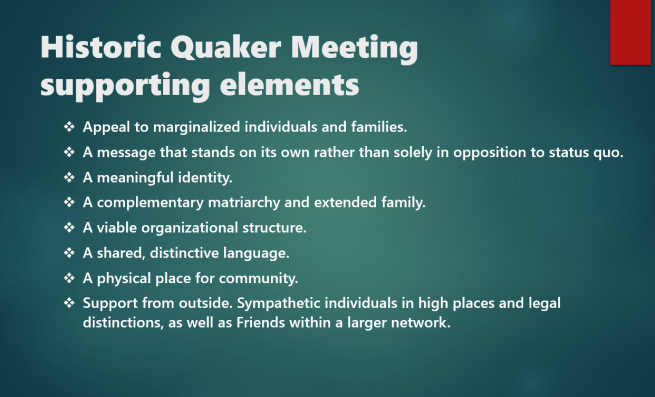 I do hope you can join us online for this free presentation on Sunday, July 9, at 12:30 pm. Please not that preregistration is required at https://bit.ly/QuakingDover.
You don’t have to be a Quaker to participate, either. (Insert smiley face emoji if you must.)
Just how do peaceable communities emerge and survive?
Frankly, I hadn’t thought about this side of my history Quaking Dover until I was invited to do a Zoom presentation. But the elements are all in the story as I recorded them.
(This is one more example of where readers’ insights are important to authors.)
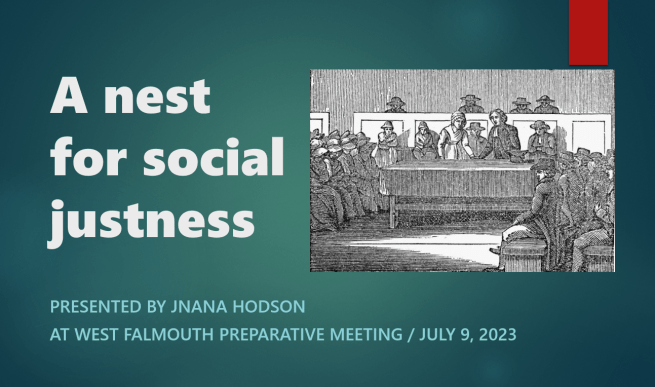
Here’s hoping you can join me virtually from Cape Cod on Sunday, July 9. Do note that preregistration for the free event is required.
In reviewing passages I deleted from my draft version of Quaking Dover, I found this troubling detail. The conflicts with the Indigenous people, after all, are not the focus of the book. And yet …
After “the Indians renewed their ravages on the frontiers in small parties [in 1711, with several of the attacks detailed] in consequence of these ravages the House of Assembly passed the following vote: ‘Voted for Incouragement of Volunteers to Kill and Destroy the Indian Rebels in the province of New Hampe for every man shall be paid sixty pound, for every woman forty pound, for every child thirty to be paid out of the Treasury, and that the said Volenteers shall Remain in that service at least four months, not leaving any Garrison unnarmed, but have the consent of the comitte of Meletia for there so Inlisting … by order of the house. Sam’l Keais, Clark.”
~*~
That’s it, a bounty for killing children, and another, their mothers. Men might be considered warriors, but not necessarily.
Even if this was never paid, it’s inexcusable.
And the English considered the Natives barbarian savages?
 Jnana's Red Barn