Hometown News is the one novel Cassia from What’s Left didn’t press me to revise, but it got the treatment anyway. At least the title stayed the same, though the subtitle “Reports from Trump country” was added.
Political novels rarely work, so I’ve heard. And I didn’t pitch this was as dystopia, though casting the book more along those lines might have been more successful.
The book still stands apart from my others.
In the time since its first draft and my big round of deep revision, much that I had investigated only worsened. The once powerful newspaper industry was a ghost of itself, and many of the once legendary nameplates were owned by hedge funds whose owners or managers were among the world’s top billionaires. The Rust Belt communities like Rehoboth still hadn’t rebounded – their lucrative unionized manufacturing jobs were never coming back, either.
~*~
Unlike my previous newspapers, the final one I served had job security and decent wages, thanks to our Newspaper Guild representation. I finally made it to median income, even.
Socially, its newsroom broke down into three distinct circles with little overlap. There was the daytime staff, an echo from the days when we still had an afternoon edition; it was the crew that did the features and opinion pages. The nightside staff produced the next day’s daily editions right up to 1 a.m. And the Sunday News staff worked a four-day week culminating in a double shift on Saturday. We got to know each other the most through union meetings revolving around contract time.
At my first paper, where we worked into the night, the staff usually gathered at the bar next door after their shifts and stayed till closing time.
At another, where we were mostly young and without kids, it was on Friday afternoon – the POETS society, as our divorced city editor dubbed it: Piss On Everything, Tomorrow’s Saturday.
Usually, everybody lived at a distance from the newspaper plant. Few could afford the rents or mortgages in the city of publication.
I can’t speak for other office situations or professions, but I did find that close friendships were rare. You knew your coworkers more by a phrase or two they repeated or a favored style of clothing they wore or, as some of the guys seemed to do, by the kind of car they owned.
Still, things came up at parties. Consider the quip from one generally naïve woman regarding the allegator-skin cowboy boots one of the sportswriters once appeared in: “Hey, you look like a pimp. What’s up?” And then the shock we felt a month or two later when he was arrested, having procured women and motel rooms for men in the car racing circles he covered.
At these gatherings we usually huddled around the share our war stories and talk what one spouse dubbed “Bodoni-Bodoni,” after a widely used headline typeface.
Most of the papers I worked at were the smaller operation in a broader market. And I usually was part of a news team with a competitive, aggressive mindset. That part was exciting.
In the revisions, I did have a new paper to draw on, not that it was of the progressive mold I was pursing in the book. The daily interactions, though, could be just as rich.
~*~
From what I’ve seen, the situation of low-level, “shirt-sleeves” managers has only worsened across the board. Perhaps the Covid pandemic work-from-home option has eased the pressures on white-collar jobs, but that happened after my final revision.
There was little job security in working for mass-media companies. When I was with the features syndicate, I’d spend a year nurturing a relationship with the top editor, who promised to buy a certain comic strip or opinion-page columnist or weekly business report from me when the next annual budget was approved – only he was gone by then. Turnover was high, often blamed on “bad numbers” like shrinking circulation or advertising revenue. Or, in one case, because the company headquarters decided to buy a radio and TV broadcast chain.
I do wonder what happened to several of the family-owned papers I called on. They’re top editors didn’t feel a need to attend the usual annual conventions where networking occurred.
I should also mention that several of the papers I worked for did bring in management consultants, giving rise to the team in my novel. Give credit to the one that threw up its hands halfway into the projected year of monthly meetings, declaring that the news business just didn’t fit any of their models.
The Dilbert comic strip touched on many of the office realities, but at a superficial level.
Best-selling management books – Tom Peters’ In Search of Excellence, for example – were exciting but didn’t reflect the everyday realities we faced meeting hourly deadlines leading up to the big, final deadlines. The ones you didn’t dare miss by more than a few minutes.
~*~
So I made tweaks to strengthen the focus on central characters and acknowledge the big hit from the Internet.
~*~
I should say something about public misconceptions of journalists and their papers.
One colleague, who lived a block from me in the town I call Rehoboth, told of a neighbor who complained to him every time the met around the driveway. There was always something wrong with something we’d done. Finally, my buddy fired back. “What do you think the reporter of that story is paid?” The man, a steelworker, fired off a figure. “Less than half of that,” my buddy said, “and she has a Master’s degree.” The man was shocked. After that, he always had something good to say.
As for the right-wing perception of liberal bias, the reality was that many of the biggest papers were unabashedly conservative: Chicago Tribune, Los Angeles Times, Phoenix Republic, Boston Herald, Cincinnati Enquirer, Columbus Dispatch, Indianapolis Star, and probably the majority in the smaller markets. And that was before Fox.
If there’s a bias, it’s for facts rather than presumptions. The Louisville Courier Journal’s Pat Siddons, who covered Bloomington, once said. “I know I have a controversial issue right when I get complaints from both sides of a story I’m covering.”
The fact that journalists are largely low-paid, working nights, weekends, and holidays, did nothing to incline them toward big business, though. One thing we hated was injustice. Another was the lies that accompany it.
~*~
Trying to locate Rehoboth?
It was a composite, drawn mostly from the Rust Belt that extended from Philadelphia and Baltimore west to the Mississippi or so. While my book describes the steel mill that dominated the town, similar communities may have had auto assembly plants, appliance manufacturers, parts makers – the list would be long, like the empty factories they left behind. I observed large swaths of devastated industrial zones in Youngstown, around Pittsburgh and greater Philadelphia or upstate New York or Detroit – places that resembled arial bombing scenes from World War II Germany and Japan. Similar scenes existed along the Lake Michigan shoreline of Indiana, and across Wisconsin and Michigan.
I could now add to that the former papermill towns of Maine.
The fact that there’s personal breakdown as well, as I present in the story, is more than symbolic.
~*~
As for authors and books percolating through me during the final revision and later, the culture J.D. Vance describes in Hillbilly Elegy is one I knew well. Our high school basketball team played his, for one thing, and I had toured its steel mill twice as a Boy Scout. His Middletown could be one more nominee for my Rehoboth.
Add to that Ben Hamper’s Rivethead: Tales from the assembly line, David Foster Wallace’s The Broom of the System, Charles Bukowski’s fiction, a shelf of business case-studies, Kenneth Patchen’s poetry, E.F. Schumacher’s Small Is Beautiful. And Brian Alexander’s Glass House: the 1% economy and the shattering of the all-American town is high on my TBR pile.
~*~
Seeing the loss of status and influence of an independent press has been personally painful, as has the breakdown of communities despite the opportunities of small is beautiful, especially in the Midwest.
Since the final revision, one of the figures in my book, the major scumbag, really, died in a horrific late-night car crash. And pneumonia took out Major Bohroh a little over a year ago.
If I were to tweak Hometown News yet one more time, I’d intensify their evil nature.
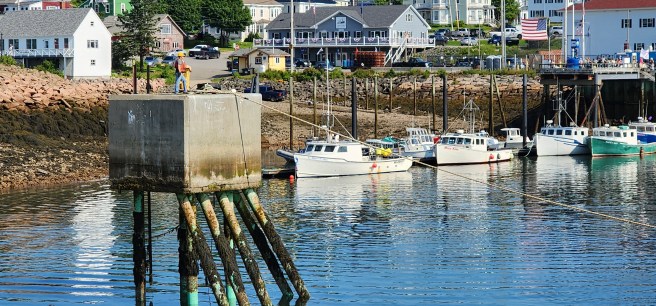 He’s waiting for the USS Oscar Austin to slacken the heavy line so he can heave the loop into the water as the destroyer prepares for departure during last year’s naval visit to town.