Beginning my 30th year. [I wouldn’t turn 30 for another year. It’s just that you start life at age 1, not zero.]
Quaker Meeting in our house last night, 17 in our little place [in town], Ward’s observation, “This is a comfortable room.”
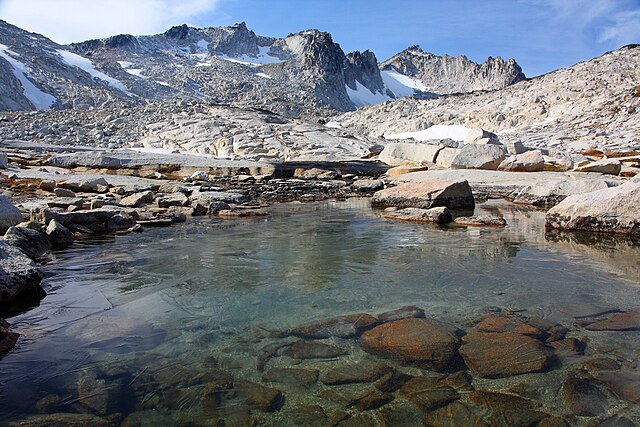
Swiss-born Louis Ulrich spoke of gearing up to ascend Mount Stewart again, “a cure or a kill.” He was in his late 70s at that point. The mountain summit rises 9,415 feet above sea level and is notorious for its rugged steep sides.
“How are you going?”
“Up my gully.”
Otherwise known as Louie’s Couleur on the official maps. He was in the trio that made the first known ascent to the summit, pioneering his technical-climbing route.
As I would discover, beyond Wenatchee and Leavenworth two hours to our north:
Enchantment Lakes Wilderness Area at Mount Stuart, photo by Jeffrey Pang. via Wikimedia Commons.When we had Meeting in Louis and Anna’s home, I was drawn to a curiously striated large rock on their fireplace mantel. It was the size of a bowling ball but much heavier. Turns out to be a mastodon tooth found on one of his outings.
~*~
Throughout our valley, set up next to the mountains, there was great concern about drought, especially the lack of snowfall, which was the source of the irrigation water.
As I noted from one trek:
The Wildcat is not raging … despite a snow shower off in the mountains …
Or, regarding the Lady in the White Continental: And since there was no snow at White Pass she took the twins and flew to Switzerland.
Thing is, she can’t ski.
Well, I’m now thinking the twins soon became Olympic skiers.
~*~
People think of writing, perhaps especially poetry, as work but here I’m seeing more the frustration when it’s constipated.
Much later, I would come to see the practice of writing crossing over into prayer.
~*~
What I couldn’t see was how much change was about to occur in the multiple fronts of my life in the coming months.
My mother-in-law sent a copy of the R-T — nothing there but sadness — the only merit to the pages at all were touches I had added: Datebook, Round the Square — a paper the current staff can’t handle …
And then, Friday night, 2 pitchers of beer with Gil, many revelations, that he has his eye on many people and when he gets his own paper, he’ll go after them … and that I’m No. 1 on his list. “It’s almost eerie how you take a project of mine and do what I want and improve on it” … would especially like to see me in a weekend editor capacity, responsible for the whole paper … also, details about the new photographer, as photo chief over Dean / fireworks … desire to revamp the p.m. edition but no idea what the publisher wants … As Gil said to Tippet: “Hodson’s my man, he never was part of the news desk pool” … that Kent can’t stand [fill in the blank], “Every office has the squealers who camp in the boss’ office” … Gil keeps waiting for the bubble to burst, for the dream to fade, but it doesn’t … [how was Kent able to create Gil’s position and then mine?] … In that regard, this was my golden era … not a later leap, back in Ohio, despite its aspirations … I came in there a step too late and D.P.’s fatal blow sent us reeling …
Here, though, our initial changes seem to be working: “We’ve thrown just about everything at you and you’ve improved it all,” as Gill confided in me.
~*~
Early February ’77:
Bummed and surprised after Whiz-Boy’s first slide show at the office and the threatened reaction of the drones, sleepwalkers like Marriott and the admen … the comfort of mediocrity, newspapers dying in their sleep versus the growth and excitement of life and excellence …
Early March:
Awoke at 4:30 despite falling off at 10:30 or 11 at Whiz and Wisteria’s, where we felt the awkwardness of office status distinctions. He was officially a step above me, meaning having dinner with the Kents and Gils the night before and, besides, they get a free membership at the Y.
My wife was secretly resentful, but it’s not a just world.
Monday night, the 4th, at work — everything going well until the end, when heds piled up (Marriott on the rim), meaning we didn’t finish shipping until 12:20, didn’t get off the floor until 1 … bad night, horoscope said it was good day for my career …
The workweek was too long. Arriving at the office on Tuesday, already a day behind. The TV booklet was due out back on Monday. On Friday I lose three hours to the arts section and meetings. No time to breathe in between, no sense of creation. That’s no way to work.
August:
Kent “unveiled” his master plan yesterday — going to a more “magazine” style (my God, how many typographical sins have been committed under that category? How many magazines practice any kind of layout of that order?). Where we had variety, flexibility, we now have one rigid style; where we once kept mediums with mediums, we are now ordered to mix them, not necessarily attractively. … We now have a complex set of directives of what size goes with what hammer, depending on the number of columns used in that instance.
The new plan requires twice the time to perform, and twice the space, of the old …
Surprisingly, Gil was never consulted. Whiz is not a makeup man; Gil is. Gil is supposed to be in charge of the desk. But these orders came down on him as much of a surprise as to the rest of us.
Realize I need to sit back now, just do my job, not offer any help (it’s requested but never used). Let Kent do himself in or split somewhere with Gil.
The entire newsroom reaction: resentment. Fishback’s Q in the staff meeting wasn’t about feature photographs at all. It was about content and guts. Just where are we really going?
Enough of this. Must remember not to pull any “grand plans” when I’m in the place. Take everyone into my confidence.
[One thing I did win here was raising datelines to their own line of type, flush right, in the manner of the New York Herald Tribune.]
Actually, there are a lot of them. A recent Census of Agriculture found that of Maine’s 13,053 farmers, half are over the age of 57½. Not only that, but there are more farmers over 75 than under 35. Do we see a shortage coming soon?
Now, for ten more tidbits.
Four-fifths of the farms are family owned-and-operated. Corporations account for less than a tenth, 677 farms, while another 474 are partnerships.
A bit over two-fifths of the respondents said farming is their primary occupation. The majority of the farmers rely on other jobs or other income.
Women farmers comprise 43 percent of the workforce, 5,638.
As the Census observed, “Male producers had higher rates of involvement in land use and/or crop, livestock, and marketing decisions than female producers. Female producers were most involved in day-to-day, record keeping and financial management decisions.”
USDA-certified organic farms = 412.
Black farmers: 132 operating 2,238 acres.
New and beginning producers = 4,681.
Renewable energy-producing systems in use = 907 farms.
The state leads the nation in wild blueberry production and ranks second for maple syrup, but potatoes lead the way as the largest crop. Other leading agricultural products potatoes, milk and other dairy products, chicken eggs, and floriculture.
Of special interest to Washington County, where I live, was the Maine harvest of 24,735 acres of blueberries on 703 farms in 2022, an increase from 20,473 acres five years earlier.
In reviewing my journal scribblings, I’ve been surprised how little I recorded about my introductory months at the Herald-Republic. By the way, that had been “Republican” for much of the paper’s history. What I am seeing, though, is how much I was Gil’s right-hand man, rather than the newbie at the bottom of the pecking order. Still, I was a utility player who had to jump in wherever the need arose. Not exactly a floater but close.
For the first time in my career, I was working closely under a manager who was actively grooming me. It was definitely different from my internships at the Journal Herald, which had presented some solid coaching all the same.
I don’t know how much of this period was reacclimating myself to daily journalism after my year-and-a-half break in academia, but in addition to adapting to a new landscape quite different than any I had known, I was also observing the lay of the land inside the newsroom, where Kent and Gil hadn’t made any big changes yet.
Astrologically, my Aquarius was a complementary opposite to Gil’s Leo, and from the ashram, I had learned to let him shine. In return, he respected my need for independence. It worked well. He was an avid sports fan, contrary to me, and had even been executive sports editor at the Miami News in one of his stints.
One bit of interesting coincidence was that in the Air Force, he had almost been posted in Enewetak in the Air Weather Service, 1957-’58, when Sam [my father-on-law] was the meteorologist in charge during hydrogen bomb tests.
In trying to catch up now, I see that he was born in Omaha in 1936 and died in Newburgh, New York, in 2015. I always thought of him as a Californian and learn from his obituary that he moved there after his military service, attended college, and then worked at a series of California papers before joining Kent as the assistant managing editor in Yakima.
~*~
As for my floater situation? As I noted:
Tenth straight day of work. The Sunday night/Monday morning doing me in. But have built the GR boards (timeless backup stories ready to paste up if the system crashes) and removed deadwood. …
On day shift this week and told I’ll be editor of special sections — day shift, M-F, beginning early December … [four months away] .
~*~
Photo by Cacophony at Wikimedia Commons.
~*~
Should you wonder why I go by Jnana:
Ours was a newsroom of Jims: both the current and future publishers, the city editor and his assistant, the sports editor, our local columnist, maybe a reporter or two … ultimately, a third of the males in the newsroom … as for the composing room, advertising, the pressmen? It was like being named “Boy.”
Even so, I was back to my pedestrian given name in this setting, unlike Bloomington. Here, Jnana became reserved for my friends, fellow Quakers, and literary endeavors. You’ve probably figured out by now that I have often functioned by relying on a compartmentalized life.
In the initial job description, if there had actually been one, I would have been doing some basic reporting, including the lead for Crossroads, the weekly religion tab section we ran on Saturdays.
I was also working nights and weekends, including one Saturday or Sunday night when I wound up in the copy desk slot rather the rim after Belcher handed it over to me after he had had it with superiors’ memos. We finished pasteup with one minute before the 12:30 deadline. I’m a whiz.
My basic schedule seems to have been day shifts, 10-7 tues-fri, then late weekend Saturdays while Gil’s in slot. So I do scrub work on advertising-driven special sections and love it … He’s appreciating my willingness and flexibility … he asked about weekend slot, “Kent was in Sat.” and then asked if I was comfortable there, adding he has plans … so things looking good (did new TV listings logo last night, it’s OK) …
One reporter’s husband had Keogh as his PhD chairman at IU… turns out Rash is the top man in his field in the country, yet one more humble Quaker in my exposure.
In retrospect, the early office was more conflicted than I recalled … my erratic hours did give me most Mondays off …
Kent’s big dream, with me being assigned much of the effort, was a weekly outdoors tab to be called Action Northwest. At this stretch, it was still in the early planning stage.
Essentially, I was learning the local ropes first.
The first of my extra-long spiral notebooks was a, Citadel, 8-by-12½ medium ruled with a 3-inch wide margin.
Begins on the new moon, 28 June 1976, “as we await our future.”
We were back house-sitting on Harrison Lake, just a sliver of that moon against caps of rosy storm clouds over the hardwood hills at the end of the water, one of a series of lakes backed into the first of the “Brown County mountains.” Elsie Sweeney’s palatial contemporary temple overlooked everything, facing the sunrise. [She was a spinster philanthropist from the Cummins diesel engine family.]
Also:
Nervous about job interview, Center for Law and Poverty. Bought new pants (fancy but I can live with them) and tie. Actually, for Yakima, if that works out but will do the dry run with this.
Indianapolis more active, dressier, cosmopolitan than I’d seen it before. The director was pretty mellow, surprisingly so. The job was $9,500 to $10,500 a year, with four-weeks’ vacation. I would have to develop contacts, write my own material, edit, etc. Doesn’t look too bad, if Yakima doesn’t come through. Some PR and video work, too.
Fourth of July fireworks in Woodsville, after worship in Waynesville earlier in the day. Different corners of the state.
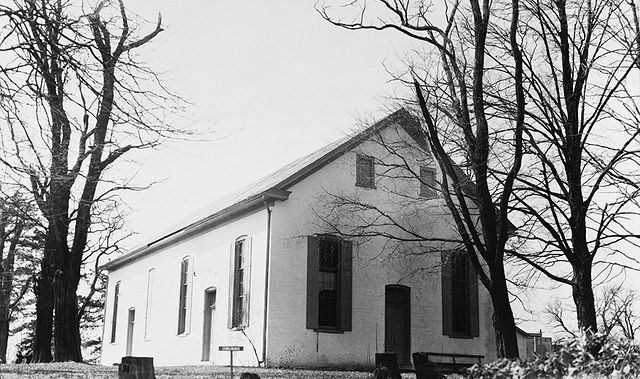
The Quaker meetinghouse in Waynesville, Ohio, in a 1937 photo by E. Schrand and J. Mitchell via Wikimedia Commons.
Waynesville Quakers — Miami Monthly Meeting. The house of worship was built in 1810, during Madison’s administration. It originated with South Carolina Friends (Quakers) who nearly all relocated north in reaction to slaveholding. Many came first to Waynesville and then moved on within western Ohio and all of Indiana. Miami Monthly Meeting held their memberships until new meetings were established, resulting in Waynesville’s being the largest monthly meeting in all of Quakerdom by 1805 and explaining the large size of the house, with three rows of facing benches (the ministers and elders’ gallery). It’s the oldest meeting west of the Alleghenies. (A detail that may allow Friends in Tennessee some leeway.) The meeting was central to the Underground Railroad, I was told.
Worshiping there was a fine way to spend the Fourth of July 1976, the bicentennial of the nation.
Do note, the Underground Railroad was founded and organized in the South.
Followed by limbo
Feeling of hopelessness, of inutility, a faith-draining thing. This waiting, suspension, is costly: can’t send any poems out (mss), we don’t expect to be here long. Kat can’t sign up for summer school, we need the funds and must be prepared to run. Plus the energy lost sending our job applications, etc. the money in samples and resumes (a quarter each) and postage. “We’ll be back to you in a week,” the liars, so polite.
Waiting for mail that doesn’t come, telephones that do not ring.
And then the whirlwind
Weir Cook airport, same rotunda where I departed on my first-ever flight (the Florida Easter). Put together the details for the Yakima trip yesterday afternoon.
Sentimentality now about Daffodil/Bloomington. Figured out what’s bugged me: everyone is so slow — the farmer syndrome.
Is the Waynesville Meeting working its magic again? (The Fostoria job came through after I worshiped there …)
Can we afford the move ($1,000 loan from my parents?). Will all of our goods fit into an 18-foot U-Haul?
Washington state newspapers seem to have the fanciest letterheads: color print jobs, imaginative graphics. A good sign, it seems.
Bill and Mig stopped in Chicago, hoping to see his brother still alive. Instead, Bill arrived in time to conduct the funeral.
The interminable earwash of airport lounges. Last time I flew American to the Northwest was breaking up with Nicki.
Bob Suter’s advice: “Don’t stick your finger in front of any turtles”
Long trek at O’Hare to new international section — Customs and all the rest — not much traffic, empty inside — airlines share the gates — glassed-in halls within halls — was beginning to wonder if this flight was going on to Japan or if I had the wrong gate designation …
Midwestern farming towns, seen from the air: two parallel tracks cut through: one the highway, the other the railroad tracks Can hardly tell which is which, shining in sunlight: white concrete, white gravel, plus white blazing roofs.
2½ more hours to Seattle
Over central South Dakota, at 35,000 feet the outside temperature was minus 59 — Centigrade!
Flying over Billings, Helena, Great Falls — echoes of that futile trip to lure Nicki back … my first Far West exposure …
~*~
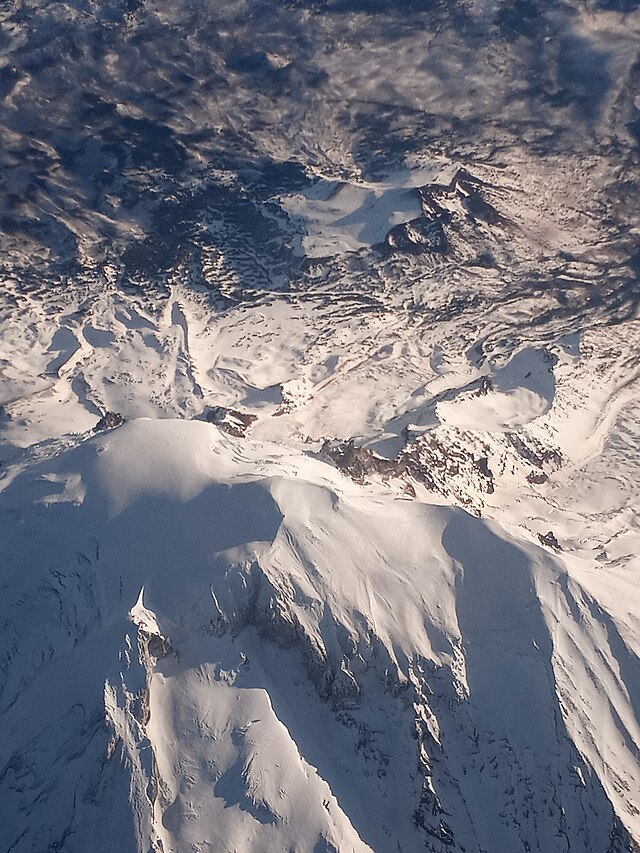
The sky scudded over from there. Only gray below me. But then, at one point, I looked down at something incomprehensible and amazing.
Rainier from above by Feed Me Paper at Wikimedia Commons.
Yes, we had flown directly over Mount Rainier and its glaciers.
~*~
As for the rest of the trip?
Don’t think things today could have gone much better. Spent six hours with Kent, the m.e. Lunch with him and Gil, the assistant m.e. (who was critical of some of my layouts with Marcy’s photos … and one pic I should have cropped). Gil telling about almost grabbing rattlesnakes beside lost golf balls … sluggish, unmoving bastards, sez he …
Good meeting with Human Resources, too. (Is the department always headed by a woman?)
A short meeting before I left. Accepted the offer, $260/week … more than double what I had been earning …
Sounds like I’ll be doing mostly editing, special sections and weekend news, as well as lead articles for Crossroads …
[I should note that this flight was also at my own expense. If the job had not come through, we would have been screwed.]
Back home
Received a letter from Indianapolis, no dice, as if everything were working with Divine plan …
Maybe they didn’t like my looks? You never know.
Indianapolis? I’d just as soon live in Scranton.
Got a few nice poetry rejection letters but mostly silence …
As you’ve noticed, I fell into the practice of journaling rather haphazardly. At times compulsively, even. I started to say the “habit” of journaling, but it was rarely that effortless,
I was still in spiralbound volumes — eight years before a stretch of using hardbound sketchbooks followed by a return to spiralbounds before the hardbounds took hold a dozen years after the journal at hand.
No. 45, for those keeping track, was the first of the 8-by-12½-inch books I’ve truly appreciated. The added inch-and-a-half of length fit my hand and pen well, though not the bookshelves or the milk crates that generally wound up holding my journals.
Eventually, there were 17 of those in all, plus three fat softcover sketchbooks, 15 black-cover spiral sketchbooks, and three bargain thin hardbound journals nearly that tall. Thirty-eight in all, out of 200-plus. Why did that shape vanish from the market? Probably because I preferred them. I have long run contrarian to the marketplace, not exclusively involving my tall, skinny clothing size.
Somehow, I had thought that my legal-size notebooks started at the Cornell bookstore, but it now looks like my first ones were bought in Bloomington.
In looking up what’s called “legal pads” (as if the others are clandestine?), I find most today have shrunk to 11¾ inches height, though at least one exists at 8½ by 14 for those willing to pay a premium. And that’s not bound. As for filing those in storage cabinets? I’m not a lawyer nor a legal secretary. It no doubt requires special filing furniture.
~*~
The first third of the volume covered our final month-and-a-half in Bloomington, aka Daffodil, followed by my flight to the Pacific Northwest.
As I look ahead, I see pages that were used to draft and refine poems that found publication as well as other entries that more or less became fiction in my novel Nearly Canaan and the third novella in The Secret Side of Jaya.
I’ll skip over those in this series and instead look for the unexpected.
Reporter Jerry Handte, someone I saw as a grizzled old-timer. Threw the word “hardscrabble” at me in a story, one I didn’t know. Changed my perception of him.
AP’s middle-class conformity.
Contrived news stories, with formulated sentimental reactions: hippie story, Agnew story, dog or handicapped child story, medical/scientific breakthroughs, etc.
“Chimes,” the Evansville Courier’s wrap-up of church activities.
The Press won’t hire anyone else as long as it can slide by as it is.
~*~
The tug toward middle-class: security: keep job, get a degree, build retirement, home, house, and family. It’s gonna be so hard telling Mom and Dad I’m splitting.
I’m becoming like them: Don’t rock boat, don’t do deep fixes on stories, let it slide, why bother with better headlines and layouts, etc.
As I’ve been seeing in this sweep through my journals, not all of my experiences in Bloomington wound up in my poetry and fiction.
Back when I switched my college major from journalism to “something that would expand my mind,” as one influential editor advised me, I chose political science because so much news coverage focuses on government and its impact. Somehow, I fell under the spell of Vincent Ostrom, especially his federalist perspectives of a compound republic and ground-upward rather than top-down action. My earlier posts reflect how this turned into a personal relationship, even before I was invited to join what’s now known at IU as the Ostrom Workshop.
His wife Elinor, better known to us as Lynn, was just beginning to teach at IU when I was an undergrad and I didn’t find the opportunity to enroll in her courses. (The fact the department scheduled her classes at 7:30 am was an additional problem for night-owl me, as I was as the time.) Despite obstacles erected because of her gender, she soon became a popular teacher and by the time I returned to campus, was a rising star. What I saw on my return was how naturally she functioned as the central figure in running our collaborative workshop, and how utterly amazing she was all around. It should be no surprise that she became not only the first woman but also the first political scientist to win the Nobel Prize in economics. Yes, the dismal science.
While I have never run for political office or served in a governmental role — I’m of the camp that believes doing so would compromise the neutrality or objectivity at the heart of serious journalism — I have carried many of the lessons from that training through the remainder of my life.
One is the ability to critically read a text, period. It serves well in literature, theology, proposing a course of action, as well as editing. A corresponding step then asks which assumptions can be relaxed or even removed from the paper under examination.
Another lesson involves management and associative structures. Many similarities exist in operating public, for-profit, and non-profit organizations. They are what make a civilization function. They were especially helpful when I was navigating the steps in the management ladder of corporate journalism in my moves to come.
The next question regarding any field of organization, of course, is how do we make it work better?
~*~
In this review of the experience, I’m surprised to see a parallel in the youthful enthusiastic personnel at the Workshop to the idealistic newsroom staff in my novel Hometown News. Most of the events shaping that book, be warned, come in the years ahead.
~*~
As I look back, I see how crucial this year-and-a-half became in my life.
My evolution from yogi to Quaker began, for one thing, though an overlap would continue for another year or two.
Through a circle headed by three very fine poets, my personal voice in that vein took shape, accompanied by appearances in literary reviews across the nation.
Kat and I settled into a life that was largely pleasurable and fulfilling. I’ll leave the details for you to decipher in my novel Nearly Canaan. The middle novella in The Secret Side of Jaya, “Miller at the spring,” was also inspired by this period but written 40-some years later and recast in the Ozarks.
There was a curious semester when Nicki and Kat were enrolled in the same weaving class in the art department. Did my ex-lover know my wife was a classmate? Eventually, they became acquainted and that led to a face-to-face of the three of us, allowing me some resolution to the past.
And I felt freer to move forward.
~*~
Vincent had grown up on a mink farm near Mount Baker in Washington state, and he was quite encouraging in our move to the Northwest. Living in the interior desert, I would finally understand the intricacies of water legislation and management, which had been one of his specialties. Another arose from being a writer of the Alaska state constitution, a place that also had close connections to Washington state.
After packing up and moving westward, I never returned to Indiana, apart from the brief drive crossing on the toll road in the north on our return to Ohio after the Pacific Northwest.
I’d say the book was closed, yet the writing and revision were actually still ahead.
~*~
From Spiralbound Hoosier, with commentary from now.