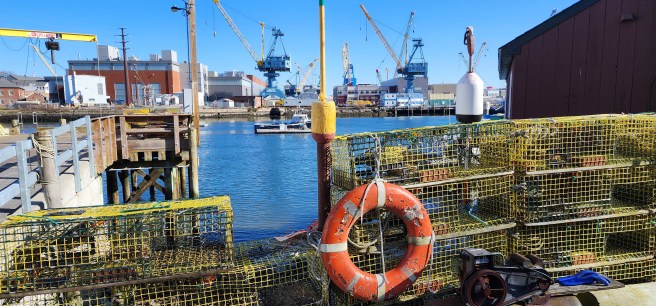
The historic boatyard, now a booming submarine maintenance facility, is situated on an island across the Piscataqua River from New Hampshire’s Seacoast city of Portsmouth. It’s seen here from Kittery Foreside, the town with the military base gates.
You never know what we'll churn up in cleaning a stall
The historic boatyard, now a booming submarine maintenance facility, is situated on an island across the Piscataqua River from New Hampshire’s Seacoast city of Portsmouth. It’s seen here from Kittery Foreside, the town with the military base gates.
What was the best year of your life and how did it look?
Pondering the possibilities for my most perfect year, I see how much even the best was tainted.
’72, I had the high of the ashram but it involved going through a lot of psychological muck and growth to get there. See Yoga Bootcamp for the parallels.
’73 was the whirlwind with my future wife, but I was laboring at subsistence pay, at best. See Nearly Canaan for the parallels.
’83 encompassed both my divorce and an exhilarating engagement with the young cellist who promised to be The One. It was also crushed in long workdays as a shirtsleeves manager in a newsroom, no matter how engaging I found the challenge professionally.
’86, I was deeply ensconced in a self-awarded sabbatical, but generally loveless. The core of my fiction was drafted in this period, and my circle of friends included Mennonites and my introduction to part-singing.
’99, the excitement of the ultimate woman in my life, as well as our frustrations in trying to find a home we could afford along with some emotional upheavals at the office.
2021, my exile to Eastport in what became a heavenly writer’s retreat, resulting in the publication of Quaking Dover the next year. It did mean being apart from my family and friends back in Dover for much of the time, but included exploring the fantastic outdoors of the waters and woodlands around me as well as the artistic stimulation of my new community.
So here I am now, with what’s turning into the home of my dreams in the sunset of this life.
Rather than the big splash – the masterwork, Oscar performance, Pulitzer Prize, MVP sort of thing.
Think of a pastor, crafting sermon after sermon each week.
A woman who found housing for the homeless and then patiently worked them through their finances to point them toward independence.
The big dreams of a novelist or poet page by page that never found a readership, or the correspondent for a local weekly newspaper.
A doctor or nurse. Teacher. Carpenter. Mechanic.
Keep your eye open and the list grows quickly.
It even becomes more impressive than many who have fame.
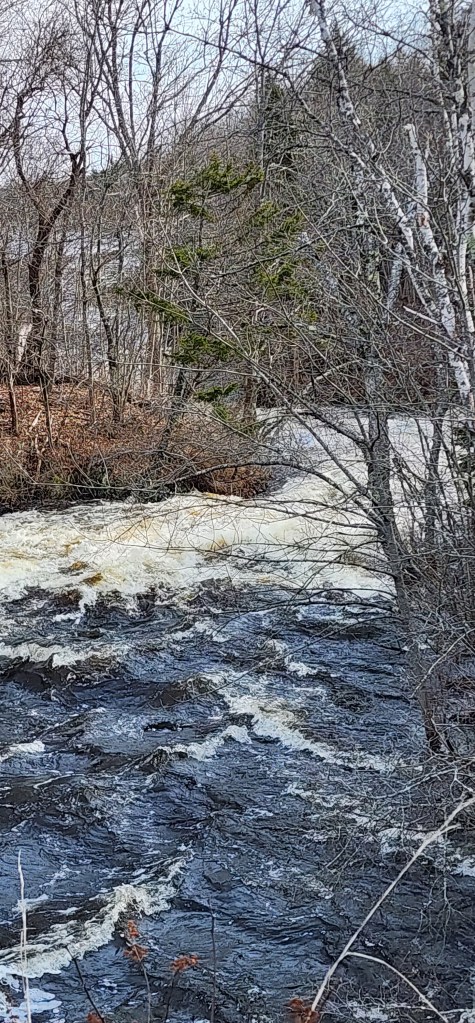
Swollen by melting snow and ice, forest rivers in Maine were used to float log booms to sawmills or railroads downstream. It’s hard to imagine now, though the tradition involved extensive preparations and skills. This example is the Mattawamkeag River in Aroostook County.
He promised lower prices. Here are ten you can bet will go up because of his promise of “lower taxes.”
One place prices seem to be going down is stocks.
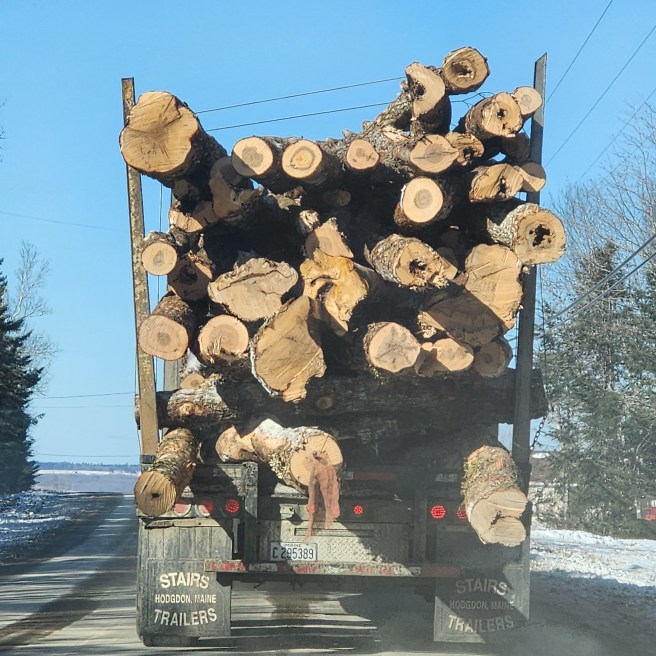
Winter is when lumber is cut in the forests. The ground is frozen solid and there are no bugs in the air. Load up the trucks, then, and head off to the nearest sawmill.
As the calendar year ends, it’s fair to ask What’s Left in your own life as you move on for the next round.
In my novel, the big question is stirred by a personal tragedy, leaving a bereft daughter struggling to make sense of her unconventional household and her close-knit extended Greek family.
In the wider picture, she’s faced with issues that are both universal and personal.
For me, it’s somehow fitting that my most recent work of fiction returns to Indiana, the place where my first novel originated before spinning off into big city subways. The state is also home to more Hodsons than anyplace else in the world, as far as I can see, not that I’ve been back in ages.
What’s Left is one of five novels I’m making available to you for free during Smashword’s annual end-of-the-year sale, which ends January First.
Get yours in the digital platform of your choice, and enter the New Year right.
For details, go to the book at Smashwords.com.
Ability to take criticism …
an open mind …
humility …
forgiveness …
compassion …
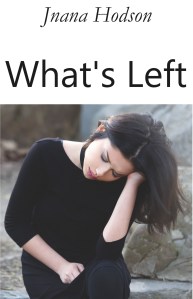
The model in the photo I selected for the original cover of the story that stands today as Nearly Canaan was nearly too perfect. I even had to tweak the description of Jaya on the pages inside to make for a better match. Much later, I came across other photos from the shooting and was appalled.
In yoga circles, it’s what we would call Maya.
Apparently, I had shifted Jaya’s spiritual identity from Sufi much earlier than I recalled. Now that I had a solid backstory for her in my novel Yoga Bootcamp, I could turn my attention to the messy trove that had sprawled into three big books. Thanks to Cassia from What’s Next, I was now intent on distilling them back into one. Trying to compress them into the maximum 120,000 upper limit of a big novel meant having to hone more than one hundred pages of manuscript. And that’s before I decided to add a fourth section for fuller closer.
~*~
At heart, I was trying to figure out just what had gone on in my first marriage. I’m still not sure. And note I had said “gone on,” not “gone wrong.”
But I also wanted to say something about the influence of the landscapes where I’ve lived. In fact, I came to think of them as major characters. If only I could have allowed them to speak? The first was pretty bleak and, for a small town, rather petty. The second had its beauty and its rough spots. The third, their intended Paradise, initially appeared desolate and unforgiving.
Place as a character? How about the Mississippi in Huckleberry Finn? The story wouldn’t have been the same if Twain had started on the Ohio River, even though it was larger than the Mississippi where he did.
Naturally, I had to abstract real people and events and in doing so, I settled on some big flips. Jaya emerged as the older partner in her marriage, for one, which gave a fresh twist on a December/May romance.
Along the way, the story became one of overlapping couples, a contrast of marriages that were close to Jaya’s home. It’s almost like the mirrors in an amusement park house of mirrors, to my way of thinking, not that the story started out that way.
Yeah, we’re supposed to avoid religion and politics. That leaves some pretty big gaps in the meaning of life and, as I’m seeing, in relationships, too.
If you haven’t noticed, changing the novel’s name from Promise to Nearly Canaan is a Biblical nod. Well, I had previously been calling it their Promised Land.
Developing Pastor Bob and his wife, Wendy, provided a big advance for the revised novel. They might have had serious reservations about her as a heathen, but they were still intrigued and at points even supportive. That marriage also had its problems.
I definitely wanted to avoid having southern Indiana in one more of my books, so I shifted the scene of the middle section to the Ozarks of Arkansas. There are a lot of similarities, from what I’m finding.
In addition, I wanted Jaya’s career to be as volatile for her as newsroom management had been for me. She needed to work weekends and nights, too. Beyond that, I did have an experience of being paid from “soft money,” as grants are sometimes called, and having a very good neighbor work as regional director of a social action agency provided me more inspiration.
By the way, the cover photo I settled on for the revised edition did require some tweaks on Jaya’s physical description on the inside pages.
In my parallel universe, my real-life life, newspapers were caught up in technological “advances” that kept setting us back. Those changes had started well before my sabbatical break, but they were speeding up. Back when I was starting, perforated teletype tape meant we really couldn’t edit stories we received from the Associated Press or United Press International or similar services. And then scanning of typewritten pages made improving even staff reports physically difficult. After that came the early stages of computer screens and keyboards, where editing took about three times longer than it had with a pencil – moving that cursor around took more effort, certainly, and computer crashes were commonplace. These were all matters that impacted the emerging story of Hometown News, though I believe anyone working in a large business office would have parallel experiences to relate.
We forget how much reliability our laptops and PCs have gained. Does anyone else remember losing a draft to a static electricity spark that then erased whatever was on your screen? Or, for that matter, when it was a bigger power outage?
I could detail the shifts from letterpress and hot type to pasteup and eventually pagination or from typewriters and linotype machines to early computers to, well, the digital devices we have today or from letterpress to offset printing and now digital editions skipping paper altogether.
Or similar leaps in photography, as we see in following Kenzie.
~*~
Paid work occupies a large part of most adult lives. Even when it doesn’t, how we handle our money, wealth, time, and so on is a highly emotional issue, no matter what the dismal science of economics insists. (For that line of useful inquiry, go to the Talking Money series on my Chicken Farmer I Still Love You blog.)
I just couldn’t create characters without their having jobs. Well, most of them – the hippie farm had some of dubious means.
Besides, so much of a typical male’s identity and life purpose is tied up in his job, especially when he can take pride in it. The job even defines his social circle.
I didn’t want to add another book about a hopeful writer to the literature. What a cliché. Or a musician or actor or even a painter. How about a plumber or fireman or circus clown?
But I still needed a witness figure for the history abstracted to fiction that was before me. I defaulted to using a photographer, in part because I had wished I had taken up a camera, if only I could have afforded the time and a darkroom, blah-blah-blah, and in part because I had been a serious visual artist in high school. You can see those elements developing in Daffodil Uprising and later coming together in What’s Left, but they also play out in Pit-a-Pat High Jinks and Subway Visions. I’m a highly visual guy in my awareness and thinking, OK? The fact he was employed at a newspaper is one part I couldn’t evade.
I still value novelists who manage to set their story outside of the writing world, and that includes universities. Charles Bukowski gets points for me for his novel Post Office. Well, I guess that’s also where genres kick in, too. They’re about detectives and spacemen and billionaires and cowboys and so on.
Photojournalist? At the time of the first draft of Subway Hitchhikers, I didn’t have any models to draw from, but that quickly changed. I wound up working with some of the best in the business.
Over time, photography, the kind that required light meters and F-stops and film and darkrooms, became ancient history. That part I would have to intensely rework and explain as my books underwent revision, thanks to Cassia in What’s Left.
In contrast, Hometown News was primarily about work. I had no problem in this case where everything took place at a newspaper plant, though the economics of the surrounding community also emerged as a central thread.
Jaya became a more difficult case. Her career in the early drafts was drawn from my newspaper offices and hours, now vaguely abstracted to management in general. It would get more specific in the revised titles, where she specializes in nonprofits management. It’s a real job description in a major component of the economy. For that flash of inspiration, I could look to one neighbor in Dover and the impact she had statewide in peace and social justice matters.
 Jnana's Red Barn