When I see this …

… I think of this.
 For the free ebook novel and more, click here.
You never know what we'll churn up in cleaning a stall
When I see this …
… I think of this.
For the free ebook novel and more, click here.
In college, I went through a soul-searching crisis that questioned whether we could justify subsidizing symphony orchestras or opera companies or art museums and the like in light of the economic inequities in our nation and world. And then I noticed how much of an entertainment industry flowed through the ghetto and Third World, too. That is, everybody has art (even those old Quakers, in a few restricted forms) — it’s not necessarily about money but a need for expression. And all of the emotions and aspirations that go with it. As well as the big bucks, for the big jobs.
In my trials after college, I eventually found myself moving among Friends and then, in time, a few who had grown up under the old restrictions that banned fiction, theater, and even music. Harsh as the old discipline was (and I could have never lived under it), there was also a valid criticism – especially of the superfluous nature of so much of the artistic effort and the egotism so rampant in its ranks.
Maybe the early Friends saw, too, how much the arts were a function of the royal court and its fashions. Or a gilded church. Even the way arts were used to veil the upper crust from the populace and its labors. It turns outs the original Quakers were also picking up on a dialectic from the earliest days of the Christian church, one that contended acting arose in counterfeiting thoughts and actions, many of them of an evil nature.
Within the memory of Quakers, at least, the fine arts have come a long way from the 1650s, pro and con.
Still, proscribing many of the arts did focus Friends on other matters, including abolition and nonviolence. It channeled creative energy into mathematics and science, architecture and industry, poetry and journalism (“We Friends only read true things,” as one Quaker purportedly said, regarding a neighbor’s stack of novels). Go ahead, tally the other fields.
On the other hand, how much of our own focus is deflected by our apparent indulgence? Or how much of it is enriched and deepened?
So how do we make peace with that seemingly artless side of our legacy? Let me suggest we begin with a consideration of “only true things” in our practice. Back to the deeper expression, the part that reflects Truth that goes beyond quantifiable facts. We might even begin with questions of quality or justice or compassion. And then, as they say, the plot thickens.
I dream of a kind of writing that approaches, well, dreaming. A narrative of free-floating, widely associative surrealism that’s richly informed by fomenting emotions.
So the other morning I was somewhere in the vicinity of what I report in my novella, With a Passing Freight Train of 119 Cars and Twin Cabooses, and having coffee with an ex-boss, maybe even at the same cafe frequented by John Wycliffe and Hieronymus Bosch in my book. We were too far from the ocean to be considering his sailboat, so we must have been discussing a story in the works. Or maybe politics or updating him on office gossip, now that he’s moved on.
Next thing I knew, we were joined by Jerry Seinfeld – as he was on the show, who knows what he looks like now – and an invisible stranger. Jerry started telling me that’s not how he would have constructed the scene under consideration in my new story.
“When it comes to going to the dentist,” he said, “I would make it as awful as I could. Everything has to go wrong.”
But that’s not how it happened, I want to reply. It’s not true – not true to the facts.
“So?” I can hear from his end. “Wouldn’t it be true to the dream? And much funnier?”
He’d have a point. I’m still thinking about it.
For the record, let me say – there are no scenes with dentists in my novels. And maybe just two or three poems with the hygienist.
 ~*~
~*~
For this volume and more, click here.
As one traditional Quaker query was read aloud during a meeting for worship, one of its phrases began echoing within me: “Truth in the heart.”
How remarkable! Not in the head but rather the heart! Truth, which we see so often as ground in facts and logical consistency, is now assayed not in the brain but rather in the core of our affections.
As early Friends used the word, Truth is much more of a verb than an immutable object. Think of the progression from true to truer to truest. Maybe you can sense that motion in the slightly fuller expression of that day’s query, asking if we, individually and as a group, heed “Love and Truth in the heart” …
As I said, a remarkable phrase.
The old strictures sought to keep Quakers focused on their religious calling. As Damon D. Hickey explains (The Southern Friend, Volume XXVII, Number 2, 2005) them, “This cross, this obedience that was called for, was in the broadest sense the death of self-will and obedience to the inward Christ. … Thus, worldly amusements, especially dancing, were a waste of precious time and unfit the mind for devotional exercises. Music was the devil’s instrument. The Lord called his people to leave the world’s friendships, vain fashions, … sinful amusements, which would include the movies, the theatre and the dance. Perhaps this part would not much apply to our readers, but … in nearly all the so-called Quaker Colleges and Preparatory Schools dancing is practiced.”
He continues to quote 1943-44 writings by North Carolina Wilburite Anderson M. Barker, who argued that by yielding to Christ the Ruler
He will rule out all hurtful reading, and preserve all from putting too much time upon the news, and other such readings, to the neglect of the Bible and other good books, which have to do with our eternal interests.
Then there’s the quotation, “We Quakers only read true things,” told by a boy returning three novels he’d borrowed from a neighbor. Or what is erroneously sometimes called a Quaker hymn from North Carolina, which is usually heard these days in folk music circles, “How Can I Keep From Singing?” Or the recorded ministers who dragged me to an apple barn in Ohio for my first contradance, only to hear the next morning an elderly friend wearing a bonnet rise and wag a finger into the air, warning us of “that evil amongst us known as folk dancing” – while others looked down, sheepishly, trying to suppress a grin.
From the beginning of the movement, we have Margaret Fell’s objection to the strictures of a “silly gospel” that took hold, all the same.
Or later Quakers who accepted things that bind and pinch, as long as they’re chosen.
Or the struggle to keep a vibrant faith and intellect, rather than a barren one.
Always, the tension, in Scripture, between one world, “And God saw that it was good,” and another, sometimes called the ways of the world or even the wayward world.
So the challenge is in keeping a focused life that avoids becoming simply barren.
Let me point to the proportions of the classic meetinghouses – elegance as simplicity – plus the emphasis on philanthropy. Poetry as prayer.
So here we are, with our love of movies, music, theater, visual arts – and a tad of guilt?
I hear an echo of my father, with his passion for big-band music and some of the old hymns, “It would be a lesser world without music.”
I think, too, of a couple who lived without electricity as part of a strict economy that allowed them to focus full-time on calling and playing for country dances.
So here we are, with a visitor asking after the rise of worship – “Are you the pastor?” Before I could say anything, a voice behind me: “He is, he just doesn’t know it.”
Look, I want everyone to sit on the facing bench (elders gallery) at least once a year. “Her turn – next, a child.” Facing each other across history.
~*~

For more on my poetry collection and other reflections, click here.

She wanted to review our email exchanges from our days of courtship but couldn’t find copies of what she’d sent me. Hoped I had printouts.
I’ve been downsizing, so some things weren’t where I expected to find them. Knew I had a loose-leaf binder somewhere.
Nowhere in my studio, though, the one in the attic. No, not the bookshelves or even the remaining filing cabinets or the knee-high closet under the roof. Nor in the first sweep of the loft of the barn. Not in the drawer of surviving correspondence there, either.
Naturally, I was perplexed.
One more round, though, and I came across a crate of binders. Aha! First one had Quaker letters, back before Internet. Second one, other letters. And then, a three-inch thick binder, our nine months of emails. My first emails, actually. How embarrassing … and fascinating! So long ago, it now seems.
Has me reflecting on how much times have changed, too – amazed, on one hand, how much I actually sent out in the postal system and received in reply. Where did the time come from? And reflecting, on another side, at how much today would be a click and later delete … and thus lost. (Printouts? Too tedious, most of the time.)
Another question even has me pondering how much of my poetry and fiction would have simply been shot off as blog posts rather than tediously typed and retyped, revised and condensed into literature, had another option existed?
If my small-press acceptances letters fill three filing drawers, as they do, the rejections would take up 20 times the space. Where would I put them? Or why?
Now, back to the juicy stuff …
As I’ve previously mentioned, Quakers historically were among those Christians who did not observe Christmas, much less celebrate it as a holiday. Of course, I’ve also noted that it’s hard to live as a “peculiar people” within a wider society and not run up against the festivities, especially if you have children. (It’s far easier to be a minority if you’re not the only one or even the only family. Preserving your distinct identity really does require a community.)
Add to that the fact that Quakers do not follow a set liturgy through the year, although I might argue we’ve had a very subtle one based on the seasons and our quarterly and yearly meeting gatherings or even our monthly sets of queries.
One of the queries, though, reminds us of the importance of preparing ourselves during the week for our Meetings for Worship – taking daily time for prayer, reflection, Scripture, and spiritual readings. In that vein, joining with my wife in a book of readings for Advent seems to fit right in.
Finding the right book, though, has been another matter. Some years, we’ve found that the commentary and accompanying discussion questions don’t really fit with the Scriptural text or the excerpts from significant authors that open the daily reading. Other times, the focus veers into speculation, away from personal experience and encounter, and has felt less than edifying.
This year’s another matter, I’m happy to report. The book we’re following – Keeping House: The Litany of Everyday Life by Margaret Kim Peterson – isn’t even set up as daily readings, much less of an Advent sort, but the pages are working … well, let me use an old English word I’ve come to treasure, goodly. Not perfectly, then, but goodly.
The narrative opens with a defense of keeping house – something that has, as Peterson notes, become tainted in modern American society, even as it’s taken on a Martha Stewart mythology. Put another way, what we’re looking at is theology from a woman’s reality. As she argues, feeding and clothing the poor doesn’t have to mean people we don’t know. In modern society, impoverishment comes in many forms, even for people who seem to have more than enough material goods. People like us.
You can see where this is going – right to the heart of our daily survival.
Of course, I can also ask: What recommendations do you have for next year’s readings? Anything that’s especially moved you? Are there particular practices you find helpful? Any noteworthy memories? What are you doing this Advent, if anything? If you’re not in a Christian tradition, are there other winter solstice practices you find satisfying and would like to present?
Advent, we should remember, is quite different from a holiday shopping season.
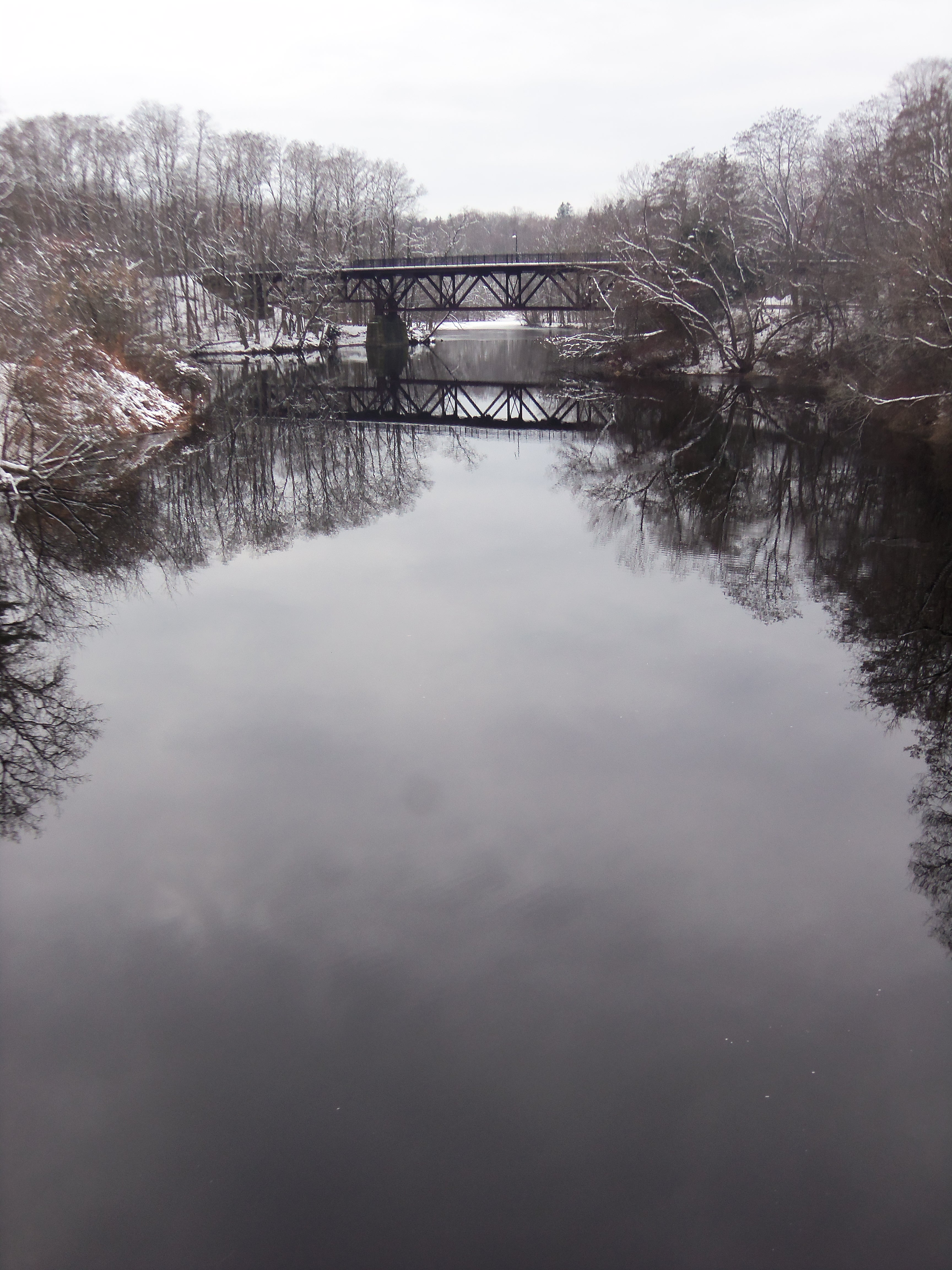 The former railroad bridge that now delights pedestrians on the Community Trail reflects in the black mirror of a late autumn morning. Snow, by the way, transforms the trail for cross country skiers. It’s what we can expect to see any day now.

 Jnana's Red Barn