AS THE SAP FLOWS

The mind dances here and there, rarely in a linear fashion. So what’s on my mind these days? How about counting on these fingers?

~*~

  1. Wet, sloppy snow? The kind that falls all day, making me want to scream each time I look out the window, even when it’s half melting on the street and ground and even though I no longer have to commute through its hazardous, annoying conditions. The mere thought of it, though, has us going stir-crazy.
  2. Maple-sugaring season, for some of our friends. Just listen to all the discussion regarding this year’s sap run.
  3. Blame the switch back to so-called Daylight Saving Time. Keep feeling I’m way behind. Look at the clock, it’s 1:30 p.m., then have to tell myself it would have been only 12:30 just a few days ago. This internal ticking!
  4. Revisiting Wagner’s epic Ring Cycle (four operas spanning 17 hours, which somehow pop up for me in late winter), I confess it’s hard for me to wrap my head or heart around the mythological story. Gods who are not omniscient or who are ruled by lust – that is, who are not omnipotent – make the first obstacle, even before we get to all the reliance on magic and potions. Only when I see them as today’s celebrities does any of this come into focus. And then there is the matter of flawed parenting and marriage. Even more tantalizing is the concept of casting the “gods” as the superrich who are bankrupting America – off they go to their compound.
  5. In observing the Eastern Orthodox dietary restrictions for Advent and now Lent, I’m made more aware of the world’s poor and hungry. Reach for milk for my coffee or for an egg or cheese or butter, then pull my hand back, realizing they’re dairy products, and thus prohibited for the stretch. Under a lacto-vegetarian regime, which I’d practiced in my past, these would be acceptable. The vegan alternative is so much stricter. How out of reach our Western abundance is for so many in the world. As my wife says, the practice makes us tea-totaling oil-free vegans. Curiously, our temporarily limited diet (or “fasting,” in the terminology) does not have me feeling penitent but rather, as we pursue it, has me delighting in ranges of food we normally slight. Even so, I’m really looking forward to feasting come Easter.
  6. Considering many of my favorite hippie-era writers, I’m surprised to see how apolitical many of them are. Richard Brautigan, ever so playful – or even Jack Kerouac, who inspired so many of us. I am open to alternatives, like John Nichols or Edward Abbey, though their writing feels far more conventional and less heartfelt. Makes for a fresh way of revisiting the literature of the era, especially as it leaps ahead to our current political situation.
  7. Insecurity is a manifestation of ego, standing counter to humility.
  8. A sense of being released in to the NOW for the NEW. The way some work continues.
  9. How do people in the construction trades schedule their lives? Do the calls for repairs, remodeling, and new building really average out week after week?
  10. No idea what’s on tap for tomorrow.

~*~
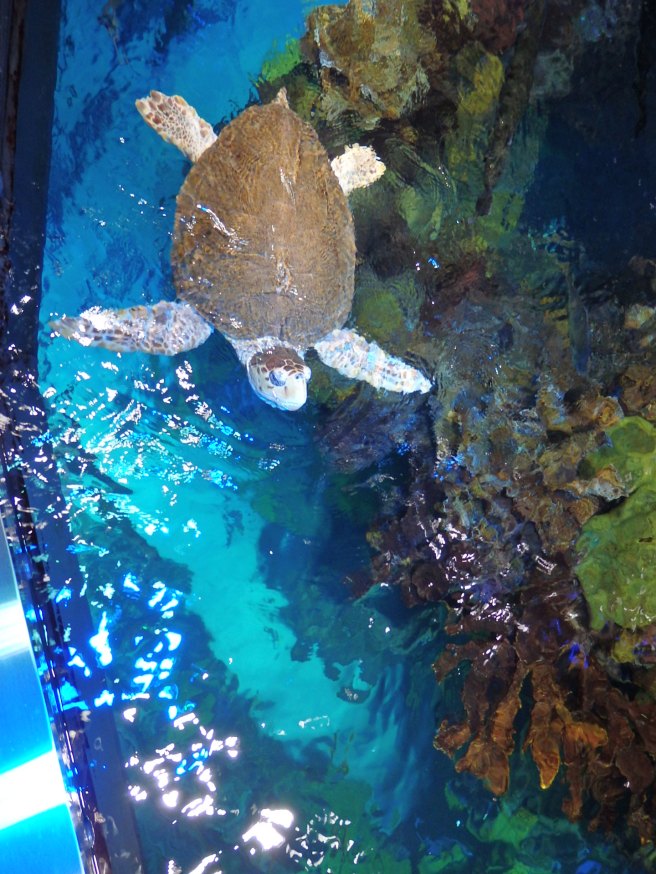
New England Aquarium.

Yes, I’m still swimming laps in the indoor pool, the one in downtown Dover. Glad he’s not in my lane.
 

MOUNTAINS AS A RELATIVE MEASURE

As I listen, I realize the locals don’t consider the surrounding ridges to be mountains. Although these “foothills” or just plain “hills” are as tall as Pennsylvania’s Alleghenies, shorn of trees, to speak of “mountains” signifies that one must drive away into forest. The time comes to hike in unfamiliar high country.

I drive west, into a mountain pass, and park at the trail head.

Climbing through clouds on Sheep Lake Trail, I identify snow lilies, phlox, two whistling marmots I mistake for groundhogs, and a ptarmigan. In these topless mountains, snow and rocks glimmer atop jagged white threads that twist, plunge, and roar over miles. In this clarity I recount a friend’s determination to perceive the important task to perform each day — a focus she achieved in the sunset of her young death. Go on.

The next outing, I follow another friend’s favorite trail. My valley of orchards and meadows stretches behind in a twilight of small-city lights and barren blue ridges. In golden splay dusk, I learn to fear glaciers atop volcanic spines and in their grooved depths, too. So much depends on which way you turn. Clouds, one moment pink, shift into slate-blue. Think of a great-uncle’s farm in Ohio flatlands when green-wood ringed the fields and autos were novelties; and how, when the United Brethren in Christ build their new sanctuary, one tree furnishes enough lumber for all the pews. Such timber is long gone from most of the Midwest, and nearly gone here, as well.

Strangely, adjusting to such disorientation can allow one to see more than the landscape with fresh eyes. I begin reckoning my birthplace afresh, too. I perceive a native poetry now vanished: in flat terrain they coined Sweet Potato Ridge Road when they became sensitive to what had been called Nigger Pike, after work crews that came out from the workhouse jail in the city; Diamond Mill Road was made of limestone gravel flecked with quartz or mica, but named for the distillery beside the rails. What could be in those rural lanes I had sped along on the way to the farm to cause their ghosts to arise out here? I think, too, of the hayloft I had delighted climbing in, even though the old folks feared I’d fall through and be trampled by cattle; more ominously, some shed rafters I walked like a high-wire artist had hogs rummaging below, with razor snouts and teeth and a latent taste for blood. That farm acreage is scarcely like these Western orchards or open ranges, yet something echoes. It’s earth and air. Sunshine and clouds. My days in the mountains are airy conifers. I could be a pioneer, in spirit, at least. My ancestors settled those Ohio tracts. Another line, a bit earlier, settled North Carolina Piedmont. Here, I find unspoiled corners.

Perhaps bears do drink beer. Rocks, leap from mountaintops into oceans. Naked breasts, swell from snowmelt pool to sky.

Against this wall, between his desert and the frigid sea current, I declare my vast ignorance: left to myself, I’d likely starve, soon sicken of berries, and have never caught fish properly or gutted a rabbit. Somehow, I wait to be fed. Thus, one point of my Dedicated Laborious Quest involves learning to be wholly myself — embracing flaws as well as talents, as I search out my own boundaries.

Away from the office and encircled by an ever-renewing earth — even an apparently lifeless desert that restores his sanity and a brand of insanity, too — you may find that every trail you follow brings you closer to your own attainment, your emerging sense of place and mission within the universe. As for looniness — ah, loco! — you soon appreciate how all are in some way at least un poco, indeed.

For more insights from the American Far West and Kokopelli, click here.

BY UNINTENDED DESIGN

relocating
once again recognize
some possessions as useful

simplicity, sincerity, modesty, honesty, justice
that dwell in the Life and Power

when goods are tools
style arises within purpose

*   *   *

addressing basic practices
ordering well-made clothing
that’s both simple and expressive
and fits properly
liberates
from inbred feelings of victimization and deprivation
O Holy One

to choose what is not fickle
instills elegance
of clear function

I’m a sucker for clean, balanced design
outward expression of orderly life
gingerly facing the idolatry of things
made from metal, wood, stone
and yes, plastic

look, there’s nothing wasteful

O Holy One
elegant is also simple in design and execution
though not always easily accomplished
(the skillful hand and eye – the years of mastery)

Poem copyright 2016 by Jnana Hodson
To see the full set, click here.

MARCHING ON, BRAVELY

Being mindful of what’s right in front of us can always be a challenge. Here are 10 new items from my end.

~*~

  1. Keep an eye on the pussy willows, about ready to harvest – a sure promise of spring. How gallantly, snowdrops in bloom – green shoots of hyacinths – even in receding snowbanks.
  2. Keep an ear open at night for peepers, coming to life in their thawing vernal ponds.
  3. Time for seaweed runs, too. Off to the beach to collect mineral-rich debris for the garden. What about picking something out of the canister of kites in the loft before I go? Spend a little more time by the surf? Rather than just dashing off and back home?
  4. As I’ve said, I welcome a faith that encourages questioning and action. I’ve come to appreciate the implicit yes in the Quaker queries. (Link to Light)
  5. Keep hoping to find my appropriate schedule, my right routine, my most balanced pace of life. Years before retiring, I’d draft what I thought might be ideal daily and weekly rounds – charts that drew my wife’s derision when she finally viewed them. (To be fair, some predated our marriage.) Yes, there’s so much I overlooked or simply assumed would fit in. And so much that’s come into my life since. My weekly choir rehearsal in Boston, for instance, throws me off-kilter, since it means getting home around midnight. Otherwise, I’d be rising before 5 or 6, as she does, and sitting to meditate as a yogi or just write. So what have I really settled into?
  6. We are getting days now when the top of the barn’s warm enough for yoga exercise and meditation in early afternoon. Not the schedule I’d projected, but one that’s organic to our situation.
  7. Maybe it’s just a fantasy: past/present/future all within this moment, if you pause.
  8. Fulfillment is ultimately not on my own time scale but the Holy One’s. How terrifying!
  9. Perhaps Verdi’s most compelling plot line until Otello, his 1850 Stiffelio tells of a Protestant minister and his unfaithful wife. Tellingly, it was censored at the first performance and then lost until 1960. In the background, at the time, the composer was living with a divorced woman. Could this be the basis for yet another masterpiece?
  10. Why do Americans keep reelecting the same members of the Worst Congress in History? Is there some death wish for democracy?

~*~

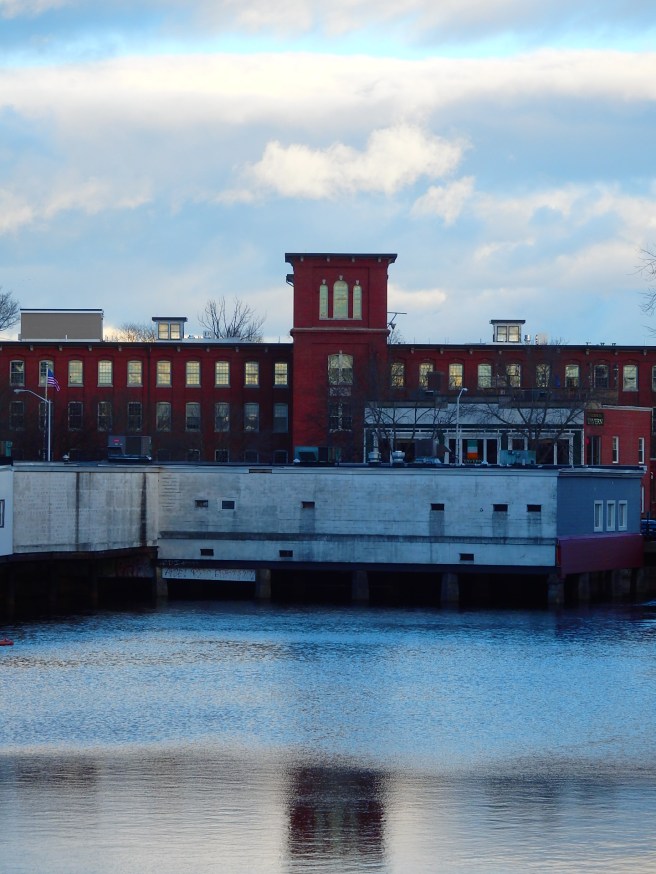
Right in the heart of downtown Dover, the mill. The retail store in the front sits out over the Cocheco River.

LIBERTY

Few people move to desert out of any desire for its peculiar landscape. True, there are those who hope its dry air will alleviate some health problem, yet even they typically install green lawns and shrubs requiring frequent irrigation. There is the prospector expecting to strike riches to squander elsewhere, or the cowboy or shepherd accompanying the herd or the flock, or a refugee or smuggler moving across the opening as a place of the least likelihood of detection or the least resistance in the border. Admittedly, some come to a particular job or to retire. Some come for opportunities of outdoors recreation — proximity to forested mountains or snow-fed rivers rather than the tawny dry ground itself. Almost all, however, have taken flight from something back there — whatever their birthplace or last residence — more than any deep conviction that this horizon embraces their Promised Land. They arrive with boxes and garments, with reminders of conflict or distance. Moreover, they cling to the desert fringe — settling in oasis towns or cities where irrigation water rushes along cement ditches — rather than miles beyond their next neighbor, with only buff surroundings.

My wife and I are no exception.

At the office, I’m asked, Where were you born? What brought you here? Where are your parents? I calculate: few children live within a day’s drive of grandparents, aunts, or uncles. Compared to my birthplace, cemeteries are rare. Nobody admits fleeing family, which is a fact of life. The trout fishing, they say, is unsurpassed. There is salmon. If you have water, you can garden nearly anything to perfection. You can hunt elk in the mountains or various quail in the foothills. You can raft on the river. There’s no rain to speak of, and overcast days are infrequent, excepting the winter.

I explain my reasons were professional. I’m establishing a career and am something of a specialist whose last job was eliminated by sharp, painful budget cutbacks. Here, at least, I have opportunities to advance as a manager, working under a progressive-minded mentor. I accept this move as a shortcut before moving on, to bigger things beyond that horizon. Besides, I’ve promised my wife that somehow we’d relocate to this corner of the nation, a place she fondly remembers from four years of childhood. Following me in this move, she’s distraught to find desert where she anticipated rainforest. In short, both of us suffer dislocation.

Here, then, a rewiring begins. Some of it connects the person to the place. Some of it, the two people to each other. Some of it, the individuals to their dreams.

Horses preserve a way of desert life. Consider rodeo. Agriculture is spelled rancher, not farmer: Even fifteen acres becomes a ranch. There’s great distance nearly anywhere you’d want to go. Religion polarizes into New Age, on one hand, and fundamentalist, on the other, with little in between; this condition is as true within denominations as across the diverse range of religions themselves. There’s a different spectrum of ethnicity to contend with, too — Native-American, Hispanic, and Asian. More, too, than the Eurocentric nationalities and African consciousness he had seen Back East — to say nothing of rearranged economic strata. Within and without. The bum on the corner turns out to be a multi-millionaire who owns a thousand acres. Here cattle are not cows; it’s beef rather than dairy. Federal government agencies are omnipresent: the Bureau of Reclamation manages hydroelectric generation and irrigation; beyond, there are military bases, national forests, tribal reservations, high country meadows, famed parks, Corps of Engineers reservoirs, state-owned sporting grounds, horticultural boards, Extension Service projects. People apply to the Feds when they file for grazing rights or mineral mining stakes supposedly there for the taking. You’ll observe unspoken contradictions, beginning with the right-wing rhetoric common within these federally subsidized communities. As for the Bureau of Reclamation: how dare we say we’re reclaiming when we’re merely putting our human stamp on a piece of soil by diverting water and planting? Maybe we’re declaiming or proclaiming instead. The Bureau of Indian Affairs appeared even more unsettling. Chiefly …

I am learning. There’s good reason the rattlesnake-infested, corrugated humps encircling the orchard valley are pale brown: they receive none of the snowmelt impounded from late March into July in the high mountains. Agencies release and distribute that water through blazing summer into October. Green agriculture parallels the river and irrigation canals, defying the tough, roasted inclines above, where sagebrush and bunchgrass stroke tawny eternity. In this compass, wind rarely precedes rain. Beyond lucrative strips of orchards, the principal agriculture involves herds or hay; because of irrigation and unfettered sunlight, five mowings a year are common; bales are trucked to dairy cows and pleasure horses on the rainy side of the tall mountains. Desert has few chickens — and no pigs to speak of. Somewhere out there, Basque shepherds elude the heat. Forests begin at the top of high ridges observed fifty miles distant.

In the Far West, most men hunt and fish. Their goal is big game: deer and elk, especially. Big trout and salmon, too. Everything else remains “Back East” or target practice. Its vastness hammers the imagination.

On our journey westward, we notice that Custer National Forest flanks the barren holdings of the Crow and Northern Cheyenne reservations. Somehow that summarizes a Far West polity in what I thought would be a classless society.

For more insights from the American Far West and Kokopelli, click here.

SIMPLE LYRICS

Charles Ives, supporting a childhood memory
with a cosmos of commotion
how holy!

me? I’m an American, through and through
who wonders just what it means
to be bred in the USA . one, that is, without
the increasingly militaristic outlook

one also passionate about
symphonic and operatic repertoires
and steeped in the history of painting

the apologetic place of American artists
(especially in classical music).
only rock, country music, and the movies
seem exempt
and ever so profitable, as an industry

Poem copyright 2016 by Jnana Hodson
To see the full set, click here.

BY DAY, BY NIGHT

1

I admire a lighthouse more than a ship
without masts, as a qualifier

anchored in some upstanding foundation

I, who have roved the continent
and no further
gaze from the shore

or out, from the water,
to peer at each obelisk
instructing the coastline

yet masts, in open sail
could make this a wash
or a wish-list

2

I look in vain for a painting or photograph
of ocean only
always some shoreline
or ships – naval battle
conflict or simply
what attempts to bridle wild space

the lighthouse, as a genre, especially
countering the fabled variations of blue

at last, O’Keeffe’s large canvas of clouds and sky
comes closest
even more than her cross by the sea

3

costly as a ship
to construct and to run

this marker
of commerce, progression, and change
made obsolete, still

a warning as welcome

faithfully alludes to danger
in homecoming

a way around obstacle
a passage through the mouth
to safe landing

as much as the other abode
sailors justly dread

4

in daylight, a solitary standing figure
a sentinel
upright numeral one

a spire, a prayer
shrine, stupa
gravestone

defiantly erect penis

by night, its repetition
insisting
“Here! I’m here!”
as much as “Beware!”
in a tally of shipwreck

once with its whale oil and great lenses
arrayed on a crystalline comb
investment in life

such magnification
casting its spark
so far

this rock, uttering its expletive
to death

pinprick of light

Poem copyright 2016 by Jnana Hodso
To see the full set of seacoast poems,
click here.

VISIONS OF BLESSED COMMUNITY SOMEWHERE WE MIGHT REALLY LIVE

Again, try to envision that perfect spiritual community. How do we plug our own households (with all of their struggles in a disintegrating society) into that envisioned fellowship? Terra Mama’s got her hubbie and kids, with all of their confrontations in the wider world; meanwhile, this poet-monk keeps hoping to find wifey and kids, to engage in a, well, household, for starters – just to finally get into the game. Too often, I feel like a monk without a monastery! And my prayer life often takes the form of poetry writing, collecting rejection slips from publishers, or playing solitaire and sipping martinis because I don’t want to tackle Pile A, Pile B, or Pile C of obligations awaiting my labors in my studio – usually after my workday.

Put another way, I just don’t see it in the nature of our own liberal/artsy/leftist leaning folkies to get together in anything having a degree of gelassenheit – submission, discipleship, or correcting-rebuking potential. It’s the old problem of trying to herd cats. (Or, as one clerk greeted the Meeting after a presentation by the kids at the rise of worship: “Welcome to the New Age Holy Rollers!”)

Several newer Friends in Agamenticus have been stunned to hear our current clerk tell them how long it has taken Friends here to finally accept my messages, with their Biblical references. Then they look incredulously at me to see my nodding affirmation. There is a place for patience, but the Meeting as a whole still has a long way to go before we’re Biblically rooted. And there will always be a hole forming a “doughnut Meeting, sweet at the edges but hollow in the middle,” until we learn to pray together. At least some people are asking in our announcements time that other Friends hold them in prayer, rather than simply in the Light.

I suppose that practicing as a faith community without openly acknowledging the power and presence of Christ is like trying to do chemistry without any mathematics; things can happen, but you’re never sure quite why, there’s always a high degree of chance, and it’s bound to be messy with unfinished materials all about. Thus, while I find Quaker worship and service can come closest to that of the early church, it is also with a measure of bad manners, not to acknowledge (more specifically, praise and give thanks to) its root and source. Hence, my Mennonite experiences and discipleship, small group, and you and Eric. What a trip!

Now, do you expect the job of pastor to be any easier, facing a congregation of uncomprehending faces or Sunday-only Christians? Most of the pastors I see are pretty isolated, too; they and their families don’t really fit easily into their congregational fellowship. You know the struggles of most P.K.s (“preacher’s kids”); many of the spouses are the real martyrs of Protestant parishes. Maybe what you and I yearn for is grandparents and aunts and uncles in the Spirit, and we long for an extended family – the kind where four Hodgin brothers marry four Ozbun sisters over the course of several years, and are then available whenever for each other whenever needed (that is, between the demands of their thirty-two or so children). Instead, we get Hollywood romance: boy meets girl, zippo.

Actually, you need to go to Cuba and visit with our sister Meetings there. They have community because there’s no alternative. They walk everywhere together. Their faith has been refined in the fire, and they see know their neighbors problems and needs because they live nearby, and they Jesus everywhere. Their representatives who visit New England are re-evangelizing NEYM. Some of their teens, writing to Wellesley’s young Friends, asked: “Tell us about your conversion experiences!” (Our WHAT?) (Out of that, one Massachusetts teen voiced how much his/her parents opposed said teen’s attendance at any religious observance – going to Meeting is an act of rebellion.)

When I clerk, I continue a practice from Ohio of prefacing the session with a quotation of Scripture, which is then minuted. Last QM, I selected a chunk from 1st John. Later, a red Valentine cutout was passed around, a gift from a youth in our sister Meeting, Holguin. As I translated the text, in my hands, I realized she had written, in Spanish, much of what I had read in English earlier. That’s what we long for.

Well, my three-year stint on Ministry and Counsel is now completed, and is I exhausted! Told Nominating I need at least a year’s respite, will serve only as Quarterly Meeting clerk this year; turned down Yearly Meeting, too, in its request for me to be one of the recording clerks. Same reason, plus the gelassenheit reality from above. One thing is enough.

On top of it, I’ve raised a concern with Yearly Meeting’s M&C that maybe it’s time to lay down the Quarterly Meetings, or at least seriously reconsider their role. I think that with modern transportation, the Yearly Meeting committees have simply replaced the QM in most if not all of its functions.

Other fronts help, too: After Meeting for Worship a few months ago, I was in a conversation with someone who shocked me by saying that she and her husband were about to step into retirement – they certainly don’t look it – and that led into a tally of little adjustments in the aging process – the reading glasses, aches, and so on. “Yeah, this getting older isn’t any fun,” I quipped. From behind us came a soft voice, “That’s why old age is saved for those of us who are tough!” – and we turned to see it had come from eighty-something Grace. So maybe we’re just toughening up, rather than being patched up?

~*~

For more Seasons of the Spirit, click here.

JUST TRYING TO KEEP PACE

Just a taste of what’s popping up. In case you were looking for a prompt.

~*~

  1. March, with its upheavals, has any bouts of single-digit lows unable to hold long. Typically, it’s the month most prone to heavy snowfalls, especially when temperatures hover around freezing. Country roads get their “frost heaves,” too, for bumpy travel. And bits of green begin trying to break through.
  2. “Why are you getting so upset, so defensive,” she asks after I encounter a setback that makes a mess on the counter. “It’s the sort of thing that happens to everybody” Except I want to shout, “No! It doesn’t! It only happens to me!” Actually it’s an echo of the childhood reaction after being accused, “Why did you do this to me?”Or more accurately, “How could you do this to me?” Mother blaming the Golden Boy once again.
  3. Making photocopies at our computer printer has me remembering one of my definitions of “making it” as a writer, back when – the desire for an IBM Selectric typewriter and my own Xerox copier. Just think, our computer keyboards are a vast leap forward from any typewriter, at least for klutzy typists like me, while our kids take the copier for granted. Oh, it’s just the beginning of a long list of good gear rendered obsolete in our lifetime.
  4. Been harboring a lingering notion about selecting a “top 100” or “best 100” or “favorite 100” compilation of my poems. Not that I really want another project to tackle, but looking at the range of my work over the past half-century sometimes leaves me surprised. Yes, much of it has a graffiti-like imperfection, once I decided to write on the run and revise along the lines of jazz improvisation more than aspiring to a perfectly formed artifact – or whatever. Let me say there are more rough edges than I’d like. Still, that 100 cutoff would mean an average of just two poems a year from what’s been a prolific output, even without the novels and essays. I’m still wondering how I ever did it while working full-time elsewhere.
  5. Rereading Walden with an appreciation of Thoreau’s pervasive satire. It’s a refreshing perspective.
  6. Can the question “Who are you?” be addressed by “Whom do you hate?”
  7. As an acquaintance was told at the office one Monday morning: “You have a billion dollars to reallocate.” It’s something that happens in a corporate buyout. Not that she saw any of it.
  8. Gotta try praying rather than worrying.
  9. Stay balanced and rested.
  10. We’re big on putting the lentils back in Lent.

~*~

Yes, this days our Tibetan prayer flags are frayed and thin.
Yes, these days our Tibetan prayer flags are frayed and thin.

IN SEARCH OF DEEPER EXISTENCE

We made a leap, heading off nearly stiff-necked to find ourselves, as some diners proclaim, “served where quality counts.” Over steak dinners, this quaking closet monk is surprised by how much change can happen when I think nothing is moving. Just pass the salt, sugar, coffee, cream — thunder, please — in what they call the Brand Room surrounded by “Western art,” supposedly realistic styling of cowboys, Indians, and wildlife in dramatized poses. People from all over the world come to a few tiny rodeo towns like this to collect such canvases. Examine the pieces closely, though, and you perceive the false notes. The clothing, poses, landscapes distort. The artists react against the very masters they wish to emulate. Much of it is cranked out without looking acutely at the things being portrayed. Some may be driven by a worship of a past that never was quite that way; some, by a retreat from current events. Most viewers merely acknowledge symbol and go on as though sleepwalking, an act that continues misunderstanding. The rifle, saddle, spurs, and cougar evoke no real emotion: they are foreign to the touch and nose. But I desire to perceive this territory afresh — no matter how startling my findings deviate from convention. When I meet a bear or a buffalo, it won’t be like the dilated scoundrels in these paintings. My horse won’t rear behind me. He’ll simply center in his tracks — quiet, aware, efficient. He knows how it will be.

The Dedicated Laborious Quest begins with sustained exercise of a specific activity: a sport, an art, a science. Anything that requires years of individual exertion, even solitude, drawing upon many facets of the practitioner’s being — heart, mind, soul, and might.

Somehow, the novice begins dancing, if only in his head. Something simple, at first, until familiarity gains ground. Feet, legs, torso, arms, and hands eventually follow. A reel leads into a jig. Thought and emotions balance. Head and heart dialogue. With confidence comes freedom. More and more, the aspirant concentrates on partners or the group or motion itself, rather than his own next step or position. The music becomes more textured, until the hornpipe stands as the liveliest structure. So it’s been in this landscape. This is not just any desert, for there’s nothing generic about any detail encountered closely. With both people and places you come to know dearly, you find nuances and subtle contradictions will blur any sharp image. It’s easier to describe someone or something you meet briefly than what you know intimately. To say desert is dry and sunny misses the point, especially if you arrive in winter. At first, like so many others, we didn’t even consider this valley as desert, for it has no camel caravans or mounds of shifting sands with Great Pyramids on the horizon. One word or phrase can be misleading. Even the Evil Stepmother from folklore and fairy tales must have possessed some redeeming qualities. Could we be more specific than “evil”? Simply selfish? Or was she mean, jealous, domineering, afraid of whatever, from the wrong party? Suppose she was really a victim of some deep abuse? The portrait changes. Has anyone detailed how she dances? In the end, it’s either entertainment or worship, depending on the individual’s orientation. An authentic spiritual discipline teaches, through experience, we are not gods. Choose, then, good or evil, flowing or hoarding, living or dying.

Matching maps to the landscape, I look vainly for towns that do not exist or discover attractions placed on the wrong side of the road. Admit that everything is moving and transitory, even the mountains. Mariners, too, will speak of shifting sandbars as only one hazard of sailing on charts. Pay attention, then, but never toss your maps overboard. Are they all that different from Holy Scripture?

In a multitude of ways, people fear religion will lead them not just into wilderness but a desert. Demand, in fact, they leave everything behind. The description will vary by tradition. Entering the Void or emptiness, becoming selfless or egoless, abandoning the Little Self for the Big Self, achieving annihilation and sacrifice, attaining renunciation (Sannyasa), taking up your own Cross — these are a few of its names. Marriage adds its own complications.

Having come to the desert, we now know the fuller value of water. Something simple, essential. No one can live without it. The list of necessities is a short one; the possibilities of embellishment, endless.

There are rivers on every map you rely on. Sometimes when I walk out into the expanse, I encounter one. Sometimes, one deep enough to block my way. And then I turn to the page for a bridge.

Or, better yet, call out for my buddy, Kokopelli.

For more insights from the American Far West and Kokopelli, click here.