on the way out, a fifty-year-old shrimper from Louisiana –
originally from Gloucester, where he’s visiting his sister –
tells of the Gulf’s particular brutality
how crews typically go out twelve days
till the hull is full . his boat with three Rolls-Royce
engines so loud harborside residents complained
he hesitated to open full throttle
unless the water’s churning was especially rough
rocking at the jetty-mouth sandbar
like Canobie Lake’s pirate ship ride
three delighted school groups shriek
when we top twenty-one knots – his boat, twenty-three
yet his went down / couldn’t salvage any gear
lost two crewmen with him five years
he himself now limps
wounded in the knee by a barracuda,
and it’s not healing right . he hobbles along
with a cane, wondering if it’s time to quit
the shrimping in his blood
run an excursion boat instead
“and you, sir?”
Poem copyright 2016 by Jnana Hodson
To see the full set of seacoast poems, click here.
On scattered reservations, a few elders rise before dawn each day and summon the sun to return. Don’t scoff. When I, too, get up in the dark and meditate, I feel my own self-confidence rising. Watch the world awaken. Light a wood fire, something I sit beside and watch for hours, its flames more imaginative than television. Bask in the radiant warmth.
Kokopelli, night owl that he is, still slumbers.
My wife, in another room, rolls toward the wall and finally rises to join me.
There’s a science, and then there’s an art. In the pyre, paper first chars, then shrinks, and finally explodes. Only then do flames engulf it. “Consider the bomb a ream would create,” I grin at her.
“Now who would you want to bomb, Buzzard?”
But I also know how difficult igniting that ream would be, and how difficult to keep it burning. Watch carefully and misconceptions turn to ash.
In the continuing drought of that fall and winter, I explore national forest well into February. Areas that should be buried in a half-dozen feet of snow are instead bare. Atop one mountain, I look over a cliff. “I think it’s dolomite.” Maybe it isn’t. Maybe the identification isn’t earth-shaking important, but learning the names of places and their minerals, fauna, and flora adds dimensions to a place. Improves your chances of survival, too, if put to the test. For now, I scramble on the scree and realize that white painted stones at the cliff’s edge marked out a heliport. Far below my feet, a table of forest spreads into basins that are invisible from my vantage, and other places I’ve already been. I trace Forest Service roads, such as they are — 1707 from Raganunda to the top or 601 down to Willy Dick’s. “Keep elk gate closed,” the sign reads when I came out, passing a few back country ranches to the highway’s rush and debris. Far above all that, I sing out: “God bless a bloody rib cage above gray fuzz. Perhaps we’ll have rain in the morning! We shouldn’t be kicking this dust.”
In a zero-degree fog, the sun rises as white as the moon.
“Let our liquid flow again despite this desiccation!” I cry in my dreams. “Why is it so difficult to recall the thoughts rainstorms instilled?”
“You put too much value on sorrow,” Kokopelli tells me. Even in my sleep, that old guide’s still at work.
For more insights from the American Far West and Kokopelli, click here.
don’t presume the ocean is smiling
or the gulls enchant
the spire warns you
especially in New England
to step
back from the wreckage
or unexpected nor’easter
2
gales and furies
sweep up and disappear within hours
behind placid indifference
raise public duty
expense and craftsmanship
defining coastline
signatures, on the dotted line
in the clearest conditions
3
pointer / referent / rhythm of light / solitude or
loneliness / romantic illusion / high-maintenance history
lightening bolt / flicker / flare / discharge
beer can or wine bottle uncorking or blowing its cork
tourist magnet / spike / whistle, horn, upturned bell
observatory / night madness / memorial / first end of the sea
fist of defiance / ordered rock on rocks / spiral staircase to sky
to the horizon / a hollow tube / a composition of lenses
slivers of glass / slivers of crystal / a glass circle carousel
a hermitage / pigeon roost / billboard / thumbtack
anchored ship’s bridge / silver cup tilting / upraised finger
4
Boon Island, flashing white every five seconds
projects nineteen miles out to sea
Goat, faintly to the north
to the south
White Island, out in the Shoals
and Whaleback, would be double white flashes every ten seconds
just over the trees
way off, Thacher Island Twin Lights
(aka Cape Ann Lights or Rockport, Mass.)
project seventeen, but viewed from up on rock
at Nubble, some extra distance
on a rare night
of calm
antiquity
joining the squat red beam
and strobe flash
each one
proclaiming liberty
over any face of oppression
the tyrant sea offers
Poem copyright 2016 by Jnana Hodson
To see the full set of seacoast poems, click here.
Over the years, my own spiritual practice has undergone many changes. In the essays and notes of my Seasons of the Spirit collection, I touch on struggles that led me to reject the mainstream Protestant teachings of my childhood as well as my leap into the monastic life on a yoga farm before I chanced into the Society of Friends, or Quakers, where I’ve remained for more than four decades.
I arrived as an ABC Quaker – “anything but Christ” – but many sections in this collection arise in a subsequent, evolving evangelical encounter and language, especially as my community of faith moved into the more historically active strands of Quakers in Ohio Yearly Meeting and then into Mennonite and Brethren extensions.
That tone and scope of thought moderate as I grow older, living and working an hour north of Boston.
A crucial influence through much of this volume reflects seasons of relationship – intimate companionship, family, and friends, as well as the workplace. Cycles, too, like those of progressing from childhood and parenthood into retirement or release.
Even in a tradition like the one I’ve embraced, seemingly free from an annual liturgical calendar or its outward emblems, cyclical changes mirroring those of the seasons do appear. Since much of this time has been spent within the Society of Friends, or Quakers, I’ll give one example from Salem Quarterly Meeting in Ohio, where the session each Fifth Month (that is, May) meant rhubarb in the applesauce. See it as sacrificial and special, a kind of unwritten liturgical calendar waiting to be observed through repetition.
In speaking of this awareness and growth as Seasons of the Spirit, we may also consider their interplay with the Seasons of the Flesh – and ultimately, their unity, contrary to Descartes and conventional teaching. From my perspective, perhaps with a Buddhist twist, we can proclaim an alternative:
I breathe, therefore, I am.
Spirit, after all, is the very core of the word inspiration —and at its heart of meaning. I’ll also focus on Spirit as the Holy Spirit — the Spirit of Christ — in contrast to other spirits, such as jealousy, anger, envy, and so on. Translate this as you wish.
Seasons of the Spirit
Whatever the pathway, there are times of struggle, doubt, and distrust. Times of whirlwind passion and excitement. Times of discovery. Times of drought or deep winter, relying on what’s brought out of storage. Times of renewal and recharge.
This has manifested as periods where I’ve been able to dedicate significant time to meditation, solitude, travel in ministry, prayer, Bible study, research into history and theology, organizational service, teaching, correspondence, or writing, as well as to regular disciplines such as fasting or physical spiritual exercise (the hatha yoga sessions or even wilderness hiking). Emphatically, however, one would predominate while others would likely be absent or greatly diminished. In addition, they would be strongly impacted by the events of my daily life itself – whether I was single, married, divorced, or “in relationship,” my hours and nature of employment, my friendships and faith community, my driving patterns through the week.
The result of all of this would be a crazy-quilt tapestry or a ricochet trajectory if it weren’t for a spiraling within it. That is, over the years, various periods and interests begin to overlap one another, creating a kind of harmony or accumulated depth. My asparagus bed in New Hampshire has roots in my experience of asparagus along irrigation canal banks in Far West desert three decades earlier. A dog sitting through Quaker meeting here is a reminder of dogs sitting through predawn meditation sessions in the Pocono Mountains, or of the cats aligned on the scaffolding outside the windows, as if they, too, were deep in concentrated worship. I read a particular Psalm and see the passage taking twists I hadn’t perceived earlier.
In my own life, my childhood was filled with natural science, hiking, and camping, each with its mystical visions and moments. Adolescence led into politics, classical music, opera, and writing complicated by unrequited sexual yearning. Without romantic companionship, a Lone Ranger journey. Rejection of existing creed while ensconced in youth church office was followed by flight into atheism and hippie excess landing, inexplicably, in a yoga ashram with its hatha exercises and sustained meditation. From there, into liberal Quaker practice, where the ashram lessons were applied in circles of deepening prayer life. By steps, I moved toward Christocentric and Plain speech, and an especially faith fervent language. Among the traditional Wilburite Friends as well as Mennonites, especially, I came to wrestle within Scripture while simultaneously undergoing repeated Dark Night journeys and questioning. Turning to emotional therapy, I wondered if anyone could come along with me through all of this – my career moves, spiritual shifts, and geographic relocations. By now, too, I was no longer meditating to get high, or transcend, but rather to center down to what the early Quakers emphasized as the Seed. Here, too, with all of the Quaker committee work, I was engaged in a religion that combines mystical experience with social witness and activism. In a nutshell, then.
Each swirl also stirs up something from before. What failed in earlier marriage or relationships reappears. What has been left unfinished is not left entirely behind. What has been shredded remains to be woven. I’ve heard this opera in its entirety a hundred times. Have I ever heard this note before?
I moved from the Midwest to the East Coast and back before heading on to the Pacific Northwest in what seemed an epiphany but instead shattered amid volcanic eruption and devastation. I left the wilderness for another kind of wilderness, back across the Rust Belt of the Midwest and then on to the East Coast. The pendulum, as they say. Here, I now see life as both linear and circular – that is, spiraling. The spirit requires flesh, or is it that the flesh requires spirit? Seasons include times that are full or overflowing, and times that are barren or dry. I now welcome the questioning that is not hostile is both essential and healthy.
My first spring in the orchard, I expected all of the trees to blossom simultaneously. They don’t. The apricots and cherry petals give way to plums, pears, and peaches. The apple blooms arrive last, when others are already gone.
Experiencing a new place through a full year or repeated years provides a much different understanding than a tourist gets – even one who spends several months there. Relocating requires a year-and-a-half to gain familiarity with the new surroundings – to get beyond the obvious, to establish friendships, to be oriented with the elements one finds essential or special. A favorite restaurant, a woodland pathway or place to swim, a boutique or gallery.
There are seasons for a person of faith, from winter to spring elation and then into fullness, dryness, struggle, or disillusionment. To harvest, perchance. Marriage? Family? Children? Extended into joy, compassion, humility, appreciation – one begins observing and naming.
The turning point in my own journey came when I accepted a new name – Jnana – while living in the ashram. The rest of the developments followed.
The mind dances here and there, rarely in a linear fashion. So what’s on my mind these days? How about counting on these fingers?
~*~
I’m still impressed by all the latent energy stored above the waterfalls in the streams around us.
The water’s flashing. Rivers and ponds spark – shoot away – fire away – in rippling sheen.
Another of my spring tasks involves bringing the garden hoses down from the loft, connecting them to the faucets, and going to the cellar to reopen the valves.
It’s time to pencil in a trip to the Garden in the Woods in Framingham, Massachusetts. The site, headquarters to the New England Wildflower Society, is especially popular through May into mid-June, for good reason. The organization goes to great lengths to enhance nature, though you have to look close to detect their careful irrigation units and similar touches.
Even when the material for a blog is mostly already done, this act of posting takes up more time than anticipated. Where do the hours go?
A fine time to hike in Maine woods: no black flies and no skeeters. The only sounds in some places: wind in the trees or water sounding like highway traffic.
It’s one of those years when the Eastern (Orthodox) and Western dates for Easter coincide.
Time to be on the lookout for tender young dandelions for our diet. They’re surprisingly good with eggs over easy, a drizzle of bacon fat, or homemade vinaigrette. Gotta pick ’em, though, before they bloom and turn bitter.
A favorite minitrip: Head up to Portland, Maine (just an hour northeast). Hit the Standard Bakery near the docks and then the 10 o’clock mail-run ferry around Casco Bay. Six stops on five islands. Reminds me at times of Puget Sound, so many years back.
And, as they say, introduce yourself. These days, could use something catchy, humorous. Something, for that matter, like a good pickup line, not that I ever had any. Feel free to share your examples.
~*~
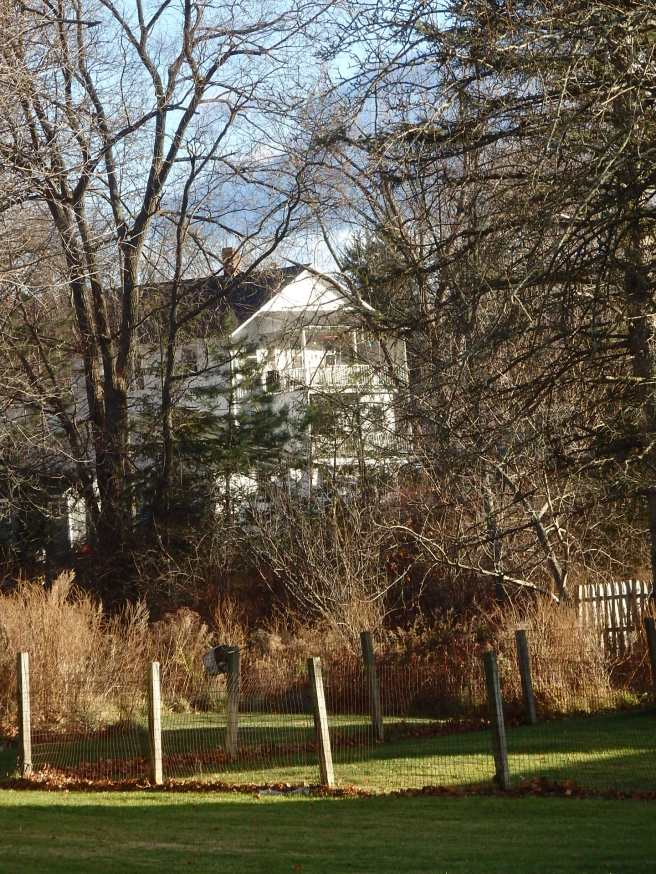
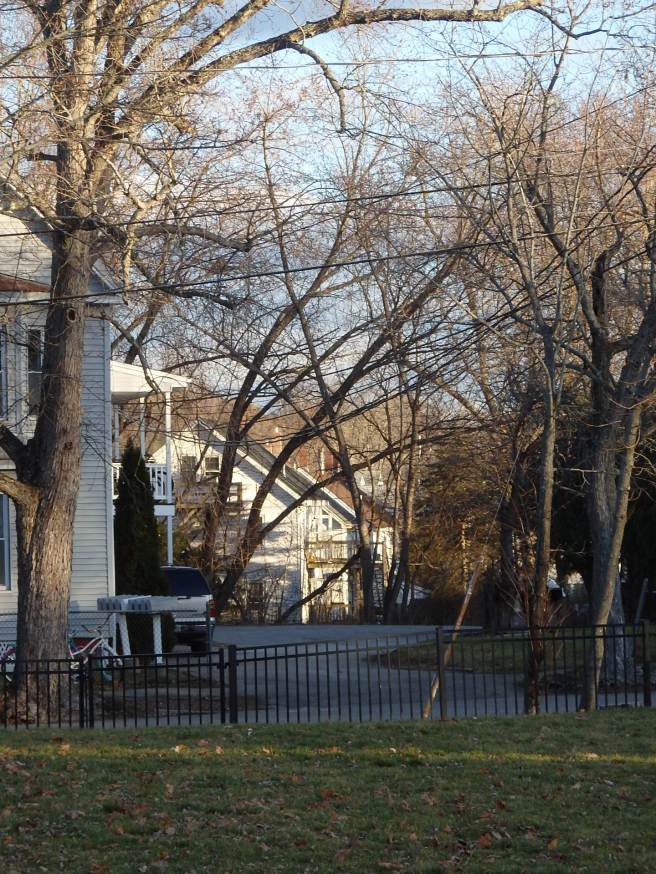
Here’s a view, one backyard to another, only a few blocks from our house. Looks a lot wilder than it is.
Those of us on the liberal side of the social and political spectrum like to think of ourselves as open-minded, which means the times we exhibit flashes of bigotry can be especially painful.
First off, we’re blind to it. Not us, right? But we do.
And sometimes we do it to each other.
An example comes in the gold cross a young woman decided to wear. She’s nothing along the lines of a Fundamentalist or even a committed believer, but she liked her grandmother’s jewelry and this particular piece. Difficult, though, was her experience of the reactions from her fellow college students and faculty, starting with their physical motion a step backward. Literally.
There were words that would not dare be said to Jews or Muslims or ethnic groups of any stripe – and assumptions that simply did not fit. In fact, there’s a presumption of right-wing positions accompanying an ignorance of the social-justice dimensions of other Christian communities and their actions. And there’s nothing of the nuanced theology that moves beyond the cartoonish criticisms we often hear.
For the record, Quaker tradition long frowned on any jewelry whatsoever as superfluous and vain. But I’m not wearing the distinctive Plain clothing of Quaker history, either. Now how would they react to that?
outwardly, my ways were simple
even austere or ascetic
my modest apparel
considered drab or seedy
still I was becoming
wary of self-negation
that denies the sweet
Bread of Life
* * *
when John from Tri-State Megabucks phoned the office
to report the latest week’s winning number, he asked
in an attempt to be friendly, if I had my ticket in hand
so I replied, “no, it’s against my religion” and then
sensed a stupefaction on his end of the line
there might be another position on this business
O Holy One
keep me tender in reaching across differences
where a holier-than-thou attitude accomplishes
nothing more than standing in faith
* * *
if there weren’t so much insufficiency all around
the homeless, unemployed, imprisoned,
impoverished, illiterate
quickly overwhelm
apart from family and spiritual community
within my neighborhood
how little I alone can do
against needs deeper
than those seen
where any sense of great inadequacy provokes
a hardening wall
while judging myself harshly
reminded
to my own consternation
of how I’m lacking
Poem copyright 2016 by Jnana Hodson To see the full set, click here.
In the historical overview that forms the core of Seekers Found: Atonement in Early Quaker Experience, Douglas Gwyn casts his net wider than the circles in northern England of the mid-1600s who formed what we’ve come to know as the Seekers. What he traces is a broad undercurrent of radical faith from the outbreak of the Protestant Reformation, an alternative Christianity in which an Indwelling Christ or Inward Light is to some degree acknowledged and which, in turn, leads to rejection of many or all outward sacraments or ritual in worship. It turns out to be far more widespread before the Quaker movement emerged and gave it distinctive voice than I’d previously seen.
Frankly, as he focuses on seminal figures who advanced this thinking, I’m amazed that his brain didn’t simply explode. Remember, he’s following not just one person but many, all with flashes of nuance and insight that begin to overlap and also to diverge. Nothing is static.
Of course, we face similar problems looking at the counterculture movements of our own time. Just who, for starters, would we look to as voices of hippie thought and lifestyle?
When Gwyn remarks that “many of the Seekers-turning-Quakers … started out as hyper-Puritans whose idealistic moral absolutism made them unbearable to themselves and to those around them,” I feel an echo in my own hippie passage. Many of us seemed to be doing something similar. My, could we be intense! (That, along with the emphasis on “mellow.” Go figure.)
It also has me wondering about the spiritual starting point for many of the teens and young adults in our wider society today. Just where would deep conversation and inner growth begin? What are the driving forces in their lives?
Historically, the focus on events in England also leaves me sensing a gap in awareness of the radical advances in New England from the 1630s, exemplified in Roger Williams, Anne Hutchinson, and Samuel Gorton, as they prefigured those in England in the 1640s. I’m not faulting Gwyn here, since his thesis is on the forerunners and emergence of the Quaker movement, but it is a topic ripe for exploration. Let me suggest John M. Barry’s Roger Williams and the Creation of the American Soul: Church, State, and the Birth of Liberty (Penguin, 2012) as a starting point. The New Englanders, quite simply, seem to be ahead of their Old World compatriots. Maybe the British court records present a fuller picture, but until the end of censorship in 1642, we seem to have little else to go on.
It’s all a potent mix. When the first Quakers came to New England, they found fertile ground.
What Quakers added, according to Gwyn, was a means of putting that seeking into action within daily lives. It was a matter he views as apocalypse. Somehow, our hippie adventures never got that far, which leads to a whole new set of considerations.
~*~
More of my own reflections on alternative Christianity are found at Religion Turned Upside Down. You’re welcome to take a look.
Being mindful of what’s right in front of us can always be a challenge. Here are 10 new items from my end.
~*~
On the highway north, somewhere just before Tamworth, comes that first big view of Mount Washington. This time of year the crest is an eagle span of ghostly white spreading atop powder-blue ranges below. Sometimes another band of clouds resembling mountains stretches above, and all three sit below a blue band of real sky. Knowing what’s coming up simply heightens the anticipation.
Back home, my rounds of outdoor spring tasks soon lead to the Smoking Garden. The bags of leaves stacked beside the barn as windbreakers will need to be moved to the big compost bin, which needs to be emptied first (though it’s usually frozen tight this time of year). Then there’s the hammock to reassemble, after being stored in the loft. Strings of twinkle lights will go up overhead, too. I’ll often take lunch here, though my wife finds the air too chilly. Not too chilly, though, to prevent us from grilling on charcoal.
Yes, warm enough to grill a beer-can chicken (insert open can into bird, which you cook upright). Excellent, despite the stiff wind.
Seapoint in Maine (town-resident sticker required for parking, May 15 to September 30, where the road ends at the ocean): trek out to the spit between beaches, hunker down in clefts between rock and sunshine for needed respite against wind. The restless blue ocean opens before me. A tease, awaiting summer.
Woodpecker still has a splitting headache.
Income tax time runs up against my professional life as a journalist. How much I hate waiting till deadline to finish something. Get it off, quickly, if you can.
Need to find ways to keep my lair from becoming a chamber of static energy. Ditto, the loft of the barn.
The leadership we’re seeing is a bunch of cowardly brutes.
Once again, the moral issue of civil disobedience comes to the fore. For the record, regarding the Transcendentalist Henry David, it’s THOR-oh, not Thor-OH. And Nixon lawyer Charles Colson came to advocate some powerful moral guidelines for civil disobedience, after he’d repented – that is, “turned” – while imprisoned.
What turns you WILD? (As in dreams and passions, secrets and fetishes. Am I really so orderly or repressed at this point? I’m clueless, apart from anger.)
Someday I’ll learn the identities of clouds. Buy the chart, memorize their qualities and forms, and then watch the flowing sky afresh. This is, after all, yet another strand of mapping.
From childhood, I’ve absorbed maps. Mind travel. Concepts augmented by photographs and writings, which have often furnished a sense a such familiarity that when I arrive in a new place, strangers stop me to ask directions, even on my inaugural visit. Foliage, waters, buildings, and people fill in the lines of his maps as they stretch toward some new border. But this move, with its desert, has been an exception. Nothing’s been predictable or particularly comforting. Besides, I experience a vague agitation when venturing to the edge of my known universe. If possible, when visiting new locale, I push out a few miles further, to determine what’s over the next ridge or river — or at least down the road — as if to anchor myself within some context, rather than remain at its periphery. Curiously, I feel more secure when placing that border at some shoreline or rise — countryside, at the least — rather than within seemingly endless tracts of housing, factories, stores, and pavement. Even a round earth has places where monsters may lurk. Gaps exist in any map. Consider the clouds. Everything is, after all, changing. Even that rock, where Kokopelli is sitting.
For more insights from the American Far West and Kokopelli, click here.

 Jnana's Red Barn