CELEBRATING ‘HIGH SUMMER’

I’ve long been fond of collage as an art form. These Tendrils continue the stream.

~*~

  1. Tomatoes are in! Real tomatoes! Nothing like the ones in the supermarket all year, no way! Julienne is our workhorse variety, small but firm and reliable from the beginning to the end of the season. We dry and freeze many of them to use well through winter. Even while raising a dozen or more varieties, we find New England’s susceptibility to blight has erased most of our favorite big heritage varieties from our rounds. Hurrah, though, for some of the hybrids. For the big juicy reds we’re relying on Bobcat, Brandywine, and Cherokee Purple. Any other suggestions?
  2. “High summer” is what I celebrate once the oppressive heat and humidity of July break, rather than bemoan the few weeks remaining. …
  3. How tasty/zesty the wild blueberries on Mount Major!
  4. Dog Days, indeed. Swimming at what I call Fort Lobster. The water, choppy with a rip. A short swim can be exhausting. I can see how panic would set in. Meanwhile, she sleeps on the warm pebbles of this beach. Back home, we grill steak and corn on the cob.
  5. I really do have to learn to play bocce. Or bocci, as I usually see it spelled around here.
  6. At yearly meeting and other big Quaker gatherings where we rent a college campus for a week, we use golf carts to ferry folks from dorms to dining hall to the auditorium or classrooms. Has me thinking of amusement parks with their kiddie-car courses. Especially the faces of the volunteer drivers reliving a highlight of their childhoods.
  7. Still, I wonder about those who publish a short story and are then approached by an agent. Especially considering how difficult short-story collections prove in the marketplace. Short fiction, remember, is a whole different beast than a novel.
  8. Wandering through galleries of maritime paintings, she became fascinated by the way waves are depicted. Turns out to be a good way to traverse the collection.
  9. Before her, I had no real conception of house repairs! All these things that need to be done! Is it really endless?
  10. One-pot meals can be classic. To wit: I boil a pot of water, add corn on the cob. Remove the corn, replace it with lobster in the same (now seasoned) boiling water. Serve with butter and lemon and beverage of choice. All yummy!

~*~

Wild yarrow betwen staghorn sumac.
Wild tansy between staghorn sumac. Here I’d thought it was yarrow.

STAY FOR THE SERVICE

I’m invited to photograph an Indian funeral for a 109-year-old woman. It’s a traditional affair, with a Pendleton trapper’s blanket on a casket lowered by hand. Even so, young punks surround me: “Don’t you think you’re crazy,” they ask, implying?

I look around for Kokopelli, who might intercede on my behalf. He’s nowhere in sight.

Later, with a Styrofoam cross and dozens of American flags, the casket rides the back of a pickup, viewed by faces in Cool-Ray sunglasses — ancient traditions side-by-side with the cheapest, most honky-tonk trinkets of the New American Way.

I wasn’t permitted to enter the house, either.

For more insights from the American Far West and Kokopelli, click here.

THE SURFACE

with distances
our skin
our heart
our thoughts

the countryside
a big city

such poverty and misfortune
such glittering opulence

visibly and invisibly
blinding

even before the mildew

*   *   *

my turtle shell my weakness
three times I’ve prayed it not be moved

*   *   *

casting addiction
or promiscuity
or crime
along racial
or ethnic
or neighborhood
in or out of

where charity is not supple
communion

no hour
attended as fully as we might

Poem copyright 2016 by Jnana Hodson
To see the full set, click here.

ALL IN THE FAMILY

She asks, “What do you want?” (Apart from the obvious?)

For this household to be harmonious, I reply.

It’s a good place to start, she agrees.

Safety, for one child. And gratitude – including the things that haven’t happened.

Health – and the right companion – for the other.

Healing, happiness, and meaningful employment, for yet another.

And contentment, for the mother-in-law.

A good garden, too.

As for me? Where do I even begin? Really begin?

INVITATION TO FLIGHT

On one of my solitary walks with Kokopelli, I admire the fullness of purple-tipped grasses along the canal bank. Some offer bunched, short seeds in clusters. Others have long-shafted seeds in plumes. Or oblong, spiked seeds suspended like bells. “There must be a thousand golden variations,” I tell him. Oats. Wheat. Barley. Bread and beer. Silk-enshrouded ears of corn for sweet butter. Fat tender steaks. Sour whiskey mash. Like some people I knew. The many named needles and strands of whips and brushes reach skyward, flaying the wind, inviting birds to flight.

For more insights from the American Far West and Kokopelli, click here.
RETURN

1

slowly approaching a line
that grows from the edge of the sea
and then spreads at the harbor mouth

slowly, details emerge
and at last, some recognition
in what’s become familiar

home, or at least neighborhood
extending

attuned here, more than elsewhere

the awareness, something all your own
has happened with this place
but not knowing precisely when

in the tide
returning

2

introductions, by degrees
lapping and receding

even in six hours

Plum Island with Eric, Bill
and the baby, “Why don’t we leave our towels
down there?” rather than the crest of the dune

“you’ll see”
once the surf bubbled inches
from our possessions

or high tide covering the jetty
that shaded the sailboat venturing out

or entering a ferry on one deck
and exiting
on the return, from another

or weather

on a carefully selected
Sunday picnic, and air
optimal for swimming at the sandbar
only to have the Coast Guard
pull up in an inflatable raft with a bullhorn
“Out of the water! A storm’s coming!”
while the sky’s still cloudless but
before we reach shelter two hundred
feet away, the sun’s gone and a deluge opens

with or without hail

or the mid-afternoon ferry
through twenty-foot swells
and returning at sunset
on calm water

not that we’re friends
or have much of what you’d call
a relationship

3

miles inland, closer to the house
detecting high tide in marshes and rivers
or its absence

salt hay in cow milk

Poem copyright 2016 by Jnana Hodson
To see the full set of seacoast poems,
click here.

GETTING ACCLIMATED

As I wrote at the time:

It’s the third straight day of temperatures above ninety, with humidity to match. Still, we’ve avoided a miserable July this year, and the heat has not locked itself into the house: we’ve been able to cool everything overnight. What strikes me is that we’re no longer floored by the oppression. We simply move slower, more deliberately. Avoid using the oven. (We’ll grill outdoors this afternoon.)

In other words, we’ve adjusted ourselves to seasonal change.

Come winter, we’ll have to brace ourselves all over again for biting cold. What will be bitter in November or December will instead feel balmy come February or March.

At the office, I know that any sharp change in the weather brings an increase in obituaries. We can joke about the shift that sends those who are barely hanging on over the edge, but the numbers support us. People in climate-controlled chambers all the same responding to minor shifts in barometric temperature or dew points, all the same. Do we inhale and exhale something other than air?

Spaces I’ve entered where silent prayer or meditation are already under way all felt set apart from their surroundings. I’ve sometimes described it as diving into water and swimming beneath the surface or like entering a pressurized rare-book library.

Returning to the ashram and its grounds after being away presented a similar sensation, as have old Quaker meetinghouses, even years after their regular use.

Live within that energy, and you no longer notice it – it’s simply the way life is. Leave it, though, and you can feel you are falling through space, for weeks on end.

~*~

For more Seasons of the Spirit, click here.

ALL OVER AGAIN. OUT OF NOWHERE

Why wait for the dust to settle? Here are 10 bullets from my end.

~*~

  1. A bit of gardening before Meeting for Worship. A round of picking raspberries, peas, string beans. Blueberries and currants are next to ripen.
  2. One foot in the present, the other in the past. Not just a pattern for dreams. It’s intrinsic to the process of writing. Add to that smells, sounds, touch, taste.
  3. I love the concept of the Commonplace Book – a kind of scrapbook of observations of a personal journey. It’s related to the tradition I discovered in whaling ship logs.
  4. The logbooks, by the way, had a specific form, which by 1840 came in printed versions with columns H, W, K – hour, wind, knots – plus course and comments like “lost sight of land” or notations of birds seen. Across the bottom of each page are other notes, such as latitude and longitude or the distance traveled in a day, where I saw up to 140 miles recorded. Turns out the entries also helped determine or justify extra rations for the crew and so on, depending on the conditions. Wonder how that format would work as a personal journal.
  5. What do we make of rounds of thunderstorms, interrupted by bursts of sunlight, knowing more weeds and garden slugs are on the way?
  6. The Portsmouth Greek Festival differs from ours in Dover. Their event has two food lines, rather than one, and an outdoor tent for dancing. It all takes place behind the church, rather than miles away. I’m surprised how little interaction there is between the two Orthodox congregations.
  7. Been meditating for 66 years now, one way or another upholding the spiritual discipline. More than half of that time has been as a member of Dover Friends, worshiping in our 1768 Quaker meetinghouse. Some of the members have been there the whole time with me. (How could that be? Already!)
  8. I’m not a big fan of comparative religion, looking for commonalities and similarities. I’m more interested in vital differences and nuance. How far this is from what I’d envisioned, back when I was largely agnostic.
  9. In a very fragile condition, a snake having just shed its skin.
  10. What was the biggest mistake in my life? (Or in yours?)

~*~

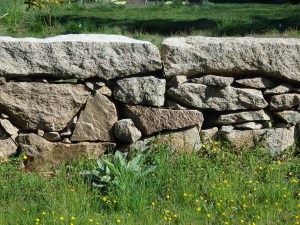
Doesn't everyone have a stone wall for the pots?
Doesn’t everyone have a stone wall for the pots?

ANCIENT VIBRATIONS

Instead, I looked in another direction and discovered that the Yakama people once occupied 17,000 square miles and had three distinct language stocks. So, even back then one tongue was insufficient to articulate the vibrations of this place, even as an open desert. To try relating the qualities of a simple thing, a pane of hundred-year-old glass, perhaps; the interaction of clouds and sun, alkali and volcanic ash is far more complex. You start by learning the names of flora and fauna. Watch, listen, wait. I open a window and consider the current research, which places the first people here about 14,000 years before my arrival. These nomads made tools from bone and mineral. Hunted large and small game. Fished salmon. Collected river mussels. Gathered wild food plants. Given a guide and sufficient time, maybe I could learn to do these things. (Don’t look at me, Kokopelli shrugs. I’m not from around here.) Maybe I shouldn’t feel so strange about being here, either, even though such long perspective makes me feel incredibly insignificant. The Anglo civilization embodied here is only veneer concealing much deeper systems. The ancient climate was cooler and moister. The land was dotted by many lakes and small streams. Grasslands scattered with pine stands and willow flourished where there’s only sagebrush now. Food sources included bison, antelope, deer, foxes, muskrats, rabbits, ducks and geese (their eggs, too), and turtles.

I want to leap through time to join them, dressing the hides of their game, or making rattles and tools. These people used red and yellow pigments, and valued birds for their feathers as well as their flesh — cormorants, geese, condors, turkey vultures, and eagles all had clothing functions. Maybe I need some ceremonial garb. (Come, now! Kokopelli is hooting with laughter. He loves to taunt and mock me.) Tiny bone needles were used as far back as 10,000 years. I have enough trouble with steel needles today. So what do I make of their earliest burials, cremations that send the body back into spirit?

It’s obvious my own difficulties won’t end overnight.

This is a time of sparrows.

For more insights from the American Far West and Kokopelli, click here.

AS TRULY

the reality of who we are
becomes too unbearable
to sustain

the animal, adorned
over shame

crawl away, then

in whose image
of Creation
are we naked?

O Holy One
casting light within
the diverse exhaustion
yet exposes
and heals

Poem copyright 2016 by Jnana Hodson
To see the full set, click here.