Sunset years?
The stars beyond!
~*~
It really is a hint of eternity.
You might also want to check out some of the photos I’m posting at my blog As Light Is Sown.
Enjoy life to the fullest when we can.
You never know what we'll churn up in cleaning a stall
~*~
It really is a hint of eternity.
You might also want to check out some of the photos I’m posting at my blog As Light Is Sown.
Enjoy life to the fullest when we can.
Somehow, much of Downeast Maine feels mountainous, even without the loft. The highest points in Washington County, for instance, are Lead Mountain, at 1,479 feet elevation in Beddington, and Pleasant Mountain, 1,373 feet, in Devereaux Township, mere foothills in some other places I’ve lived. Yet the terrain has steep slopes that still challenge motor traffic, as well crests that offer long views of seemingly unending forest.
In that way, it has a lot in common with the Allegheny range in Pennsylvania or neighboring West Virginia, which touts itself as the Mountain State.
The elevations here can be misleading, since much of the landscape is only 20 or 30 miles from the ocean. The town of Wesley, for example, population 98 or so, occupies a highland reaching only 226 feet above sea level, but that’s also a windswept blueberry barren with far horizons. The drifting snow piling up on State Route 9 there can be treacherous, as I learned the hard way.
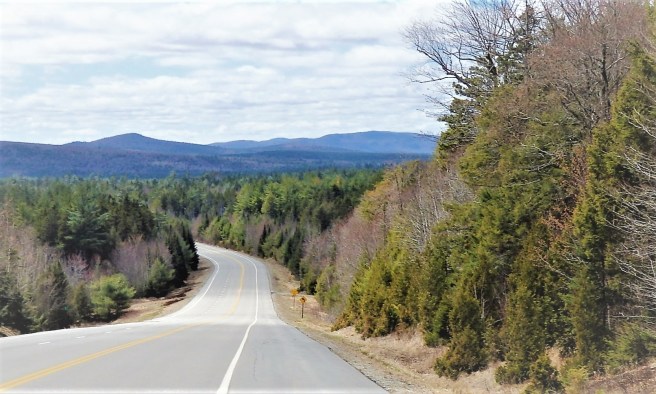
The highway itself sometimes runs along ridges as long as it can before dropping to a streambed below and then climbing to the next crest. I’m struck to see the next landmark cell-phone tower on my route not off in the distance in front of me but rather far to my right or left with a chasm and lake in-between.
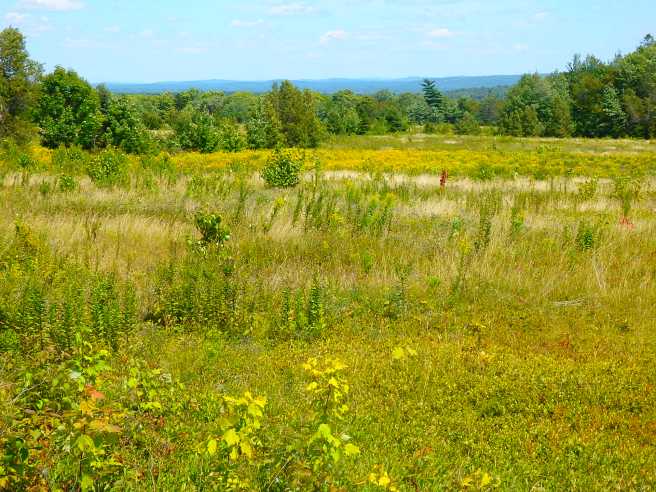
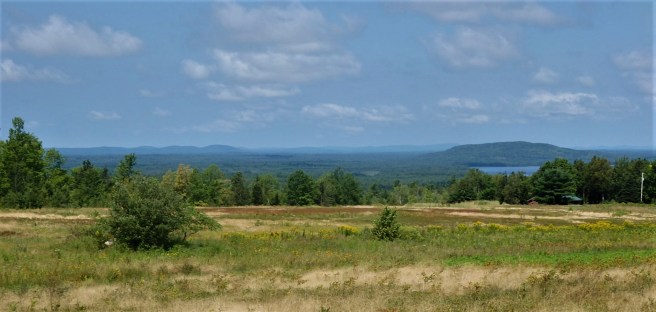
Much of the land is boulders and exposed bedrock rather than rich loam.
There are reasons, then, those hills are named mountains. Pay heed.
The mystics and traditions I’ve encountered are anything but airy-fairy. In fact, they can be pretty down-to-earth and practical, based on personal experience and testing rather than empty speculation or dogma.
As George Fox said at the beginning of the Quaker movement, “This I knew experimentally.” That is, by first-hand experience including trial and error. Or as was said a few years later, “Some of the best barns in Rhode Island were designed during Quaker Meeting,” during quiet meditation.
Never underestimate the importance of the disciplined circle of fellow practitioners, either. Anyone who says “I’m spiritual, not religious,” but lacks that communal base is headed for trouble.
I learned that 50 years ago in a yoga ashram – see my novel Yoga Bootcamp for unorthodox examples of how it works – and have seen it in other traditions since, especially my Quaker circles.
One of my favorite stories comes via fellow blogger Tru-Queer, who relayed the incident this way:
A Tibetan lama and a famous Korean Zen master in the Rinzai school were to have a debate.
The Tibetan lama sat meditating, counting his mala. The Zen master produced an orange from his robes and asked the lama, “What is this?” It was a famous koan. Waiting for a response, the lama continued meditating. The Zen master asked again, “What is this?”
The Tibetan lama spoke with his translator for a moment, who said, “Do they not have oranges where he is from?”
~*~
I suppose I should explain that a koan is a kind of mental puzzle intended to push a student beyond rational thought. Zen is essentially black-and-white ascetic, while Tibetan Buddhism is full of colorful esoteric teaching and drama. Yet here the roles are reversed, in a great joke.
But it doesn’t end there. When’s the last time you really looked at an orange? How many varieties can you identify, much less their differences in uses or subtle flavors? Does your recognition that it’s “an orange” put a stop to regarding it fully? That is, when’s the last time you had an “OH WOW!” moment with something so seemingly commonplace.
Gertrude Stein was aiming at something similar with her “A rose is a rose is a rose,” which blows open when you learn she was also speaking of a friend named Rose and not just the metaphors associated with a specific flower that somehow too often gets lost in the entire equation.
So just how do we live full of wonder – a state a Friend hailed as the Holy Now?
I’d say having dear ones who share it with you does help. Even if they’re Zen Buddhists.
In my novel Nearly Canaan, Joshua and Jaya meet in a railroad crossing known as Prairie Depot. And in my newest release, The Secret Side of Jaya, she returns there in a magical sort of vein.
Yes, Prairie Depot is somewhere in the Midwest. But the region itself is hardly as homogeneous as many portray it.
~*~
~*~
What are your impressions of this part of the country?
Except on overcast or stormy mornings, the early light of day in Eastport is amazing. Campobello Island in Canada blocks the first rays of the rising sun from striking us directly. Instead, the beam is deflected from the ocean into the air to become an ethereal rosy radiance, sometimes against a dark bank of clouds hovering off over the neighboring Fundy islands. And then, with that doubly-illuminated sky mirrored in the two-mile-wide channel separating Eastport from Campobello, the overhead color spreads out below as well.

When the sun itself finally swells into view, the blaze is nearly blinding, winter or summer.
Note to self: Keep sunglasses at hand.
As the sign in front of an Aroostook County church advised:
Yes, I had to laugh.
It all starts with the events being remembered today.
The quote also flips the quotation from Revelation, which I recall with its association with an illustration on my grandparents’ dining room wall, where he’s knocking at a thick wooden door. Maybe that’s a symbol of our own hearts, too many days … closed, hard, and dark.
Today, let him enter, in spirit, and dine with you and those you love most dearly.
May you be spared all temptations in this blessed day.
Just because I watch the stars doesn’t mean I trust them.
We had foxes at the bird feeder and viewed them as they slinked off into the woods, akin to Garrison Hill, and next to it was a bear.
I was a championship swimmer and a symphony violinist not actually competing or performing but enjoying the status.
At the airplane crash scene as a reporter, I helped put bodies in valet bags.
It is how striking the impulse to prayer arises across cultures and eras. I’ve even noted that one set of Zen Buddhist prayers in print is something even an atheist could endorse.
In her book, Help, Thanks, Wow: The Three Essential Prayers, Anne Lamott lays out a basic approach to the universal practice of turning to the Holy One, regardless of name. Her three types seem to cover it all.
Still, there other types, even before we touch on wildly different faiths and theologies. Here are a few, even as I search for some formal Greek theological terms I’ve filed away somewhere.
~*~
And we haven’t even touched on postures or breathing, much less chanting or dancing …
In my novel The Secret Side of Jaya, she learns a lot about Baptists while living in the Ozarks.
For starters, within their shared identity, they come in all varieties of theological nuance and group practice – and the lines within them can be drawn sharply. And they don’t handle snakes as part of their worship.
Here are a few facts:
~*~
Does this make their identity any clearer? We haven’t even touched on some of the key theological language.
Let’s skip past Jesus and Lincoln and King David and Gandhi, Martin Luther King, etc. Go to more regular folks who also had everyday lives.
~*~
Well, this list has changed over my life!
Who would you name?
 Jnana's Red Barn