grass / shoe / potato
Rabbit Rocket Sprints
You never know what we'll churn up in cleaning a stall
grass / shoe / potato
Rabbit Rocket Sprints

Let me be honest and admit that the most amazing fall foliage I’ve seen was in 1970 in the Susquehanna Valley of New York and neighboring Pennsylvania. I’m not sure how it would stack up today, if I had a way of reviving the actual color, but the experience was unlike any before or since.
I was fresh out of college – free of being cooped up on campus and indoors. I had my own wheels and a job that had me free by midafternoon, when the angular sunlight was kicking in. And the local forests blended the species of New England with those of the middle Appalachians. What I had known before was Ohio and Indiana, without the big foothills that propped the forests up before my eyes like giant canvases or, from the crests, arrayed them below me like vast quilts punctuated with villages and farm fields and meadows.
I suspect another major factor was a killing frost by late September, which would intensify the color and make, officially, Indian summer. With global warming, that frost has been delaying until all of the leaves have fallen.
All the same, living in New England for nearly half of my life now, I recognize how profoundly the autumn change strikes the region. My in-depth reflections and accompanying photos from New Hampshire are found in the archives of my Chicken Farmer blog. Do go there, if you can. The posts and slideshows appear in the New England Spirit category from August through October 2013.
What I’m now encountering is Coastal Downeast Maine, with its own variations. The forest is largely evergreen, which of course stays green. But it does provide a solid background for the deciduous trees as they change.
Having written that, I encounter an early morning drive across stretches where everything is perfect. The foliage is prime, a full range of the palette, nothing holding back. The temperature’s still chill, so maybe they’ve already had that hard frost up here. Better yet, the sunlight’s brilliant buttery and straight-on, rather than overhead, illuminating the leaves from the side facing me.
It reminds me of other “oh, wow!” epiphanies in northern New England that no doubt would equal or even surpass the year further south that set the standard.
So here’s a taste of how it happens around here.


Ripe orange descending
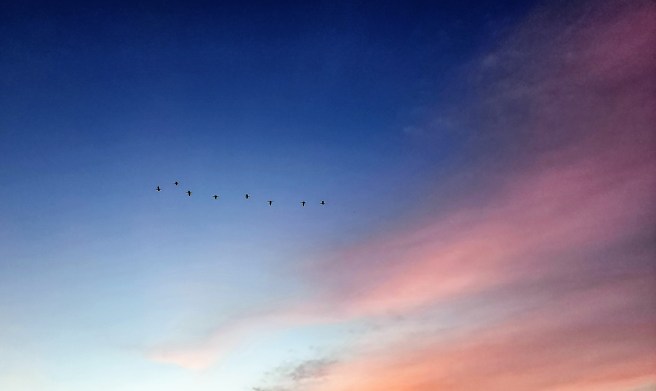
And then the sharp scythe new moon
With her consort, Venus
Orange-fruit globe ascending
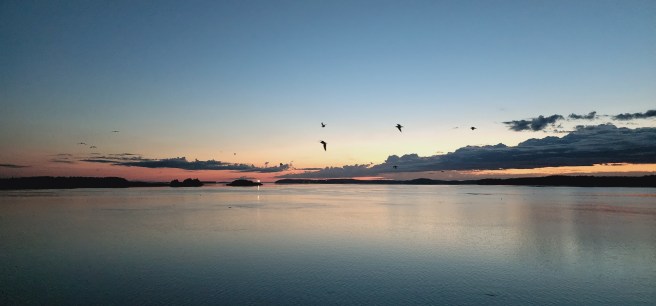
Silvery lakes between fog-wisped forests
Many miles intervening
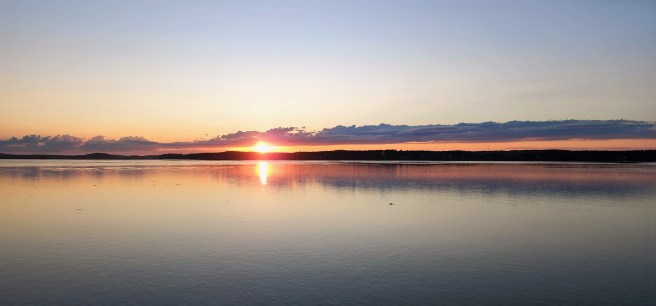
Same orange glop descending
And then the sharp scythe new moon
With her consort, Venus
Refined Japanese, I’m told, would gather with sake to watch the full moon rise. First there’s only the crown of the head, and then the brow and cheeks and chin before the moon lifts altogether in the air. The passage is both slow and fleet, maybe five minutes, if that.
The event would be celebrated with the writing of hokku on the spot.
Here’s how it happened one summer night in Eastport, looking over Campobello Island. And this is what you get rather than a cocktail or poem.


While Eastport and its neighboring towns are technically on Fundy Bay, they’re sheltered from the open ocean. Not so for much of Lubec and Cutler to our south, where the shoreline on the open Atlantic rivals anything Acadia has to offer. It helps to know where the trailheads and parking are, though. Here are some views from the trails in the Maine state public lands in Cutler.


Unlike the two most photographed and visited lighthouses around here – East Quoddy on Campobello Island, New Brunswick, and West Quoddy in Lubec, Maine, both of which have been featured here at the Barn – the remaining lighthouses I encounter locally are small-scale. They’re beacons, all right, but to call them houses may push the definition.
You be the judge. Here they are.


That’s not the way it used to be, not when I was younger and could dash things off in the flush of inspiration, but it is what I’ve encountered revising my last two books.
It’s not even Wes McNair’s advice to write 400 good words every day. Not unless one of those sentences is an over-the-top wonder of 250 to 300 words.
The turtle pace here seems to arise when I’m trying to weave some new material into an existing draft, making it connect on two sides seamlessly. It’s not just the craft of fine writing, actually, but also the thinking more deeply about the unseen significance of the subject at hand. What, exactly, is beneath the surface before us?
Of course, as a writer, this pace also has me wondering if I’ve simply used up all the easy stuff and left the bigger challenges for my senior years.
Any suggestions?
Here’s hoping my reflections on life here at the Barn stimulate an awareness of so many of the riches around you, too.
A couple of incidents regarding my daughter’s chickens have me thinking about human affairs.
Her hens were increasingly picking on one another and squabbling until an incident with a neighbors’ dog posed a terror. In response, they instinctively banded together, including their otherwise useless rooster. For weeks after, their antisocial behavior was transformed, focused on a common enemy.
A year later, the same thing happened when a red tail hawk picked off two of the hens in the yard.
That leads to the question:
Do we humans really need some villain, however small, to make our own lives meaningful?
We see it in politics, for sure. And in sports. As for personal development and ethical living?
I am convinced we need to keep an eye on Satan, in whatever garb, but also need to be careful we don’t start “preaching for sin,” as early Quakers cautioned. The fact is that in fiction it is much easier to create a believable bad guy than a good one.
So even secular novelists must make sure to avoid exclusivity in their vision.
We also need to keep another eye on the Light and its leadings. Otherwise, well, we’d still be chickens at the mercy of foxes and weasels.