FIRST, YOU READ

As long as I can remember, I’ve been a reader, thanks, especially, to a third-grade teacher who got it rolling and a fifth-grade teacher who extended the Landmark history volumes. Robinson Crusoe, Tom Sawyer, Gulliver’s Travels were all early triumphs. Curiously, Huckleberry Finn was easier at age nine than it was as required reading at seventeen; the second time around, the dialect was more difficult to handle. My general interests, however, soon veered from history to chemistry until the writing bug hit me through a very demanding high school sophomore year English teacher who drilled grammar so thoroughly we were diagramming 250-word sentences and arguing our alternative versions. She also solidified a tentative curiosity in my enrolling in journalism the next year, which wound up leading to my career path. In my senior year, when I was editor-in-chief of the high school newspaper, another English teacher confidently insisted, “You know why you write.” Followed by, “Yes, you do.”

In truth, I’ve never quite been sure what her answer would have been. I assumed she saw a desire to be noticed or appear important. But that’s not what I would have answered. I was, after all, a skinny intellectual in a school that valued football and basketball players. Moreover, my father’s side of the family – the ones I knew, since my mother’s parents had both died before my birth and the rest of her blood relations were in Missouri – had little use for either art or learning for its own sake. They were a practical, God-fearing people where a gift in language would be best employed as a preacher. (Lawyers were another matter.) Only after my father’s death did I learn he had once dreamed of being a sportswriter or the pride he took in my work as a professional journalist. When that flash connected with my grandfather’s saving copies of all of the Dayton Journal and Herald newspapers from the World War II era (“Someday they’ll be valuable”) and his mother’s lifetime of meticulous reading of the daily news could I finally perceive their approval in what I had come to see as a low-paying, and increasingly low-status,  occupation.

From them I also carry a deeply ingrained sense of social responsibility, one in which my personal relationships are often motivated more by duty than love. Here, then, my leap in concern from history to politics would seem natural. Little wonder the novels Animal Farm, Brave New World, and 1984 re-ignited a passion for fiction and what the written word can do. Politics is also the mother lode of journalism, especially for those of us who believe progress is possible through civic action. And so I might have answered Miss Hyle’s statement with, “I write to improve the world.”

~*~

(How audacious that sounds now, more than four decades later. How innocent, too.)

~*~

What she may have seen was unmistakable ambition – a desire to win for the sake of winning, apart from being noticed or appearing important, regardless of the game at hand. Winning as an act of self-affirmation. Winning as the reward for solving the puzzle faster than your rivals. With or without the laurels, trophy, or monument.

Secretly, though, there has been the hunger for a monument, the book in every home or library, the paperback cover in the supermarket and drugstore, the repeated praise in the New York Times Book Review section. Even, at one early point, the aspiration to have not just volumes of poetry and fiction but a play or musical on Broadway as well.

But then the plot thickened.

And how.

NO MATTER THE PRICE

Inscribed on gravestone of John P. Hale (1806-73) in Dover:

He who lies beneath surrendered office, place, and power rather than bow down and worship slavery …

He was the first United States senator to take a stand against slavery.

Earlier, while serving in the federal House of Representatives, he refused to follow the New Hampshire legislature’s directive to support the admission of Texas as a slaveholding state. In the following election, barred by his party from running under its banner, he ran as an independent; none of the three candidates won a majority and the district went unrepresented.

Kodak26 071

Kodak26 068


DECORATION DAY

As I settled into my bench on a clear Sunday morning, my thoughts kept returning to a disquieting subject. Perhaps it had something to do with the Psalm facing up from the open Bible beside me, beginning with the line, “Deliver me from mine enemies, O my God,” or an acknowledgement of the city cemetery just beyond the trees outside our meetinghouse windows. Perhaps it was a continuation of a thought I’d had the night before, how the event being observed this weekend was originally called Decoration Day, conducted to commemorate the Civil War dead. The act of decorating gravestones seems to me to be superficial or even, in some perverse way, profane – and yet, as the subject kept returning in the stillness, I realized there’s one pilgrimage I would make, to leave a flower on the neglected stone.

I had uncovered much in the previous six months, delving once more into my genealogy research. There was no intention of resuming intense investigation and writing at this point when I responded to a few innocent online queries, which unexpectedly snowballed. The project itself had begun a quarter-century earlier with the surprising discovery that my Hodson ancestors had been Quaker, the faith I had also joined after a circuitous spiritual journey. The historical research later expanded into my grandmother’s Dunker (or German Baptist Brethren/Church of the Brethren) lineage, which also came as a revelation. Here, much of my fascination has been with the dynamics within communities of faith and the ways the members extended their religious practice to all facets of their lives. Crucially, both churches maintained that bearing arms and military service are contrary to the spirit and teaching of Christ, and both churches were based on traditions of lay ministry.

Once identified as a genealogist, however, I soon became the recipient of family miscellany, regardless of value. That is, one becomes the guardian of last resort, or all that stands between antiquity and the dump. Somehow, I’ve become the caretaker of a flag draped over a great-uncle’s casket for military burial, a scrapbook of a great-aunt’s post-World War I newspaper clippings, and many curling photographs of unidentified people and places – things that presently add nothing to the ancestral story. On the other hand, I took up the project just a few years too late to save a great-aunt’s correspondence with my great-great-grandparents, who remained in North Carolina after their sons moved to Indiana and Ohio. Even so, I have also come to possess a few priceless letters and photos and other bits that allow sharp insights into lives that would otherwise be unknown.

In August 1985 I received a package with a note that said, “I am also sending a copy of someone’s journal. It is either from Grandma Hodson’s or Ralph McSherry’s papers. I thought we might be able to figure out the author. Or whatever?” At the time, I transcribed the photocopy of the handwritten memoir, A Journal of My Experience in the Rebellion of 1861-2, and attempted to analyze its curiously bland text. The opening paragraphs went into almost agonizing daily detail of marching across Kentucky, setting up camp, and moving on, often with no sight of the enemy. By the time the unit moves to the Battle of Shiloh, however, the descriptions are brief, even rushed, as if the writer were embarrassed of being ill in the infirmary rather than fighting, even if that illness likely saved his life. And then the text trails off. Since this manuscript would have been from my great-grandmother Alice McSherry Hodson’s line, I tentatively thought it might have been written by her father, who would have then come home to Ohio to marry, but I could find no record of his serving in the Civil War. I identified some other possibilities in her family surnames and had to leave it at that.

Much later, when I reopened my genealogy reports, I decided also to clean up materials my mother had collected on her side of the family in Missouri. With an array of new source material available online, I found myself sifting through Census reports and death certificates and then Civil War records and Census slave schedules – the latter items things I’d never previously encountered, and many of the details troubled me. In the practice of genealogy, you build a personal history that somehow invests you in the unfolding action; sometimes it stands at odds with the general history you were taught in school, or sometimes it allows you to see individuals moving within a larger picture. As I looked at my ancestors in Civil War Missouri, I was surprised to learn that illness killed more soldiers than the fighting did; in my case, John Gilmore died in camp a month after enlisting. I had no clue of the extent of Confederate guerrillas until learning of my Gatewood kin’s clandestine ambushes of Union soldiers. Still, I’ve argued that if one undertakes genealogy, one must be prepared to accept the facts one uncovers.

But that’s not exactly where my thoughts kept returning this morning. Rather, it was to the consequences of one website I had come across while working on my mother’s ancestors’ Civil War service, which now allowed me to consider the possible authors of the memoir I’d transcribed. The movements it detailed matched those of the 1st Ohio Infantry and 2nd Ohio Volunteers, units my great-grandmother’s uncle, John Z. Bahill, served in – back on my father’s side of the family.

The Psalm describes enemies, but that morning I was not led to ponder my own potential enemies. Besides, they would be nothing like the enemies Bahill encountered. His memoirs break off on June 17, 1862, in Alabama before the actions at Battle Creek and then pursuit back to Louisville, Kentucky, the Battle of Perryville, or the march to Nashville before coming to Stones River near Murfreeboro, Tennessee – his second round in that locale. That is, his chronological narrative breaks off before the real action begins.

If you can’t identify the Battle of Stones River, you’re not alone. Neither could I, before Bahill led me to it. The fighting began in the sleet, rain, and fog of New Year’s Eve morning in 1862, and erupted into what would stand as the eighth deadliest battle of the Civil War. It was a crucial victory for the Union forces, coming half a year before Gettysburg and denying the Confederacy the essential agricultural resources of Tennessee. When the three days of fighting were over, there were 24,645 casualties – more than one in every four participants.

You can look at hour-by-hour analyses of the campaign. The opposing strategies, too: the Union plan foiled when the Confederate forces made the first move. Read the reports. As the Union flank collapsed, Bahill’s unit was part of the force that held ground at all cost. No one can imagine being in close fighting where your own death is imminent. Even the description of the deafening cannon fire is beyond comprehension.

This is what I was sitting with, in the quiet of a Sunday morning. Not the noise or the blood but an awareness of the dedication of one’s life to a larger cause.

This was also at crosscurrents with the stream of vocal ministry that morning. One Friend spoke of the importance of having all people agree on a set of basic rights for all humans. Later, another recalled the New Testament scholarship of Albert Schweitzer, which led another to speak of an uncle who gave up university prestige and security to become an inner city pastor instead, where he was murdered in murky circumstances.

I wonder if the Civil War might have been averted by nonviolent movement. The first speaker reminds us that rarely does anyone give up a position of privilege voluntarily. Not unless he sees himself gaining something better. I think of the slaveholders’ great capital wealth combined with the unequal political clout it had given them in the nation’s affairs, and their ruthless efforts to expand it. The witness of Mahatma Gandhi and Martin Luther King seem all the more miraculous in contrast. And I wonder what might have happened if Bahill’s unit had crumpled under its relentless assault. And those are the thoughts I kept circling back on in the silence.

Bahill was among the wounded. I have no idea what his wounds were, precisely, or if he underwent amputation. Still, from the title of his memoir, he apparently knew that his war service was over. The officer commanding the 2nd Ohio, Lt. Col. John Kell, had been killed in action, as had the lieutenant leading Bahill’s company.

But I had been wrong in my initial analysis of the text. I now assumed this was something Bahill undertook on his hospital bed, before the infection set in. Something he undertook, in other words, on his deathbed. He died 2½ weeks later, before he could finish his memoirs. He was 26.

From another website, I view a section of the National Cemetery in Murfreesboro, where he is buried, far from his family in Ohio. He was the last male in his Bahill line and unmarried. The memoirs have come down through my great-grandmother, born 2½ years after his death.

Decoration Day, initiated to remember people like Bahill, seems a more fitting name than Memorial Day. One conveys an action, even if it’s more ritualistic than I would embrace. Memorial Day, in contrast, feels cloudy and unfocused. Who can say if his gravestone was ever decorated by his family? A farm boy, without his garland.

Later, recovering in the hospital from surgery, I would wonder if Bahill had the strength or clarity to write on his deathbed. More likely, it seems he drafted what he did before re-enlisting, perhaps even as an exercise convincing himself to do so. We’ll never know for certain.

GETTING FLOCKED

Don't mock these humble birds. They're great fundraisers, as I remarked in a post the other day. Now he's the rest of the story, the one I thought I'd published long ago ... but hadn't.
Don’t mock these humble birds. They’re great fundraisers, as I remarked in a post the other day. Now here’s the rest of the story, the one I thought I’d published long ago … but hadn’t.

At a party one night in our Smoking Garden, a friend was telling about a fundraiser her church youth group had done back in Massachusetts.

“That’s a great idea,” I said. After all, she was a United Church of Christ pastor with all kinds of connections. “UCC,” for short.

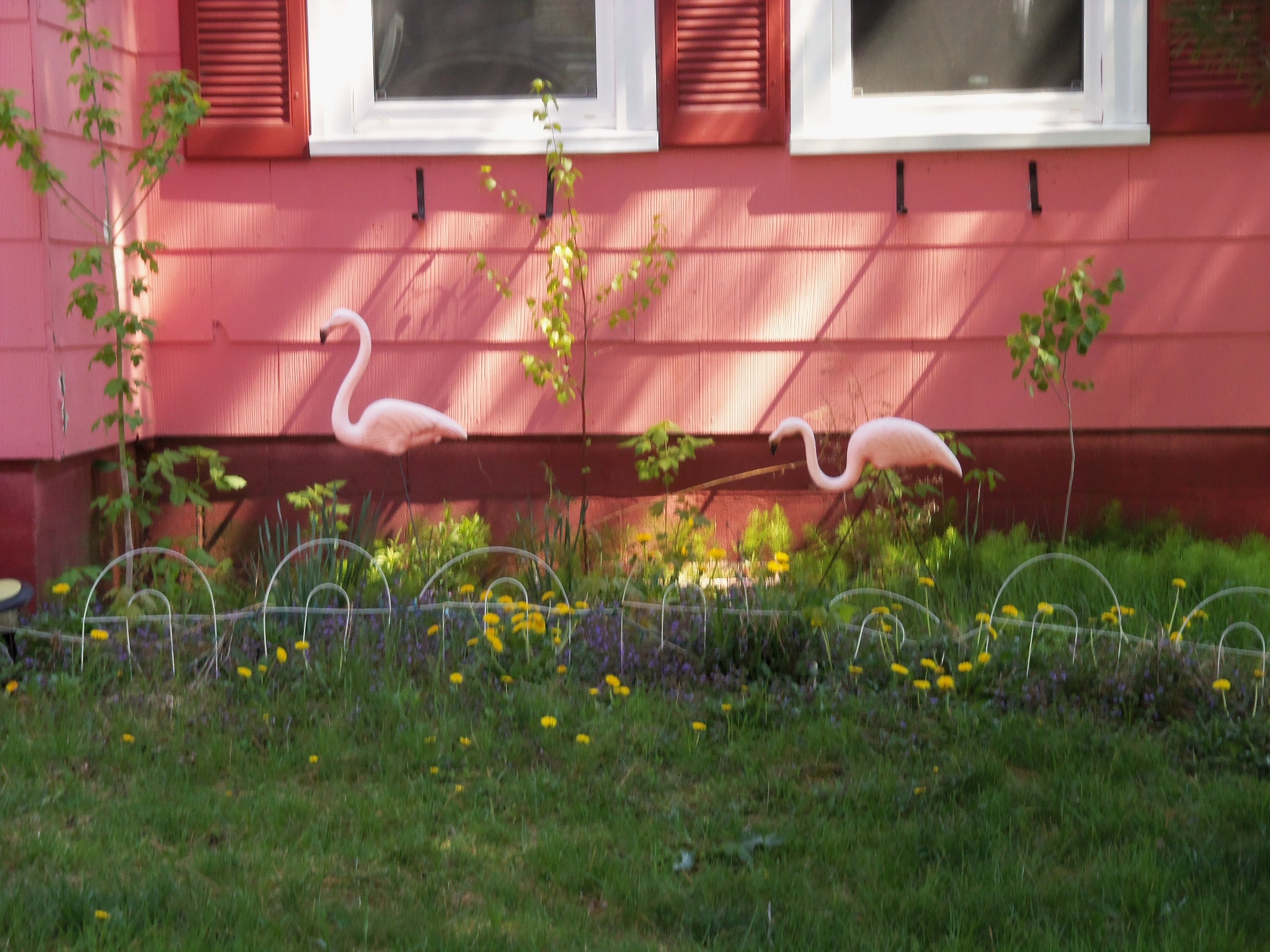
Next thing I knew, a big sign and box appeared in our Quaker meetinghouse, warning Friends to buy flamingo insurance. This is New Hampshire, remember, not Florida.

One night after our party, our renowned sculptor Jane and her husband had come home to find her flock of pink flamingos missing from their yard and garden, but a sign stood in their place: “They needed to be quarantined.”

Uh-huh. I was as baffled as anyone that Sunday as we entered the meetinghouse and faced that big sign and its box of warning.

Here’s how it worked: you could donate any amount for insurance, but if someone else trumped that figure by offering more, you could still get flocked. And if you were flocked, there would be an envelope for another donation for their removal. In other words, you could get hit coming and going.

Then the plastic birds – and wooden cutouts – began appearing in Friends’ lawns. Folks living in apartments weren’t immune, either: the birds showed up strung around balconies or in the backseats of cars left unlocked or wrapped around cars that had been locked.

For the most part, it was great fun – even for the police officers called out to investigate rustling sounds in the night. We had no idea who was in on it, and nobody from our Smoking Garden party guest list was looking guilty.

When we were hit, one of our neighbors laughed and explained why she knew we hadn’t selected the birds as permanent decor: “You’re too organic.”

(Ouch!)

The Sunday morning the operation came out in the open, a guest to Meeting told me, “We did the same thing, down in Connecticut.”

“UCC?” I countered.

“Yes, how’d you know.”

“Just a lucky guess.”

So it had been the Meeting’s kids who were keeping the secret, along with a couple of very, very discrete adults. The money we raised went to the Heifer Project. Our children had to decide what kind of animals they’d send to the Third World – something big, like a cow, or something smaller, like a lot of chickens? And then they took a field trip to the project’s New England farm to check out all the options.

It’s a much better story than the one about my ex-wife’s two birds – the ones a friend of hers stole from my yard after the separation.

 Flocked

 our Lady of Pink Flamingos keeps taunting
“Have you been flocked?”

where’s it going, our summer of plastic flamingos?

 poem copyright 2014 by Jnana Hodson

COLORING THE WIND

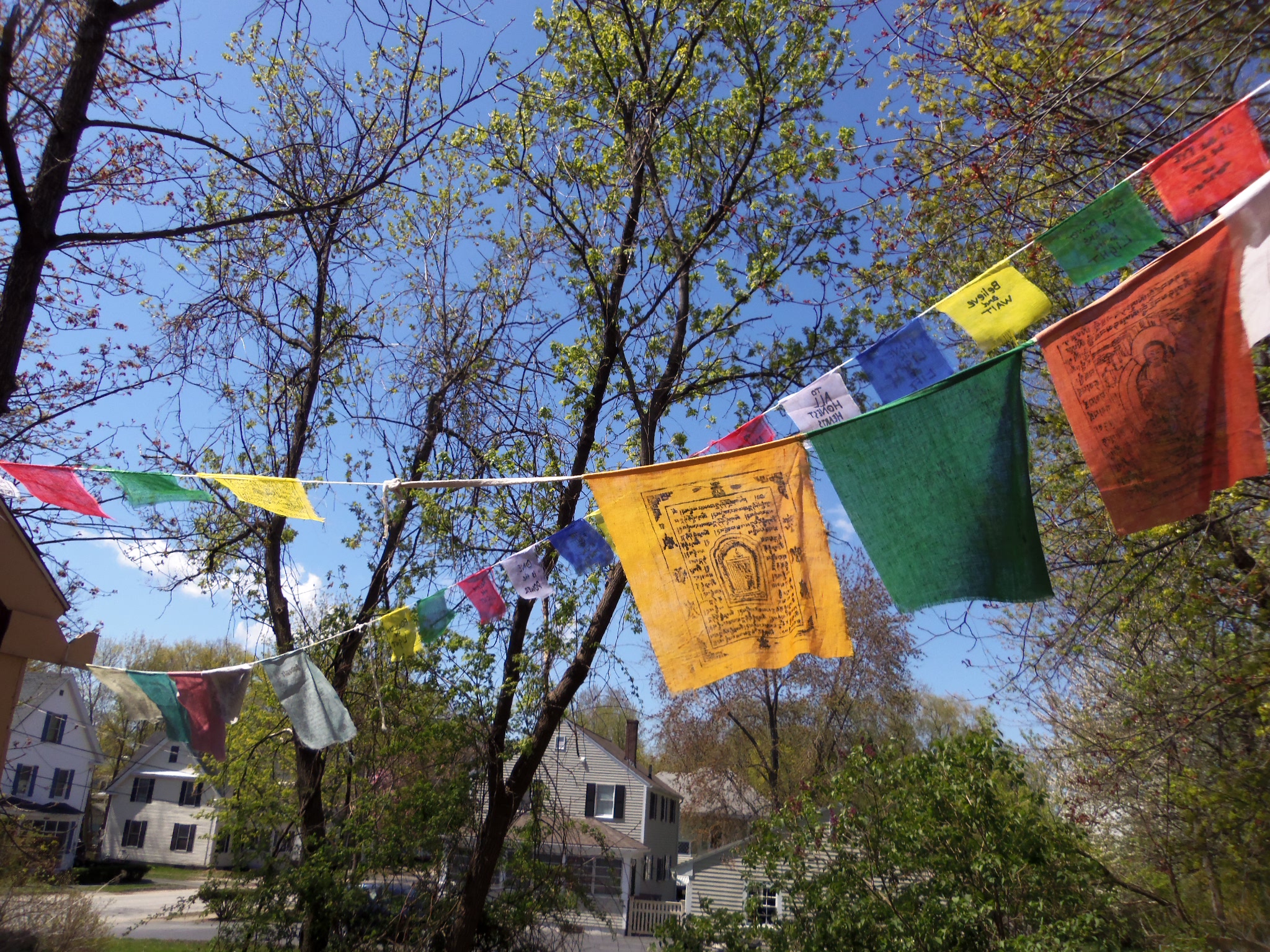
Each spring, new flags join the line in our yard.
Each spring, new flags join the line in our yard. The second strand, at the rear, has quotations from James Nayler, a powerful minister in the early Quaker movement.

The Apostle Paul has urged Christians to pray without ceasing.

I view Tibetan prayer flags rising in the breeze as joyous reminders my heart can do likewise.

THE SHORT VERSION

Asked for a short theology, I’m likely to reply I’ve come to the conclusion God has a different way for us, individually and as a society, to be living.

It’s the story I see evolving in the Bible, for one thing. And in much of the history since.

It’s not hierarchy-based, for starters, and something quite different from nations, with their armies, as we know them.

We get a hint of it in the suggestion of the Jubilee, the redistribution of wealth every 50 years for the entire populace.

Maybe you’re already sensing I don’t draw a distinction between here and eternity, not the way Augustine did. It’s the “Kingdom Come, on Earth as it is in Heaven,” as Christians pray.

The long version, of course, is where all the details come into play.

RETURNING TO THE MONET WINDOW

The window I long viewed from my seat on the facing bench in the meetinghouse may also be regarded as an icon or mandala – a piece of art to facilitate the practice of spiritual focus and release. As an image used to settle a person into meditation, the window is hardly static. I’d settle in and close my eyes, as usual. At some point, though, I’d open them, softly, gaze around the room and then the window. Where is my heart today, truly? Where are my emotions? Let my thoughts still, for now. One looks out, to look within.

I recall another Friend, Randy Kezar, who once proposed photographing the view from another window in the room. His concept was to shoot the same scene from the same spot, at the same hour every Sunday for a full year. The record would show the small wooded slope blooming and in fullness, autumn color, snowfall and melting. Sunny days and rain. Glimpses of the city cemetery beyond.

On most Sundays after that, I would ask myself which artist best related to the scene framed before me. It turned out to be quite a collection.

And then there was that one April morning when I realized the visual quality of the air itself had changed. We’d crossed out of winter and into the light that accompanies summer. In the coffee hour afterward, a former TV producer told me of the ways his cameraman had to have the film adjusted to accommodate for this change every spring and again every autumn.

Just as telling was that one morning in May when I was struck by the hues of green and blue in the window and saw what resembled a Monet painting. While this was not a reference many of the earlier Friends in the room would have acknowledged or accepted, it definitely was one I could … along with most of the others present that day. The view in that color continued for three weeks but has never returned quite the same.

If I watch my own window hoping for a return of the Monet experience, I can too easily miss what’s present.

A FEW THOUGHTS WHILE SIFTING COMPOST

Come springtime every year, there’d be a predicable domestic spat. I’d say the compost was ready. She’d look at it and retort, “No, it’s not: you can still see bits and tell what it’s made of.” (Actually, two shes – mother and daughter.) “Then you’ll have to wait another year for it to finish to your specifications,” I’d shoot back, only to be told we couldn’t wait that long. And so on.

Part of this seemed to question my very manhood. I was, after all, the one doing all the work, from collecting the bags of leaves around the neighborhood and dumping the kitchen garbage in the covered bins to changing the rabbit cages, in large part for their precious, nitrogen-intense pellets.

Well, most of the work. The red wigglers would also do a large share.

Still, I suspected that if we waited as long as they wanted, all of our organic matter would evaporate.

At last, I had a flash of genius. I’d slowly sift the pile, trowel by trowel, and whatever came through the screen turned out beautiful. They approved and used buckets of it on the square-foot garden beds as fast as I could provide them. The part that didn’t fit through the screen was also beautiful, along the lines of woodland detritus with flecks of brown eggs.  I put that aside to decay further, perhaps to be spread as mulch in July or August.

100_8405

The motion of sifting itself can become a kind of Zen practice as you admire the material before you and the thoughts flitting through your awareness.

This movement’s like panning for gold, as I found washing my dishes in the glacier-fed river below Mount Shuksan. Back and forth, back and forth, with all that matter getting smaller and sparkling more in each round of swirling.

All the peach stones are tokens from our cheap peach bonanza after Hurricane Irene ruffled nearby orchards.

The squirrels plant a lot of our wild black walnuts.

Listen to all the cardinals and mourning doves.

Plastic, in flecks, is inescapable.

How loud, those geese overhead! Me, I’d be more stealthy.

We eat a lot of eggs.

FLOWERING MEMORIES

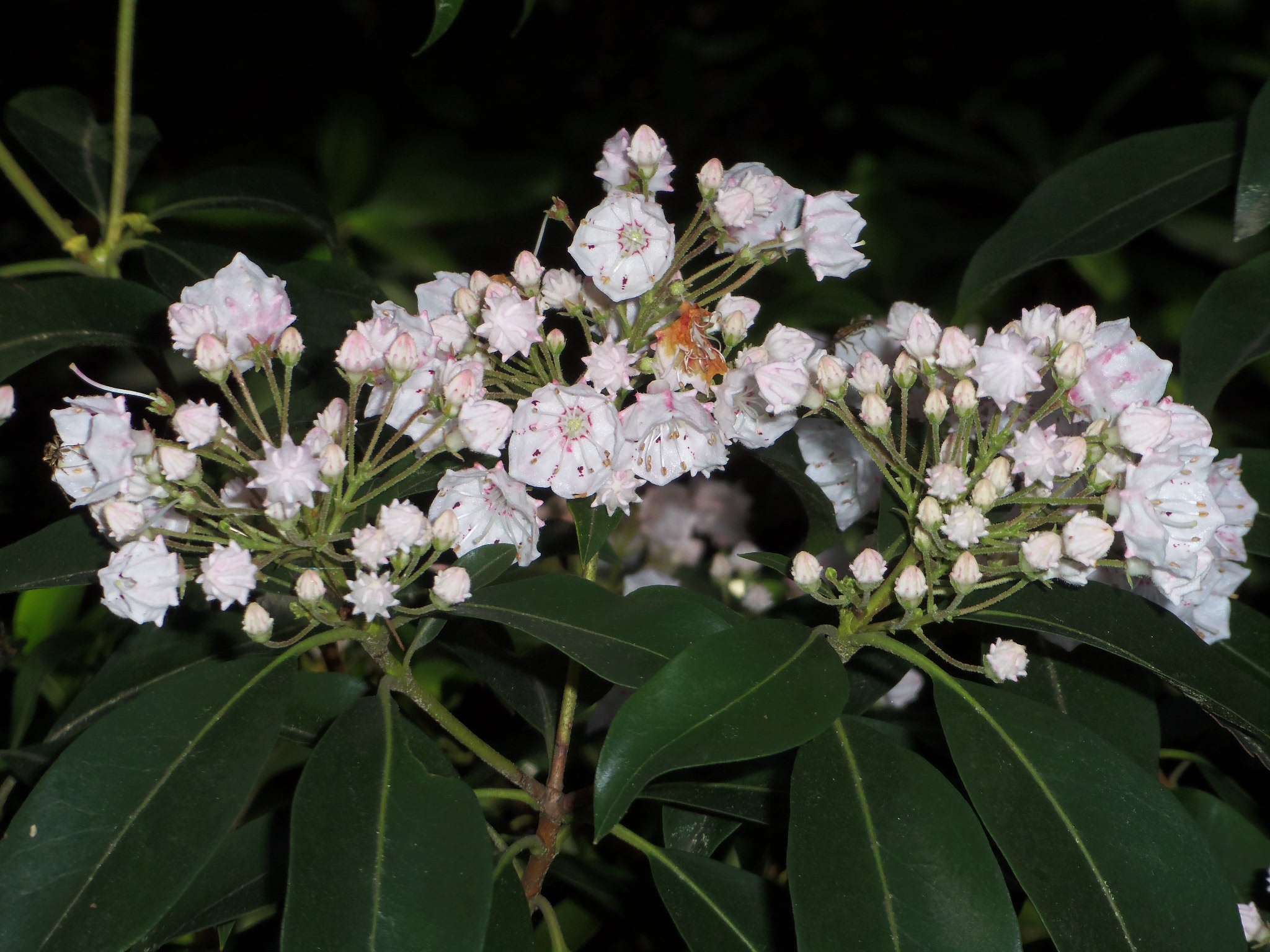
Mountain laurel have taken hold in our Quaker burial ground. Now, if I could only get them to do likewise in our yard.

My fondness for mountain laurel springs from my days in the ashram in the Poconos. Those tiny white clusters like origami that open into tiny teacups are, I was told, the state flower of Pennsylvania, and protected by state law.

My fondness for rhododendron goes back even further, to backpacking a section of the Appalachian Trail as an 11-year-old Boy Scout and coming upon Roan High Knob in full bloom in North Carolina.

Joe Pye weed is something I’ve learned to appreciate here, after we bought our annuals at the Conservation District sale.

Add that, as it thrives, to our azaleas.

Rhododendron and mountain laurel line the lane under tall pine in our undisturbed Friends burial ground.

COMPOSTING AS PRAYER

One of my annual rituals involves emptying the large compost bin as we prepare to enrich the garden for our new plantings, and then refilling it with layers of collected leaves (bagged by our neighbors, especially, each October), a winter’s worth of kitchen garbage, and bunny-cage hay and its prized pellet-manure. The production of “organic matter” to counter our clay soil is also part of our battle against what my wife calls Dead Dirt Syndrome, and it’s been a wonder to observe progress over the years we’ve been at it.

The Apostle Paul has exhorted Christians to pray without ceasing – an impossibility, as we know – yet as I lift forkfuls from the big bin, reline its sides, load and unload the wheelbarrow, I often find myself entering a prayerful zone of reflection. First, there’s the reminder that humus – the stuff of compost – and humility are words sharing a common root, and that both are nurturing elements for life. Then there’s an awareness of our essential abundance – all the meals we’ve enjoyed; the reality that children in America are familiar with tastes that kings in earlier times would have never imagined. We haven’t gone hungry. In fact, there’s so much waste to lament, a resolution to be more frugal or attentive, and then a sense of contrition knowing that we’re still putting this to work rather than tossing it out to the local landfill. Soon I’m appreciating the stages of transformation as I observe how matter breaks down into something resembling potting soil – rich, dark, soft. But I also know this always requires patience and will go at its own pace, no matter how I might try to rush it.

I’ve learned to watch the stages of change, too. That period when the pile begins steaming and its interior reaches 140 degrees or so. Followed by that period when the red wigglers (or is it wrigglers?) appear and proliferate. My buddies, reducing the leaves and hay and newspaper and cardboard and garbage into finished compost. You could view them as angels, arriving from wherever to bless the home and garden. At least I do. Yes, gratefully.

Already, as the compost pile thaws, the Cadillac of worms is digging into work. A happy sight, indeed.