It’s tune in, turn on, and take action in this tale of campus intrigue. Little does a small band in a remote college town realize its opposition to small-ante bureaucracy goes straight to the state capital. And then Washington and the Mekong Delta are another matter as the hippie movement hits tranquil Daffodil. Nothing will remain quite the same.
As the headline said:
BOTCHED DRUG BUST BACKFIRES.
When narcotics agents made an early morning knock-down-the-doors raid on the twelfth-floor of one of the high-rise dormitory towers, they turned up nothing – and were surrounded by irate residents before they could frame anyone, either.
“If you think the slaying of innocent students at Jackson State University was merely a racial atrocity,” Lakasha proclaimed, “you’re not seeing the big picture. It’s about an attack on civil rights – freedoms that belong to all of us. You don’t have to live in a big city to live in ghetto housing. Every student in Daffodil lives in a ghetto. Where I come from, we have a word for high-rise housing like these big dorms – the Projects. And the pigs who come charging into the Projects act just like those who busted in on the twelfth floor the other night. Never mind whether they find anything or not. Look, the university’s demanding that the students pay for the busted doors and busted furniture and busted walls. That’s why they call it a bust in the first place. Wake up, America! Demand the names of the ‘unnamed informants,’ the ones who were so wrong about the presence of illicit substances in those rooms. Wake up, I say! Mississippi’s closer to Daffodil than you think!”
~*~
To learn more about my novel, go to my page at Smashwords.com.
I read – and write – not to escape the world but rather to more fully engage it. So literature for me hardly falls into the Entertainment category, even when it’s entertaining.
Likewise, my goal in the written word is to perceive some basic or essential connection with new clarity, understanding, and compassion.
This makes a world of difference, page by page. Maybe I’m just looking for holy scripture, even of a secular sort. Or at least the Holy One along with the mundane.
Often, my approach to writing and other fine arts resembles the essence of a dream – one foot in the present, the other in the past. Or, in another way, one foot in concrete reality, the other in fantasy of some sort, such as surrealism, as a way to engage more than I’d otherwise apprehend.
Rockport, Massachusetts, sits at the end of Cape Ann.
Mention “the Cape” anywhere in New England and people assume you’re talking about Cape Cod, that marvelous arm extending from southeastern Massachusetts. (Well, it does have its own dictionary entry.)
Mention “the Other Cape,” and a few knowing heads will nod or smile in recognition of Cape Ann, jutting from Boston’s North Shore.
It’s not that those are New England’s only two points of land extending into the ocean – the definition of a cape. For perspective, two of Maine’s most photographed lighthouses are on Cape Elizabeth and, close to us, Cape Neddick.
What Cape Ann and Cape Cod share is a certain ambience, a feeling that – well, you’re in a unique place and not just anywhere in New England.
If you’re not familiar with Cape Cod, let me say there are many fine guidebooks that describe the experience. Today’s gallivant, though, takes us ever so briefly to Cape Ann, which by its most generous definitions (probably mine) can be no more than a third the length of its famed rival. While Cape Cod is neatly demarked by the Bourne and Sagamore bridges, Cape Ann is a bit more diffusive. Since we come down from the north, we find that “Cape” familiarity in the air as we come into Ipswich, which claims more “first period houses” (1625 to 1725) than anywhere else in America – 58 in all. It’s a charming community and, like most of Cape Ann itself, has a more varied mix of social classes than you typically find on the bigger peninsula.
My introduction to the town came last fall when K. Peddlar Bridges invited me down to do a poetry reading on his Roadpoet cable-access television show – and we had a blast. Before the taping, I went for a walk through some lovely year-round neighborhoods that could stand as textbook tours of American architectural styles. I crossed a stone arched bridge as geese took V-formation and honked low above me. Turns out the 1764 Choate Bridge is the oldest double stone arch bridge in continuous use in the country. (I don’t make this up, nor do I challenge the accuracy of the claims.) Leading to an impressive Colonial-era garrison house, the span connects to Turkey Shore and Labor in Vain roads. You get the picture. And, yes, you don’t get a better sense of that Puritan outlook than “Labor in Vain,” do you?
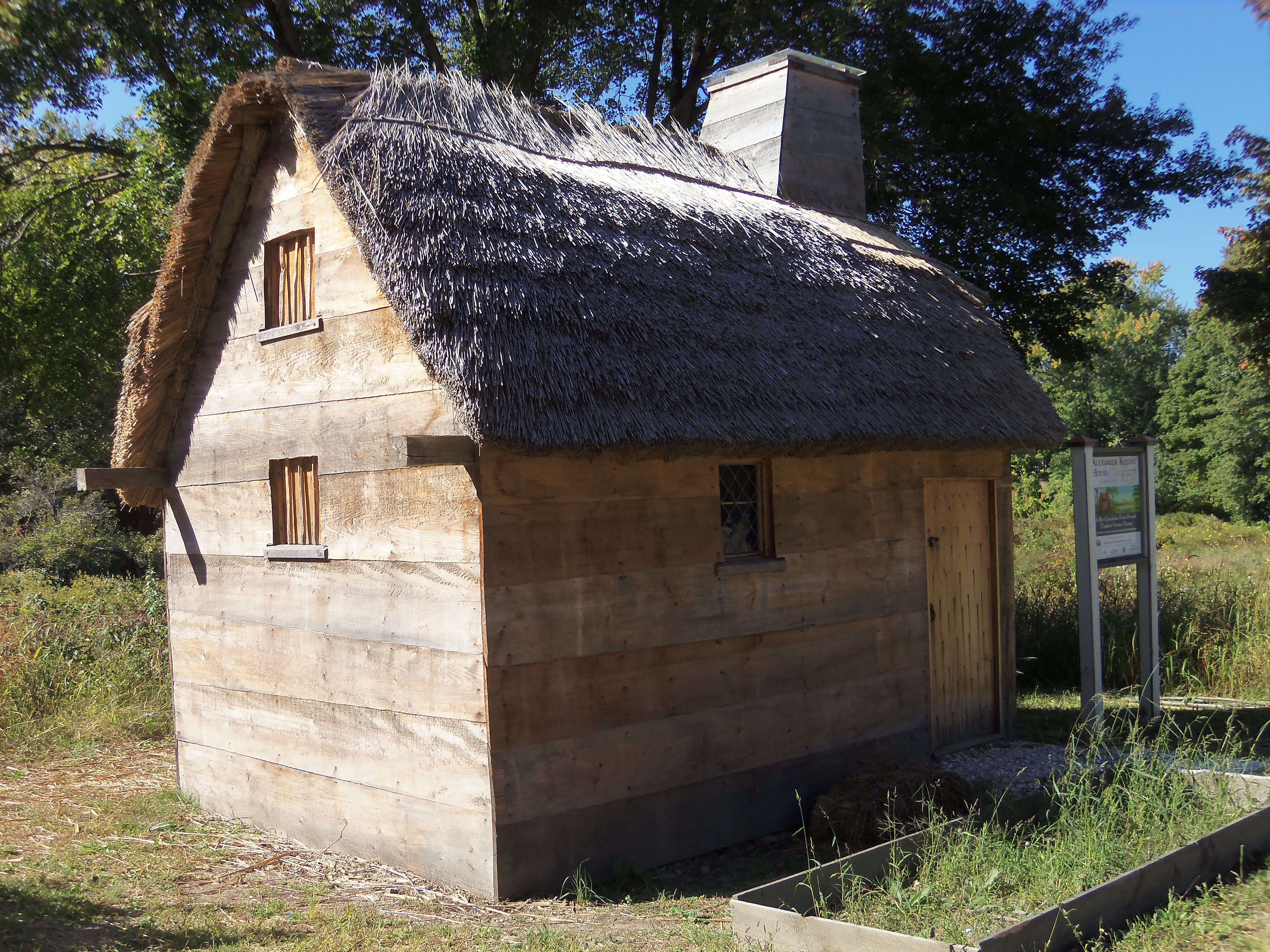
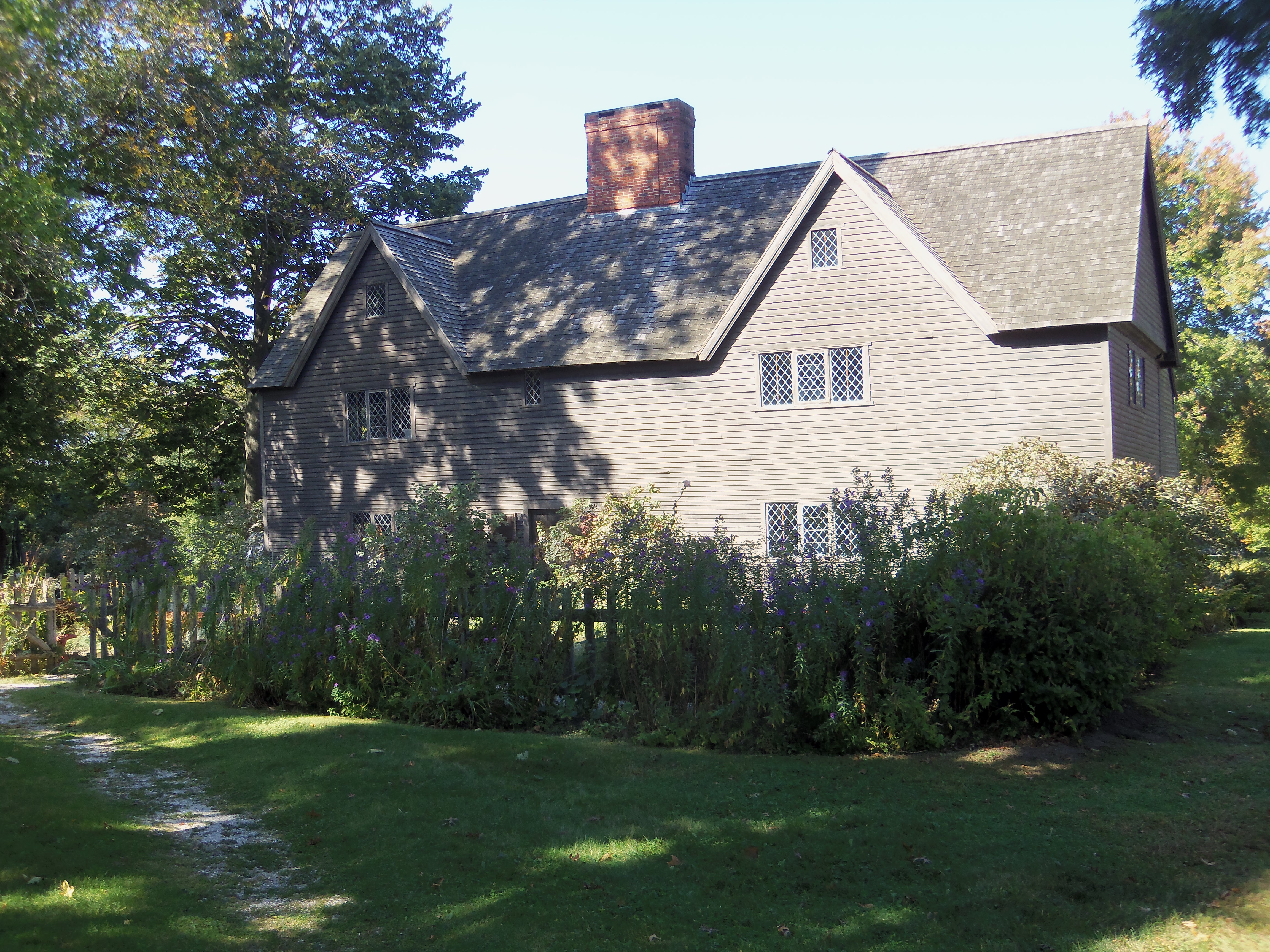
The reproduction 1657 Alexander Knight house in Ipswich, Massachusetts, suggests the difficult life facing the early settlers, especially through a New England winter.The elegant 1677 Whipple House in Ipswich is considerably smaller than the House of the Seven Gables in Salem but similar in style.
So the next week, my wife and I took off for a fuller exploration. We headed on down the road through gentleman farms and veered off for Crane Beach, passing long vistas of salt marshes where prized hay was once harvested. (It was high in mineral nutrition but gave the milk a salty taste, according to the tales.)
The beach itself was once part of the Crane family’s Castle Hill summer estate, which is another destination. The estate, the 1,234-acre Castle Neck dunes and beach, and adjacent 700-acre wildlife preserve are part of the Trustees of Reservations holdings. (Be advised, there’s an admission fee to the park – $8 a car when we went; up to $25 a car on summer weekends.)
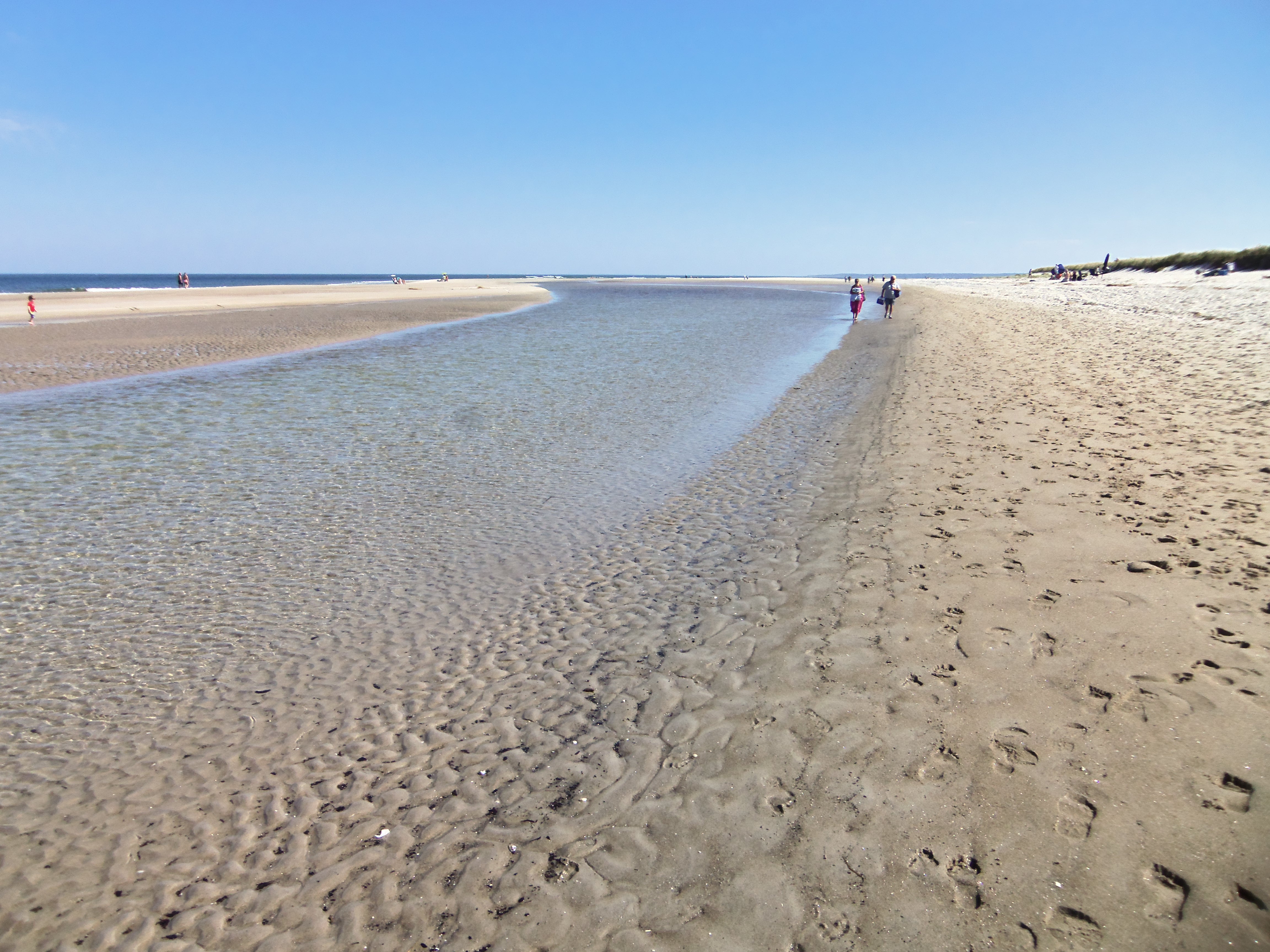
But what a beach! My wife was overjoyed to see white sand, like those of her native North Carolina, rather than the usual gray or brown of New England. And that sand seems to run on forever, with fascinating patches of rippled washboard, tufts of sea oats, and an array of shells we don’t find in our usual rounds of the coast. It may have been October, but our nostrils were greeted with that distinctive Coppertone aroma, and our eyes viewed an array of sun worshippers extending their tans as well as a few daring souls in the water. We walked and walked and, well, might still be walking if we hadn’t felt hunger kick in.
We’ll be back.
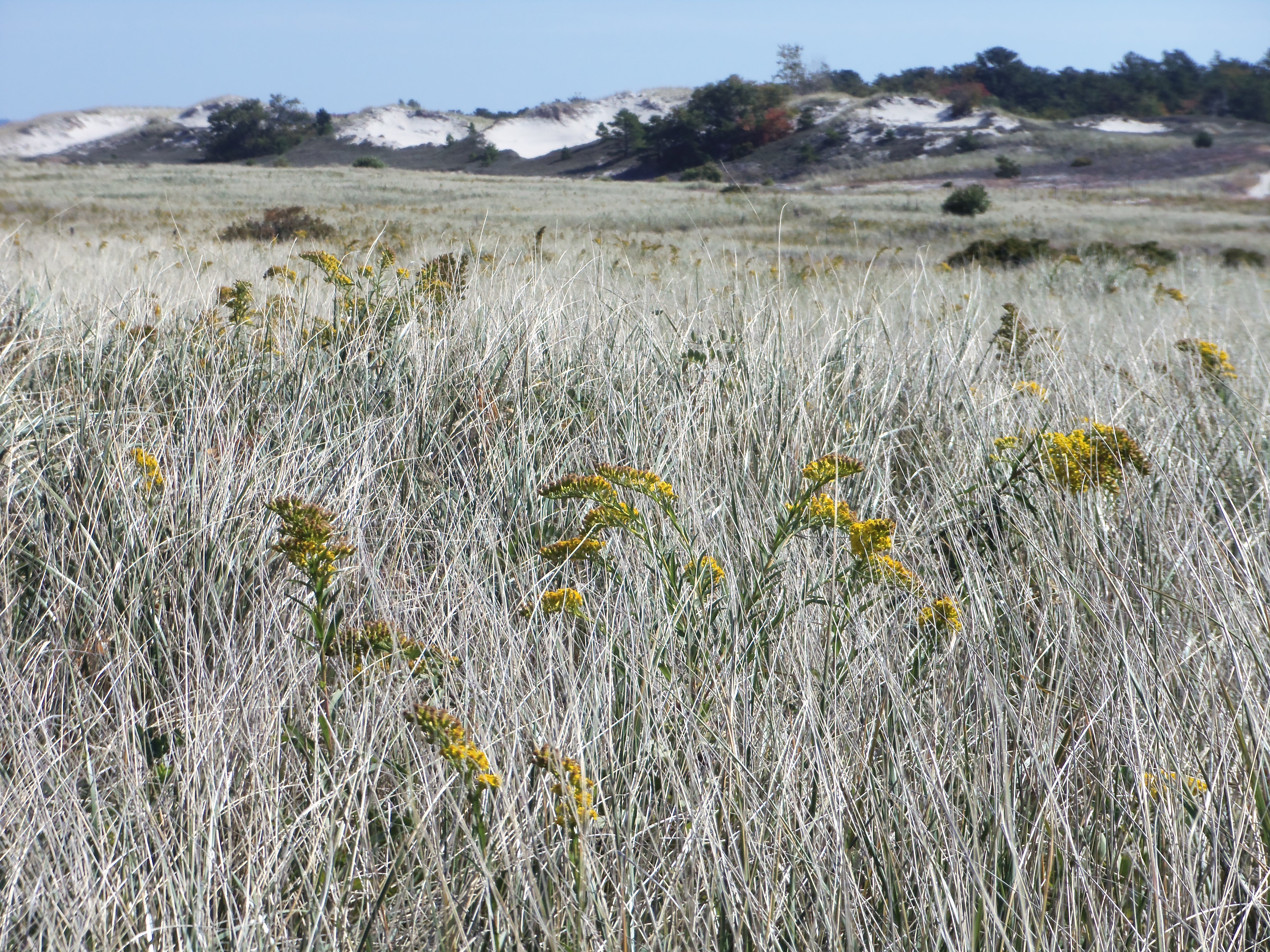
Washboarding and footprints decorate the sand at Crane Beach.Here’s a view looking into a dune behind the beach.
Venturing on, we came into the small waterside village of Essex, where we poked into Woodman’s “in the rough” for a seafood lunch. “Rough,” which is also in the name of an outdoor haunt we love in York, Maine, seems to indicate ordering and picking up from a counter rather than wait staff service, as well as a picnic-flavor rustic decor. As we looked at the blackboard and its prices, we nearly left for cheaper fare, but Rachel caught a posted review by food gurus Michael and Jane Stern – and I knew we weren’t leaving. I’m glad we stayed.
It was fun and filling – they don’t skimp on their portions. We can see why it’s a classic destination for the traditional regional seafood, especially of the “messy” sort. And, as she said, they “know how to do batter.” That’s a high compliment on her part. (Onion rings, anyone?)
The heart of Cape Ann is the city of Gloucester and its varied neighborhoods around the waters. It claims to be from the same year as Dover, although unlike my city, it was abandoned for a period, and is about the same size, roughly 29,000 residents. It lays claim to being America’s oldest seaport and has always been a busy, often brutish, fishing harbor. Gorton’s Seafood uses the city’s sea captain sculpture as its emblem. The Perfect Storm movie captures some of this legacy. These days it’s also the home to a number of whale-watch operations, due to its proximity to the famed Stellwagen Bank fishing grounds. In the 1950s and ’60s poet Charles Olson sought to capture the local spirit in his Maximus series, drawing on Ezra Pound’s literary foundation.
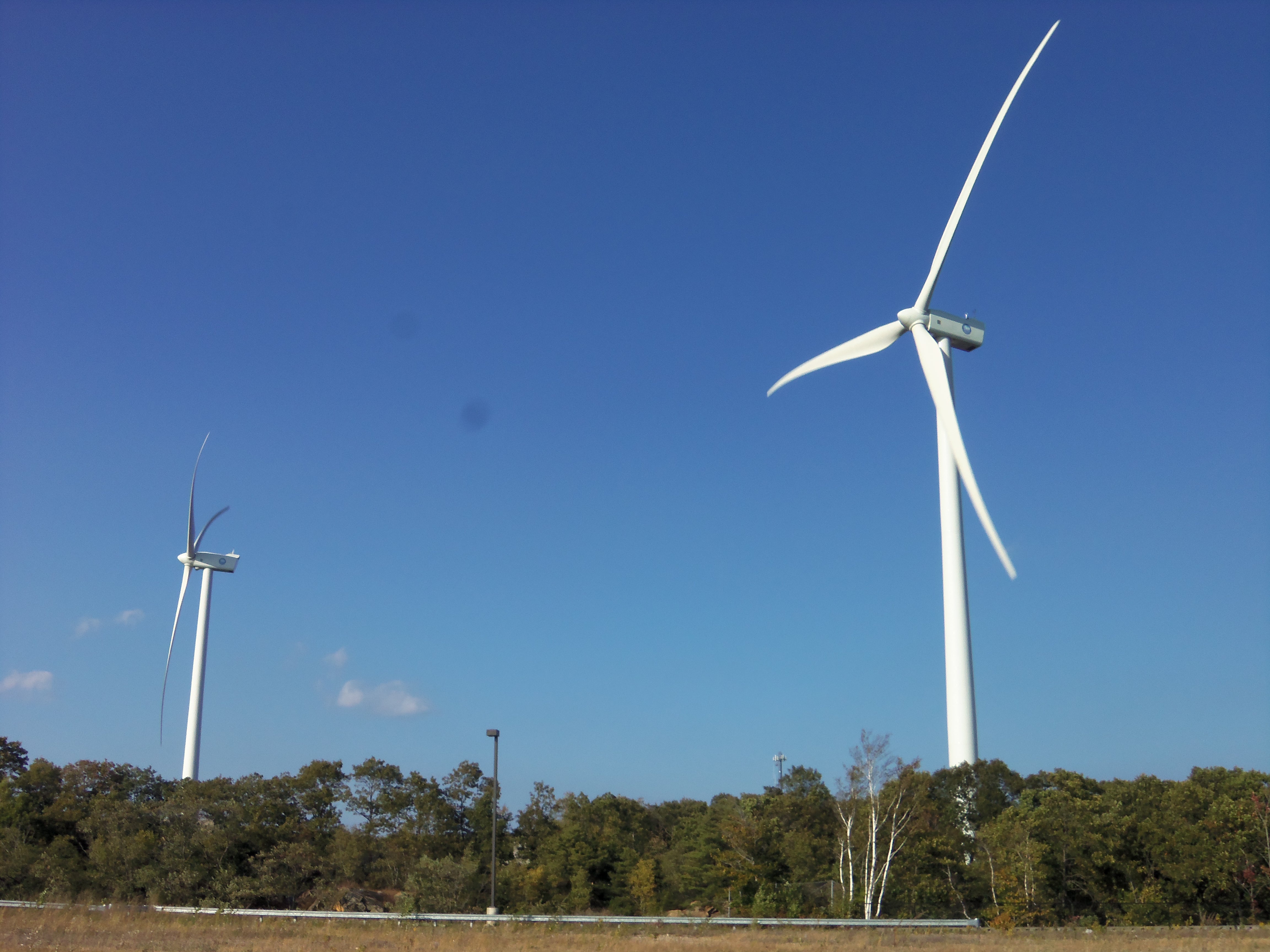
For us, though, the glory of the place is its three large wind-generator turbines rotating gracefully from the highest points along Route 128. They are immense works of art, comforting, landmarks. How anyone can oppose their construction baffles us. And, yes, they do sing … softly.
The trees might give you an idea of the scale and majesty of these Cape Ann landmarks.
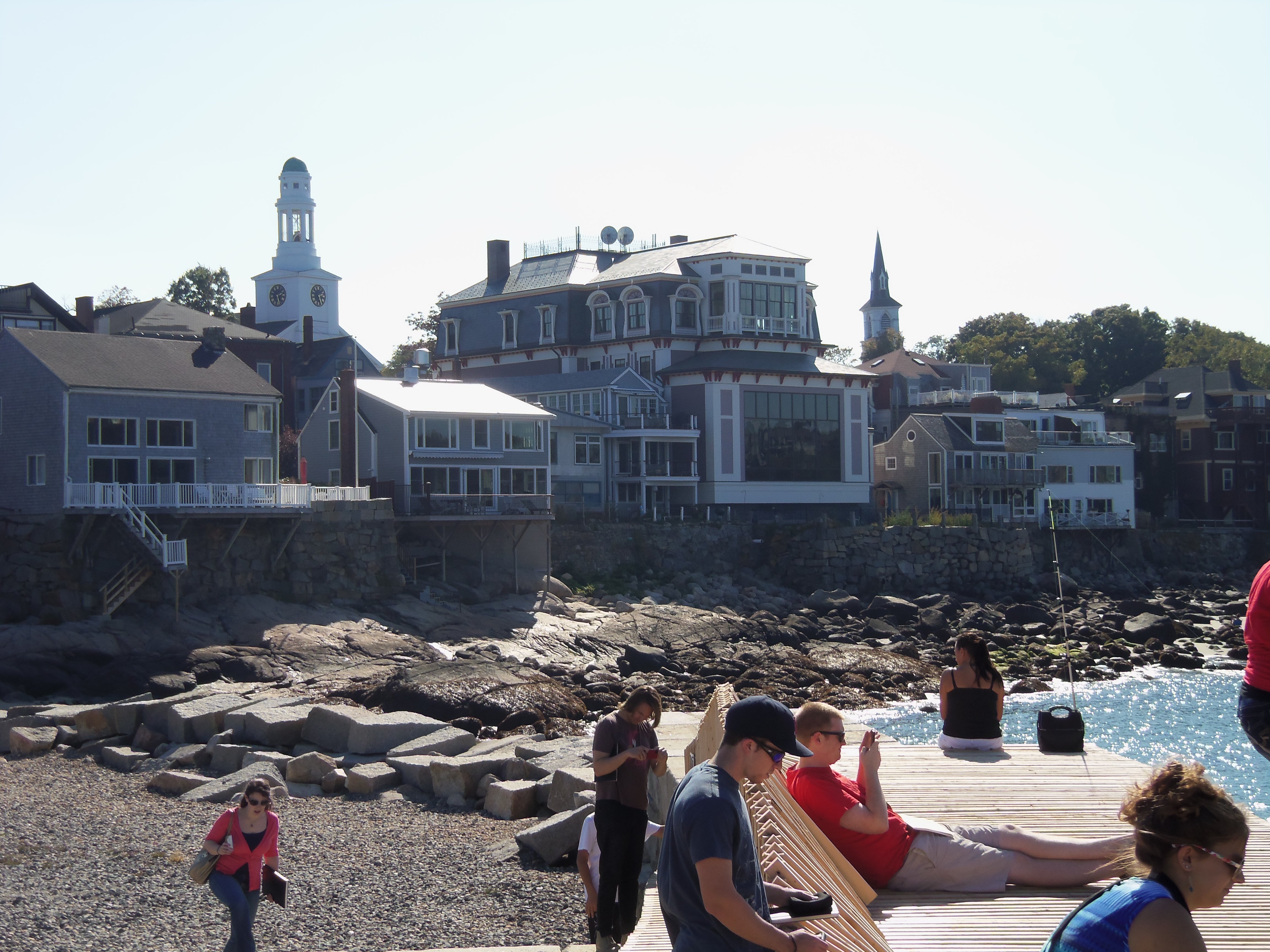
Cape Ann culminates in the town of Rockport, which has long attracted summer artists to its shores. More recently, the three-decade old Rockport chamber music summer festival has developed a loyal following, which led to the 2010 opening of the 330-seat Shalin Liu Performance Center and its year-round offerings that include classical, folk, blues, and jazz. When they say “intimate,” it’s true. What makes this hall truly amazing is that the back of the stage has wooden panels, for acoustical purposes, that roll away to reveal a panorama of the harbor. Maybe the Santa Fe Opera surpasses the view, but I bet you can find folks who can quibble.
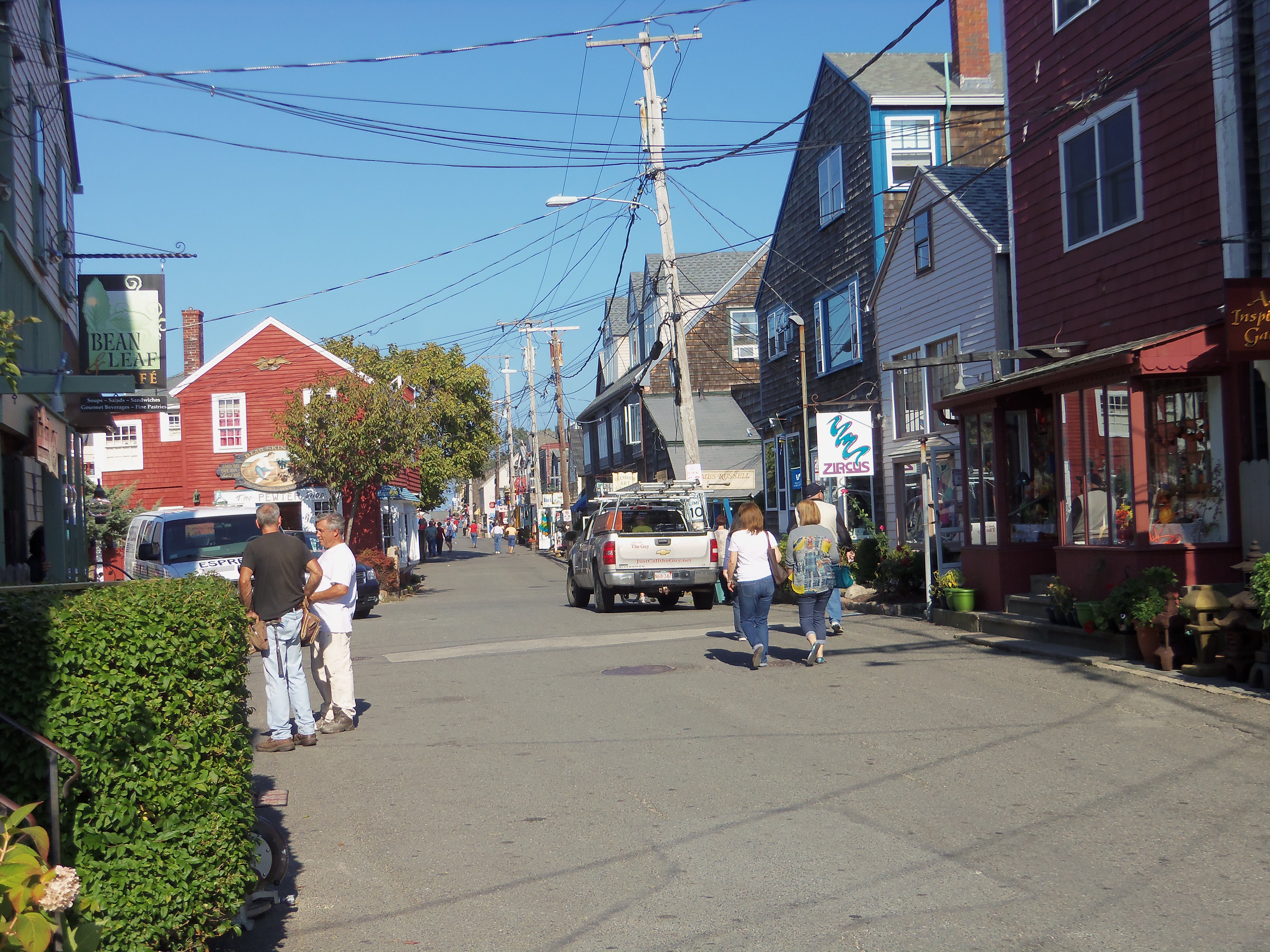
The village itself has much of the Cape Cod shopping flavor of boutiques, restaurants, artist galleries, jewelers, and so on – especially in its Bearskin Neck district.
The big window in the largest building overlooking Rockport Harbor is the back of the stage at the Shalin Liu Performance Center. By the way, the tide’s out. We were among a crowd enjoying an art installation that doubled as sunny seating on one of the stone wharves.Downtown Rockport has a traditional blend of resort retailers … and shoppers to match.
By the way, Massachusetts Bay Transit trains run from Boston’s North Station to Rockport, with Cape Ann stops along the way.
While I mentioned whale watches, I should note we prefer to venture out from Newburyport to the north, in part because the vessel there has the option of heading to either Stellwagen Bank in Massachusetts Bay or Jeffrey’s Ledge in the Gulf of Maine. When it goes to Stellwagen, though, it cruises around Cape Ann and offers fine views of the Straightsmouth Island and Thacher Island twin lighthouses – the 1861 replacements for the 1771 originals – closer to Gloucester Harbor.
We could be considering writing or painting and drawing as much as the photography that prompts today’s line of thinking. Specifically, I’m reflecting on the tension between trying to capture everything I see everywhere versus the reality that one needs limits.
For starters, I reach a point in shooting where I begin to weary. Push hard enough and everyone hits a wall. When it comes to photography, I just stop seeing images of interest. When I’m writing, my words go flat. Folks in other endeavors can relate their own versions.
A second fact of life comes in trying to arrange and manage what I already have. Accumulate too much and I’ll never find anything when I want or need it.
I find a similar tension in a writing project, where I can hope for a tightly focused, crystalline work even as it begins to expand into a complex baroque construction. Or the other way around.
As I’ve been shooting over the course of the Red Barn, I’ve found myself increasingly resisting an urge to range more widely from my base in Dover. I’m sticking more and more to what’s at hand here and in a few other familiar places like Sandwich, to the north, and Fort Foster in Kittery Point, Maine. We’ll see how that evolves in the future.
For now, what fascinates is seeing how much new keeps appearing to me in our yard or while I’m walking to meeting for worship on Sunday. Perhaps that’s why working on pieces in a series hold so much appeal as more and more keeps surfacing from the depths.
The other aspect of the series is the desire that somewhere in there is the one iconic piece that rises above the rest, can stand on its own, deserves its own place.
Oh, what would Monet say to all this? Or Matisse? Or any of a host of others!
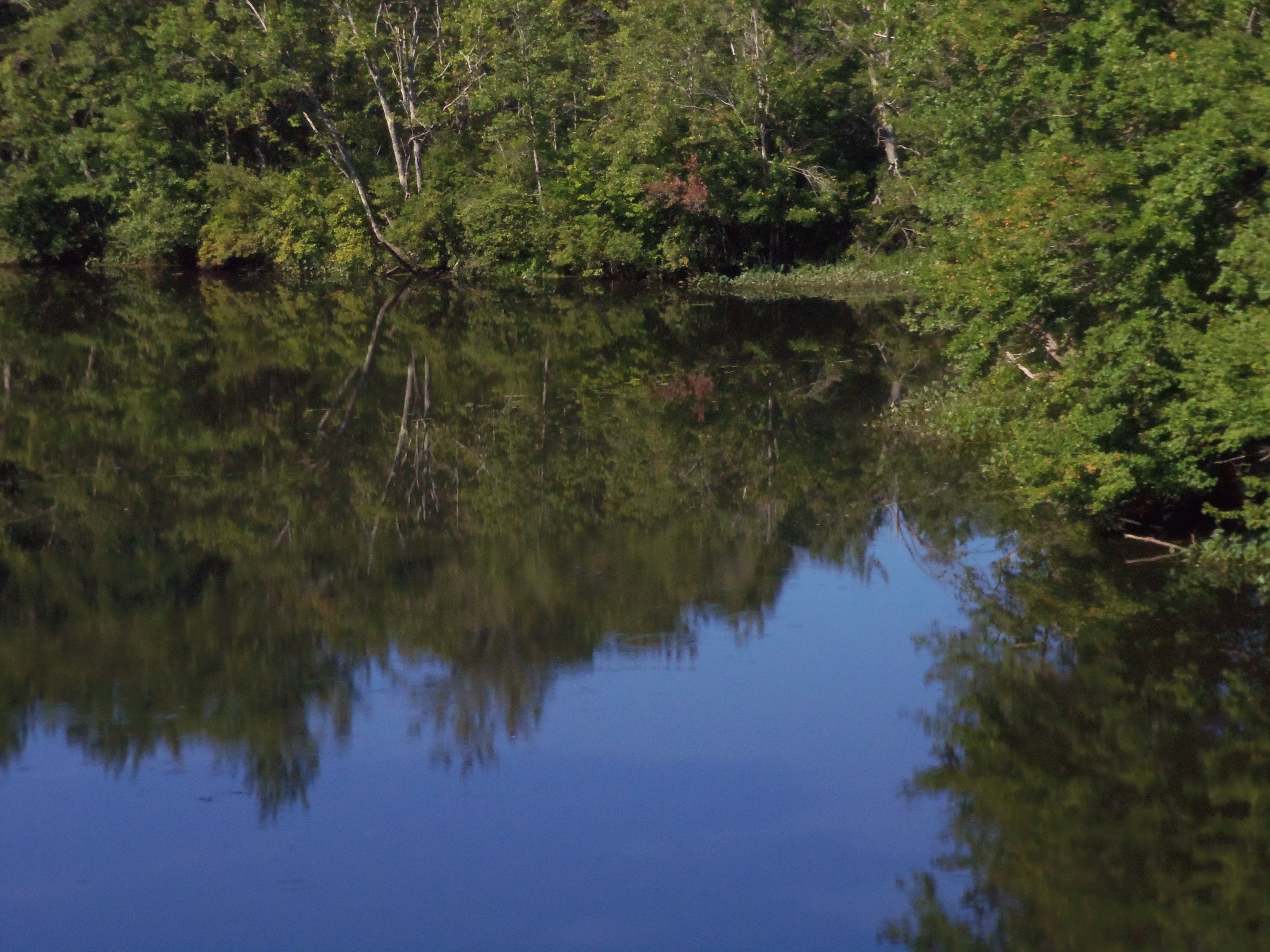
The Cocheco River viewed from the footbridge on the community trail has become a favorite spot for my camera. Here’s part of the scene as I was walking to meeting for worship one Sunday morning.
Returning to my native corner of Ohio, I’m astonished by its flatness; what had seemed to be large hills or significant valleys now appear embarrassingly horizontal.
On the other hand, as I’ve uncovered my ancestral roots in that land, I’m finding a lost and untold richness in what was essentially a Pennsylvania Dutch heritage continuing in western Ohio. Feel free to take a look at my findings at the Orphan George Chronicles.
We’re well into the back-to-school swirl. Considering how many Friends teach for a living, it’s a wonder we don’t talk more about what Quakers used to call Sound Doctrine.
Not dogma, creed, doctrinaire, or even indoctrination, mind you. Doctrine, meaning teaching. The essentials for practicing our faith, just as certain skills are needed in mathematics or foreign language. Or, for that matter, for good cooking or carpentry or sewing.
It’s not just the children, either. Some messages arising in worship are basically teaching, and some are admittedly sounder than others, the latter including those that George Fox derided as mere “notions.” (Consider the Quaker who preached that Friends should not disturb the ground to obtain well water, until another spoke out during worship, “And Abraham digged a well,” citing Genesis 21:30 and apparently settling the matter.) Our own reading and inquiry, meanwhile, can be pretty much hit or miss. Who knows about other sources? Film, television, radio? And, as with all teaching, how strict should one be – and how flexible?
If we were passing a hat to collect slips of paper suggesting what should be included in our own “sound doctrine,” what would you write on yours? For that matter, how much would be a matter of content – and how much, process?
Sometime, perhaps, we’ll even have a session to hear our teachers talk a bit about their teaching – both content and method – and a continuing awareness of learning. Or maybe another, to consider all the ways we have learned from each other – and not just matters of faith, either. The progress of my compost bins, after all, is guided in part by eavesdropping on a few after-meeting conversations and their lessons of patience, humility, and renewal.
~*~
This has me wondering, as well, how we might extend a pursuit of “sound doctrine” into our secular circles. Economics, politics, education, even entertainment could all use a dose of what Friends used to call “close labor” – the effort of living with ever greater integrity. Any ideas?
For much of its history, the Society of Friends forbid the use of engraved gravestones, deeming them vain and superfluous. Even so, another custom emerged, the drafting of memorial minutes for Quakers whose lives might serve as an inspiration for others.
The result was quite different from either the typical obituary or eulogy, and many of them prove surprisingly candid, as genealogists discover. If a eulogy celebrates the person, the memorial minute focuses on the individual’s spiritual life and service, especially in the ways these play out in the world.
Often, the minute would be approved by the local Quaker Meeting and entered into its records. If the individual had been active at a wider level, the minute would also be forwarded to the Quarterly Meeting (a gathering of local meetings that comes together four times a year), where it would be shared and, in due practice, approved. If appropriate, this would be repeated at the larger Yearly Meeting level.
As an example of the practice, here is the nearly finished draft of the minute for one Friend. As a member of the committee that prepared this, I’d like to show the “long” version that includes more of her remarkable career, in contrast to the shortened versions that were approved by the circles of Quaker meetings.
Alanna’s minute was approved by Fresh Pond Monthly Meeting and endorsed by Dover Monthly Meeting, and then accepted by Salem Quarterly Meeting, before being included in the minutes of New England Yearly Meeting’s sessions last month.
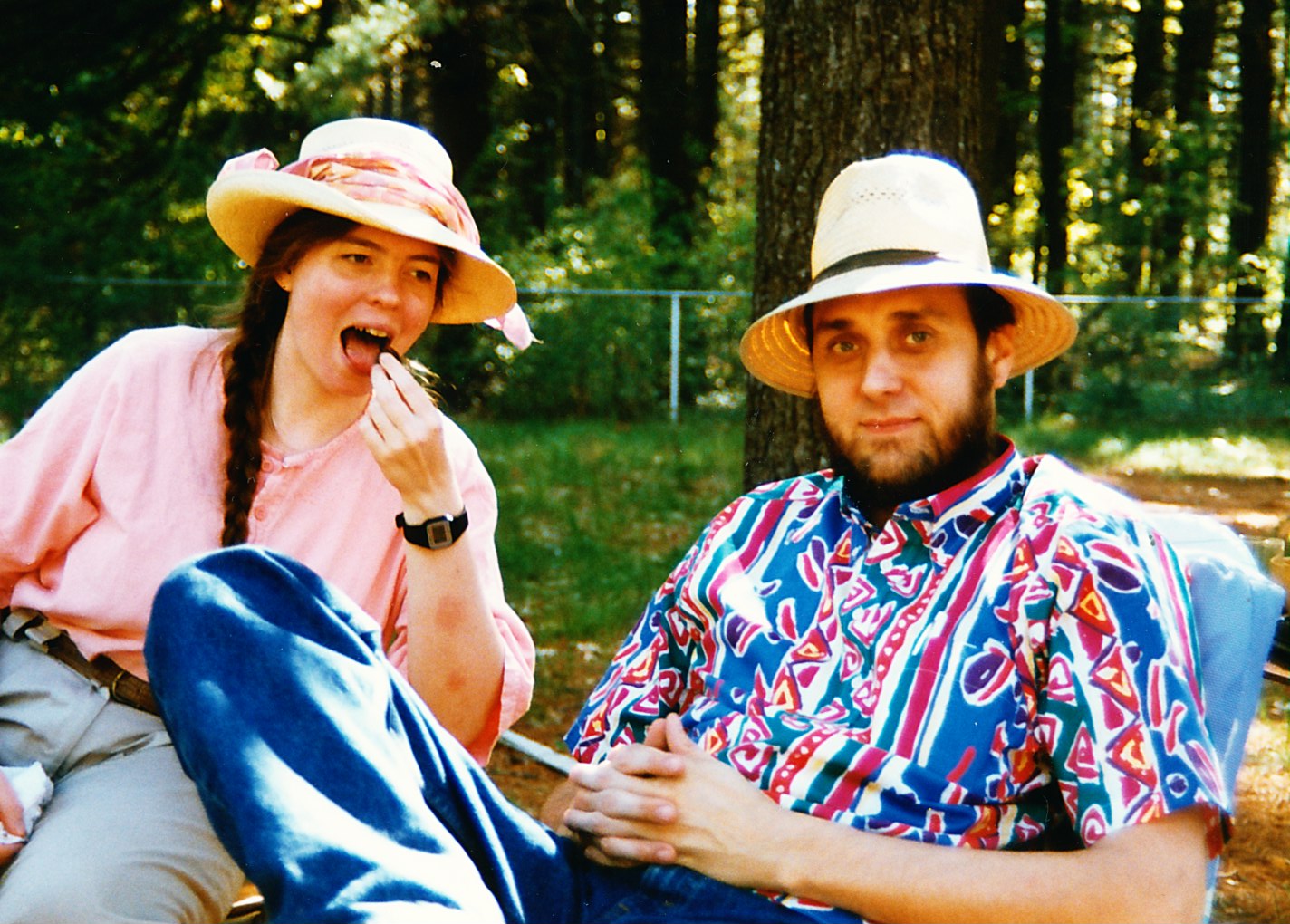
Alanna and me early in our friendship.
ALANNA CONNORS
September 25, 1956 – February 2, 2013
From an early age, Alanna Connors discovered a need and a capacity to trust her own compass. She was a mathematician at a place in time where women were seldom found. When her high school math teacher flunked her for excellent work, another teacher told her: “You know he’s giving good grades to boys and not to you, because you’re a girl.” Recounting the story in later years, Alanna said, “I didn’t need that; I knew I could do the math.” She held true to her course.
Long before finding Quakers, Alanna lived the testimony of experiencing God in everyone. While most of us have tight circles of caring – our family, friends, coworkers – Alanna’s circles were as unbounded as a wave expanding to all of space. It seems no accident her profession became looking at objects distant in the universe: across the many communities of her life’s paths, she welcomed all beings. Living with her was a joy; her love for others was never abstract but a centered flame close to her and everyone she touched.
Alanna was born September 25, 1956, in Hong Kong to Richard and Sonia Mitchell Connors. Her mother, who herself had a degree in mathematics and studied with Jean Piaget at the Sorbonne in Paris, ultimately worked as a font designer. Richard learned to fly in his youth and became a pilot with Pan American Airways, stationed in Hong Kong. Through his delight in sailing, his five children all learned to sail. Alanna took the lead, becoming a competitive sailor in her time at the Massachusetts Institute of Technology.
Returning to the United States in 1963, Alanna’s family settled in Greenwich, Connecticut. Living with four siblings – one older, Cynthia, and three younger, Kathleen, Noirin, and Patrick – in environments not always centered on these children’s welfare, Alanna developed an immense capacity to listen and extend empathy. Imagination shone through her grade school writings; her elaborate, award-winning gingerbread houses; and family-staged dramas.
Alanna was irrepressibly fascinated by math and science. She thrilled to the elegance of mathematics in expressing, revealing, and predicting physical behaviors. For her, mathematical physics was inseparable from the playfulness, color, artistry, and imagination by which she produced it. Whether it was classroom notes, derivations on scratch paper or napkins, or formal solutions, her handwritten analyses were crafted in flourishing script, vivid with colored pencil illuminations, and playfully annotated with such characteristically inventive words as “whatsit.”
Alanna’s dorm room hosted a wide array of human spirits. Her hotplate, washstand, handmade teapot, and mismatched cups provided hearth and an excuse for tea and convivial warmth at all hours of the night.
She met fellow student Phillip A. Veatch while they were both organizing MIT’s first on-campus food cooperative. After a year of courtship, they exchanged private vows of marriage in 1978, on a basketball court in East Cambridge. Alanna was opposed to the state-sanctioned institution of marriage because of its historical role in the oppression of women.
Communal living, conceived around Alanna’s dorm room, continued into her committed life with Phil through group houses with shared vegetarian cooking. While in Maryland during her doctoral years, they asked all prospective housemates: “Can you have: 1) too much garlic; 2) too much chocolate?” A no answer on both questions was mandatory for joining the group house.
With one housemate, Alanna went “church shopping.” While appreciating the wide span of worship experiences, Alanna gravitated to the Religious Society of Friends in 1982 in Adelphi, Maryland, dragging along her then-reluctant partner. A deep commitment to the Quaker principles of simplicity, peace, integrity, and justice soon enriched both of their lives. They continued at Dover Monthly Meeting in New Hampshire and finally settled at Fresh Pond Monthly Meeting in Cambridge, Massachusetts, in 1998.
Wanting to understand stars, she became a groundbreaker in charting the sky of X-ray sources. Being of a mind to “like thinking we are all professional visionaries,” Alanna’s deep searches into the distant sky uncovered new observations and questions. After earning her doctorate at the University of Maryland, Alanna made significant contributions to the Compton Gamma Ray Observatory as a research scientist at the Space Science Center at the University of New Hampshire. She introduced astrophysics to Bayesian methods of statistics, which start from an assumption that knowledge about a problem is always incomplete. Applying this rigorous data analysis to X-ray and gamma-ray astrophysics, she provided a foundation for statistical methods generally unknown to astronomers in the early 1990s.
As a banjo player, she encouraged use of the Rise Up Singing songbook, learning by heart its song “Julian of Norwich.” Original lyrics and tunes came to her, either fully formed or developing through writing. Alanna’s spirit still comes to us through the texts and music of the dozen songs she set down in composition.
Despite being an intense introvert, she harbored a lifelong belief in the importance of community-building. She cofounded an astrophysics statistical working group at the Harvard Smithsonian Center for Astrophysics. As a senior scientist, she was known for her support of young graduate students. She founded a singing group at Dover Meeting, and while living in Arlington, Massachusetts, enjoyed singing with Nick Page’s Mystic Chorale Singers. After the birth of her son, Roy, in 1999, she worked with other parents to reform special education in the Arlington public schools. She volunteered regularly at New England Yearly Meeting annual sessions working both in child care and the bookstore. She regularly attended the Women’s Group at Fresh Pond Meeting, where she spoke regularly about her concerns in raising her gifted son.
Alanna envisioned and encouraged public science education. She taught astrophysics at Wellesley College as a visiting professor, participated in university physics instruction at UNH and UMD, contributed to public education in science through projects at the Christa McAuliffe Planetarium in Concord New Hampshire, c0-organized family science days at her son’s elementary school, and encouraged exploratory science learning and teaching through many other avenues. She had an abiding interest in the history of physics and astronomy from its ancient origins, in welcoming women’s participation in physics, and in celebrating stories of diverse contributors to science.
Alanna was first diagnosed with breast cancer in 1995. She lived with the disease for 18 years. Characteristically, through its recurrences and treatment, she refused to be defined by the disease and conceived her son, Roy, born in March 1999. To her, the illness was but a single strand of her life. When Roy was 4, her disease recurred, and she took him with her to treatments, where he found the hospital’s high-energy accelerator intensely interesting. Whatever life brought her, she lived with it; she saw illness as no excuse to build walls. When her disease recurred for the last time, in an advanced form, Phil asked if she wanted to go on a special vacation. She did not, preferring to live in her callings.
At Dover Meeting, 1988-1998, she rotated through nearly every committee but also stayed long on Buildings and Grounds. During the first Persian Gulf War, Dover Friends called on her to write a compelling minute explaining the Meeting’s opposition to the invasion of Iraq and Kuwait. Phil and Alanna were lifelong advocates of same-sex marriage. When they decided for Roy’s sake to get legally married, they would not seek marriage under the care of Dover, as that meeting had not yet completed its process of hosting marriages for same gender (it has since done so).
During her time at Fresh Pond, her participation in committee work was limited by parenting and the recurrences and treatments of breast cancer. She was, however, a quiet and regular presence at Meeting for Business and an infrequent but powerful minister during Meeting for Worship, where her ministry was often structured around song.
Just as she knew not to take to heart a teacher’s censure that could have devastated a young mathematician, Alanna maintained integrity without ceding herself, her work, or others to be diminished. Mathematics was one route by which she independently investigated, questioned, and confirmed the truth for herself without relying on the claims of teachers and other external authorities. She stood up for discovering and expressing the full potential of one’s mind and heart, inspiring those around her to undertake aspirations and risks of which they did not suppose themselves to be capable. She knew greater being lies imminent within us all. Whether it was the rights of any couple to publicly live their committed love or a child’s mind emerging along ways and curiosities differing from the school norm, Alanna honored and worked for the fuller life she knew to be there.
Alanna’s spirit lives with us and continues to teach us. We remember her implacable but gentle striving to see the truth and to tell it. The women of Fresh Pond recall Alanna’s intense, powerful mothering, against all odds. Throughout her life she resisted the limits and distortions that social norms can impose on our vision of others. Knowing that a prism takes a beam of light and separates it into many separate parts, Alanna lived her life striving to bring the many separate parts of our world together into one shining beam.
Her memorial service was March 2, 2013, in the Wellesley Friends meetinghouse under the care of Fresh Pond Meeting. She was 56.
Some varieties of sunflowers have dramatic dark reddish petals instead of the usual yellow. This one is all the more stunning with the sunlight illuminating it from the back.