Make way for ‘The Secret Side of Jaya’

As a third book involving Jaya shaped up, I reflected on ways some people perceive things most folks don’t. The angels everywhere, as Hassidic contend, perhaps matching the dakinis of Tibetan Buddhist circles. Some of my fellow yogis saw auras around people, although I’ve seen just one, quite black, surrounding the Reverend Pat Robertson when he and his handlers walked through the newsroom for a conference with the editor-in-chief and the editorial writer.

Since moving Way Downeast, I know of the small rock people some of the Passamaquoddy observe.

You might add elves or gnomes or other creatures to the list.

The concept did give me a threat to unite the three novellas into one.

~*~

What was needed was a third novella, reflecting the place Jaya lived between Prairie Depot and the Pacific Northwest. It would have With a Passing Freight Train of 119 Cars and Twin Cabooses before it and Along With Kokopelli’s Hornpipe following. It would be like an adagio in a symphony or sonata or the middle panel in a painted triptych.

I decided to draw on a wooded alcove I loved to explore during my return to Bloomington. It was a largely unknown tract that had included a city water reservoir as well as several caves and springs that had fed two gristmills.

In the years since I moved on, the site has been cleaned up into a city park that even has a stairway down one of the steep slopes.

It had inspired a set of Leonard Springs poems you can find as a free chapbook at my Thistle Finch blog. As I revisited those pieces, I realized that the hollow’s scene and history just beyond the duplex my first wife and I rented on my return to Bloomington as a research associate would transport well to the Ozarks. Especially the part about grist mills at the foot of the sharp hillsides slopes where springs poured out from cave formations.

The story took off from there, especially when I chanced upon the woman miller. I must confess being especially fond of the result. Was this Cassia from What’s Left whispering in my ear once again?

Researching details for this story was a delight. Grist mills had run for a while in my ancestry; the Hodgson Mill in the Ozarks, for one, reflects one side of my family – they even spelled their surname for a while without the G, like mine. (They descend from one William while the other William, also a miller, was my umpteen greats-grandfather.)

Caves were another thing the Ozarks had in common with southern Indiana.

And, speaking of things some people see and hear that others don’t, we had the American Shakers whose spirit drawings and writings wandered outside of the normal artistic constraints. That gave me one more element to play with, especially when I turned to the artistic projects that Jaya had relied on to replenish her own soul in her spare time. I didn’t want her to be writing poetry, as I had, but to be creating some blend of art forms beyond that. Think of Joseph Cornell’s boxes or Emily Dickinson’s bits of paper constructions as possibilities. While I touch on Jaya’s legacy on that front toward the ending of Nearly Canaan, I felt freer to explore it here.

Just what was Jaya’s off-hours creative activity and spiritual practice leading to? Or what prompted them?

Miller at the Springs became an ideal forum for their consideration. Here it was, the final piece of writing in my range of fiction, and it was the most joyous to draft, the least ambitious in its art, and perhaps the most down-to-earth.

~*~

These three novellas presented a private Jaya much different from the one in the public eye. Titling the book the Secret Side of Jaya came naturally, along with the subtitle, Three surreal and fantastic encounters.

The book rounded out my Living Dharma series.

I was ready to kick back and relax, intending to enjoy the role of an author.

In the revisions, the plot of our shooter’s college years ominously thickened

Sometimes, in writing, at least, starting at the end and moving forward is the way to go. Now that I had What’s Left as the ending of my hippie series, I could revise the earlier books to provide a more uniform development. I had hoped the process would involve simple tweaks.

I was wrong. A thorough overhaul was ahead.

Crucially, Cassia gave me a clearer idea of her father, the aspiring photographer. And in filling him out in the revisions, he went from being known simply as DL to Kenzie, to conform with What’s Left as well as present a more substantial figure.

She had also grown up at the edge of the campus where he had come to study. (Just as I had.) In my return to the university as a research associate, I lived at the far fringe of the college town and saw faces of the community that were quite different from my undergrad experiences.

Some of these played into her story, What’s Left, but others were woven into the transformation of his undergraduate years, what would emerge as Daffodil Uprising rather than Sunrise.

This time, it was more character-driven rather than action.

It’s also darker, including an ominous air and an admission that the hippie movement was often drab rather than psychedelic. Drugs and sex could have serious downsides, and Vietnam weighed heavily on the spirit.

Yes, Bloomington was a gloomier place than I had wanted to paint it, but now, thanks to Cassia, I could acknowledge Gothic and tragic sides – even a paranormal streak.

The plot was restructured into a full four-year chronology, and the hippiedelic excesses, as well as Kenzie’s situation of being a reincarnated Tibetan monk, were toned down or erased.

Age differences, from freshmen to seniors, took importance in the nurture of a student community. And there were significant new characters, including Lee Madbury, named after a New Hampshire highway exit sign.

The college dorm of the first half of the book was loosely modeled on the Men’s Residence Center, which was suffering from neglect on high. I am happy to see via Internet that what I call Mulberry Row in the book has been renovated into the Ralph L. Collins Living-Learning Center, one that’s not all males, either. Sometimes hard reality follows the dreams of fiction.

In moving the second half of the book more off-campus, I imported a large and once-impressive Victorian apartment house from my upstate New York hippie experience after I had graduated. Instead of having the Susquehanna (as well as the Upper Mississippi from yet another one of my personal relocations) just a block or so away, we now have the Ohio River. The distances do create a bit of a joke for folks closer to the action.

I originally thought Daffodil was about hippies. It’s really about the rise of the modern mega-university. David and Goliath with a dash of counter-culture in the face of the military-industrial complex. Really sexy stuff, right? Except that our kids and grandkids are burdened with huge debts in the aftermath of seeking its credentials. I’m thinking of it more as tragedy, with the focus essentially on Cassia’s future father, lost as he was. It might even be seen as a critique of the hippie outbreak. And did my failed engagement a decade and a half later also seep into the story? I was now looking at these events about a half a century later.

~*~

Cassia also gave me a clearer understanding of her aunt, Nita, who had functioned as guardian angel for her father in the campus years. In the revisions, Nita becomes a more central thread through the entire series.

And, thanks to What’s Left, Cassia was freed to comment on her father’s college years life. Why not? She had the advantage that looking back that history allows.

~*~

Cassia even had me adding subtitles to my novels. They’re commonly used for nonfiction, but somehow rarely for fiction. Well, why not? Adding “the making of a hippie” does give a browser (meaning a human rather than an online device) a clearer idea of what might be inside the covers. Should I have used that for the title, rather than what I did?

I do like the colorful batik flowerbed by MsMaya that now adorns the cover, even if I miss the bold single daffodil of the earlier version. To me, it more aptly conveys a sense of the era.

Daffodil The revised story now carries more heft and is, to my eyes, something of a baroque book.

Well, if Kerouac thought his experiences were remarkable, why shouldn’t I, looking at my own? And he did write in big bursts that released a lot of pent-up energy.

Acid test novelist: Kurt Vonnegut (1922-2007)

When I first encountered his writing during the fall of 1968 at the recommendation of a friend who was attending a college elsewhere in Indiana, Vonnegut was a breath of fresh air. I loved the sassiness, hipness, and dark humor of books. They had none of the pretentiousness of serious literature but were seriously satirical.

Besides, he was writing about the heartland of the neglected Midwest, at least at one point in each book. God Bless You, Mr. Rosewater nails the milieu and remains my favorite.

Overall, though, I feel an overarching nihilism negates a redemptive mission for his work. As for the gimmicks? Let’s just say this former favorite has shrunk in my estimation over the years.

How I slowly became aware of Greek-Americans

Back in high school, my best friend’s mom was buddies with a Greek neighbor who used to proclaim, “Athens! She is beautiful! The rest of the country?” A spitting sound I could never ever spell out accompanied by the open palms of both hands coming down side by side from overhead.

His other best friend was Greek, too. A kind of philosopher, in fact.

My civics teacher was Greek, as was the drama and debate coach.

In college, a landmark restaurant just off campus passed into a new generation much the way the one in my fictional Daffodil did. Somehow, the details stayed vaguely with me.

Off in the Pacific Northwest, I became fond of souvlaki and spanakopita on our forays to the University District of Seattle.

On my return to Ohio, there was a delightful Greek bakery in a small storefront on a quiet residential street six or seven blocks east of our house.

In Baltimore, “All the pizza’s made by Greeks,” seemed wrong – where were the Italians? And out on the road, “All the diners are owned by Greeks.” Little did I know about flatbreads.

In New Hampshire, the Athens restaurant in downtown Manchester – popular but, to my senses, bland and tired – in contrast to one of my favorite takeout places where we ordered for the office – the menu that introduced me to gyros.

Add to that the cathedral’s big Glendi, which sent food to the newsroom in gratitude for our coverage, or the little frame St. Nicholas I’d pass on one route to and from the paper.

One of our older coworkers, a photo lab tech, was Greek – kind and smiling, though I got to know little else.

A sharp-tongued but very competent colleague in the composing room was also Greek. Named Pericles after his grandfather, though it was shortened for us.

All of this was fleeting and fragmentary but came together in Dover and its annual, free-admission Greek festival.

And then confirmed at Davos in Watertown Square, Massachusetts, a block down the street from our weekly choir practice. The food was great, though run by Hispanics.

Now I can tell you there are Greek-Americans almost everywhere. Opa!

Cover update: One leads to another

After recently tweaking the cover for my Hometown News novel, I found my eyes zeroing in on another volume and once again questioning its effectiveness.

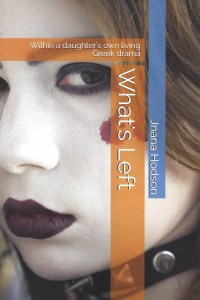
This design continues at Amazon. While Cassia goes Goth in the plot, I suspect this was a bit extreme for her style.

What’s Left: Within a daughter’s own Greek drama had been especially difficult to develop, as I’ve explained in earlier posts, but ultimately ended up following a girl who lost her father in an avalanche on the other side of the globe when she was only 11.  She then continues on into her emotional recovery and growth, rounding out in her mid-30s.

By the time the book appeared in both digital and print-on-demand options at Amazon, the cover image had settled on a photo of a Goth girl.

For technical reasons, she continues at Amazon, while my cover at other digital retailers got updated.

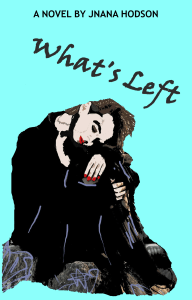
I wanted a better sense of the initial suffering, or even an edginess in her development, but nothing worked perfectly. I am still taken with the daring in her stare at the camera, but is that enough? (I did a post about the earlier covers on December 20, 2019, should you want to explore my archives. I was quite fond of the first cover, the one with its falling egg yoke, but nobody else seemed to get the connection.)

The figure appears more ambiguous in my attempt to do something more in line with some of the Young Adult covers I saw. Ultimately, this was a mistake.

Furthermore, she’s genetically a mix of Greek and American Midwest and a tad on the pudgy side. I hate it when a story follows, say, a brunette but the cover shows an obviously dyed blonde.

Another challenge involved balancing the two words of the title. The second word, “Left,” should have the emphasis, but it’s only half the size of “What’s.” Nothing I tried corrected that. In many of the typefaces I sampled, “Left” simply didn’t read easily, either. It could have been “Lest” or “Lett” on first reading. In making a sales pitch, there’s no time for deciphering the message. “What’s” presented similar challenges in other typefaces.

The text had been difficult enough to nail down in a convincing voice, but the cover was equally problematic – especially finding an appropriate image. How do you summarize all this in a single graphic impression, especially one that works thumbnail size online?

Do note, there’s an ongoing argument about using a facial image on a cover, period. Does it grip a potential reader or does it turn one away? Will it even limit a reader’s impressions of the character at the heart of the book?

At last I had a photo that more or less captures her despair. The title and author presentation never quite matched.

Remember, my budget wasn’t generous enough for a graphic designer, the kind who would create a flowing dust jacket replete with insider clues for a potential reader. I’m not particularly fond of those designs anyway. In general, I think photos pack more punch in a first impression. Just look at magazines at a newsstand. Remember those?

Cassia, or more formally Acacia, goes into mourning after her father’s death and then morphs into Goth dress and appearance through her teenage years, where much of the story develops.

The book doesn’t fall neatly into genres – part of it could be Young Adult, but I’d say the core of it is New Adult and beyond. So how old should she look on the cover?

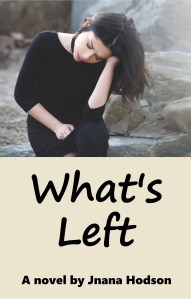
Finally, in the latest stab at this problem, I decided to run with an image I’d settled on earlier. This time, it would bleed off the cover at both sides for maximum impact. I then decided to run it off the bottom, too. Somehow, that left the photo square, a format her photographer father pursued.

At last, we have this.

My reason for cropping the photo tighter was to give it more depth, putting the focus more fully on the girl and her emotion. I’m now seeing that the rocky background I eliminated had actually suggested another kind of story. No more of that distraction now. An artist might have replace it with her extended family, by the way.

In leaving the top open for author and title, rather than separating those elements with the photo in the middle, she has more presence and gravity.

I’m also glad I stuck with an impulsive decision to not fill in the remaining cover with a background color. A new typeface for me, Yu Gothic Semibold, seemed to work best for the title, though I’m not exactly happy with the single-stroke bar apostrophe. But “Left” carries its own weight in the dance of letters.

Book Antiqua, meanwhile, a fallback for me, does nicely in italic for the author.

That’s all – clean, simple, and somehow daring in its starkness. Without an obvious border, the design declares its independence from paperbook constrictions. It’s also quite contemporary, in a confident way. It even pops out on websites. And there’s no question that it comes together more harmoniously the one it replaces.

This one’s now available on your choice of ebook platforms at Smashwords.com and its affiliated digital retailers. Those outlets include the Apple Store, Barnes & Noble’s Nook, Scribd, and Sony’s Kobo. You may also request the ebook from your local public library.

Do take a look.

The act of tedious revision can lead to some favorite lines

My novel What’s Left, was in no rush for completion, contrary to my own desires. Still, I wasn’t going to artificially pressure this one.

As for my personal surprises this time? Some of my favorite lines popped up while swimming my daily laps in the city’s indoor pool.

Here’s one of Cassia’s outbursts that almost prompted me to change the name of the novel itself:

Oh, my, am I torn! I’ll tell you this, though. Buddhism comes in very handy when other kids are giving you so much grief you threaten to cast a spell on them and break out chanting Su To Ka Yo Me Bha Wa repeatedly and then just watch them back away. Oh, I tell you, it’s so satisfying!

What’s that do?

You’ll find out. You better be good to toads.

You get lots of respect for doing that.

~*~

Which title Do you think’s better — “What’s Left” or “You Better Be Good to Toads”? Or have I overlooked something even better?

~*~

Think of it as a cool Christmas present for somebody really special. Available at the Apple Store, Barnes & Noble’s Nook, Scribd, Smashwords, Sony’s Kobo, and other fine ebook distributors and at Amazon in both Kindle and paperback.

Within a daughter’s own living Greek drama

Admitting the place of geography in a piece

Much of my literary writing has attempted to capture the unique sense of particular landscapes, sometimes to the extent that the locale becomes a character of its own. Serious wine drinkers might see this as a matter of terroir, meaning distinctive local flavor.

In my novel What’s Left, I tried to avoid this touchstone but wound up developing the neighborhood around the family restaurant anyway.

In placing it in a college town in southern Indiana, I created an inside joke all the same. If you’re familiar with the region, you’ll know the Ohio River is much more than an hour from Indianapolis. The college town where she lives is defined by both, and thus in a site uniquely its own. If only it actually existed!

Still, I think the flavor is right.

~*~

I know I’m not alone here.

Tell me of a favorite book or movie where you think the location becomes a character in its own right. Let’s make this a long list!

~*~

There’s nothing quite like an American diner in Paris …

When an author listens to the characters

The ending of my novel What’s Left, is not the one I anticipated. Rather, it’s the one Cassia dictated to me as I was drafting. Believe me, it came as a surprise, but I trust her. It really feels fitting, from my perspective.

Up to that point I’d been thinking of swapping the placement of the last two chapters, ending with Rinpoche, the Tibetan teacher, telling Cassia of her father’s last moments and maybe setting her on a new lifetime pathway. Instead, her story concludes on a rainy Saturday morning as she converses with her best friend forever, her cousin Sandra.

Not that this should be a spoiler for you.

If you’ve ever lived in Indiana, you know how commonplace the rain is, especially on Saturdays, or so I remember. But this one is truly special.

~*~

It’s one thing to be writing and other to be reading or watching.

In reading a novel or watching a movie, have you ever felt a character wanted to go in an independent direction from the one the plot follows? Can you say why or which way you’d go?

~*~

My novel is available at the Apple Store, Barnes & Noble’s Nook, Scribd, Smashwords, Sony’s Kobo, and other fine ebook distributors and at Amazon in both Kindle and paperback.

The paperback cover …

How a novel takes shape and grows

While she thinks she’s learning about her father in my novel What’s Left, we’re really learning about her.

Let me confess, that’s not how the story started out, back in 2013. Cassia really grew up in the meantime!

All of the changes are what really matter.

~*~

If it were only pink, like Cassia’s family headquarters in my novel!