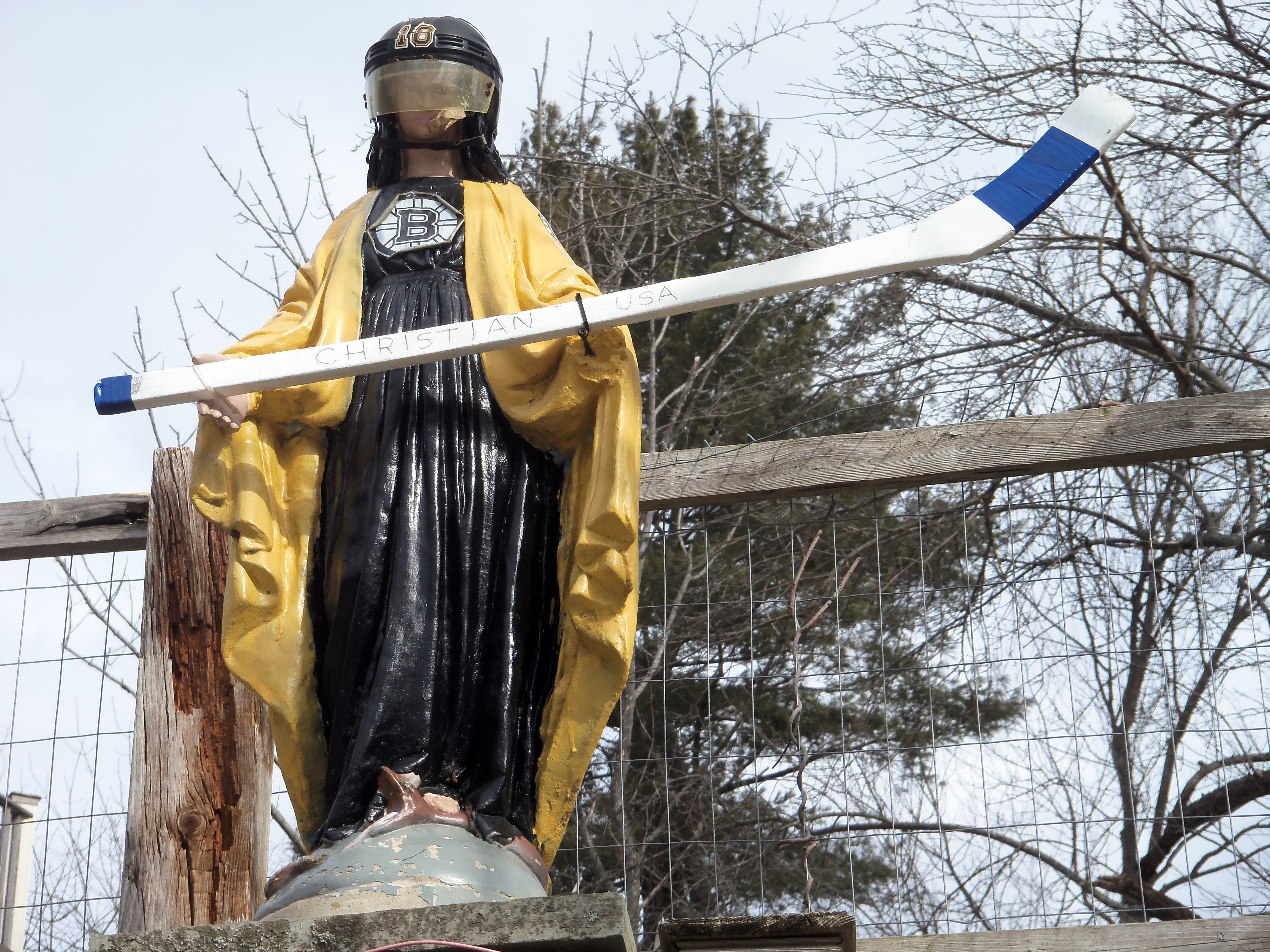
BOTTLE FARM

Among those dim memories from childhood are Sunday afternoon drives, including one on a dull rainy day as we approached Farmersville. As Dad slowed the car, I heard an eerie panorama of tinkling glass and looked out over a seeming junkyard with large, black figures shaped from roofing tin, I suppose – witches, Indians on horseback, perhaps cowboys and the like – and many poles “like cornstalks,” as some have described, but with bottles instead of leaves. Plus, as I’ve read, a number of old church bells mounted somewhere, in addition to the bells of grazing sheep.

Yes, it was the chorus of sound that lingered strongest in my mind.

By the time we got a chance to go back, it had all been razed, declared a public health hazard, I remember hearing, because of the broken glass caused by vandals. Other stories suggested the orgies of motorcycle gangs instead.

One history I’d heard, that this was a relative of the late comedian Jonathan Winters, proved erroneous. The owner’s name was not Zero Winters, but Winter Zellar (Zero) Swartsel (1876-1953), an eccentric who turned his 22 acres into artwork fashioned from discards such as old bedframes and twisted wire. What I retain from that one day is far more cluttered than the clean photographs taken by Edward Weston.

It’s all lost, of course. How much it could have been an installation in some gallery will forever remain conjectural, but Winter was way ahead of his time on his multi-sensual approach to creation.

TALLY HO, PIMLICO

As I said at the time, I’ve been thinking about names. Especially place names. Take “Baltimore,” a name most of us use repeatedly and never consider. There’s Balty More, kind of salty. Or Balta moor, rather Mediterranean. The name itself sounds Irish. I know, they were English. But it sure sounds like Ballyhagen or . . .

Of course, not everybody pronounces quite the same. I was in Florida a couple of years back and we went out to a restaurant owned by a woman and her husband, who had retired from Tennessee and, well, got so bored with the retirement life they went back into business just to take their minds off the boredom. So, following the dinner, she asked us where we were all from and the first of my colleagues replied, “I’m from Los Angeles,” and she said, “Oh, that’s very nice,” and the second colleague replied, “I’m from Chicago,” and she said, “Oh, that’s a nice city,” and the third said, “I’m from right here in Florida,” and of course she had to ask what neighborhood, and then my fourth colleague drawled, “I’m from right outside Atlanta,” and naturally they had that Southern thing going right away, in ways we Northerners can never know about. Finally, she turned to me and I said, as some folks around here do, “Bal’mer.” All of my colleagues looked at me queerly. Bal’mer? Not Bal-ty more? But not that lady, no sir. Without missing a beat, she came back, “Oh! Merlin!” Yessirree. I’m from the state of Merlin.

But back to Bal’mer, which sounds like something you put on a wound. Especially a burn.

At one time, the name made sense. Unique, except for the home plantation, wherever that was back in the British Isles. Named for the good Lord Baltimore, and all that.

But it’s time for a change.

For one thing, there are so many other Baltimores around the country, we’re only the biggest of them these days. I mean, there are all of those West Baltimores, New Baltimores, and North Baltimores, and so on running around, who needs them?

Even the Baltimore and Ohio Railroad decided it was time to change its name to CSX or whatever. Even here, in the metropolis, we have problems confusing, as we do, between Baltimore City and Baltimore County.

No, friends, it’s time for a change. New and improved, as they say in the advertising business.

We could turn to the original names, but Fells Point just doesn’t ring quite right. And Jonestown just won’t work, not after the Reverend Jim and his little band of suicidals. Nor would Otterbein, with its sectarian overtones as a denomination that no longer exists, for that matter. Harbor City doesn’t quite say it. Our nicknames Charm City, Mobtown, Crabtown, and so on, fail us as well.

What I am proposing is Pimlico.

Yes, this is Horse Country. And Pimlico has a nice ring to it. Consider the crowd that does Paris and Rome each year. Would they ever say, “I did Paris, Rome, and Baltimore”? Hell, no. But now try “Paris, Rome, and Pimlico” and you see what I mean. Pimlico has the kind of sound to it to reflect our definite up scaling of the city. It sounds just a tad racy, too.

Say Pimlico it shall be.

Remember, when you see the shining college students outside your favorite supermarket and they ask you to sign the petition, do not hesitate. And remember to vote yes on Proposition Fourteen, to rename Baltimore City and Baltimore County. Either or both.

Then we call all unite in saying, with renewed vigor: “Tally Ho, Pimlico!”

If only …

BECOMING A CHARACTER

Everyone where she was from said simply, “Oh, that Anna! She’s a character!” But they’d never say why.

I met her long after she’d moved east, and sensed in her a deep spiritual presence.

Still, when it came to opening her memorial service, I couldn’t refrain from mentioning her identity as a character. What emerged in the next hour was quite a lesson.

Afterward, as I drove home from New Jersey, I embraced this mandate: we have the first 40 years of our lives to get our act together – and the next 40 to become a character. If we can. If we’re worthy.

HOT DOG BUNS VERSUS FRANKFURTER ROLLS

Once upon a time, or so it seems now, a girlfriend sent me out with orders to come back with hot dog buns, which is what I did.

But when I handed her the grocery bag, she cried out, “Oh, no! What are these?”

“They’re hot dog buns,” I replied ever so naively.

“No they’re not!” she insisted.

“But they’re what I’ve always had hot dogs on,” and they were.

She would not believe me, so off we went, together, to the supermarket.

“These,” she said, “are hot dog buns.”

Asked to pick out a hot dog bun, which would you choose -- the ones sliced on the top, at left, or on the side, at right?
Asked to pick out a hot dog bun, which would you choose — the ones sliced on the top, at left, or on the side, at right?

They looked like a flattened loaf of bread cut in fat slices. The side of each “bun,” in fact, was without crust – naked, to my taste.

Pointing to another shelf, I looked at the kind I’d always known – the kind, that in fact, came labeled Hot Dog Buns. Hers, in contrast, were labeled Frankfurter Rolls.

Hmm, we both said without satisfaction.

She had, in truth, grown up in New England and lived nowhere else. And her idea of how to serve a hot dog was unique to the region. Not in something she considered a torpedo roll.

Ah, but the plot thickens. As I bought packages of each this time around, there was no Frankfurter label -- and the Hot Dog tag instead went on what my wife confirms are often called Frankfurter buns or rolls around here. As a further complication, we now have the term Coney Island, which confounds my elder daughter while bringing to my mind something completely different, a miniature hot dog where I grew up, often served covered with "chili." But that's a whole other story.
Ah, but the plot thickens. As I bought packages of each this time around, there was no Frankfurter label — and the Hot Dog tag instead went on what my wife confirms are often called Frankfurter buns or rolls around here. As a further complication, we now have the term Coney Island, which confounds my elder daughter while bringing to my mind something completely different, a miniature hot dog where I grew up, often served covered with “chili.” But that’s a whole other story.

This can, in turn, point to a lot of other regional distinctions. Whether you call a device a watercooler, a water fountain, or a bubbler, as we do here. Or whether you order a soda, a pop, or a cola. Feel free to expand the list. It can go on a long time.

Fast forward, then, to lunchtime at a national conference being held in Rhode Island. I sat down and joined a random group that included a handful of teens. One was from North Carolina. I pointed to the hot dog on his neighbor’s plate. He looked bewildered. “What’s it wrapped in?” he asked.

“Would you call it a hot dog bun?” I prompted.

“No way!”

“Oh yes it is,” said the girl from Connecticut. “It’s what we always use.”

You know where the conversation went from there. Yes it is, no it isn’t.

At least the college cafeteria knew to stock both Hot Dog Buns and Frankfurter Rolls.  As we all discovered.

Hmm. Maybe next time we have a crowd over and we’re grilling hot dogs, I’ll get packages of both – and then see which kind goes first.

Social status versus social value

You see the lists from time to time: America’s richest individuals or families.

You also see how proud people are about finding loopholes to cut their own taxes or lobbying for another advantage over the rest of the public.

Seems we’ve had it wrong. We should be according that respect to America’s top taxpayers. Yes, let them compete for the status of being the most generous Americans, the ones who step forward for their country. We could even break this out by occupation, for extra Top Ten lists. I’d even be in favor of having a monument in Washington inscribed with their names.

Let the rest of them be considered shirkers.

A LIVELY CAST

One of our favorite TV comedies has been Little Mosque on the Prairie, a Canadian series about a small, struggling Muslim community the fictional prairie town of Mercy, Saskatchewan. I’ll let those of you in other faith traditions weigh in on the parallels, but I suspect you’ll find each of the show’s characters already existing in your own congregation.

You’ll also see many of the same dividing lines and tensions. Traditionalists versus modernists, for instance, or those bred to the faith versus converts. There are even the basic questions of identity and self-identity or motivation and discipline.

As I look at my own Quaker circles, I sometimes see a line between those drawn to the hour of worship itself and those drawn to the peace-and-justice witness, such as gender and racial equality, global non-violence and fair trade, prison reform, environmental concerns, and the like. Sometimes the difference shows up most sharply in the announcements that come at the end of our period of silence – those who want to leave quietly, savoring the calm, and those who instead urge us to attend all kinds of lectures, discussions, demonstrations, fundraisers, and other gatherings in the coming weeks.

Sometimes the lines even cross.

SUMP PUMP

I’ve learned to listen whenever we get heavy rain. Check to see that the jerry-rigged sump pump is still upright and its line’s not clogged.

Yes, indeed: too much rain, and the sump pump kicks in. Or else the cellar floods, along with the furnace.

It’s all a matter of perspective.

CELLARS VERSUS BASEMENTS AS A DIMENSION OF NEW ENGLAND

Where I grew up, we had basements. They rarely flooded. Some were even finished into spare rooms, with TVs, carpeting, or best of all, a pool table. Here in New England, most of us instead have cellars, where water seeps through the walls after heavy rainfall (some even spurt).

And so, under the house, confusion. Mold. Dampness. Leakage. Not the order of a basement, with dry walls and solid floors, but a cellar. With small garden snakes and a sump pump. Rick, our carpenter, says you find the soul of a house there. Its support. The wiring – we’ve removed many strands of stray threads overhead, each staple a bear of resistance. It wasn’t the same as the secrets we found in the kitchen walls, the 1928 newspapers, during that renovation, but secrets all the same. You sometimes read about bodies being buried in the cellar. Instead, we have trenches along the wall – and maybe some stray tree roots. I need to replace the bottom stair, the one broken from rot. And soon, I would hope, the sump pump itself with something smaller, more powerful, and more reliable.

Yes, an old New England house is always a project. Even one only little more than a century old.

FROZEN FISH

Our antique fish weather vane has long been something of a puzzle. It’s a rather attractive piece of copper, but these things don’t come with instructions, and the parts didn’t quite seem to come together. So it’s sat around in a corner of the barn just waiting for the day it could swim in the air again — or maybe simply on an indoor wall as an ornament. Still, finally getting the roofs over the barn and kitchen re-shingled this fall before the weather turned bad provided a stimulus for action.

The first challenge was trying to figure out how to connect the rod to the roof. As I inquired at one hardware store after another, I kept getting the same response. “I don’t know, it seems like there should be a simple way to do it. But we don’t have anything like that.” A few clerks suggested places that turned out to be dead ends. And as I looked at all the cupolas under many of the vanes around town, I realized that even with a cupola, you’d still have to have some way of attaching the vertical rod.

Finally, after a bit of online surfing, I came across an answer — a store, in fact, we’d passed many times in the coastal town of Wells. Weathervanes of Maine turned out to have a nifty little adjustable roof mount for $30 that fit our needs quite nicely. The store, by the way, has row after row of shiny new weather vanes — roosters, horses, eagles, moose and bear, ships, dragons, pigs (yes, flying pigs), and many more. If you’re ever driving along U.S. 1 there, stop in — it’s quite the destination.

Still, the connection to the fish itself still didn’t seem right. And again, nobody could give me a satisfactory answer. So it was back to Wells, where a fancy soldering job did the trick. Our fish could now face the wind. And, as you can see, more.

Where we live in New England, vanes are useful predictors of weather. While our prevalent wind is from the west, wind from the east or the south comes in over the ocean, where it loads up with moisture we encounter as rain or snow. From the north, of course, means colder than normal — a pleasant touch in summer but a nasty bite this time of year.

I’m quite happy to have the fish provide a modest and useful crowning touch to the barn. Or, as I sometimes announce, “The fish has turned.”