Ogunquit has one of Maine’s loveliest sandy beaches (to distinguish it from some pebble sites we frequent, especially). It’s more than a mile long facing the Atlantic, with house-free dunes behind it.
One corner, near the parking lot, is bordered by the Ogunquit River, which is fun to float in, as long as you avoid the whirlpool.
That end also has a lovely large apron of sand at low tide, and unsuspecting visitors often carry their towels, folding chairs, bags and coolers right out to the edge of the water, establish camp, and head off into the surf. While they’re at play, though, the tide turns quickly, submerging much of the apron within minutes, generally approaching the camp from behind. You should see their faces as they suddenly recognize the catastrophe at hand and desperately try to retrieve their floating debris from the quicksilver waters. Their chairs, coolers, towels and blankets, even shoes are all heading out to sea.
Soon, most of the beach on that end is under water. Remember, the level changes more than a foot every hour … and sometimes it’s closer to two.
The veterans, in contrast, set themselves up much higher, against the rocky base of the parking lot itself.
I wish he hadn’t said it. My former landlord in the Yakima Valley, visiting us here in New England, remarked on how many of the houses he saw that were in need of new paint. That was before he saw ours, too.
Now, in this seemingly picturesque location, everywhere I turn, I see houses with peeling paint. Or worse.
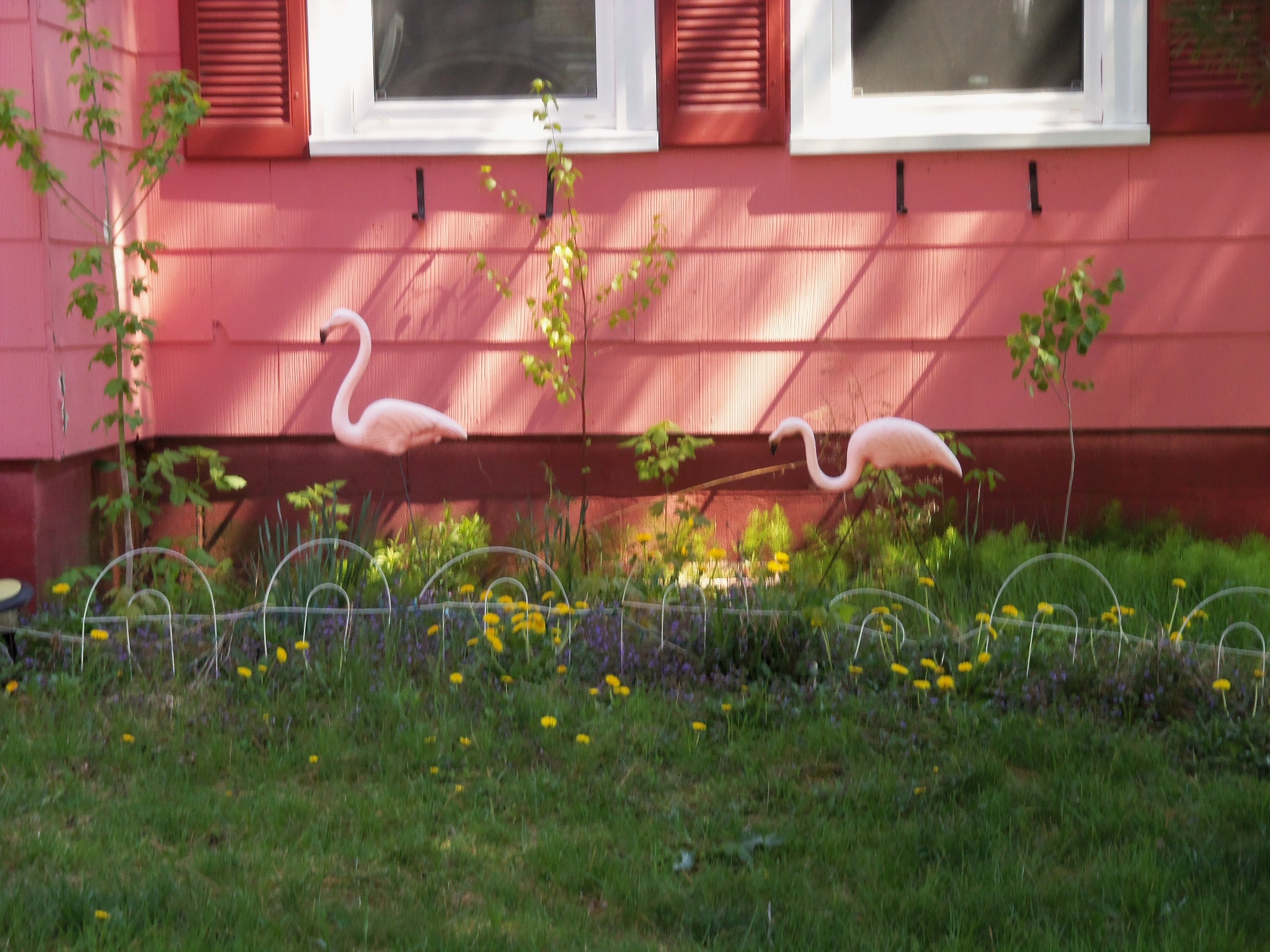
Don’t mock these humble birds. They’re great fundraisers, as I remarked in a post the other day. Now here’s the rest of the story, the one I thought I’d published long ago … but hadn’t.
At a party one night in our Smoking Garden, a friend was telling about a fundraiser her church youth group had done back in Massachusetts.
“That’s a great idea,” I said. After all, she was a United Church of Christ pastor with all kinds of connections. “UCC,” for short.
Next thing I knew, a big sign and box appeared in our Quaker meetinghouse, warning Friends to buy flamingo insurance. This is New Hampshire, remember, not Florida.
One night after our party, our renowned sculptor Jane and her husband had come home to find her flock of pink flamingos missing from their yard and garden, but a sign stood in their place: “They needed to be quarantined.”
Uh-huh. I was as baffled as anyone that Sunday as we entered the meetinghouse and faced that big sign and its box of warning.
Here’s how it worked: you could donate any amount for insurance, but if someone else trumped that figure by offering more, you could still get flocked. And if you were flocked, there would be an envelope for another donation for their removal. In other words, you could get hit coming and going.
Then the plastic birds – and wooden cutouts – began appearing in Friends’ lawns. Folks living in apartments weren’t immune, either: the birds showed up strung around balconies or in the backseats of cars left unlocked or wrapped around cars that had been locked.
For the most part, it was great fun – even for the police officers called out to investigate rustling sounds in the night. We had no idea who was in on it, and nobody from our Smoking Garden party guest list was looking guilty.
When we were hit, one of our neighbors laughed and explained why she knew we hadn’t selected the birds as permanent decor: “You’re too organic.”
(Ouch!)
The Sunday morning the operation came out in the open, a guest to Meeting told me, “We did the same thing, down in Connecticut.”
“UCC?” I countered.
“Yes, how’d you know.”
“Just a lucky guess.”
So it had been the Meeting’s kids who were keeping the secret, along with a couple of very, very discrete adults. The money we raised went to the Heifer Project. Our children had to decide what kind of animals they’d send to the Third World – something big, like a cow, or something smaller, like a lot of chickens? And then they took a field trip to the project’s New England farm to check out all the options.
It’s a much better story than the one about my ex-wife’s two birds – the ones a friend of hers stole from my yard after the separation.
Flocked
our Lady of Pink Flamingos keeps taunting
“Have you been flocked?”
where’s it going, our summer of plastic flamingos?
Thunder pealed again, and everybody packed up. Outside, Roddy and Erik danced in the eerie dusk. A soft drumming in trees sounded like drizzle, but instead of water, powder fell. Everyone appeared amazed, even elated. Weren’t we fortunate to have a volcano blow up in our face! Then Jaya recalled history: “Oh, Pompeii! Will guides conduct tours here, showing the world exactly how we victims perished? Is this the way our world will end?” Something gripped her, insisting they get home or die in the effort. She dragged Erik, protesting, to the car and raced through the grit. Autos in front of them were invisible, even their taillights, until Jaya was almost atop them. The ink blot overhead closed in on the far horizon, sealing off the last natural light. Plunging through this tar-paper snowfall on a route they knew so well, Jaya recalled the many times she had joked about being able to drive it blindfolded.
~*~
To learn more about my novel, go to my page at Smashwords.com.
Looked up as I drove by a big green lawn the other day and saw it was dotted with pink. A bright pink unlike any flowers we grow in these parts.
Then I smiled, realized the house had just been flocked – there was even a note stuck on a stick.
In a flash, even at a distance (this was the kind of place that has a small pond between the house and the highway), I sensed the two dozen flamingos were all uniform, likely brand-new, unlike the motley band we “quarantined” for our own use all too many years ago now. Why, ours even multiplied in the course of their service – some of the dads were making new ones from plywood, rather than plastic.
Flocked, you ask? Oh, I was sure I’d told that story, somewhere.
Yeah, I know that seeing the first robin of the year is supposed to be a harbinger of spring, but the reality is that it’s possible to see them all winter, even where we live.
Just consider the day we looked out the window in the middle of February and saw 10 flocking together in our driveway – and believe me, we were a long way from the end of winter. There were more on the snow on the other side of the house, too.
The true bird of spring tidings is the buzzard. That’s right, the one more properly called a turkey vulture, back from wintering in Florida. (I happen to think there’s a lot of symbolism there. And they call the senior citizens “snow birds”? Maybe a better term would be “bait.”)
Yes, you can observe the stray vulture around here in the middle of winter, but they arrive in numbers just as the air’s turning from the depths. Sometimes it’s just as the last snow of the year is melting, in years like this when we’ve had a heavy and sustained pack build. Doesn’t matter, really. Somehow, they know.