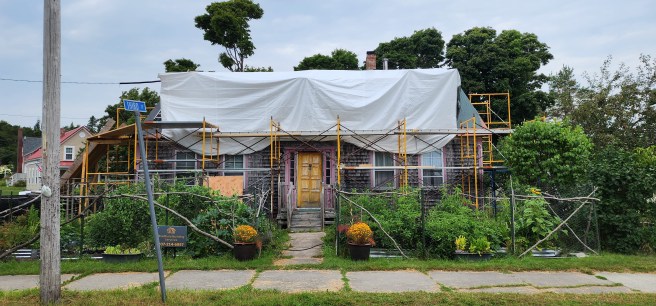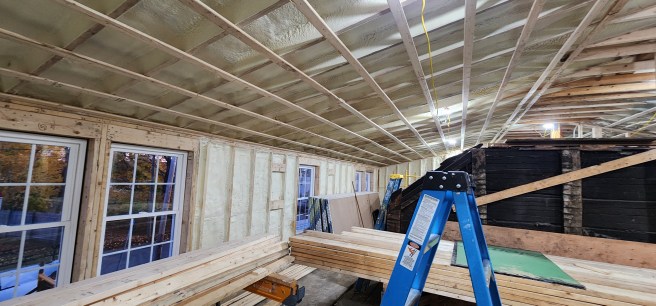
Watching the rooms take shape was especially exciting

There were moments when we wondered about leaving all of that space open – just one big room. Maybe something like an artsy loft apartment. But then we returned to our projected needs and the plan at hand.

As the framing and wiring and flooring moved along, as well as the drywall itself, our hopes of painting the interior in the weeks between Thanksgiving and Christmas got pushed back till after New Year’s. Still, we were able to sleep some of our visiting family up there in primitive conditions as the drywall taping and mudding dried, thanks to a flurry of action just before Christmas.

The two front bedrooms are nearly twice as large as ones in the back. No surprise there, since the back half also has a small hallway and the bathroom and the laundry room.

Altogether, we have twice as many electrical outlets up there than we do on the first floor. And twice as much natural light.

As for the views? Sometimes breathtaking.

The good news is that the upper level, which prompted all of this work and expense to date, is largely complete.

Yay! Yes, Phase One is in place. The part that demanded we do something, or at least have it done.

~*~

Not surprisingly, this first phase cost about three times what we budgeted and took at least three times as long as we planned. Sadly, it is a rule of thumb in these undertakings. We have arranged refinancing to assure the work will be finished in the months ahead while we have our beloved contractor, rather than trying to reschedule later, but other projects we intended were reconsidered.

Working solo, as many of the carpenters do around here, meant our contractor was moving along at a slower pace. The good news came in the appearance of an enthusiastic apprentice two or three days a week, along with a helper as needed.

Immediately ahead of us was painting the ceiling, walls, and floors and then moving our stuff out of storage and up from downstairs.
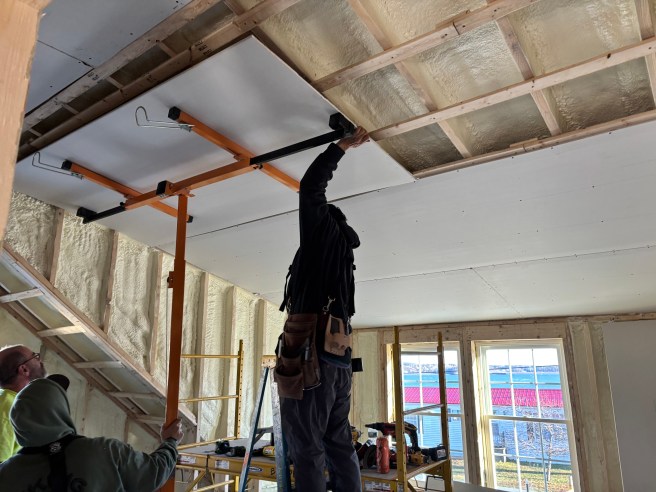
In the coming weeks, we’ll be looking at specific areas of the work inside.

At this point, we did take time to review our budget and resources, and consider modifying our direction as needed. Just getting the upstairs under control was a huge relief and accomplishment, one much larger than I had anticipated.

~*~

The most maddening item involved moving the wood-burning stove from one corner of the front parlor (aka living room) to another. It made sense for several reasons, safety for one, but also straightening out the stainless-steel chimney pipe to allow for more room in the kitchen and bedrooms above. Getting a subcontractor back to finish the job was another matter, one not uncommon problem around here, as we’re finding.

That stove is an important factor for us when it comes to the frequent electrical outages in Maine, at least in all but the summer months. And it is a major improvement in heating the house through our cold winters.

Maybe if we had decided on the emergency generator back when?

There are tradeoffs, after all.

As for the placement of electrical light switches or which way the doors opened?

Right-handed or left? Have you ever considered that? You just reach and hope, right?

~*~

We were far from finished, of course. The kitchen remained a priority, along with the adjoining mudroom. And the downstairs windows, with all of their rotting, did need to be replaced. The small downstairs bathroom and tweaks to the other rooms could, if necessary, be put on hold. Not that we’d prefer.

In the bigger picture, we’re hoping the extensive renovation of our old house assures its continuance for another 200 years or more.

A surge of activity after seemingly nothingness

In the renovation, we had periods were seemingly nothing was happening but then, BLAM!, things suddenly moved on all fronts.

This was especially true when we were at the mercy of other tradesmen and their schedules – plumbers, high on the list.

One of those involved the crew that would do the sprayed foam insulation on the front half upstairs. We decided to go with a different company than the one that had done the back, in part because the new one got back to us with a bid promptly, unlike the other. Not only that, they could get to work for us sooner than later.

That did put some pressure on Adam to get the electrical wiring and outlets in the framing before the crew showed up, so it was crunch time there.

But then the electrical panel in the basement blew out.

We were without power going into the weekend. And without heat.

Adam did have an amazing storage battery that we plugged the refrigerator into while he patched the old system.

As he said, the only thing holding the panel together was rust and spider webs.

This came only months after he had rewired the pretty much the whole house, everything but the panel and circuit-breaker box. They were scheduled for later.

And then, the whole town lost power for a few hours, all just before the weekend and the foam-spray guys on Monday.

As a further complication, we had to be out of the house for 24-hours after the foam application. We got a two-night reservation near West Quoddy State Park, in a delightful cabin overlooking Lubec Channel and all the way up to a corner of Eastport. We were so close to home and yet a world away.

The bad news came when we determined the extent of damage done by the power surge. Four of our surge protectors were fried, as was the outlet to our washer (for a while, we thought it was gone), and then a unit in our furnace was also kaput – requiring a night call for service.

It was quite a whirlwind for us.

That sprayed-in foam insulation also covers the wiring. It’s amazing.

We still needed a new electrical panel and, while they were at it, a new circuit-breaker box, too. Adam called in some allies to tackle that, and they got to us quicker than usual. The problem was getting the electric company to come promptly to cut off the power to the house and restore it.

Whew, it did happen, though the utility forgot to include a ladder with the first truck it sent out.

~*~

Perhaps this is the time to explain why we passed on the Generac backup when we moved to town. You might get a charge out of this.

Most of us, at least in the industrialized world, take reliable electrical wiring for granted. An old house, especially if you’re updating it, can remind you otherwise.

I’ve already mentioned the hot topic that Maine is prone to widespread electrical power outages. The state does have some arcane accounting details that likely abate the problem, but I’ll spare you the common rants about our utility companies and their higher-than-average rates.

One upshot is that many houses around here have emergency generators emplaced to kick in at the outbreak of an outage. Sometimes we hear that before we realize our lights and other conveniences are out.

We nearly got one ourselves, despite the high price. The tripping point turned out to be where to put the unit itself, its concrete pad etc., but especially the propane tank – a much bigger one than we thought necessary. The only viable site in our yard was in the heart of our best full sunlight, a spot we deemed more valuable as a future garden bed.

That didn’t rule out a smaller portable Honda generator in the future, though it wouldn’t go into service automatically and requires attention for the duration of an outage.

Better yet, the portable battery Adam lent us looked like the ideal solution for us, especially after we found one on sale.

We’re thinking between that and our wood stove we can ride out the typical outage.

We’ll see.

The upstairs front half wasn’t nearly the snap we expected

Now, to update you on much of the demolition and rebuilding that transpired while we engaged in uncovering the history of our old house. Or as I can now say with confidence, our historic house. I do hope you enjoyed reading those findings.

While I’m confident we do not have ghosts in our crannies, unlike some of our neighbors in theirs, I can say that after learning of the families who previously resided here, I am conscious of the earlier residents’ imprints. Our is not just any old house, then, but a manifestation of Eastport itself. I do wonder how the parade of earlier inhabitants would react to what we’re doing to the home. The few still living whom I’ve spoken with have been encouraging. And Anna M. Baskerville is, I hope, smiling over all of it.

My biggest lesson to date is that ours is an ongoing project, a work-in-progress, far from finished much less ever perfect. Still, we keep trying to come a bit closer to that ideal.

~*~

As we entered 2024, we still had the front half of the upstairs to rip away and enlarge.

The biggest hurdle was already behind us — the insertion of the ridgepole the length of the roof and the four supporting columns. It was needed to hold up the old front rafters until they were replaced, and needed afterward, as well. The new front rafters would connect to it.

This round promised to be a piece of cake in comparison to what came before. There would be no plumbing to contend with.

We now knew how the roofing would come off, as well as the way that removing the knee walls would extend the wall of the new dustpan dormer out further than the two small dormers that were becoming history. Also, the color of the new metal roofing was already decided.

We even knew the brand and style of the windows.

If only it went that easily.

~*~

We anticipated resuming full-force in the spring, but it was closer to the beginning of summer. Our contractor had a few earlier commitments to follow up on, for one thing, and then rainy weather forecasts set us back, for another, as well as health issues for our hardworking contractor.

And then those little dormers turned out to be far more complicated than expected. When they were added, apparently sometime after 1850, the rafters above them were simply severed, with no structural support. Adam was appalled. What were they thinking? How did it ever hold up, especially once a slate roof was added?

Weather didn’t cooperate, either. And then when all the debris would have been generated, we couldn’t get a dumpster – turns out they get booked out a year ahead around here for the town’s big Fourth of July festivities. Who’d a thunk?

And there were other delays.

Our plumber, for one, wound up on a big project out in Indiana and then another in Seattle. He promised to be back.

Some people thought we staged this as a theatrical statement, but the big tarp was a desperation replacement for several smaller ones – and it, too, got torn up in some fierce weather. We had some water “raining” in the two front parlors, despite the best efforts otherwise.

The roofing, eaves, window framing, new electrical lines, and spray-foam insulation all took time.

And there was the delay when the electrical panel in the cellar blew out and had to be replaced, along with the circuit-breaker box.

The upshot was that the front upstairs wasn’t buttoned up until Halloween, a bit over a year after we set forth, and then interior framed and drywalled finished just before Christmas.

Many people told us that was moving quickly by Eastport standards.

Uh-huh.

It has been an adventure, one that fluctuates wildly between elation and despair.

So just how old is our house?

Real estate transactions did use the lot at the corner of Water and Third streets as a referent for other lots. We’ve already seen examples of John senior’s mention of “land owned by me” and the like. Later, we encounter “the homestead of my late father John Shackford” and “the old homestead of my father the late John Shackford.”

Yes, homestead.

This detail on our stairway resembles others from the 1830s and 1840s in town.

After considering the 1806 Samuel Wheeler house at 9 Washington Street and the Federal-style 1805 Hayden (the oldest two-story dwelling in town), the circa 1807 Lewis Frederick Delesdernier on Franklin Street, the 1810 Jonathan Weston, 1820 Daniel Kilby, and 1821-1822 Stetson-Starboard houses on Boynton Street as well as an 1812 Cape on Washington Street, the 1816-1818 Dr. Micajah C. Hawkes on Shackford Street, 1819 Jonathan Venzim-E.E. Shead on Middle Street, and 1821 William Bucknam and Captain Joseph Livermore houses on Key Street, I’m confident that ours predates them and may indeed be older than 1803, as the routing of Water Street route proposed.

I’m willing to venture 1780s. Feel free to argue otherwise.

The mortices and peg holes in this rafter from our house reflect timber framing techniques.

As for time? An Eastport Sentinel article on the Wheeler house, March 29, 1882, mentioned that under the ownership of Bion Bradbury, the home “was changed by the substitution of a pitch roof,” among other modernizations. I hadn’t really considered the pitch of our roof until this but now realize it is lower (or was, before our own modernizations) than many of the later structures in town. The Federal-style houses, of course, are an exception.

As for Shackford Head

While the 100-acre Shackford holdings along Water Street underwent subdivision and real estate development, the 100 acres at Shackford Head remained intact. So far, I’ve been unable to locate the original title that would have been bestowed by the Commonwealth of Massachusetts to Captain John Shackford senior, but the documents for the adjacent Coney or Cony Farm repeatedly refer to the land held by John Shackford, during his life, or later, “land formerly of John Shackford.”

In 1837, when Joseph Coney leased his 40-acre farm to his son, Samuel May Coney (1812-1895), the rent was recorded as one cent a year.

Samuel soon came into full possession. By the time of his death, he had added the Shackford property, too, as was noted in the sale from the estate (attorney John H. McFaul) to Charles O. Furbush in 1896. That transaction included an 1895 Plan of Shackford Head by surveyor H.R. Taylor.

All of this would become part of the controversial attempt of Pittston Company’s attempt to build a massive oil terminal and refinery on the site in the 1970s.

I can see why Shackford heirs living in Eastport would have held onto the rugged land. A house could go through 40 cords of firewood in a year, and with seven homes or more at times, having a large wooded reserve would have been useful. Depending on the proximity of a sawmill, the wooded land could have also supplied the Shackford shipyard or even the wood in our house.

So much past under one roof

I never suspected our humble cottage would hold so many stories and twists. A sea captain’s home should have a widow’s watch, right?

Ours, as you’ve noticed, doesn’t.

Still, a single house like ours can be a miniature version of the whole island’s history.

There are still so many unanswered questions to work around in this puzzle, along with points that will require clarification and correction. Consider this, like the house itself, a work in progress.

Besides, we’re living out the next chapter, including the renovations and restructuring that’s occurring as I write this.

Regarding Samuel Shackford and son Samuel

Captain John senior and Esther had one other son, Samuel, who died in South America in 1820. His wife, Elizabeth Lincoln, had been born in Hingham, Massachusetts, and died in 1884 in Eastport, age 90.

The only child, Samuel, became a ship captain and, in 1851 in Eastport, married Mary Tinkham. He was also the one who provided the Shackford family profile in William Henry Kilby’s 1888 Eastport history volume.

Samuel junior turns out to be a remarkable figure in his own right.

As the 1895 Album of Genealogy and Biography, Cook County, Illinois with Portraits detailed, “He was, like his father, a shipmaster, which calling he followed until he came to Chicago, in November, 1853. Immediately on reaching this city, he engaged in the commission produce business, an enterprise which he carried on until the great Chicago fire, after which he removed to Winnetka.

“While living in Chicago, he was one of the early members of the Board of Trade, and served two terms in the city council during Mayor Rice’s administration. For five years he was a member of the Cook County board of supervisors, serving on several important committees, and for a time was chairman of the finance committee. During the Civil War, over two-and a-half million of dollars of soldiers’ bounties passed through the hands of this committee. He served about four years as a member of the Chicago board of education. … For many years he was a trustee of Rev. Robert Collyer’s church in Chicago, and was an exemplary churchman, never noted for extreme piety, but highly respected for his practical ideas of Christianity. He has been for years a trustee of the village of Winnetka …”

In addition, “Mr. Shackford has always been highly esteemed as a public-spirited and useful citizen. Before the Great Fire he had, perhaps, the finest and most complete records of city and county affairs ever in the possession of any one person, and his excellent memory aided him in the recollection of important transactions, which made all very valuable to the citizens. The people seemed to feel, and often expressed themselves in saying, that if he was chairman of a committee, that committee would do its full duty in advancing the interests of the city. He was indefatigable in looking after the affairs of the public in general, nor was he negligent of his own business.

“He has the best genealogical record of the Shackford family, and more interesting family records and mementoes than any other man in the state. Members of the old Shackford family are related to the first families in New England, proof of which he has in his possession. Mr. Shackford has written and left to posterity many valuable genealogical records, which have been, from time to time published. Notable among these, because of national interest, is ‘The Lineage of President Abraham Lincoln,’ as published in the New England Historical and Genealogical Register for April 1887, in which the writer, whose mother was a Lincoln, proves beyond a reasonable doubt that the brothers Mordecai and Abraham Lincoln, sons of Mordecai and Sarah (Jones) Lincoln, of Scituate, Massachusetts, were the ancestors of the Lincoln families of Pennsylvania, and that Abraham Lincoln, the Martyr President, was descended from the brother Mordecai …”

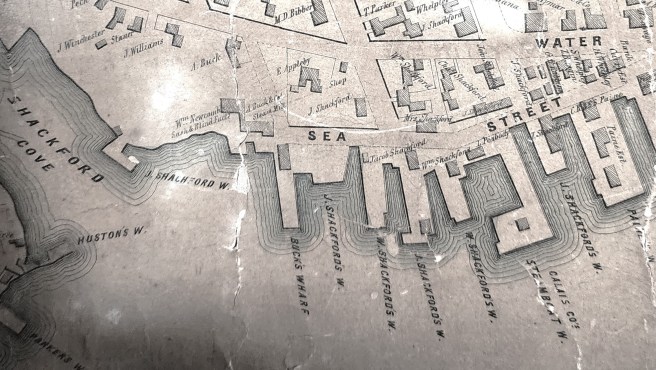
The 1855 Eastport map, produced shortly after Samuel had relocated to Chicago, illustrates how much the family had flourished. At least 13 buildings are labeled Shackford — most of them along Water and Sea Street just below our house. Many of the latter were likely warehouses and offices related to the six Shackford wharves and piers flanking the Calais Co.’s Steamboat Wharf, at the time owned by John junior.

The 1850 Census had eight Shackford households in Eastport. The 1860 Census had ten. And soon there were none.

So much for the Shackfords who grew up in the house we now own and their descendants.

Now for a touch of scandal in the family

The house at the corner of Water and Key streets came into the ownership of Jacob’s nephew, John Lincoln Shackford, who had married Elizabeth S. Clark in 1838 and, following the occupation of his father and siblings, became a mariner.

In 1847 Captain John Lincoln Shackford he was advertising freight and passage aboard the brig Carryl, traveling for Saint Marks and Newport and from Pennsylvania to the Isle of Lobos and Havana.  He also was reported as rescuing members of the crew of the bark Cambria and conveying them back to New York.

The 1850 Census recorded him living in Eastport with his parents, his wife Elizabeth, and three children. In 1860, they were with her parents and two children, presumably while he was at sea. Shortly after that, the family moved to New York, where he was recorded in Brooklyn at 111 Adelphi.  In 1863 he was listed on the Brooklyn Civil War draft registration, and in 1864, he was at Hamilton north of Fulton Avenue.

Among their children was Abby, who died at age seven in Cuba — suggesting that Elizabeth and the children had accompanied him on his voyages as a captain — and her twin Esther, who died in Brooklyn at 21, and sister Fanny, who died as an infant.

Shortly before February 1871, John’s wife returned to Eastport, where she filed for divorce, dower, and alimony, asking for all right title and interest in any and all real estate he had in the County of Washington, Maine. Before the case was settled, he died, December 20, in the Virgin Islands.

As the case was submitted, “To the Honorable the Justices of the Supreme Judicial Court next to be Holden at Calais, within and for the County of Washington in said state on the fourth Tuesday of April AD 1871.

“Elizabeth S. Shackford of Eastport in said County, respectfully represents that she was married to John L. Shackford now of St. Thomas, at Eastport in said County on the tenth day of December AD 1838 and had by him two children now living to wit; Joshua C. Shackford & Regina T. Shackford. That after her said marriage she cohabits with said Shackford in said State of Maine, and always conducted herself as a true and faithful wife.

“That the said John L Shackford unmindful of his marriage vows and covenants, and the duty affection and respect he owed her, deserted her more than three years ago, and has not supported her for the last three years.

“That he has been living with another woman to your Libelland Unknown in St. Thomas.

“That he has been married to said woman as he has declared in letters to others.

“That he has a daughter by said woman and committed adultery with said woman.

“Wherefore, because a divorce from her said bonds of matrimony would be reasonable and proper, conducive to domestic harmony and consistent with the peace and morality of society, she humbly prays your Honors such divorce accordingly …”

Additional documents listed John L. Shackford’s estate value at five thousand dollars (the number is crossed out and rewritten).  The court ordered payment to Elizabeth and ensured that the United States Consul to St. Thomas delivered a copy of the document to John L. Shackford (misspelled Schackford on the document).  The court then allowed Elizabeth to sell land to include property at the corner of Water and Key streets (formerly Greenwich Street), land on the northerly side of Shackford’s Cove, along with other property valued at $1,471.02.

Curiously, widow Elizabeth returned to New York, where she died in 1882.

The Eastport Sentinel reported, October 2, 1889, “Mr. T.M. Bibber moved last week from the Shackford house at the corner of Water and Key Streets to the Chapman house on Boynton St.” The Bibber connection may have been thicker than I’ve uncovered so far.

Obviously, Shackford descendants were ranging far from Eastport, never to return.

Jacob Shackford’s line

Captain John senior and Esther’s son Jacob commanded the steam brig New York, the first steam vessel to enter the harbor of Eastport.

He followed the sea up to 1832, when he and his brother established W.& J. Shackford & Company. Independently, Jacob did build ships, including four brigs in a few years in the 1850s. One of them was noted for riding out the devastating gale of 1854. He also dealt in real estate, as his running advertisements in the Eastport Sentinel of 1865 illustrate: “House lots on Shackford and Water streets. Also two lots. For sale on reasonable terms by Jacob Shackford.”

Jacob’s son, shipmaster George, died August 1, 1863, age 39, during the Civil War. I’m left wondering whether his death resulted from civilian or military seafaring.

Jacob’s son William did serve, from 1863 to 1865, aboard the USS Home, USS Winona, and USS Nahant.  In 1870 his residence was in Eastport; in 1880, Philadelphia; and 1890, New York, reflecting a successful shipmaster’s social mobility. His summer vacations at Cape May, New Jersey made the society pages of newspapers.  The August 2, 1897, New York Tribune reported the arrival of Mrs. William Shackford and Miss Carrie N. Shackford. An August 29, 1897, article in the Philadelphia Inquirer noted that Captain William Shackford joined his wife at the Congress Hotel to recover from “an attack of isthmus fever to regain his health.”

Back in Eastport, as Weston noted that Captain Jacob Shackford’s will, written on September 2, 1868, named his beloved wife Elisa D., his homestead on the corner of Water and Key Streets, a daughter Eliza A. Shackford, a son William Shackford, and another daughter Matilda, the wife of Charles B. Paine. It also left part of the estate to his son Henry Nevis Shackford, if known to be living at the death of his wife [Eliza]. Henry had left on a ship and never returned.

Son-in-law, C.B. Paine, husband of Matilda, had constructed the home on the corner of Water and Third streets, across from us, in 1841.

Jacob died June 19, 1869, age 79.

Over time, Jacob’s house at 4 Key Street grew from a federal style house and narrowly averted the devastating 1886 downtown fire. At some point, at his wife’s urging, the structure was turned 90 degrees, from facing the waterfront, to its present orientation, facing north, and drastically restyled.

When Eliza died on February 17, 1879, age 85, she was no longer residing in the house, as far as I can tell.

Remember, Jacob grew up in the house we now own.

As for William Shackford’s line

The second son of John senior and Esther was William, who “went to sea as a boy and continued to be a sailor all his life,” as the family said. Or maybe not quite that long. He did retire to land, as you’ll see. “He commanded the Active in 1807 and was subsequently master of the Sally, Orient, Blockade, and Five Brothers, ships largely concerned in the West Indian trade.” Naming the Blockade, by the way, sounds like an act of defiance, don’t you think? And Sally would have been a nickname for his first wife.

As a sea captain, he frequently ventured far from Eastport. As we’ve previously mentioned, at age 29 he was captured by French pirates off the coast of Spain, eventually ransomed, and made it back to Maine just before the British blockaded the American Atlantic coast during the War of 1812.

As related in another account, “He was in command of the brig Dawn when that American ship was captured by a French cruiser during the war with the French in the time of Napoleon I. He was carried to France, and upon being relieved at the instance of the American minister, he went to England and came before the mast as an ordinary seaman. He next commanded the Lady Sherbrooke and then the Sarah. His last vessel was the Splendid, a fine packet engaged in the freight and passenger traffic between Eastport, Portland, and Boston. He retired from sea service in 1833 and engaged in mercantile pursuits with his brother, Jacob.” More specifically, the firm was W. & J. Shackford & Company, merchants, shipbuilders, and fishermen. Lorenzo Sabine was a partner briefly enough to explain the “and company.”

The retirement from sea service came around the same time the Shackford siblings surveyed their shared land holdings and began dividing it. There was much wheeling and dealing among the siblings and their nephews and nieces in the years that followed. Between 1840 and 1849, for instance, William sold or transferred or traded 33 parcels, including six to his brother Jacob.

William’s home at 10 Shackford Street is one block up and a block over from ours. Like others in the neighborhood, it was remodeled as styles changed. Parts of the structure may date to the early 1800s, while the front part of the house has the symmetry and simple lines common in area homes in the 1830s and ’40s. Much later (after his death) the home was updated with Queen Ann period details popular in the late 1800s. A close look at the structure reveals later additions such as the modest tower (which would have had a practical purpose, offering views of the harbor) and a decorative porch, for the summer breezes off the sea, I’ll venture — or even watching the daily parade up and down the street.

So much for the real estate pitch. Today, Joe and Mary Clabby have overseen its marvelous restoration.

Three of William’s four sons went on to become sea captains.

John William Shackford for many years commanded the steam packet ship Illinois and other ocean steamships and was then master of Jay Gould’s famous steam yacht Atalanta. (It has its own Wikipedia entry.) He died in Philadelphia in 1905.

Edward Wallace Shackford graduated from the Eastport high school, learned the trade of block and spar making at Machiasport, and then shipped on a vessel trading with the West Indies as ordinary seaman. His second voyage was on a ship that made the hazardous journey to the Pacific coast of the United States by way of Cape Horn, South America, reaching San Francisco in 1860, and sailed as far north as Puget Sound, where he passed the year 1861-62, and returned to Maine by the same route, reaching home in 1864. His next voyage was before the mast, first mate and captain of the brig Emily Fisher, commanding the brig in 1866. His next sea experience was on a steamer on the American line between Philadelphia and Liverpool, England, in the capacity of second officer, and he made four voyages on the steamships. He commanded a bark after leaving the steamship, and in 1887 resigned the command of the bark Ormus to assume a like position on the steam yacht Atalanta, owned by the aforesaid Jay Gould, on a voyage to the Mediterranean — was William introduced by his brother? He was captain of the schooner Johannah Swan, built by Albert M. Nash at his shipyards in Harrington, Maine, from 1889 up to the time the schooner was wrecked in the terrible gale of November 1898, in which gale the steamer City of Portland was lost with all on board and scarce a vestige of the vessel was ever found. William’s wrecked schooner, however, withstood the gale for seven days, when Shackford and his crew were rescued by the German bark Anna. On his arrival home, which was no longer Eastport, Shackford abandoned the life of a sailor and retired from active participation in business life.

All of this reflects the realities of sea life in a changing era.

Edward Wallace Shackford established a winter home at Harrington, Maine, and a summer home that was a “comfortable cottage by the sea,” at Point Ripley, “which has proved so delightful a summer retreat to seekers for an ideal seaside rest.”

He also found congenial spirits at the periodical meetings of Eastern Lodge, No. 7, Free and Accepted Masons, of Eastport; Dirigo Chapter, Royal Arch Masons of Cherryfield; and Tomah Tribe, No. 67, Improved Order of Red Men, of Harrington, Maine. He was elected a member and chairman of the Harrington Republican town committee. He was chairman of the Harrington school board for three years, represented his district in the house of representatives of the state of Maine in 1903-04, and was a member of the senate of the state of Maine 1905-1906. He was president of the Ripley Land Company of Maine from its organization and attended the Baptist church, where his wife was a member.

And that was essentially the end of the Shackford influence in eastern Maine.