I like having my wife working from home.
(As long as I can stay out of the camera every time I dash past to refill my mug.)
You never know what we'll churn up in cleaning a stall
I like having my wife working from home.
(As long as I can stay out of the camera every time I dash past to refill my mug.)

The Swedish retailer of low-cost home furnishings, appliances, cookware, and the like is a magnet for folks trying to make the most of tight spaces like apartments. Say a challenge like a 400-square-foot apartment.
Even if you have an old five-bedroom home like ours, the interiors can be challenging. IKEA has frequently come to our rescue. Yes, some assembly is usually required, and I can attest it’s not always idiot proof, but overall, we’ve been pleased with the results.
The closest IKEA superstore to us is located south of Boston, and since deliveries aren’t cheap, it’s worth the four-hour round-trip, even if you get lost inside once you’re there, as I have. The cafeteria, by the way, is quite the bargain.
Are you one of those intrigued by the small-scale living space displays in the IKEA superstores?
What’s your experience been?


So here we are, spending too much time online digging for the latest in the Covid-19 deluge. I know I’m not alone there. The mere fact that so many sources for updated reports from around the globe are available only a few keystrokes away feeds our obsessive googling and scrolling – for many, a morbid fascination, for sure.
Having pretty much self-quarantined (in part at my wife’s nudging), I’ve been trying to continue generally as much life-as-usual as possible, which you’ve seen reflected in the posts here at the Red Barn. Admittedly, my life since retiring from the newsroom and turning my attention fulltime to a writer’s discipline has meant generally limited face-to-face social interaction anyway, but even I’m getting a bit antsy without my Quaker gatherings or daily swims at the city’s indoor pool or even dashes to the bank or grocery.
Still, I sympathize with those who have never undergone a discipline of doing without – as in fasting, leaving electronics behind for a backpacking or camping expedition, or even enduring an extended power outage. (As for the toilet paper, don’t get me going. That’s truly a First World problem!)
So while I’m treating these restrictions as an opportunity for reflection and renewal, here are ten things to make the best of it. And remember, if you’re sharing this hunkering down with a mate and/or children, try these together.
Here’s hoping you and yours aren’t showing any virus symptoms.
~*~
What would you suggest adding? What are you discovering … or rediscovering?
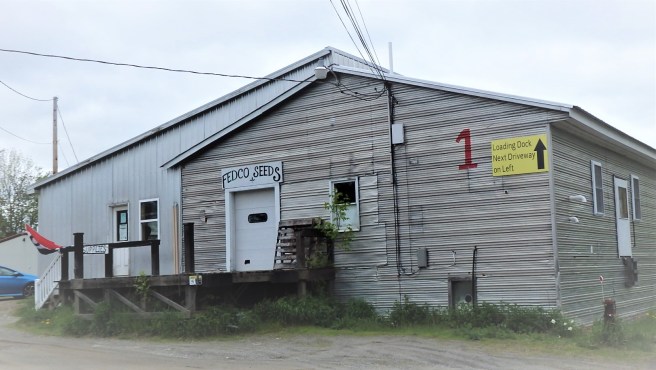
It doesn’t look like much, this former chicken barn at 688 Bellsqueeze Road up in Clinton, Maine, but it and a larger shed behind it are the operations center for Fedco Seeds, a seed and garden supply co-op geared toward the Northern New England climate. (I had to get that name in, Bellsqueeze, it’s a real, longstanding country road.) Members vouch for its high quality, low prices, and range of selections.
Let me tell you, for most of the American public, wine has really improved in the past fifty years. Most of what was available back then, except for snobs and wealthy insiders, was pretty nasty. Thankfully, that’s changed. Yes, definitely.
As for those snobs? The typical Trader Joe’s makes some good stuff truly affordable, just for starters.
Here are ten we like, with the caveat they can vary widely in quality from label to label and season to season.
And, for the record, we prefer dry rather than sweet.
~*~
If you notice, there’s no chardonnay on this list. Too much oak, my wife insists, adding if she wanted that, she’d just bite the table.
~*~
What would you add to the list?


