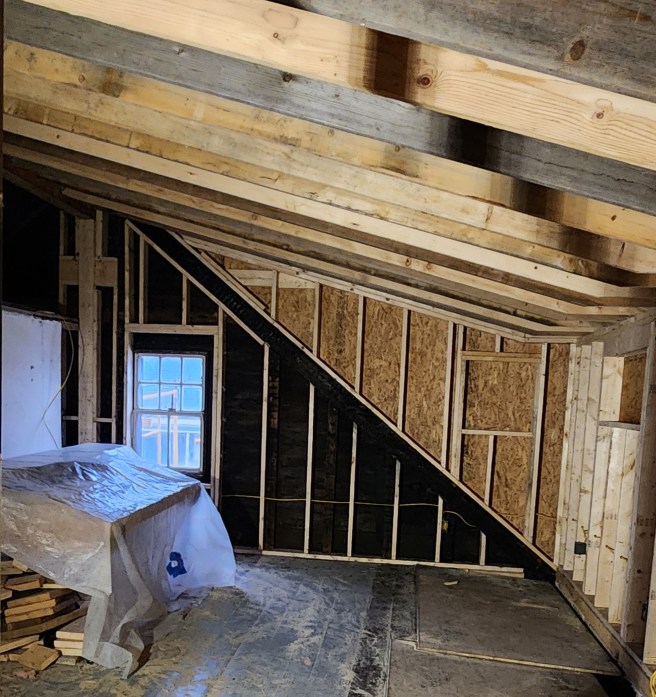
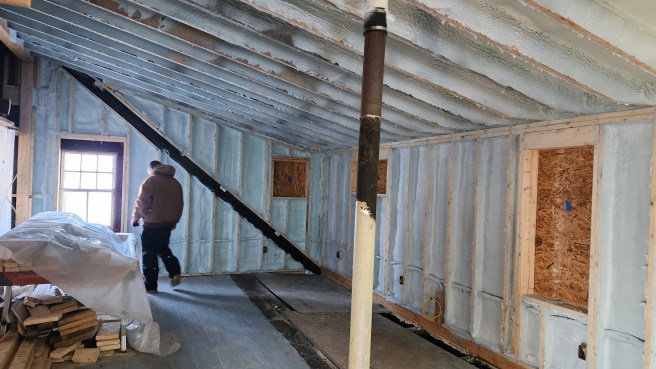
So far, no lipstick. And then? Zip, zip, zip!

After a week or more of finetuning the ridgepole and columns, Adam was ready for more drama. It was time for the old roof and rafters to go.

By now, much of the time the work was mostly loud reverberations punctuated by pounding and thuds within the top half of our house. Most of it mystified me. It often sounded like a war zone, especially when the air compressor kicked in. Not that I’m complaining.

Here we were, six weeks and thousands of dollars later and nothing we’d done was of the sort that would appear on a flip-this-house kind of a video streaming channel – the superficial changes that one local inspector we know dismisses as “lipstick.”

You do have to love an old house. Or, for perspective, an old lover.

Now we faced the decisive moment. Off with the back half of our upstairs!

A large, “rolling” dumpster was in place.

That saw appeared like the fin on a shark.

And then the roofing was removed in panels.

We got an idea of what a deck up there would be like.

The dumpster quickly filled.


Our home’s new backbone was surgically inserted

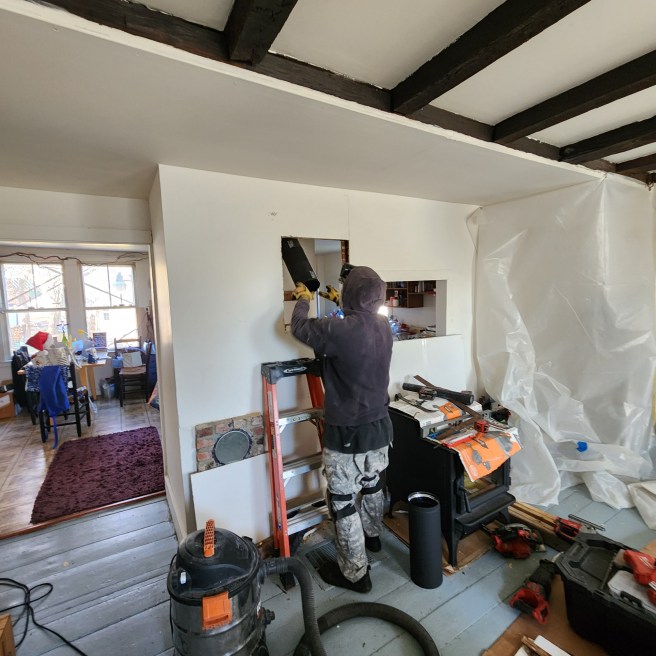
The last Saturday in October arrived clear and cool. We were now officially a month into the project, and Adam showed up with a crew of three for the dramatic operation of inserting a ridgepole. It was rather like laparoscopy, if you want to consider the small incision he made near the top of a street-facing gable.

Here’s how it went.

There was also the column to insert.


There was no anesthesia.

What makes a place ‘home’ for you?

One of the big themes running through my novel What’s Left was that “family” can mean so many different things to so many different people.

Maybe it’s all the renovations going on in our old house, but recently I’ve been pondering many varied understandings of the word “home,” too.

For starters, sampling of what others have said, a home is:

  1. “Where one starts from.” (T.S. Eliot)
  2. “Where we should feel secure and comfortable.” (Catherine Pulsifer)
  3. “A shelter from storms – all sorts of storms.” (William J. Bennett)
  4. “Where there’s one to love us.” (Charles Swain)
  5. “Any four walls that enclose the right person.” (Helen Rowland)
  6. “Where my habits have a habitat.” (Fiona Apple)
  7. “Not where you live but where they understand you.” (Christian Morgenstern)
  8. “A place that gives you unconditional love, happiness, and comfort. It may be a place where you can bury your sorrows, store your belongings, or welcome your friends. A happy home doesn’t require the trappings of opulence.” (Simran Kuhrana)
  9. “A machine for living in.” (Le Corbusier)
  10. “The place where, when you have to go there, they have to take you in.” (Robert Frost)

Is it even a place at all?

Cecilia Ahern insists it’s a feeling. Lemony Snicket pegs that as homesick, “even if you have a new home that has nicer wallpaper and a more efficient dishwasher than the home in which you grew up.” Maya Angelou relates it to an ache “in all of us, the safe place we can go as we are and not be questioned.” For John Ed Pearce, it’s a state of  mind, somewhere “you grow up wanting to leave, and grow old wanting to get back to.” Edward Sharpe senses home as his beloved’s presence, “Wherever I’m with you.” Edie Falco connects it family when he returns to them from his paying job and realizes they make his labors “richer, easier and more fun.” For May Sarton, it must have “one warm, comfy chair” as the line between being “soulless.”

As for a big hole in the middle of our house

While waiting three years for our big renovations to transpire, I often joked that living here was like camping. I won’t go into the list now, but I did accept defects that could have greatly raised my blood pressure if they weren’t already on the to-be-addressed list.

I could even go into the pro-gentrification argument that if big repairs weren’t being undertaken, these dwellings were well on their way to collapse.

Our renovation, daunting as it is, remains a minor effort compared to a few others in town, including true mansions being brought back from the brink. One is a fussy restoration project to keep the place as close to historic accuracy as possible, apart from wiring and a kitchen upgrade. Another is to improve its Victorian social showcase qualities.

I’m also finally understanding why so many old houses out in the surrounding countryside have been left to fall in. They simply weren’t worth the cost of upgrading, not when you could build newer, better, even closer to the world for less.

One of the annoyances we had tolerated was the big cavity where the second chimney had stood – the one that was about to collapse when we bid on the house.

We had passed on an offer to rebuild the brickwork, no matter how charming a working fireplace would have been. The chimney would have limited our remodeling options on the second floor, or so I argued, and without it, we do have a 2½-by-5-foot space to develop into a closet or something on the main floor. Patching the floor itself would be a huge improvement, as well, rather than having a light covering that couldn’t bear weight.

The cavity now provided a place where that 28-foot-long LVL column could run down through the house, as well as some new electrical wiring.

And, during a later break, Adam even fixed the holes.

Yes, step by step, it was all coming together.

At last, getting set for the big magic trick

Three weeks into the project, I noted my wonder at how quickly the work was going.

The back half of the upstairs interior was now exposed, giving us a sense of how much flooring and headspace we would be gaining. And we could see all of the rafters. Unobstructed? Adam had set up an impressive indoor workshop on the back half of the second floor, while the front two rooms clustered many of our possessions, now under plastic.

That said, I also noted my concern at how slowly the work was going.

The old roof over the back half of the house was still in place, and the clock was ticking down toward winter.

What dawned on me as I gazed up toward to the peak of the rafters was that the ones from the back – which were about to disappear – secured the ones at the front of the house, the half of the roof that would have to stay well in place into late spring or early summer. A few of those charred rafters would actually be remaining like forever, a nod to history and all that.

In a flash, the urgency of the new laminated ridge pole and supporting columns made sense. Without them, the whole roof would come crashing down and, in turn, there would be nothing to hold up the new one. One earlier contractor’s proposal for premade trusses to create a gambrel roof on both sides now became comprehendible – so that’s what he meant? We weren’t exactly communicating, and his results wouldn’t have been our first choice. As we were hearing, not every carpenter today knows how to frame a roof from scratch.

~*~

The key to achieving this was a recommended custom-made laminated veneer lumber ridge pole running the length of the house. Or more accurately, three pieces that would be joined together once they were inside and raised into position. Each one was 1¾-by-14-inches by 40-feet and weighed 280 pounds.

In addition, another custom-made LVL 3½-by-3½-inches by 26-feet was delivered for the remaining supporting column. That one would run down the cavity where our second chimney had been, the bricks that had been on the verge of collapse when we bought the place.

~*~

The new ridge pole would have to slip in where the rafters from each side were now overlapping. What would hold them up as he sawed them asunder? The answer was temporary framing underneath.

We were really, really glad Adam knew what he was doing, though we suspect he was losing some sleep over it. We do know he was doing his research and some thorough calculations.

had

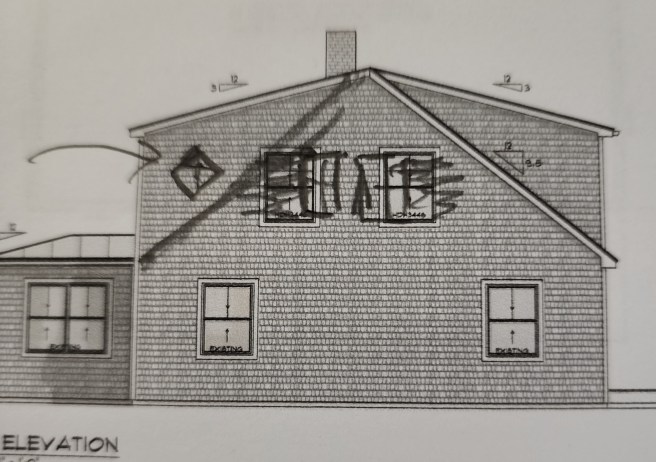
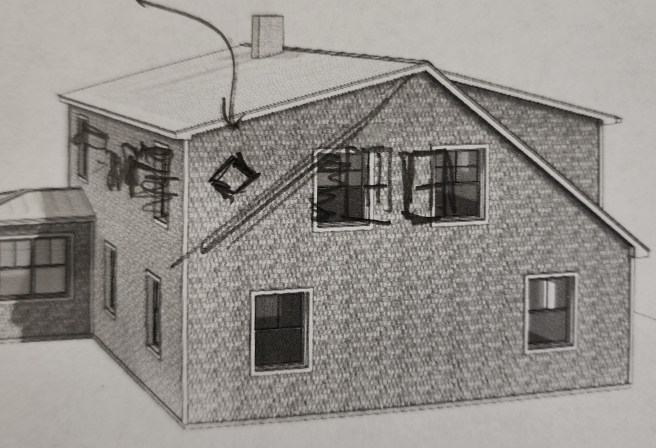
The electrical line coming into our house had to be moved to one side of the gable to allow for the ridge pole to come into the house. That meant getting the utility to come out for a free service.

Inside, our contractor was making cuts accurate to one-sixteenth of an inch. Sometimes the beam below, cut in the early 19th century, varied by a half-inch within the length of the two-by-sixes they would be supporting.

We were beginning to appreciate the fact that Adam was our contractor and not just our carpenter/electrician. He was making the arrangements and phone calls. Viking Lumber was making nearly daily deliveries from Machias.

After working largely solo, he lined up a crew to manage the pieces into the upstairs floor and then higher once inside. There was also the matter of a rented lift, positioned outside.

A lot of coordination had to come into place, even before discovering the power line coming into the house needed to be moved. Hello, Versant?

He had additionally expertly erected scaffolding by himself.

At that point, it really felt like this was happening.

So here we were, Week Four, the end of October, and the laminates were arriving – all four pieces. Well, make that five – Hammond Lumber had ordered a wrong size for the column and had to rush the corrected order down to our site.

Preparing to reframe the top of our house while we still lived below

This was turning into a more serious project than simply raising the roof.

Had we merely replaced the covering itself – either with asphalt shingles or upgrading to metal – without expanding our usable floor space on the second floor, we would have been glossing over serious structural issues. It’s a miracle the roof held as long as it did. One insurance company had cancelled our homeowner’s policy when it saw the photos of the roofing, and another insisted on a replacement within a year. That route would have been a very expensive band-aid in the end.

We had a dream of making better use of that space, as you’ll see. And now, after three years, we finally had someone to pull the project off.

As a starter. Adam needed to address some serious structural issues.

Was anything holding our roof up? It may seem strange to find that concern intensifying as we set out to remove it and its rafters, but we would need something to keep half of it up while the other half got ripped away. As an additional complication, we’d be living in the house rather than gutting it and starting over.

The absence of a ridge pole meant there would be nothing to hold up the front half of the roof when the back half came away for the new. Its lack also meant the existing ridge wasn’t straight but rather serpentine.

Adam had to make room for a ridge pole between the existing rafters. It was tedious and required some precise calculations.

Structurally, all the weight of the roof for nearly 200 years was directed outwardly to the walls – and, as he was finding, they weren’t exactly perpendicular.

Now he needed to have something to support the weight of the ridge pole and roof, too. That meant constructing four columns from the crown of the roof down to the cellar – one on each end of the house, the other two spaced in-between. That required going through two floors as well, plus building concrete pads in the cellar.

This was time-consuming work, and he was racing winter weather. We had reason for concern.

As these findings sank in, we realized our earlier option of just putting new shingles on the existing slope would have done nothing for real issues lingering underneath. Even without raising the back wall or consolidating the dormers in front, we would have had a larger problem waiting to erupt overhead. Living beside the ocean exposes us to many gale-force blasts. It’s a wonder the roof hadn’t gone years ago.

After taking some deep breaths, we appreciated what our contractor was telling us. Now, just exactly where was the center of the roof or the alignment down under? He did have some amazing laser tools to determine that.

We were really glad Adam was a pro, maybe more than the others working in town. He was definitely earning our trust and respect.

Mysteries were lurking behind the walls and above the ceiling

When Adam set about ripping out the drywall upstairs – and immediately filling his first dumpster in the process – the emerging picture soon presented a number of challenging hurdles. I’ve mentioned the lack of a ridge pole and matters regarding rafters, plus the wiring situation. This wasn’t going to be nearly as straightforward a project as I hoped.

The dumpster, by the way, was a new step for me. Back in New Hampshire, our carpenter hauled the debris to the transfer station in his pickup – or I burned what I could in the side yard. We even used a lot of the ripped-out sheetrock and plaster to “sweeten” our garden pH. How much would the alternative cost us, anyway?

I’ll say it was a bargain, especially considering the time that would be lost if Adam were driving that to the trash transfer station an hour away.

Adam’s selective demolition led to a small collections of old wallpaper examples. Meanwhile, a hippie-dippy yellow crab painted under some of the later wallpaper, alas, couldn’t be preserved, not that I quite wanted that. Mine was the minority vote. Still, we’d love to know the story of its creator – a kid? – and its inspiration.

More puzzling were the broken bricks in the walls and joists away from the chimneys. Huh?

Or, more impressive, finding some of the exterior sheathing is more than 18 inches wide. Try buying that today.

The fire damage was more extensive than we had imagined. Not just the historic downtown fire of 1886, charring our rafters but not setting them ablaze, but also a later chimney fire that charred the insulation off electrical wiring that we were still using.

What if the char damage on the beams and rafters wasn’t superficial but went deeper into what we assumed was still solid wood? (We were relieved to find out just how much good lumber remained inside.)

We’re left wondering. Did a fire originate in one of two wings once attached to the house and then spread to the roof? Sounds like an archaeology problem to tackle sometime ahead.

In addition, earlier carpenters here didn’t seem to do much measuring. I had to ask Adam, “So how does it feel to be correcting 200-year-old work?”

He gave me a look.

As I said, Adam set to work with determination and within a day filled the first dumpster.

Beyond the fire damage, he uncovered more knob-and-tube wiring to contend with than we had wished.

But to our surprise, Adam is not only a master carpenter but also a licensed electrician. This was sounding too good to be true.