THAT LONGSTANDING TENUOUS SEAM IN THE GOP

For as long as I can remember, the Republican Party has had two wings that fit uneasily together – one essentially ideological, claiming a conservative label; the other, more pragmatic, meaning liberal. Think Taft versus Eisenhower. Even so, this was still the party of Lincoln, one way or the other.

And then, when the Southern Strategy landed Nixon in the White House, everything shifted. In the ensuing tilt, few pragmatists are left, and none of them would claim a liberal streak.

What now exists is an uneasy alliance of a core of the rich Wall Street contributors and the Tea Party-related corps of voters whose numbers have kept the GOP in office. (Yes, I know the Wall Street label isn’t quite accurate either, knowing how many of the biggest contributors live in Texas.) As the insightful book What’s Wrong With Kansas wonders, this has often meant electing officials whose policies and beliefs hurt the constituents’ own best interests. It’s been big money, in the end, over middle-class working families and voters.

What’s interesting at the moment is the way Donald Trump has taken control of the presidential primary away from the Wall Street establishment and is playing directly to the street-level party members. In the September 24 New York Review of Books, Michael Tomasky denotes two elements the party has been relying on – cultural and racial resentment, combined with spectacle – “the unrelenting push toward a rhetorical style over ever more gladiatorial and ever more outraged …” Or, as he says, “There is a strong tendency, perfected over the years by Fox News, to cover and discuss domestic politics as a combination of war, sport, and entertainment all at once.”

Voila! We have the Donald, who hails from a rival television network – something that has to add to the fury Fox is feeling. (Well, he has turned some of that back on Fox News itself in refusing to be interviewed … which leads to a whole other discussion.)

I’ve long wondered what it would take to split the Republican Party the way, say, abortion rights have weakened the Democrats. Maybe it won’t come down to a particular issue so much as a feeling of betrayal when it comes to a livable income for average American households – which now require two wage-earners, rather than just one as it did when I was growing up. The focus of the war-and-sport outlook just might turn in entertaining ways nobody would have predicted six months ago. Maybe we’ll actually get serious in the aftermath and consider solutions to some very real problems.

Or maybe a long simmering realignment might happen for the parties themselves.
WILL IT BE JEB AFTERALL?

Anyone else fascinated by the post mortems following the collapse of Scott Walker’s presidential campaign Monday? Each one seems to be bringing another facet to light on what was supposed to be one of the leading candidates.

From a newsroom perspective, writing the headlines could have been fun, playing with the surname:

Walker
quits
race

or

Walker
ends
run

for instance, except that officially he’s only suspended his campaign – the technical difference meaning he can still accept financial contributions. So maybe it’s more

End of the road for Walker.

One of the telling strands for me is that the Wisconsin governor spent most of his campaign chest building a national organization rather than concentrating on the face-to-face opportunities of the first-round states. I haven’t heard much about the traditional New Hampshire living room presentations by White House hopefuls so far this round, and after last weekend’s Michigan straw poll, in which the winners were all folks who showed up, unlike the so-called frontrunners, let me return to the importance of building a following one voter at a time rather than by flooding the airwaves with ads.

In other words, this Walker didn’t lose much shoe leather walking from household to household making himself a household name around here. Or, apparently, in Iowa, which borders on his own Wisconsin.

From a campaign finance point of view, it costs peanuts to rent a motel room and move about, if you’re serious about running. Or, for the more committed, renting an apartment.

The national stories, as you may have seen, are raising detailed questions about his integrity, spending, organization, preparation, demeanor, inner character, inability to lead, and so on. One that I’d add spins off from his assertions that God had called him to run – a claim supported by his pastor. From my perspective, that just might violate the Fourth Commandment, taking the name of the LORD in vain. As the New Jerusalem Bible translates the text (Exodus 20:7), “You shall not misuse the name of Yahweh your God, for Yahweh will not leave unpunished anyone who misuses his name.” (Name meaning power, rather than a word alone.) Admittedly, nobody really expects humility from a campaigner, no matter how much the faithful are supposed to practice it. Still! A dose of it wouldn’t hurt.

Some other interesting examinations are focusing on the failure of big money, meaning the super PACs, to deliver public support thus far in the race. Well, it’s still early. Just wait.

~*~

The other hot development involves the GOP’s two leading candidates at the moment. Surely the Donald didn’t expect to get through this unscathed, did he? Carly Fiorina’s getting traction in her attacks on him, but it comes at a price. As a Washington Post headline put it today: “Trump’s sexism vs. Fiorina’s dishonesty.” A Slate headline, meanwhile, crowed her “days as GOP star are numbered.”

This fight could be riveting, especially if it drags out or others jump in. Want to talk about entertainment value and combative style?

~*~

While things are still relatively quiet here in the Granite State, it does have some of us wondering. Jeb Bush seems to be managing his funds prudently, has significant Establishment connections, and is still plodding away. Is it possible he might be the last man standing when it comes time for the nomination? Or are there other twists in the plot ahead? Someone, say, meeting folks where they live?

WHERE ARE THE SIGNS OF SUPPORT?

As the presidential gears up here in New Hampshire before the primary, along with the Iowa caucuses, I’m looking at something other than survey numbers. How about some evidence of real energy around a candidate?

On the Republican side, for all of the Donald’s flutter, I’ve seen only one property with Trump signs on the lawn. Just one. And, for that matter, not a single bumper sticker. Does he even have them? As for the others in the race? I’m waiting. (If I didn’t have a schedule conflict a few nights ago, I’d have attended the Donald’s appearance just up the road – but a rally’s not the same as a meet-and-greet, question-and-answer session where we get to size up a candidate. It’s only a special guest appearance.)

Where I do see the grassroots energy is almost entirely with Bernie. Bumper stickers, lawn signs, lapel pins, face-to-face events, canvassers ringing doorbells. All combined with a smoothly functioning organization. At the moment, his camp feels like a party, in fact. Along with the oft-repeated quip, “He’s the one who’s really telling it like it is.”

GLEANING THE MEMORIES

As I said at the time …

From those last surviving aunts, piece together what you can from what memories, photos, and documents you can collect. Maternal sides, especially, can fade from sight, even within the recent past. These personal histories can be far more revealing than those of public figures we usually hear. Especially important is recording the negative findings, as well as the positive.

Look, too, for medical markers. The depression, for example, could arise in genetics or social patterning. For what it’s worth, I suspect there’s a strand of it in my Dunker ancestry. The Hodgson/Hodson/Hodgin males, meanwhile, seem to die largely of heart diseases, probably a consequence of a high cholesterol North Carolina-style diet.

The past lives on, one way or another. It helps to discern its presence in defining your own values and actions.

UNTANGLING THE ROOTS AND THEIR RICHES

As I said at the time …

Your memories of your father’s side of your family are vital. His parting ways, in effect, holds G-d to account for its half of the Covenant in the face of the pogrom.

Fair enough. And it’s a history that must never be forgotten.

After Dad’s funeral, I spent a lot of time in a similar project with his “baby sister” and one of their first cousins as a consequence of a mention, “You know your grandpa’s slogan was ‘Dayton’s Leading Republican Plumber.’ It was on all of his advertising and even the trucks.” I didn’t remember that, but added to what she saw as my grandparents’ hypocrisy, along with their entire church circle, I had something to start with; even though I’d spent a lot of time with them, I never really felt I knew them – it was mostly through my mother’s rather resentful eyes. Up to this point, my genealogy research had leapt over them to get to the roots they rejected. Now there’s (one more) book-length manuscript, probably my one with the most commercial potential, at that. One of the things that intrigues me is the number of times each of us remembers an event or issue differently, or not at all. My advice? Rather than aiming for consistency in the narrative, embrace the variations. Thicken the plot and the possibilities. You’ll rarely know for certain, anyway. Sometimes more details make everything more mysterious. For instance, my aunt finally found the picture of all the trucks and sent me a copy. There was no slogan, though I do have a greeting card where he includes it. Come to think of it, this would have been Grandpa and Grandma’s anniversary – yes, they were married on Lincoln’s birthday, in Uncle Leroy and Aunt Anna’s parlor (I have the photo). Talk about Republican?

At the other end of the string, I found someone online whose explanations took my Hodgson line back across northern Ireland to a still-remote corner of northwest England around 1530. More writing to clean up and eventually submit!

Considering that growing up, I had really no sense of roots or cultural identity, and only much later discovered how much of my ancestry had been in radical religious practices – Quaker and Dunker (a.k.a., German Baptist Brethren and then Church of the Brethren) – has been a real mind-blower. Even though all of my dad’s lines were here before the American Revolution, most of them were pacifists, meaning there are only two ancestors whose actions would allow my sister to join the DAR, if she desired (fortunately, the answer’s no). On Mom’s side, though, there was an aunt who wanted to join, but the lines all get too blurry going across Kentucky – where a number of them were slave-owners, nasty and small-mined people, from the fragments I see.

Obviously, Dad’s side, up to his parents, is what I identify with and cherish. When you speak of the difficulty most people have with understanding the matter of continuing to be Jewish while being, as the term goes, nonobservant, I can point to similar strands on both the Quaker and Dunker sides – essentially, a culture rather than the faith. In the genealogy and broader history, I’ve been interested in seeing what values an individual keeps or discards after leaving the practice, especially across generations. By the time I reached college, I was essentially agnostic or logical positivist, yet I knew, in my bones, I could not fight in Vietnam – this, without any outward religious support and even though my father had served in World War II. Knowing its depth in my ancestry would have been very comforting and strengthening.

WELCOME TO THE PARTY

Remember the axiom about casinos, “The house always wins”?

Think about that when it comes to the Donald versus the GOP Establishment – the one that’s often seemed to be the House of Rove, Rumsfeld, and Cheney.

It’s a high-stakes game, indeed, and a lot of high rollers and table proprietors are getting really nervous. When do they call in Security? Or who’s about to lose a proverbial shirt or more?

Let’s watch as the adrenaline kick in and the poker faces crack open. It’s been too dull up till now. Let’s see who can put how much on the line …

WITHDRAWAL AND INTEREST

As I wrote at the time …

Remember when all the banks were centralizing? This was bad news for most cities, taking our money someplace else. You could see it in the way they put the screws to us. Overdrawn? Need to talk to a teller about your account? A safe deposit box? Here are our new fees, and they’re going up sharply. Pure economic theory pointing toward monoply. What happens as competition diminishes. Nobody’s explained why this had to happen. The legislators should have known better. They owned too many shares to be disinterested.

The insurance companies, too. When juries began handing out awards that few individuals could afford to pay, the insurance companies must have been gladdened, for it meant none of us could afford to be without their policies. Now, however, none of us can afford their policies, either. And they dare cry out for relief from a problem they encouraged for so long?

Where does that leave us? My auto insurance costs more than the car. Back in Maryland, a friend tried calling her company after it cancelled her auto policy when it refused her check and then, in cahoots with the state bureaucracy, she was being told to return her auto tags; the bastards at the insurance company were all snippy, even the operator; they wouldn’t even return the inquiries of her agent.

Just sign on the line. “But I refuse to swear or affirm. It’s against my religion. See Matthew.”

“Look, don’t make waves. Just sign it, OK?” So they want me to sign something that says I live up to my word, but for me to do that means I have to violate my principles.

My Bible has a story about Goliath …

A ROCK AND THE RIPPLE

Looking back on the passing of Silas (all those years ago, now) also stirs an acknowledgment of a major transition in our Meeting, something that had been in process over recent years as he retreated from the active business of our fellowship, all the while remaining a guiding spirit. Now came the finality and the reality. What’s become apparent in our recollections is that despite our emphasis on equality and the avoidance of hierarchy, some Friends are more dedicated, committed, active, forceful (fill in your own words) in their service than are others. This is a statement of fact, not a value judgment. The two decades I knew Silas, after all, came in his retirement years – which were focused fully on his passionate causes.

Maybe we were also admitting we had no one stepping into his shoes. And maybe, to some extent, that’s a good thing – he was, let’s face it, a character all his own. On the other hand, a lot of tasks in Meeting are left unfilled, to our own loss. How we would address these in the coming years was yet to be revealed.

By coincidence, we had a message a few weeks earlier about the absence of guru-style teachers among Friends. Even so, as I wrote, we encounter a string of teachers in our Quaker practice, each one a unique presence. Among them, we would have to count Silas. A Boston Globe at the time carried a story of another, by then in a nursing home in Washington state, and a violin that he’d begun making in prison during World War II, finally completed by his grandson and a friend. As I started to retell this story of someone I’d last seen more than a quarter-century previously, my younger daughter interrupted me to say she’d heard the report on public radio. With all of these overlapping circles, it can be a small world, indeed, and sometimes rather timeless. Maybe our harmony, too, will be heard, well beyond our imagining.

What I feel now is gratitude for each one in our fellowship, and the gifts we bring together. Wherever we are going in the coming years is not entirely in our own hands, but an opportunity for a revelation in faith. Maybe our being here, itself, was not entirely in our own hands, either. That, coupled with a wondering about our ripples and how far they might carry.

~*~

A wonderful documentary with Silas is now available as an online video. Just click here.

REMEMBERING SILAS

Sometimes an image says everything. I remember sitting on the green at Bowdoin College one afternoon during Yearly Meeting sessions and looking out to see a line of boys marching along the far sidewalk. Four or five, maybe six of them, ages somewhere between eight and 12, and determined with a destination. In tow, perhaps twice their height, was another, hunched forward in his gait, a man obviously grinning to be part of such a mystery – Silas Weeks, of course. Who knows what they had to reveal to him? Only that it must have been important – very important, in ways that remain veiled or part of that precise moment.

The fact that they were leading him, rather than the other way around, says a great deal about trust and openness, in both directions. Even the role of affirmation. Everything so natural and rare.

Silas was one of those “old Quakes” who had managed to become A Character, in the best sense of the meaning. He was already well into retirement by the time I relocated to New Hampshire, and remained a force in Dover Meeting for much of the next two decades, despite his growing deafness. He was one of the handful of Friends who reopened the meetinghouse to weekly worship in the 1950s, after its use had become irregular for several decades, and he faithfully served it in many capacities, including clerk, over the years. That’s not to say he couldn’t be stubborn or cranky, but he did manage to get Friends moving on a project. Thus, his passing at 94, though not unexpectedly, brought a deep sense of loss to the meeting.

“Silas tells funny jokes,” is what Eli Abbott, 13, remembered.

Silas stories were bountiful, within and without the meeting, and there’s no way I could begin to tell them all.

When majoring in community development at the University of New Hampshire, however, one of our friends had Silas for her academic advisor. She remembers being honored to be part of a group of students invited to a social gathering out at the farm, until he announced on their arrival that it was time for potato planting – and then pointed to the spades. For them, it was an awkward situation where nobody could say no freely. The next semester brought another invitation, this time accompanied by the revelation that it was now harvest time for the spuds.

Apparently, there was no ill will. After learning that they shared the same birthday, however many years apart, these two begin meeting for a dinner each year to celebrate together – not always on the exact day, but as close as they could manage – a tradition that spanned three decades. And she still keeps a garden, in response to his lessons.

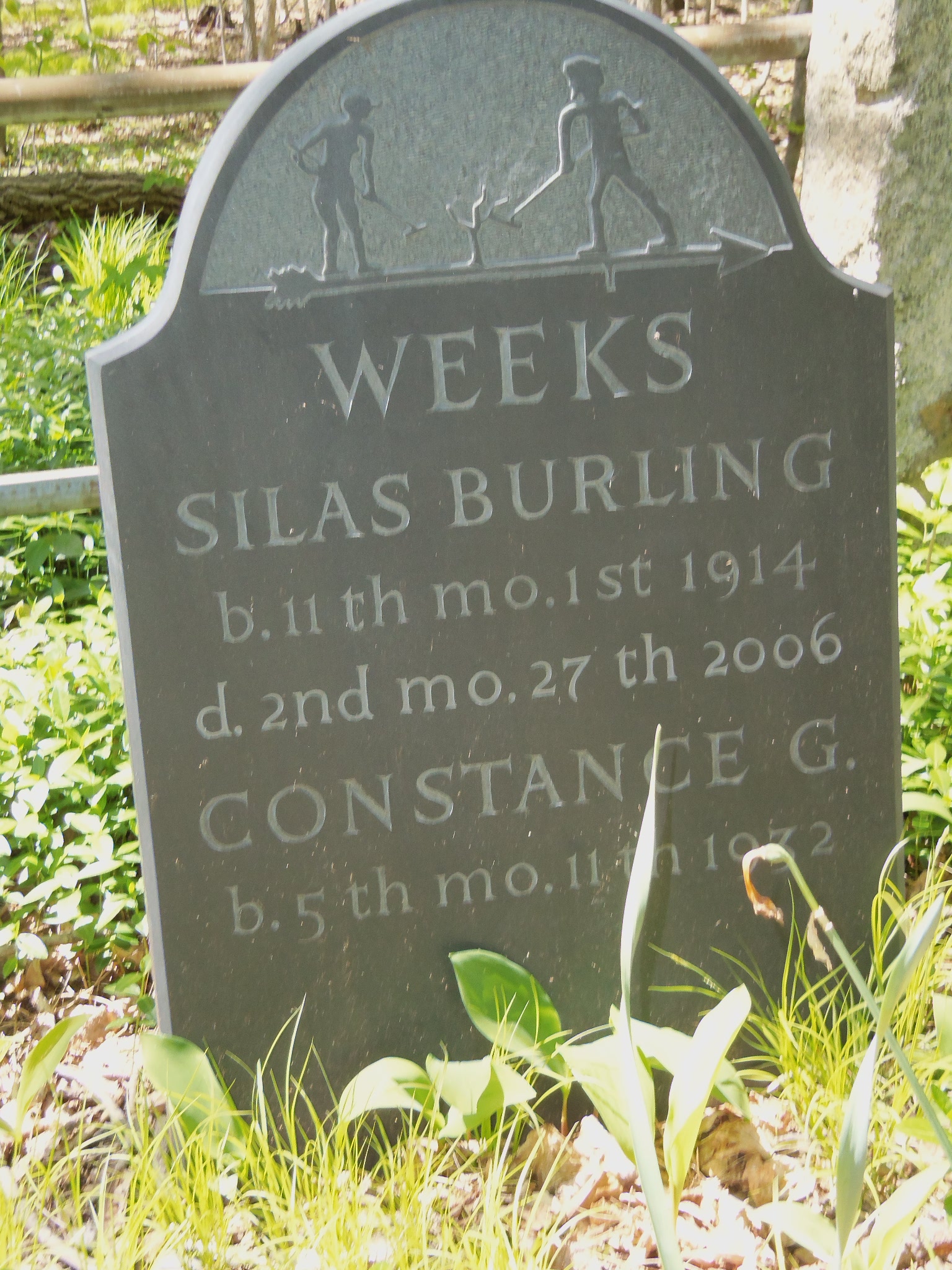
He chose to be buried in an existing burial plot on the farm, rather than in the meeting's cemetery. The engraving atop his stone is one designed as their emblem.
He chose to be buried in an existing burial plot on the farm, rather than in the meeting’s cemetery. The engraving atop his stone is one designed as their emblem.

Kodak9 033