 Each lobsterman has a set of distinctive buoys to identify his traps. This is how the floats look out of the water. Shingle siding adds to the effect.
You never know what we'll churn up in cleaning a stall
Each lobsterman has a set of distinctive buoys to identify his traps. This is how the floats look out of the water. Shingle siding adds to the effect.
I’ve long been perplexed by some banks’ claims about credit-card business, especially after seeing their approaches to gullible college students and rates that can approach 20 percent a year if you’re not careful or get in a jam.
Those of you who have older kids or grandkids can share those worries.
That’s even before wondering about the vice presidents or higher-up executives who approve what seem to be high-risk strategies – and then come to the public for relief. You know, handouts, 20 percent annual rates, and protection from bankruptcy filings by average people. Or should we say Real People unlike the corporations?
A recent experience of trying to close an account with one of them was especially trying. In the end, I’m not sure who closed whom except that the clock was still ticking on the interest – on the consumer, of course.
And then less than a month later, I’m getting solicitations to open another account with them – “We’ve matched you with this exclusive offer,” as one proclaims.
No thanks. And by the way, the same day’s mail included one that would give me money back on the transactions. It’s not 20 percent, but it’s in my direction.
From my perspective, that one has some credibility.
Gee, and we haven’t even touched on the retailers’ complaints here. Let’s just say they have my sympathy.
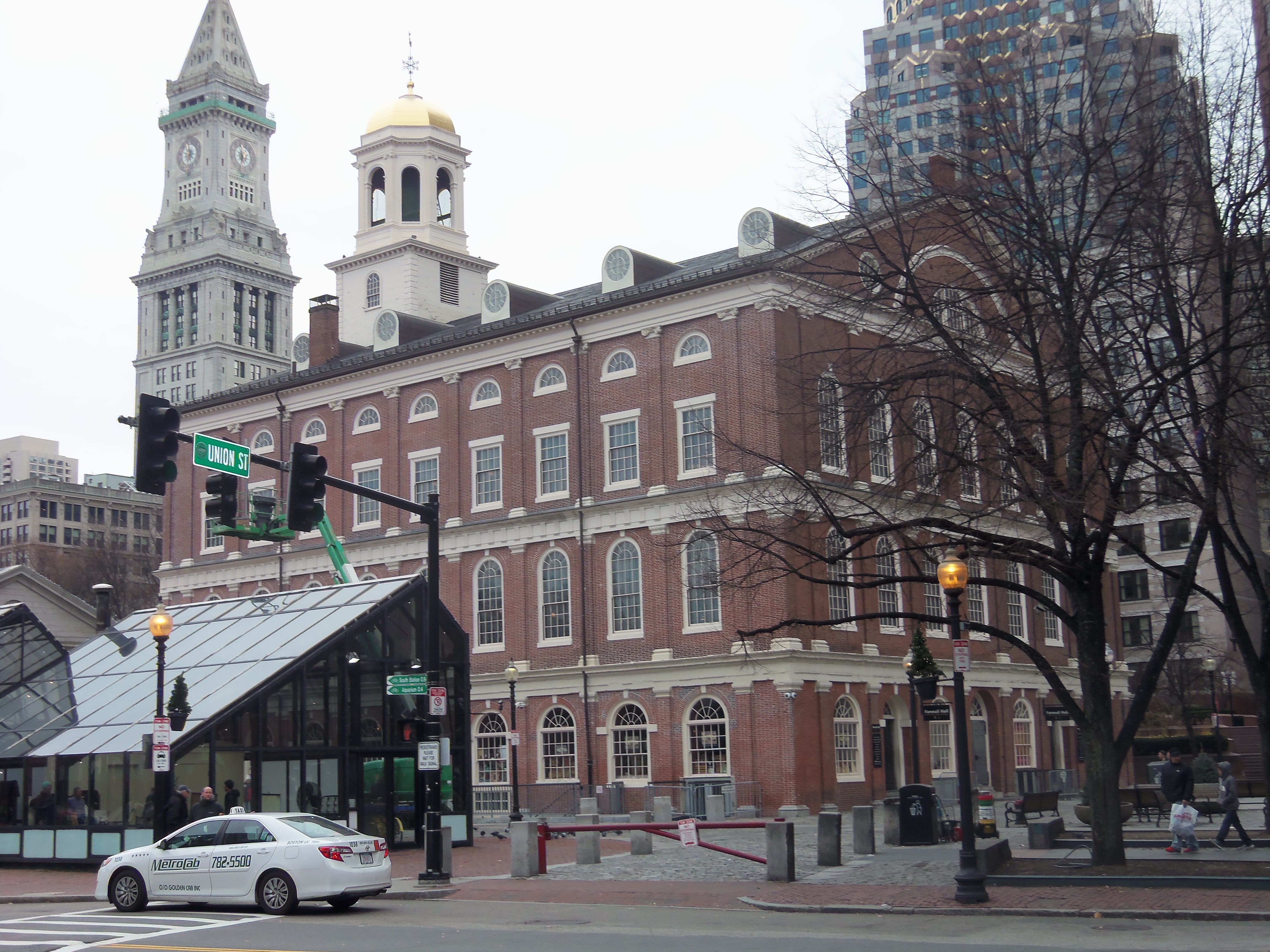

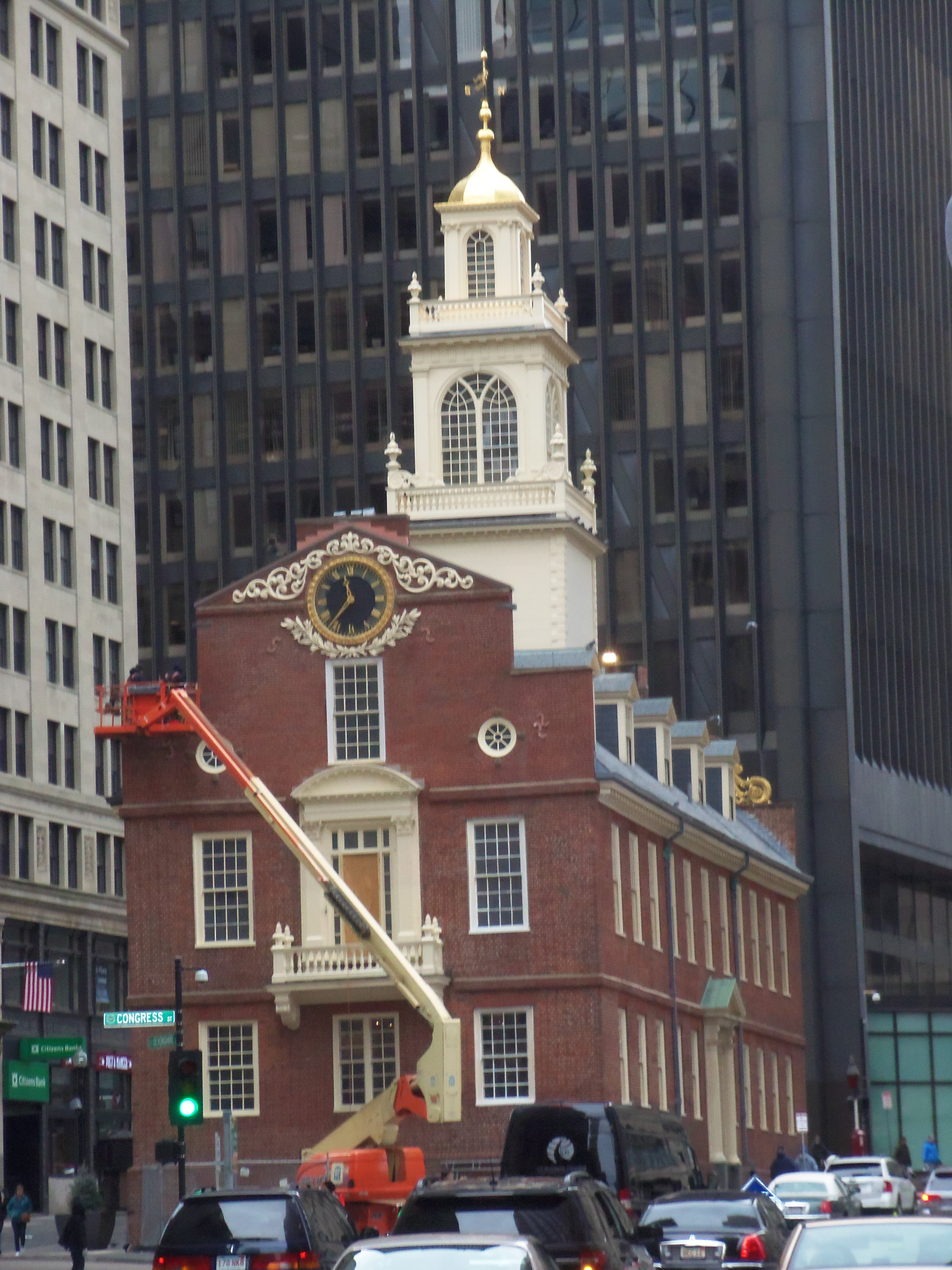
Faneuil Hall, Quincy Market, and the Old State House stand close together in downtown Boston. It doesn’t take much to imagine historic figures appearing here.
Or even some celebrity athletes.
There’s always a surprise around the bend.
Here, in the midst of the annual holiday season excess, is a good time to remember that for most of our history, Quakers did not celebrate, in their words, “that day the world calls Christmas.” In New England, at least, they were joined by the Puritan legacy. In Massachusetts, for instance, Christmas was not legal until the 1850s.
Of course, these days it’s very difficult to ignore the hoopla – especially if you have children present. And I’m not even going to get into that Santa Claus stuff.
What I will do, however, is speak of the practice of Advent – observing the weeks building up to Twelfth Month 25th as a period of preparation and anticipation. Babies, after all, arrive only after nine months (or so) of pregnancy, and there’s much to be said for the changes in both the mother and the father in that period. Some Advent calendars come with verses and stories for the family to share over dinner.
Admittedly, by not bringing the tree in until Christmas Eve and not taking it down until Epiphany (the real Twelfth Day of Christmas, contrary to what some advertisers broadcast), you’ll be out of step with most of American society. That can have its own revelations, as you recognize the struggle some other faith traditions have here. But you may also find that unwrapping the presents can just be the beginning of a holiday fullness, not its anticlimax. Actually, our tree usually stays up a few weeks past Epiphany, but that’s another story. Oh, yes, and remember to have a few oranges. (Speaking of other stories.)
~*~
My wife makes reference, too, to all the Puritan diaries from New England, which recorded December 25 pointedly and repeatedly as “an ordinary day.”
 Thanksgiving raises thoughts of New England Puritans, even though they differed in many ways from their fellow Calvinists, the Pilgrims – the ones who celebrated that first round of feasting.
Here is Sir Richard Saltonstall (1586-1661), a Puritan who founded Watertown, Massachusetts, in 1630 before his return to England.
Henry Kissinger once admitted that the realities of being Secretary of State overturned his expectations of the position. Before taking office, he saw the role as akin to being Zeus on Mount Olympus – the divine expanse of time and perspective to make wise decisions of long-lasting statesmanship. Instead, in the turmoil of relentless global crises, what he encountered was more like being an NFL quarterback on a Sunday afternoon in autumn. You had to do something fast and hope for the best before you got clobbered. Talk about high pressure? Lives were often at stake.
That insight comes back to my mind each round of presidential primaries where I live. Remember, the State Department is only one Cabinet position reporting to the White House. And it’s puny compared to the Pentagon.
Whoever wins in November 2016 will have to be able to find people who can fill these positions, and then find the time to manage their work. How can anyone possibly touch base with them even once a week, much less act with sufficient knowledge? Well, a quarterback has both the rest of the team and the coaches – plus a week to prepare and a lot of time on the sidelines, if his defense is doing its job. Not so the President, with rounds of dinners and photo ops and having to make public announcements on seemingly every news development as it happens …
I’ve seen reports on the time demands on the Chief Executive and how many of our recent examples have lived with no more than four hours of sleep a night. That’s inhuman. Period. Here’s one point where those arguing for smaller government could build their case. I’m listening.
When the most populous states try to butt up in the presidential primary scheduling, they actually lose much of their potential power. They should be holding back, as the last line of correction, in case the field goes haywire. Whatever happened to Favorite Son nominations, anyway? The placeholders who could wheel and deal at the convention?
Instead, we’re faced with what happens when it’s all Big Money and Slick Packaging.
Just as we need a rudder to steady the course, something has to be at the back end of the boat.
Another measure I apply in meeting White House hopefuls:
Does this candidate look presidential?
Or simply lightweight?
When it comes to launching a product, smart companies have long relied on test markets – small metropolitan areas where they can experiment with their advertising and sample consumer response before taking their new line national or global. They’ve learned it’s better than risking everything only to fall flat at the end of years of research and development.
In the political arena, New Hampshire’s first-in-the-nation presidential primary comes as close as we can to a test market for the candidates. Regardless of the state’s demographics, the reality remains: if you can’t win here – or finish toward the top – you’re not going to win much of the rest of the country. It’s the values that resonate.
The state is small enough the candidates can get out and meet people without having to have an enormous treasury. An advertising budget can be focused on a relative handful of newspapers and broadcasters, plus all the yard signs and buttons.
South Carolina, while small, is also nasty – and falls far to the right of the rest of the nation. Iowa, another early contender, is huge by comparison and requires much more media investment. Delaware is simply too small and unrepresentative. Any other other nicely contained possibilities? I’d like to know.
The other part of the New Hampshire tradition that’s often overlooked is that the election has legs – it originated as part of the annual town meeting day in March. As long as folks were out to do their exercise in democracy, they could also cast their votes for their party’s nominee. Besides, we didn’t have to pay to heat the town hall again. (You know that penny-pinching characteristic of our state.)
Too bad we can’t hold it all back to March, though. Christmas is way too early for this decision.
After recently coming across some now-historic Playboy centerfold playmates online – models we adolescent boys worshiped – I was struck by how average they were in retrospect. Not surgically enhanced nor abnormally thin waists nor even fashionably tall, as we’ve come to expect. Even their hair looked like the girls we knew – or dreamed of knowing.
Looking back, let me say it was the smile, more than anything, that got us.
And then, in the midst of the sexual revolution of the hippie era came a feminist rejection of Hugh Hefner’s free-love philosophy, even as events pushed far beyond his now pathetically comic hedonism. Quite simply, he went one way and we went another.
Yes, the glossy periodical was a rich patron for short-story writers and novelists, interviewers, and cartoonists, no matter the reality they were window dressing all along. Still, in many ways, Playboy appeared as a hip rival to the more staid New Yorker. For a while, it was even Chicago versus Manhattan in the realm of publishing.
And then Penthouse and Hustler attacked Hefner’s little empire from the other side of the respectability divide.
Oh, how long ago that all seems!
These days I’m reflecting on the magazine’s admission it can no longer compete with the nudity that’s readily available online for free and its decision to go more respectable, as Esquire did decades earlier. No more centerfold? Wasn’t that the magazine’s identity? What else has been stripped away?
In light of today’s world of publishing, let me say, Best wishes!
Especially considering Tinder and the rest of the new social-media lifestyle.
 Jnana's Red Barn