BRAGGING IN THE DARK

A recent brag by Marco Rubio’s camp that he nearly killed “Obamacare” could just have a boomerang effect. Yes, I know that many Republicans hate the Affordable Care Act, but the reality remains that it’s the only way for many Americans to obtain medical care.

If you have a child with a “preexisting condition” like asthma or a defective heart, you know the alternative is a death sentence. If you undergo surgery and see what the bill would be without insurance coverage – thousands of dollars more – you get a clue of the unjust disadvantage you’d be at. Bankruptcy, as your likely fate. (There goes the house. And the American dream.)

It’s not that the critics are presenting a better proposal for affordable health care. They keep ignoring the issue, actually. It wouldn’t take much for many Americans to awaken to an argument that Rubio nearly killed health care. Kinda sounds like a Neanderthal or Hun.

Saying what you stand against doesn’t necessarily tell us what you stand for. The question remains.

NATURALLY UNFIT FOR THE WHITE HOUSE?

After all of the delusional accusations about Obama’s citizenship and religion, hearing charges that Ted Cruz is not a “natural born” American and thus Constitutionally barred from the presidency comes as an ironic twist. This one might actually have legs, factually speaking.

We don’t expect him to quit that easily, of course. So this could get interesting, especially if the natives get restless.

LOCATION, LOCATION, LOCATION

Noticing the first few lawn signs for a particular presidential hopeful the other day demanded a second look.

Yes, they were brand new. Sparkling. So who was endorsing him?

Nobody, apparently. Only his staff.

Years ago I learned to pay attention to just where the roadside signs were being planted. If they’re popping up on people’s lawns, you can assume some support for the candidate. But placed on public right of way or at intersections or uninhabited stretches of roadway, it’s only somebody doing a job. (In this case, the signs were in front of the parking lot of an abandoned church. So much for separation of church and state?)

Some of us have learned not to be fooled. And some of us have learned to seriously consider a candidate, based on the lawns where their names are appearing.

WHY I’M MORE OR LESS IN FAVOR OF A BALANCED-BUDGET AMENDMENT

Those of us on the peacemaking side of armaments debates have usually resisted calls that would require a balanced budget, usually because of our concerns about what would happen to the poor and oppressed during economic downturns. It’s not that we’re against a balanced budget, mind you – many of us would favor a budget surplus and reserves.

Curiously, however, those who have been most vocal in their demands for a constitutional amendment requiring a balanced federal budget have also proclaimed strong support for large military outlays.

Here’s their unintentional bind: Some historians and economists have noted that without the ability to borrow money, America would never have been able to enter into armed conflict. Perhaps that’s universally true among nations, not just mine.

If that’s the case, perhaps we have our lines tangled. Would a balanced-budget requirement have prevented the U.S. buildup in Vietnam as well as both wars in Iraq?

Remember, too, we were on track to eliminate the federal deficit before 9/11 overturned everything.

The war costs were, in effect, put on a national credit card the hawks were never willing to pay off.

Is this a game we’re willing to play – a kind of chicken? (No pun intended.)

The concept certainly thickens the plot, even before we get to name-calling.

WALKING AROUND TOWN, MOSTLY

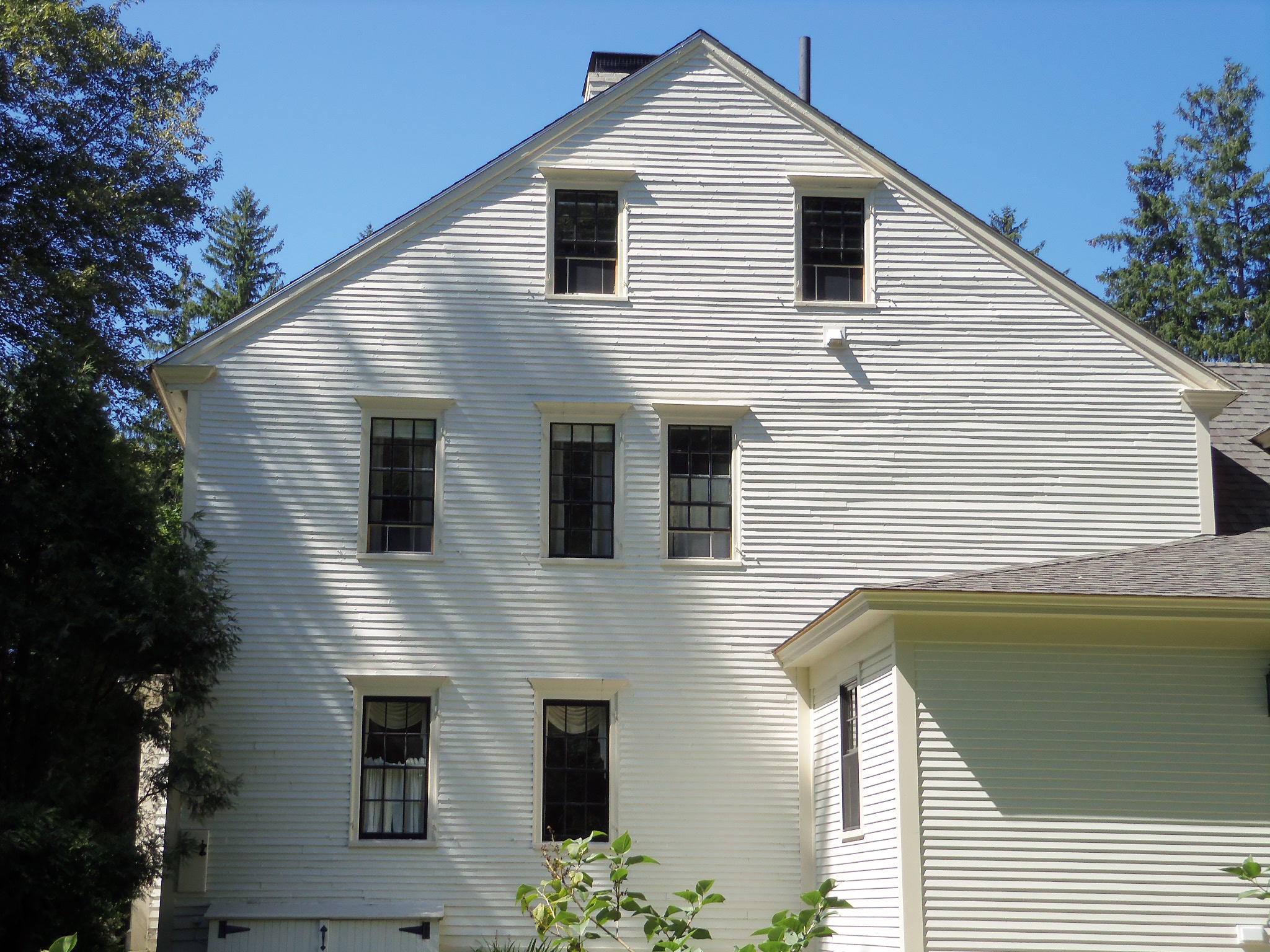
A typical New England neighborhood will mix a range of architectural styles and history. Dover is no exception.

One of the joys of living where I do comes in the variety of architectural periods you can encounter even within a block or two. While little in Dover remains from the first half-century of settlement here – a consequence, in part, of King Philip’s War along the Colonial frontier – that still leaves three centuries of development. Because my community was spared the ravages of big-city development, housing filled out neighborhoods over time as owners one by one sold side lots and pastures where new houses were then built. This makes for a rich tapestry, especially while strolling down a side street.

Throughout this year, the Red Barn will feature snapshots of some of these distinctive touches, especially in the housing styles. Hope you stroll along.

January2 046

SECOND TAKE ON THAT BUMPER SLOGAN

I’ll admit I laughed when I saw the sticker:

WHEN RELIGION RULED THE WORLD
THEY CALLED IT THE DARK AGES

But then I started thinking of the ongoing reconsideration of the era itself, which suggests a far richer and more varied culture than we’ve admitted. Just look at the glorious cathedrals, for starters.

Add to that an awareness of the atheistic evils of the 20th century, beginning with Hitler, Stalin, Mao, and others. How many millions were murdered as their victims?

The sticker was on a tiny van parked at the trail head, and a bit further I came across its owner in a cloud of smoke.

Not to be judgmental, but I found myself wondering about his alternative. It looked pretty dark. As for me, I’ve seen enough to suggest religion – true religion – can release us from darkness as a people.

Let’s start with the civil rights movement, if you wish. But there are many others.

Think of religion as a sword that cuts both ways, depending on its user and that matter of love. And then ask, How else are we to aspire to a better world?

MORE THAN SNOW IN THE AIR, AT LAST

Just as the first snowstorm of the season has finally hit New Hampshire, the state’s first-in-the-nation presidential primary is beginning to show some flickering flames. The kind that produce both heat and light. Up till now, it’s been only smoke, mostly on the Republican side. (The Democrats have been politely, though passionately, lined up behind Hillary or Bernie, recognizing the battle they’ll share together after the national convention.) The Granite State’s winnowing function has worked best when some unanticipated turn reveals a candidate’s true character for the public to see, either with devastating consequences for the campaign or its big breakthrough moment.

To be candid, I’m surprised we got through the autumn without seeing one or two of these. Yes, Trump came close when he attacked a St. Anselm college student as a “Bush plant” after she asked him a question, but the story never gained traction. The rest of the pack of candidates never picked up on the theme or any other, for that matter. The race to date has been pretty bland, all too predictable, little to set one apart from the other. Where’s the genuine courage or bold intelligence been? Talk all you want about the Trump-Carson-Fiorina outsider role, the pros in the lineup have been notable mostly in their failure to connect as seasoned campaigners rather than slick packaging alone. We’ll probably see some fascinating postmortems when it’s all over, but for now the scene’s been pretty befuddling.

We did awaken to an unexpected surprise November 28 when Joseph W. McQuaid, publisher of the state’s largest newspaper, endorsed Chris Christie. While the Union Leader and its New Hampshire Sunday News hold staunchly conservative editorial pages, there are Republicans in the state who insist these are liberal media. Ahem. True, McQuaid has often marched out of step with many of the state’s right-wing voters – anyone remember Malcom Forbes, for instance? – but you can assume Joe’s never, ever voted for a Democrat.

Yesterday morning, though, came the startling headline across the top of the front page: “Trump campaign insults NH voters’ intelligence,” an editorial by McQuaid noting Trump’s resemblance to bully “Biff” in the “Back to the Future” series. As McQuaid wrote, “Trump has shown himself to be a crude blowhard with no clear philosophy and no deeper understanding of the important and serious role of President of the United States than one of the goons he lets rough up protesters in his crowds.”

You get the idea.

And Trump’s response?

As this morning’s top of the front page headline announces, “Trump calls McQuaid ‘lowlife.'”

Of the many things you might accuse the publisher, “lowlife” is not one that springs to my mind, especially when coming from the lips of someone like Trump. The inaccurate retort carries the air of desperation – and flailing.

We’re still six weeks away from the voting booths, and Trump’s starting to show his central weakness. Am I wrong in seeing him as thin-skinned, someone who can’t take criticism or a well-aimed insult? Who can’t take what he routinely dishes out? Is this a wakeup call to his rivals to get their punches in, too, now that they see he’s not invincible? For that matter, what will their responses reveal about them?

Sure looks like it’s about to get interesting. Maybe even exciting. But first, I need to shovel some snow.